
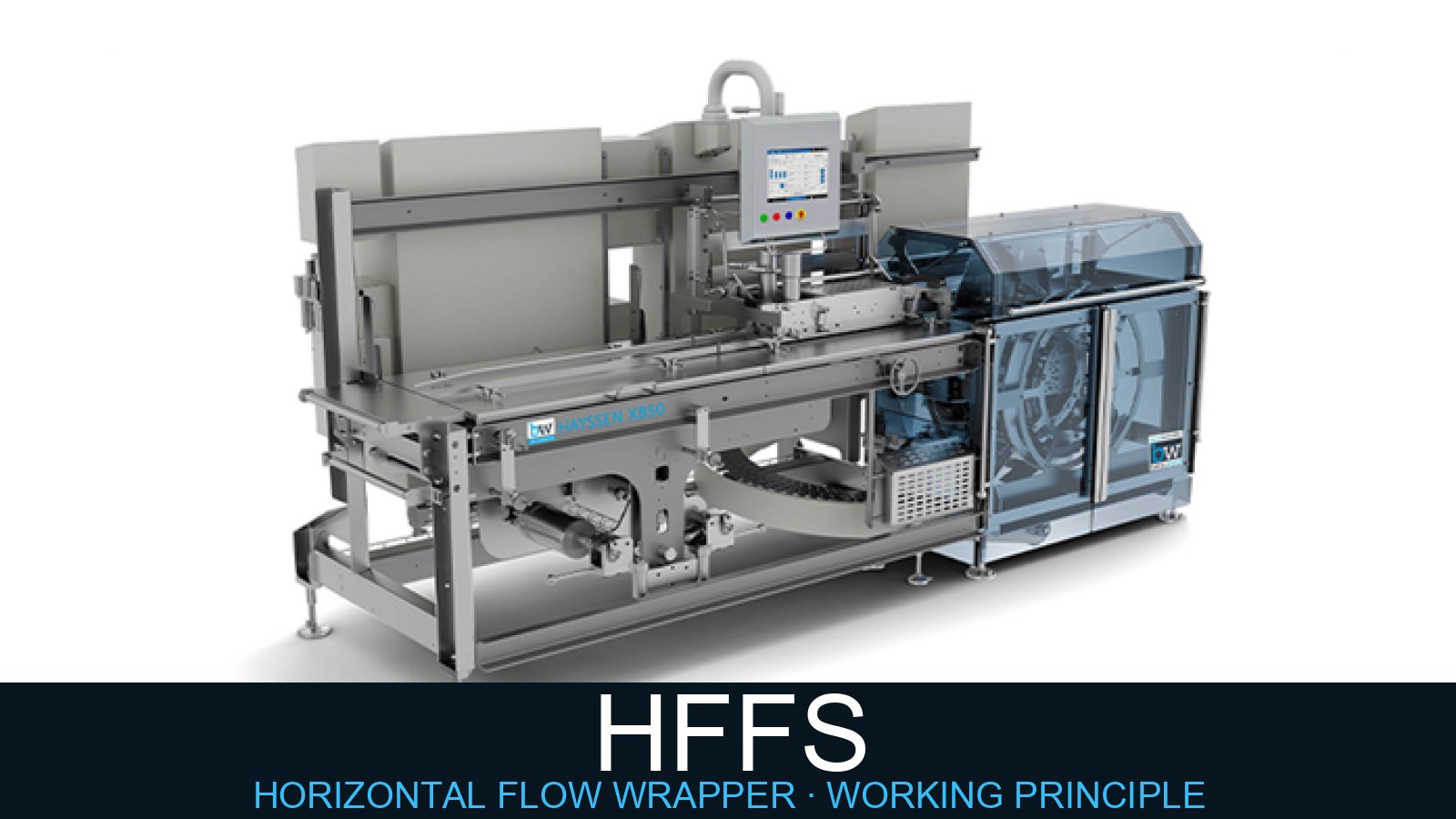
The core idea of this page: a horizontal form-fill-seal (HFFS) flow wrapper carries the product horizontally past forming, filling and sealing stations — the opposite of a vertical bagger. Choose HFFS when the product is fragile, sticky or needs orientation, and when the pack must be a pillow, gusseted or fin-seal wrap rather than a drop-fill bag.
For the machine landscape, see Top 10 HFFS Flow Wrapper Manufacturers; for the VFFS-vs-HFFS decision, see VFFS vs HFFS.
How an HFFS flow wrapper works
Film feed and forming
A single web of film is unwound and folded around the product as it travels horizontally. The product is placed on the film at intervals, and the film is formed into a tube around it with a bottom (fin or lap) seal.
Sealing
The end-seal jaws close on the film between products to make the trailing seal of one pack and the leading seal of the next, then cut them apart. Rotary or long-dwell jaws keep seal dwell time even at high output — the key to sealing high-barrier and MAP films.
Sealing systems and speed
Rotary long-dwell jaws deliver the most seal dwell at speed — Omori NSW-7000 runs 10–330 packs/min with rotary sealing, and Fuji FW3400/box-motion variants run 10–300 packages/min. PFM Tornado LD is the long-dwell reference at up to 100 packs/min. Multi-jaw machines run several jaw sets in parallel — Hayssen X850 reaches 300 ppm — so each seal keeps its dwell as output rises.
Source: NSW-7000 — Omori
Omori NSW-7000 up to 330 packs/min (rotary); PFM Tornado LD up to 100 packs/min (long-dwell).
Failure modes to design around
- Product misalignment. Product that shifts on the film produces off-centre seals and crumpled ends — the infeed must orient and space the product precisely.
- Seal dwell vs speed. On high-barrier film, insufficient dwell produces leakers; on thin film, excess heat burns through. Match the sealing system to the film.
- Film tension. Uneven tension causes wrinkle and misregistration of printed film.
- Changeover time. Flow wrappers change over by product size and film; a long changeover on short runs erases the speed advantage.
How to verify an HFFS flow wrapper
- Seal-integrity test: run 200 packs on your film and inspect every seal.
- Measured speed: confirm actual packs/min on your product and film.
- Film-registration check: confirm print registration holds at top speed.
- Changeover: time a real format change.
Frequently asked questions
When should I choose HFFS over VFFS?
When the product is fragile, sticky or needs orientation, and when you need a pillow, gusseted or fin-seal wrap rather than a vertical drop-fill bag.
What does long-dwell sealing do?
It holds the film at sealing temperature longer, which is needed for high-barrier and MAP films that require more seal time at a controlled temperature.
How fast do flow wrappers run?
From under 100 packs/min for long-dwell machines to 300+ packs/min for multi-jaw rotary machines — the speed depends on the sealing system and film.
Related guides
- VFFS Baggers: Top 10 Machines Compared (2026) — Ten vertical form-fill-seal (VFFS) machines compared across speed, mot…
- Intermittent vs Continuous vs Rotary VFFS: Motion Type Drives Speed, Seal and Cost — How the three VFFS motion types — intermittent, continuous and rotary …
- Heat Seal vs Ultrasonic vs Long-Dwell: Choosing FFS Sealing Technology — How heat seal, ultrasonic and long-dwell sealing compare for VFFS/HFFS…
- Multihead Weigher vs Volumetric Cup vs Auger Filler: Choosing FFS Dosing — How multihead weighers, volumetric cups and auger fillers compare for …
- How a Vertical Form-Fill-Seal (VFFS) Machine Works: Film Path, Sealing and Fill — a vertical form-fill-seal (VFFS) machine makes a bag from roll film ar…
- How a Multihead Weigher Achieves Accuracy: Combination Weighing Explained — a multihead weigher is accurate not because each weigh head is precise…
- Top 10 Form-Fill-Seal Machine Manufacturers Global (2026 Edition) — An independent ranking of the top global VFFS and HFFS machine manufac…
- Top 10 China VFFS Machine Manufacturers (2026 Edition) — An independent ranking of Chinese vertical and horizontal form-fill-se…
Last verified: September 10, 2026.