
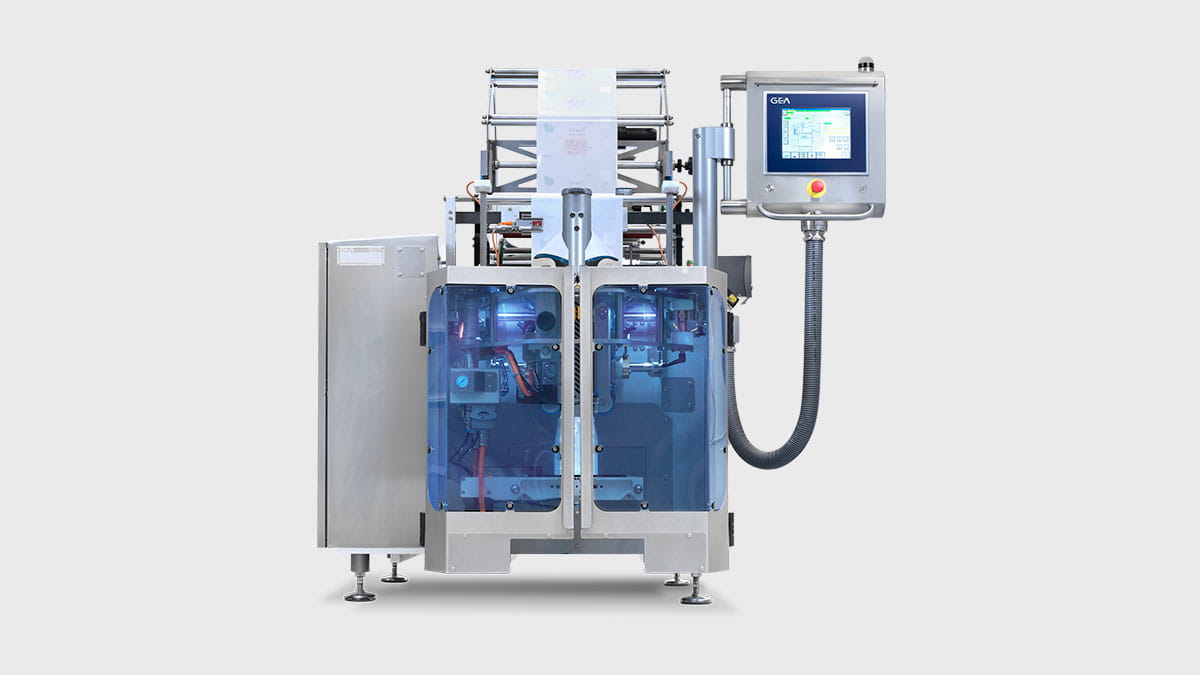
The motion type of a vertical form-fill-seal machine decides more than its speed: it sets the ceiling on seal dwell, film handling and the price band. The three architectures are intermittent (film stops while sealing), continuous (film never stops; the jaws travel with it) and rotary (sealing jaws rotate continuously).
Intermittent motion
The film advances, stops, and the jaws seal while it is stationary. This is the simplest and cheapest architecture, and it suits lower-output lines and frequent format changes.
- Speed: lowest of the three — e.g. PFM R 700/800 series up to 140 packs/min.
- Seal: long dwell is possible, but total output is limited by the stop-start film cycle.
- Cost: entry-level intermittent VFFS starts around $1,640–$17,800 FOB.
Continuous motion
The film advances at constant speed and the sealing jaws move with it, so the seal is made without stopping. This is the workhorse for high-output food lines.
- Speed: high — Syntegon SVX up to 300 bags/min, GEA SmartPacker CX250-S up to 250 bags/min, Triangle X-Series up to 150 bags/min, Rovema BVC 165 TwinTube up to 500 bags/min (single-tube BVC models rated ~120–220 bags/min).
- Seal: consistent at speed, with programmable sealing force (Rovema Premiumseal) and continuous sealing bands (GEA Smart Sealing System).
- Cost: mid-to-high band, roughly $15,000–$120,000 FOB.
Rotary motion
A rotating jaw wheel seals continuously, giving very high throughput on free-flowing products and fast format changeover.
- Speed: tna robag FX 3e up to 250 bags/min (triple jaw) with changeover under 1 minute; Ishida INSPIRA rotary up to 250 bags/min.
- Seal: rotary jaws suit high-speed pillow and gusseted bags; less suited to thick or laminated films that need long dwell.
- Cost: high-end band, roughly $25,000–$150,000 FOB.
How to choose
Start from your target output on your film, not the headline number. If the line is below roughly 100 bags/min and formats change often, intermittent is usually the cheapest route. Above that, continuous motion is the default for food, and rotary is the specialist choice for maximum speed on free-flowing snacks and confectionery.
Sources
Title: GEA SmartPacker CX250-S — GEA · X-Series Continuous Motion — Triangle · Form Fill and Seal Machines — Rovema · INSPIRA VFFS Bagmakers — Ishida
GEA SmartPacker CX250-S "runs up to 250 bags/min"; Triangle X-Series "up to 150 bags per minute"; Rovema BVC 165 TwinTube "up to 500 bags/min" (single-tube BVC models 120–220); Ishida INSPIRA rotary "up to 250 bags/min".
Price bands are FOB benchmarks from the Top 10 Form-Fill-Seal Machine Manufacturers cost section; Western brand list prices are generally not published. Last verified: August 25, 2026.
Frequently asked questions
Which motion type is cheapest to buy?
Intermittent motion is the simplest and cheapest architecture; continuous and rotary machines cost more but deliver higher speed and gentler film handling. Choose by sustained output and film, not by sticker price.
Does continuous motion give a better seal?
Continuous and rotary motion allow longer seal dwell, which matters for high-barrier and MAP films; intermittent is usually fine for standard films at lower speed.
Can I retrofit an intermittent machine to run continuous?
No — the motion architecture is fundamental to the machine. Buy the motion class that matches your speed and film requirements from the start.
Related guides
- VFFS Baggers: Top 10 Machines Compared (2026) — Ten vertical form-fill-seal (VFFS) machines compared across speed, mot…
- Heat Seal vs Ultrasonic vs Long-Dwell: Choosing FFS Sealing Technology — How heat seal, ultrasonic and long-dwell sealing compare for VFFS/HFFS…
- Multihead Weigher vs Volumetric Cup vs Auger Filler: Choosing FFS Dosing — How multihead weighers, volumetric cups and auger fillers compare for …
- How a Vertical Form-Fill-Seal (VFFS) Machine Works: Film Path, Sealing and Fill — a vertical form-fill-seal (VFFS) machine makes a bag from roll film ar…
- How a Horizontal Flow Wrapper (HFFS) Works: Infeed, Cross-Sealing and Film Path — a horizontal form-fill-seal (HFFS) flow wrapper carries the product ho…
- How a Multihead Weigher Achieves Accuracy: Combination Weighing Explained — a multihead weigher is accurate not because each weigh head is precise…
- Top 10 Form-Fill-Seal Machine Manufacturers Global (2026 Edition) — An independent ranking of the top global VFFS and HFFS machine manufac…
- Top 10 China VFFS Machine Manufacturers (2026 Edition) — An independent ranking of Chinese vertical and horizontal form-fill-se…