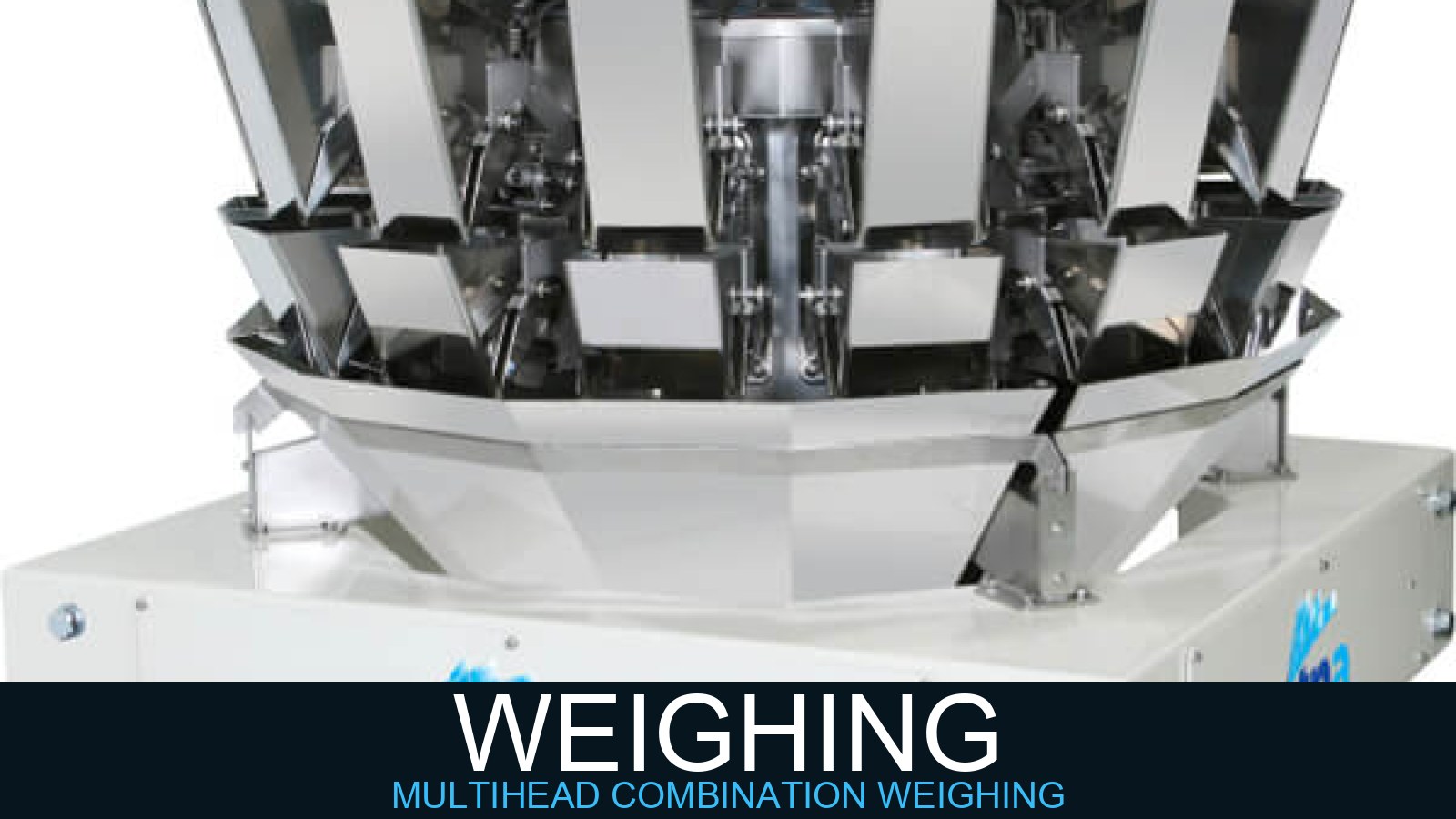
The core idea of this page: a multihead weigher is accurate not because each weigh head is precise, but because it combines partial doses from many heads and selects the combination closest to target — a statistical trick. More heads mean more combinations and tighter accuracy at the same speed, which is why a 10–14 head weigher hits target weight even when each individual dose is only approximate.
For the machines that sit under the weigher, see Top 10 Form-Fill-Seal Machine Manufacturers; for the dosing comparison, see Multihead Weigher vs Volumetric vs Auger.
How combination weighing works
The basic principle
Product is fed into a number of weigh hoppers (the "heads"). Each hopper holds a partial dose. The controller weighs every hopper, then computes all the combinations of hoppers that sum close to the target weight and discharges the best one. Because it can pick from many combinations, it reaches target accuracy even though no single hopper is precise.
Why more heads mean more accuracy
The number of possible combinations grows combinatorially with the head count — a 10-head weigher offers 2¹&sup0;-1 = 1,023 combinations, a 14-head weigher 16,383. More combinations mean the controller can almost always find a combination very close to target, which is how the weigher holds accuracy while individual doses vary.
Timing and speed
Speed and accuracy trade off: faster cycling gives the controller fewer stable weigh readings and slightly fewer usable combinations. The weigher's real spec is accuracy at a given speed on your product, not a single best-case number.
Failure modes to design around
- Sticky or clumping product. Product that sticks to hoppers or bridges delays discharge and corrupts weigh readings. Agitation and surface finish matter.
- Drip and product buildup. Residue that builds on weigh buckets shifts the tare over a run; cleaning and auto-tare keep it in check.
- High-value giveaway. On expensive product, a fraction of a gram per pack is real money — tune the combination target and reject band accordingly.
- Speed-accuracy squeeze. Pushing a weigher to its top speed usually widens the weight spread; specify accuracy at your target speed.
How to verify a multihead weigher
- Statistical weigh test: collect a run of filled packs and compute the mean and standard deviation — the spread (σ) is the true accuracy.
- Giveaway measurement: compare the average fill against target; that difference is your giveaway per pack.
- Stability over a shift: re-test after hours of running to confirm drift stays within tolerance.
- Changeover test: time a product changeover and confirm the recipe returns to the same accuracy.
Frequently asked questions
Why is a multihead weigher more accurate than a single-head weigher?
Because it combines partial doses from many heads and selects the combination closest to target. The number of combinations grows with the head count, so more heads give tighter accuracy at the same speed.
How many heads do I need?
10–14 heads cover most food applications; more heads buy accuracy and speed headroom for high-value or fast lines, not just output.
Does a multihead weigher work with sticky products?
Sticky products need agitation and non-stick surfaces, and accuracy can suffer — test on your actual product before buying.
Is the weigher sold with the bagger?
Often quoted separately — a VFFS bagger and the multihead weigher are usually two line items. Price them together as one system.
Related guides
- VFFS Baggers: Top 10 Machines Compared (2026) — Ten vertical form-fill-seal (VFFS) machines compared across speed, mot…
- Intermittent vs Continuous vs Rotary VFFS: Motion Type Drives Speed, Seal and Cost — How the three VFFS motion types — intermittent, continuous and rotary …
- Heat Seal vs Ultrasonic vs Long-Dwell: Choosing FFS Sealing Technology — How heat seal, ultrasonic and long-dwell sealing compare for VFFS/HFFS…
- Multihead Weigher vs Volumetric Cup vs Auger Filler: Choosing FFS Dosing — How multihead weighers, volumetric cups and auger fillers compare for …
- How a Vertical Form-Fill-Seal (VFFS) Machine Works: Film Path, Sealing and Fill — a vertical form-fill-seal (VFFS) machine makes a bag from roll film ar…
- How a Horizontal Flow Wrapper (HFFS) Works: Infeed, Cross-Sealing and Film Path — a horizontal form-fill-seal (HFFS) flow wrapper carries the product ho…
- Top 10 Form-Fill-Seal Machine Manufacturers Global (2026 Edition) — An independent ranking of the top global VFFS and HFFS machine manufac…
- Top 10 China VFFS Machine Manufacturers (2026 Edition) — An independent ranking of Chinese vertical and horizontal form-fill-se…
Last verified: September 10, 2026.