Last updated: July 17, 2026. Seven equipment families cover most packaging lines: filling and dosing, form-fill-seal, flow wrapping, sealing, secondary packaging, labeling-coding-inspection, and end-of-line palletizing. Suppliers organise their catalogues by these family names — but buyers rarely shop that way, so this guide also works from the opposite direction: start from what you are packing.
Use it with the Packaging Machinery topic to move from a production requirement to a practical shortlist.
Start from your product
| What you are packing | Typical primary equipment | Typical downstream equipment |
|---|---|---|
| Free-flowing powders and granules | Auger filler or multihead weigher feeding a VFFS bagger | Checkweigher, case packer |
| Liquids and viscous products | Gravity, piston or flowmeter filler with a capper | Labeler, case packer |
| Individual solid items (bars, bakery, hardware) | Flow wrapper or HFFS pouch machine | Cartoner, case packer |
| Fresh food in trays | Tray sealer, often with modified-atmosphere (MAP) gas flush | Checkweigher, metal detector |
| Cans | Can filler and seamer | Labeler, palletizer |
| Goods already in primary packs | — | Case sealer, strapping, stretch wrapper, palletizer |
Packaging machine categories at a glance
| Category | Primary job | Common pack formats | Key selection question |
|---|---|---|---|
| Filling and dosing machines | Measure and place product into a container or pack | Bottles, jars, pouches, sachets, cans, trays | What product properties and accuracy are required? |
| Form-fill-seal machines | Make a pack from film, fill it and seal it | Pillow bags, sachets, stick packs, pouches | Is vertical or horizontal machine motion best for the product and pack? |
| Flow wrapping and overwrapping machines | Wrap individual or grouped products | Bars, bakery items, medical products, multipacks | What product handling and film registration are needed? |
| Sealing machines | Close bags, trays, pouches or other packs | Bags, vacuum packs, MAP trays, flexible packs | What seal quality, speed and material compatibility are required? |
| Cartoning, case packing and tray packing machines | Place primary packs into secondary packaging | Cartons, cases, trays, display packs | How variable are the pack and case dimensions? |
| Labeling, coding and inspection equipment | Identify, verify and reject packs | Labels, printed codes, weight/metal/X-ray checks | Which quality records and traceability rules apply? |
| Palletizing and end-of-line systems | Prepare cases for storage and shipment | Pallets, stretch-wrapped loads, unit loads | What throughput and warehouse interface must the system meet? |
1. Filling and dosing machines
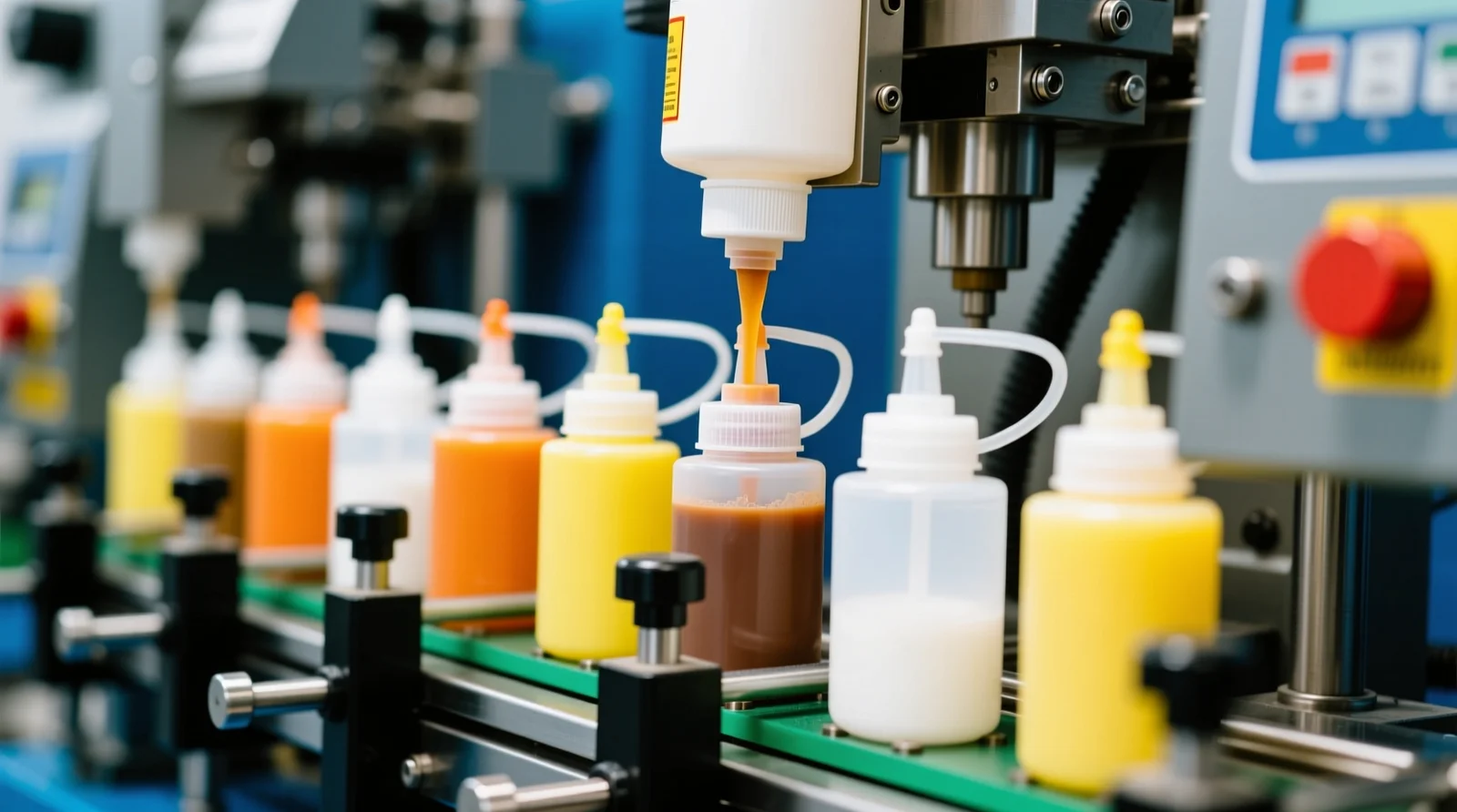
Filling equipment measures product into a container or package. The method follows the product: volumetric and piston filling suit liquids and creams, auger filling suits powders, and multihead weighing — typically combining 10 to 14 weigh heads — handles snacks, granules and other free-flowing solids down to single-gram accuracy.
Choose by: product flow behavior, target fill weight or volume, allowable variation and cleaning requirement. The filling method usually determines the line architecture before the sealing method does.
2. Form-fill-seal machines
Form-fill-seal equipment creates a package from roll film, adds product and seals it. Vertical machines (VFFS) drop product through a forming tube into the bag; horizontal machines (HFFS) carry the pack past forming and filling stations. One example profile, Hayssen VFFS Packaging Machine, is linked as a product card on this page.
Choose by: pack geometry, how the product must be delivered, and whether the design needs zippers, spouts or shaped pouches. The full comparison lives in the VFFS-versus-HFFS guide linked from this page.
3. Flow wrapping and overwrapping machines
Flow wrappers form a film wrap around a product or product group and seal it, commonly creating a pillow-style pack. They earn their place where product spacing and gentle infeed handling matter as much as the final seal — bakery lines are the classic case.
Choose by: product dimensions and stability, infeed orientation, film type and print registration.
4. Sealing machines
Sealing equipment closes a pack that is filled elsewhere. The family runs from impulse sealers and continuous band sealers — which typically convey at up to around 12–20 metres per minute depending on the model — up to vacuum, gas-flush and tray-sealing systems. Match the machine to the pack material and the required seal performance first; speed claims come second.
Choose by: sealant layer and material, contamination risk, pack dimensions and the inspection method. For cost and quotation scope, see the Sealing Machine Price Guide.
5. Cartoning, case packing and tray packing machines
Secondary-packaging equipment puts primary packs into cartons, cases or trays. The project often reaches beyond the case packer itself: collating, orientation, leaflet insertion, closing and verification frequently ride along.
Choose by: primary-pack geometry, collation pattern, case-size variation and the labor or automation objective. Confirm who owns the interface between the primary-pack machine and the case-packing system.
6. Labeling, coding and inspection equipment
Labeling, coding and inspection can be standalone steps or built into a line. Typical functions include label application, date and lot coding, vision inspection, checkweighing and metal or X-ray detection.
Choose by: required code quality, traceability rules, and the consequences of a false reject or a missed defect — the two failure modes carry very different costs.
7. Palletizing and end-of-line systems
End-of-line equipment groups, stabilizes and prepares packaged goods for transport: case sealing, strapping, stretch wrapping, palletizing and pallet handling. Scope it against real production flow and warehouse constraints rather than the palletizer’s cycle time alone. Hualian Machinery Group is linked as a company card for buyers exploring sealing and end-of-line equipment.
From category to purchase
Once the category is clear, the procurement process itself — application brief, comparable RFQs, supplier scorecard, factory and site acceptance tests — is covered step by step in the Packaging Machine Buying Guide.
Related guides and supplier research
Continue with the Sealing Machine Price Guide when sealing cost is the immediate question. For supplier research, see 10 Packaging Machinery Manufacturers in China.