
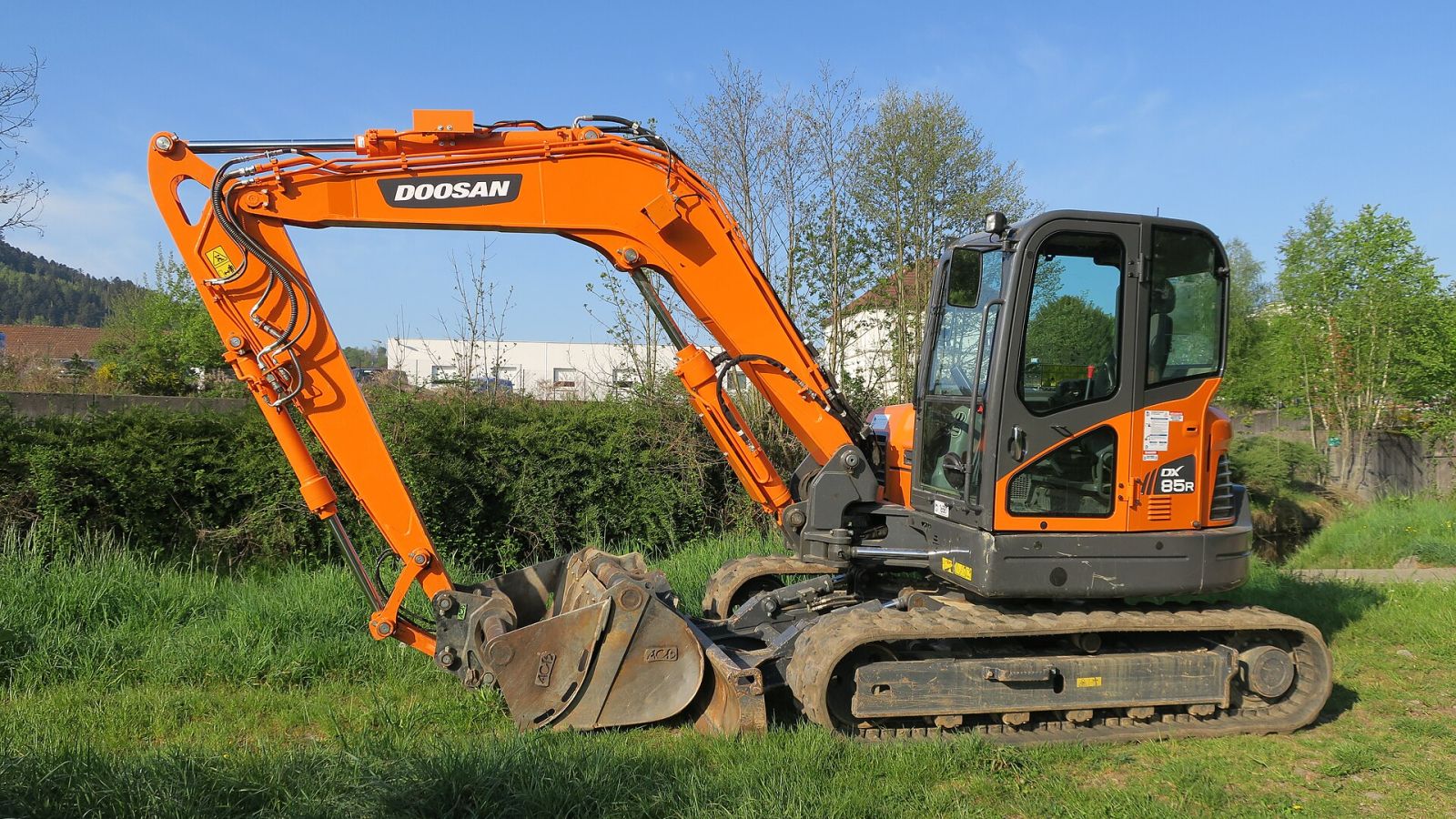
The core idea of this page: crawler (tracked) excavators trade travel speed for stability and low ground pressure; wheeled excavators trade stability for road speed and multi-site mobility. The decision is terrain × mobility × transport logistics.
Crawler (tracked) excavators
Tracks spread weight over a large contact area, giving low ground pressure and stability on soft, muddy or sloped ground. They are the choice for high-intensity digging that stays in one place — infrastructure, forestry and mass earthmoving. A Cat 336 at 36,800 kg digs with a stable, low-ground-pressure platform. The trade-off: crawler machines travel at walking speed (roughly 3–5 km/h) and must be moved between sites by lowboy trailer.
Wheeled excavators
Wheeled machines drive on public roads at 20–40 km/h, so they self-transport between sites and do not tear up asphalt. They suit hard, flat surfaces and multi-site work — municipal, utility and demolition. The trade-off: higher ground pressure (they can sink on soft ground) and less stability on slopes, usually needing outriggers or a blade for stable digging.
Crawler vs wheeled at a glance
| Dimension | Crawler | Wheeled |
|---|---|---|
| Ground / terrain | Soft, muddy, sloped | Hard, flat, paved |
| Top travel speed | ~3–5 km/h | ~20–40 km/h |
| Stability / traction | High, low ground pressure | Lower, needs outriggers |
| Road travel | Needs lowboy trailer | Self-transports (permits may apply) |
| Surface damage | Rips asphalt | Minimal on roads |
| Running cost | Track/undercarriage wear | Tyre wear + road fuel |
| Best for | Single-site production digging | Multi-site utility / urban work |
Decision rule
- Soft or sloped ground, or long single-site digging → crawler.
- Hard surfaces and frequent road relocation → wheeled.
- Both in the fleet → one crawler for production, one wheeled for utility.
Cost and verification
Tracked undercarriages are expensive to rebuild — tracks, rollers and idlers are the biggest wear items — while wheeled machines burn fuel on the road and wear tyres. Verify ground pressure (kPa) against the site before choosing, and confirm whether a wheeled machine can legally drive to your sites on public roads.
Frequently asked questions
Can a wheeled excavator work in mud?
Only briefly and with care — higher ground pressure means it sinks and loses traction. Soft ground calls for tracks.
Can a crawler excavator drive on the road?
Generally no — tracks damage asphalt and the machine is too slow. It must be moved by trailer.
Last verified: September 10, 2026.