
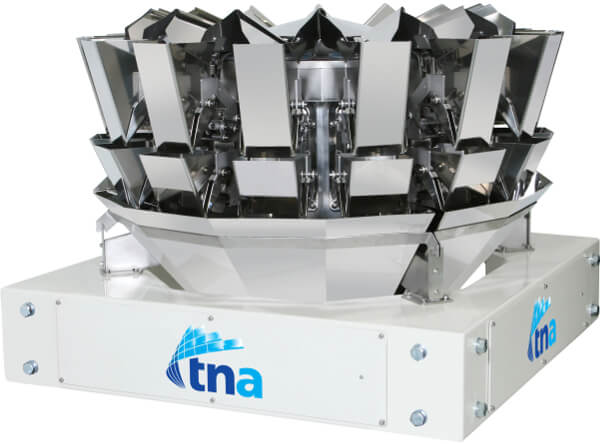
The dosing system inside a form-fill-seal machine determines both weight accuracy and which products the line can run. Three options cover most food applications: the multihead weigher (weighs each dose), the volumetric cup (measures by volume) and the auger filler (screws out powder).
Multihead weigher
Multiple weigh heads combine partial doses to hit a target weight with high accuracy, then release into the bag. It is the standard for high-value, high-speed snack and confectionery lines.
- Examples: Ishida CCW multihead weighers paired with its VFFS bagmakers; tna intelli-weigh integrated with robag baggers.
- Accuracy: highest of the three — the dose is weighed, not estimated.
- Speed: keeps pace with continuous/rotary baggers — e.g. a Dession VFFS with multihead weigher runs 30–70 bags/min.
Volumetric cup
A rotating cup fills a fixed volume, so every dose is the same size. It is simple and inexpensive but only accurate for free-flowing, uniform products.
- Best for: granules, seeds and uniform powders where density is stable.
- Limit: no weighing — density changes shift the actual weight.
Auger filler
A rotating screw meters powder by controlled turns. It suits fine, dusty or bridging powders that a volumetric cup cannot handle.
- Examples: Landpack doypack machines with auger dosing for milk powder, coffee, spices and flour.
- Best for: fine powders needing tight weight control in stick packs, sachets and premade pouches.
How to choose
If your product is high-value and you must hit a legal net weight at speed, choose a multihead weigher. If it is a free-flowing granule and cost matters more than precision, a volumetric cup may be enough. If it is a fine or bridging powder, an auger filler is the tool for the job.
Frequently asked questions
Which dosing method is most accurate?
The multihead weigher weighs each dose, so it is the most accurate; volumetric cups are fastest and cheapest but drift as product density changes; auger fillers suit powders.
Do I need a multihead weigher for snacks?
For high-value or weight-regulated snacks, yes; for low-cost granular products where a small overfill is acceptable, volumetric dosing may be sufficient.
What about sticky or bridging powders?
Auger fillers with agitation handle powders that bridge or clump; multihead weighers can struggle with sticky products, so test with your actual product.
Related guides
- VFFS Baggers: Top 10 Machines Compared (2026) — Ten vertical form-fill-seal (VFFS) machines compared across speed, mot…
- Intermittent vs Continuous vs Rotary VFFS: Motion Type Drives Speed, Seal and Cost — How the three VFFS motion types — intermittent, continuous and rotary …
- Heat Seal vs Ultrasonic vs Long-Dwell: Choosing FFS Sealing Technology — How heat seal, ultrasonic and long-dwell sealing compare for VFFS/HFFS…
- How a Vertical Form-Fill-Seal (VFFS) Machine Works: Film Path, Sealing and Fill — a vertical form-fill-seal (VFFS) machine makes a bag from roll film ar…
- How a Horizontal Flow Wrapper (HFFS) Works: Infeed, Cross-Sealing and Film Path — a horizontal form-fill-seal (HFFS) flow wrapper carries the product ho…
- How a Multihead Weigher Achieves Accuracy: Combination Weighing Explained — a multihead weigher is accurate not because each weigh head is precise…
- Top 10 Form-Fill-Seal Machine Manufacturers Global (2026 Edition) — An independent ranking of the top global VFFS and HFFS machine manufac…
- Top 10 China VFFS Machine Manufacturers (2026 Edition) — An independent ranking of Chinese vertical and horizontal form-fill-se…
Last verified: August 25, 2026.