
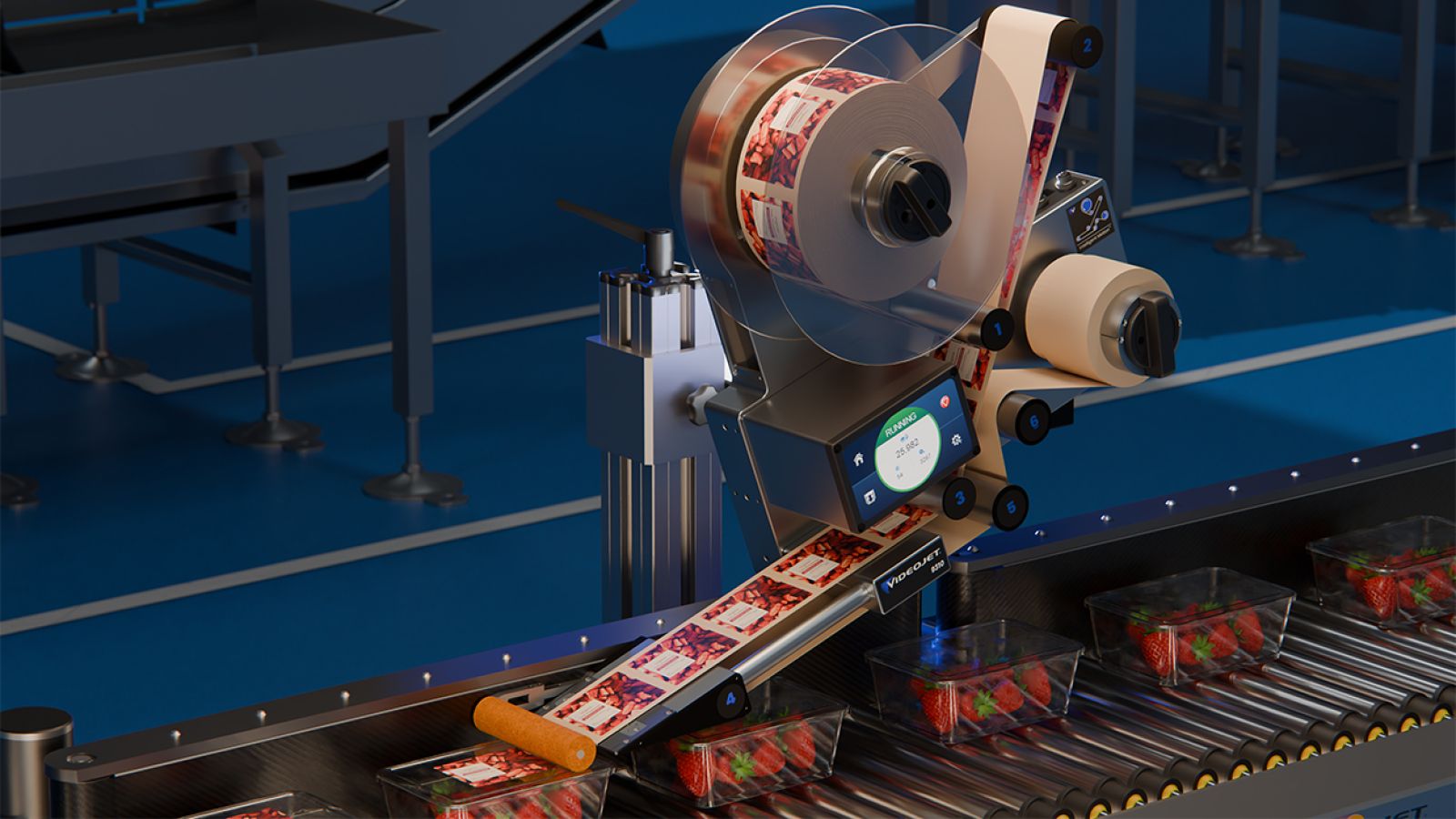
The core idea of this page: a pressure-sensitive (self-adhesive) labeler peels a pre-cut label from its liner and transfers it onto the pack with a tamp, blow-on or wipe-on head. Understanding that peel-and-transfer sequence is what lets you specify placement accuracy and diagnose mislabels.
How the peel-and-transfer sequence works
1. Unwind and tension
The label roll unwinds under controlled tension. The backing liner is pulled sharply around a peel plate (or peel edge), which has a small radius.
2. The peel point
Because the liner bends around the peel plate but the label is stiffer, the label separates from the liner at the peel point and is presented label-first to the applicator head. This is the same physics as peeling a sticker from a roll.
3. Transfer to the product
The applicator transfers the label in one of three ways: a tamp-blow head uses air to push the label onto the product, a wipe-on head brushes it on as the product passes, and a tamp head presses it on mechanically. The choice depends on the product's surface and line speed.
4. Rewind
The spent liner is rewound onto a take-up reel for disposal or recycling. Consistent rewinding is what keeps tension steady and prevents web wander.
Key variables that decide accuracy
- Peel plate geometry: a sharper, thinner edge separates small or stiff labels more reliably.
- Label stiffness vs liner release: too-strong adhesive or too-light liner causes the label to curl or follow the liner.
- Product registration: the product must be gated or sensed so it meets the label at the same point every cycle.
- Speed: placement accuracy degrades as speed rises — a Herma 500 Rotary reaches 150 m/min but accuracy is validated per format.
Failure modes
- Label curl / flagging: label edges lift because the label was bent or the adhesive is weak.
- Liner breaks: too much tension or a worn peel plate edge tears the liner.
- Misalignment: product position drifts, or the web wanders from uneven tension.
- Air-blow blow-off: a tamp-blow head misses light or curved products at high speed.
How to verify
- Placement accuracy: measure label-to-edge distance on 30 consecutive products at line speed.
- Adhesion: a peel-adhesion test on the actual pack surface (film, glass, board).
- Changeover time: time a full label-roll and format change, run by your operators.
Frequently asked questions
What is the difference between tamp-blow and wipe-on?
Tamp-blow uses air to place the label without contact; wipe-on brushes it on as the product moves. Tamp-blow suits fragile or recessed surfaces; wipe-on is simplest for flat packs.
Why do labels curl at the edges?
Curl is usually a peel-angle or liner-release problem — too-strong adhesive, a too-shallow peel angle, or a label that was bent during transfer.
Can one labeler run multiple label sizes?
Yes, but each format needs its own peel-plate settings and applicator timing. Confirm changeover time on your formats.
See also: Top 10 Labeling & Coding Machine Manufacturers and Labeling vs Coding: Which Comes First.
Related guides
- Labeling & Coding Machines: Top 10 Compared (2026) — Ten labeling and coding machines compared across self-adhesive, roll-f…
- Labeling vs Coding: Which Comes First — labeling and coding are two different machines — a labeler applies a p…
- Self-Adhesive vs Roll-Fed vs Sleeve Labeling — three label application methods solve different jobs — self-adhesive f…
- CIJ vs TTO vs Laser Coding — three coding technologies differ in durability and cost — CIJ is the f…
- How Labeling and Coding Machines Work: Label Application vs Product Coding — labeling and coding are two different machines that buyers routinely c…
- Top 10 Labeling & Coding Machine Manufacturers (2026) — An independent ranking of the top labeling and coding machine manufact…
- Top 10 China Labeling & Coding Machine Manufacturers (2026) — An independent ranking of Chinese labeling and coding machine builders…
Last verified: September 10, 2026.