
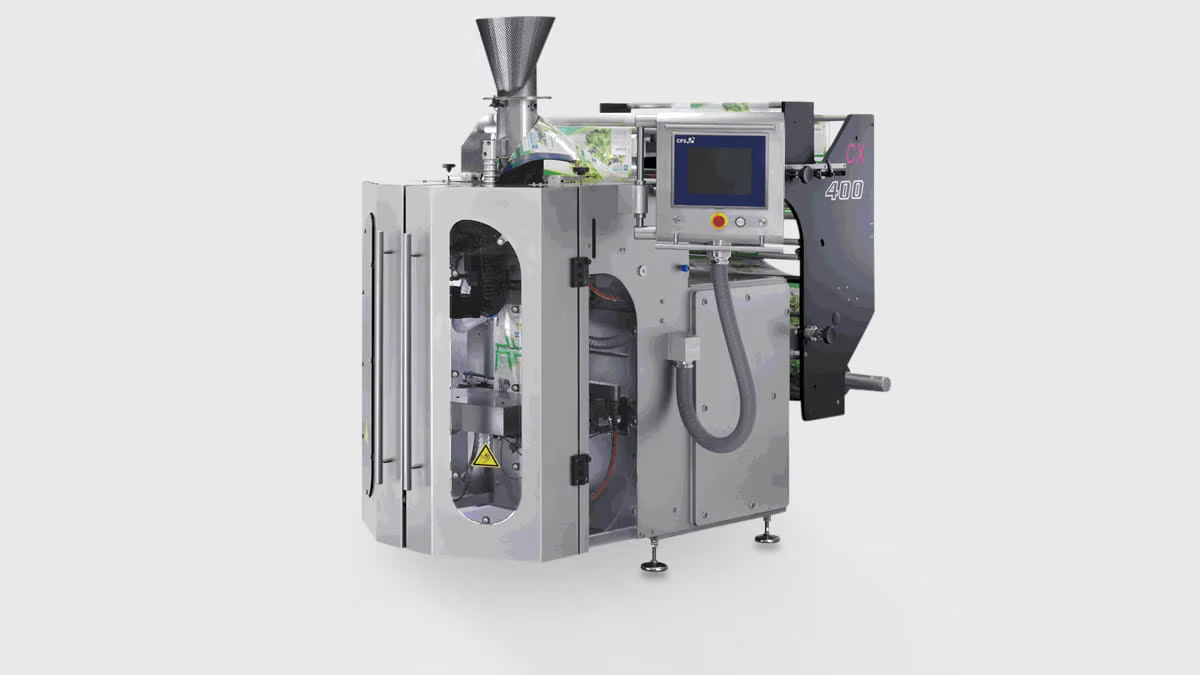
The seal is the part of the package that fails first, so the sealing technology matters more than any headline speed. Three approaches dominate form-fill-seal machines: heat sealing (the default), ultrasonic sealing (for contaminated or sensitive films) and long-dwell sealing (for high-barrier and MAP packs).
Heat sealing
Heated jaws melt the film together under pressure. It is the most common and cheapest method, and it scales to very high speed.
- Force control: Rovema Premiumseal programmes sealing force up to 6,000 N, giving repeatable seals on recyclable films.
- Continuous band: GEA Smart Sealing System seals on a continuous metal band for up to one million bags without stopping (claimed +20% throughput).
- Limit: product dust or liquid in the seal area weakens the seal, because the film must melt cleanly.
Ultrasonic sealing
High-frequency vibration generates heat inside the film itself, so the seal forms even when the sealing area is contaminated with product.
- Availability: offered as an option on GEA SmartPacker CX400 and Mespack HCM; Rovema also lists ultrasonic sealing.
- Best for: powders and liquids that contaminate the seal area, or films that are temperature-sensitive.
Long-dwell sealing
The jaws stay closed longer, which suits thick, high-barrier or laminated films that need more time to reach a hermetic seal.
- Example: PFM Tornado LD is a long-dwell flow wrapper up to 100 packs/min for hermetic, gas-tight seals.
- Best for: MAP and high-barrier packs where a weak seal means the modified atmosphere leaks out.
How to choose
Ask the supplier to demonstrate the seal on your film and your product, at production speed. If the product dusts or the film is thick and barrier-based, ultrasonic or long-dwell usually wins over a plain heat seal. If the line is high-speed and clean, a well-controlled heat seal is the most economical.
Frequently asked questions
When do I need ultrasonic sealing?
Ultrasonic sealing welds through product residue, so it is chosen when the seal area is contaminated (powder or liquid in the seal) or the film is heat-sensitive.
What is long-dwell sealing for?
Long-dwell sealing holds the film at sealing temperature longer, which is needed for high-barrier and MAP packs that require more seal time at a controlled temperature.
Is heat sealing reliable enough for most products?
Yes — heat sealing is the default and is reliable for most dry and solid products; switch to ultrasonic or long-dwell only when the film or product demands it.
Related guides
- VFFS Baggers: Top 10 Machines Compared (2026) — Ten vertical form-fill-seal (VFFS) machines compared across speed, mot…
- Intermittent vs Continuous vs Rotary VFFS: Motion Type Drives Speed, Seal and Cost — How the three VFFS motion types — intermittent, continuous and rotary …
- Multihead Weigher vs Volumetric Cup vs Auger Filler: Choosing FFS Dosing — How multihead weighers, volumetric cups and auger fillers compare for …
- How a Vertical Form-Fill-Seal (VFFS) Machine Works: Film Path, Sealing and Fill — a vertical form-fill-seal (VFFS) machine makes a bag from roll film ar…
- How a Horizontal Flow Wrapper (HFFS) Works: Infeed, Cross-Sealing and Film Path — a horizontal form-fill-seal (HFFS) flow wrapper carries the product ho…
- How a Multihead Weigher Achieves Accuracy: Combination Weighing Explained — a multihead weigher is accurate not because each weigh head is precise…
- Top 10 Form-Fill-Seal Machine Manufacturers Global (2026 Edition) — An independent ranking of the top global VFFS and HFFS machine manufac…
- Top 10 China VFFS Machine Manufacturers (2026 Edition) — An independent ranking of Chinese vertical and horizontal form-fill-se…
Last verified: August 25, 2026.