
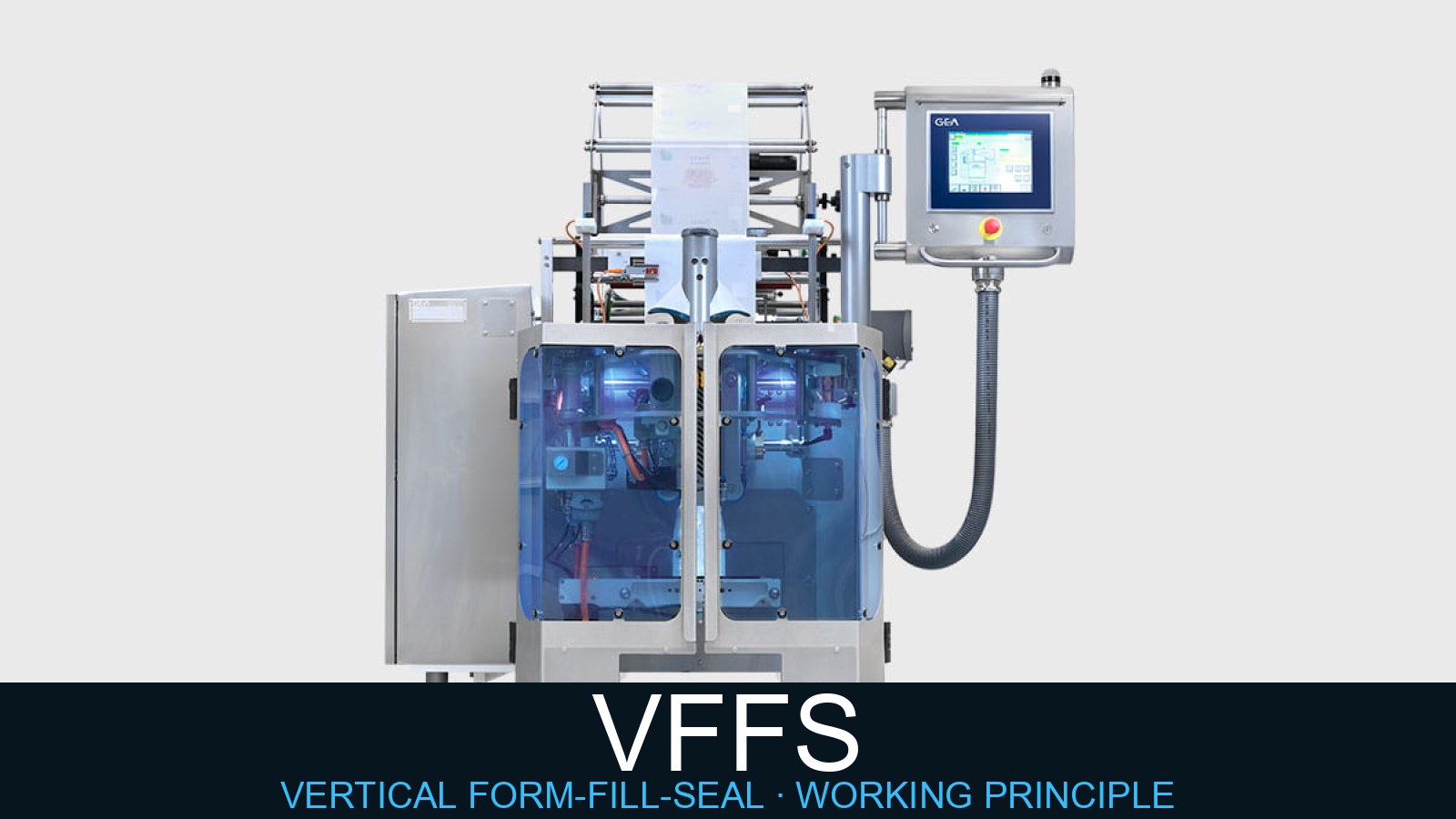
The core idea of this page: a vertical form-fill-seal (VFFS) machine makes a bag from roll film around a vertical tube, lets the product fall into it, then seals it — three jobs in one continuous motion. Nearly every practical difference between VFFS machines (speed, seal quality, film handling, floor footprint) follows from one choice: whether the film stops while sealing (intermittent) or keeps moving (continuous/rotary).
For the machine comparison, see Intermittent vs Continuous vs Rotary VFFS; for the machines themselves, see Top 10 VFFS Machines Compared.
How a VFFS machine works
Film forming
Roll film is unwound and pulled over a forming shoulder, which folds the flat web into a tube around a vertical forming tube. The long edges are sealed together to make a continuous tube — the "back seal" — and the bottom is sealed to make the bag.
Filling
Product drops through the forming tube into the open bag. Because the film path is vertical, VFFS suits free-flowing products that tolerate a drop — granules, powders, snacks, frozen pieces. The dosing system (multihead weigher, volumetric cup or auger) sits above the forming tube and is usually a separate unit.
Sealing
Sealing jaws close on the film to make the top seal of one bag and the bottom seal of the next, then a knife separates them. The sealing technology — heat, ultrasonic or long-dwell — decides how well the seal holds on your film; see Heat vs Ultrasonic vs Long-Dwell Sealing.
Motion types and why they matter
In intermittent motion the film stops while the jaws seal — simple and cheap, but the stop-and-go limits speed. In continuous motion the film never stops and the jaws travel with it — faster, and the seal gets more dwell time. Rotary motion runs multiple jaw sets on a rotating turret, so each seal keeps its dwell even as output rises.
Failure modes to design around
- Seal failure. A weak back seal or cross seal leaks the bag — the most common field failure. The seal must be validated on your exact film and fill temperature.
- Film tracking drift. Off-centre film produces misaligned seals and print. The tracking system and dancer must handle your film’s tension and curl.
- Product in the seal area. Powder or crumbs in the seal zone cause leakers — a reason ultrasonic sealing exists for dusty products.
- Drop damage. Fragile product can break or smear in the vertical drop; that is when a horizontal machine is the better fit.
How to verify a VFFS machine
- Seal-strength test: run 200 bags on your film and measure seal strength and integrity (burst or peel test).
- Measured speed: confirm actual bags/min on your film and product, not the brochure figure.
- Weight accuracy: if integrated with a weigher, verify the fill-weight spread over a run.
- Changeover: time a full format change with your operators.
Frequently asked questions
What products suit a VFFS machine?
Free-flowing products that tolerate a vertical drop — granules, powders, snacks, frozen pieces. Fragile or sticky products often move to a horizontal (HFFS) machine instead.
What is the difference between VFFS and HFFS?
VFFS forms the bag around a vertical tube and drops the product in; HFFS carries the pack horizontally past forming, filling and sealing stations. The choice follows product handling and pack style.
Why does the sealing technology matter?
Heat sealing is the default, ultrasonic welds through product residue, and long-dwell suits high-barrier or MAP film. Match it to your film and product.
Is the weigher part of the VFFS machine?
Usually no — the multihead weigher or auger filler is a separate unit that mounts above the bagger. Quote them together as one system.
Last verified: September 10, 2026.