
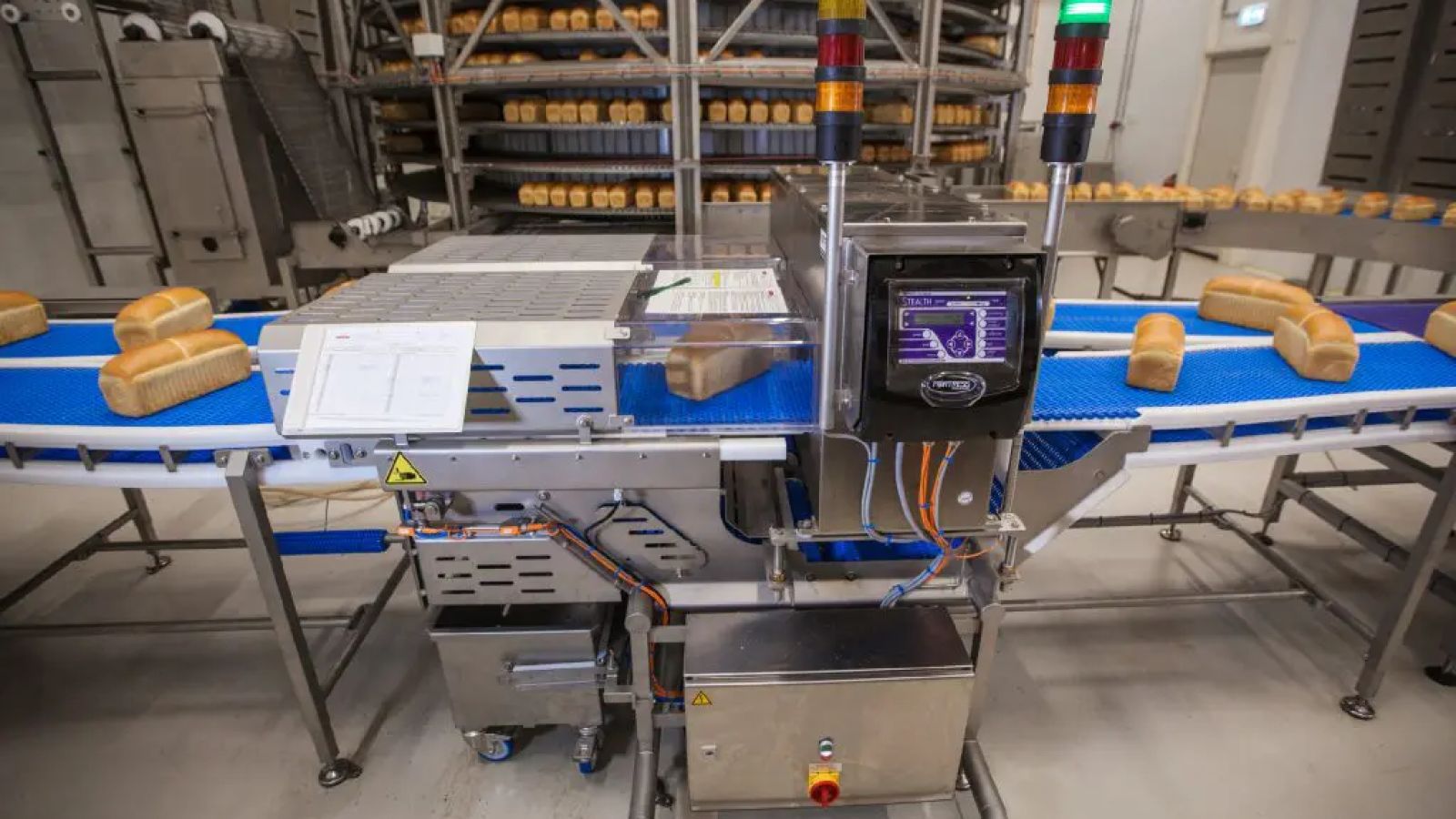
The core idea of this page: a metal detector senses metal by disturbing a balanced electromagnetic field — ferrous metal affects the magnetic component, non-ferrous and stainless affect the conductive component. The hard part is not finding metal, but rejecting only the metal you must catch while ignoring the product itself.
How balanced-coil detection works
1. The balanced field
A transmitter coil generates an alternating electromagnetic field across the aperture. Two receiver coils are arranged so the field is balanced — with no product, the net signal is zero.
2. What metal does to the field
When metal passes through the aperture, it disturbs the field. Ferrous metal (iron, steel) disturbs the magnetic component; non-ferrous metal (aluminium, brass) and stainless steel disturb the conductive component by eddy-current effect.
3. Detection and reject
The imbalance is measured, compared to a threshold, and if it exceeds the limit the detector triggers a reject — an air blast, pusher or diverter removes the pack from the line.
Key variables that decide sensitivity
- Aperture size: sensitivity is quoted for a given aperture; a larger aperture lowers sensitivity. An Anritsu M6-h reaches Fe 0.25 mm / SUS 0.6 mm on its aperture.
- Product effect: conductive products (meat, cheese, brine, wet bread) generate their own signal and reduce sensitivity — they must be "phased out".
- Frequency: single-frequency suits dry products; multi-frequency (dual/multi-simultaneous) recovers sensitivity on conductive products.
- Orientation: the worst-case orientation of the contaminant (thin sliver vs sphere) sets the real detection limit.
Failure modes
- False rejects: product effect or over-tight thresholds reject good product and erode operator trust.
- Stainless misses: stainless steel is the hardest metal to find — it is non-magnetic and only weakly conductive.
- Orientation gaps: a sliver aligned with the field can pass undetected even when a sphere would be caught.
How to verify
- Challenged test: pass certified Fe, non-ferrous and stainless test pieces in the worst-case orientation through the actual product.
- False-reject rate: record how many good packs are wrongly rejected over a full shift.
- Validation records: confirm the detector logs every test and reject, for audit trail.
Frequently asked questions
Why is stainless steel so hard to detect?
Stainless is non-magnetic and only weakly conductive, so it produces a weak signal — sensitivity for stainless is always worse than for ferrous or non-ferrous metal.
What is product effect?
Conductive products (meat, cheese, brine) generate their own signal that masks metal. Multi-frequency detectors phase out the product signal to recover sensitivity.
Do I need X-ray instead?
Only if your contaminant risk includes non-metal (glass, stone, bone) or your product is so conductive a metal detector cannot meet your sensitivity target. See Metal Detection vs X-Ray Inspection.
See also: Top 10 Product Inspection System Manufacturers and Checkweighing vs Metal Detection.
Related guides
- Product Inspection Machines: Top 10 Compared (2026) — Ten product inspection machines compared across metal detection, check…
- Metal Detection vs X-Ray Inspection — a metal detector finds metal only; an X-ray finds metal plus glass, st…
- Checkweighing vs Metal Detection — a checkweigher catches under/overfill by weighing every pack; a metal …
- In-Line vs Standalone Inspection — in-line inspection sits on the production line and checks every pack a…
- How Product Inspection Systems Work: Metal Detection, Checkweighing and X-ray — product inspection is not one technology but four — metal detect…
- Top 10 Product Inspection System Manufacturers (2026) — An independent ranking of the top product inspection system manufactur…
- Top 10 China Product Inspection Machine Manufacturers (2026) — An independent ranking of Chinese product inspection machine builders …
Last verified: September 10, 2026.