
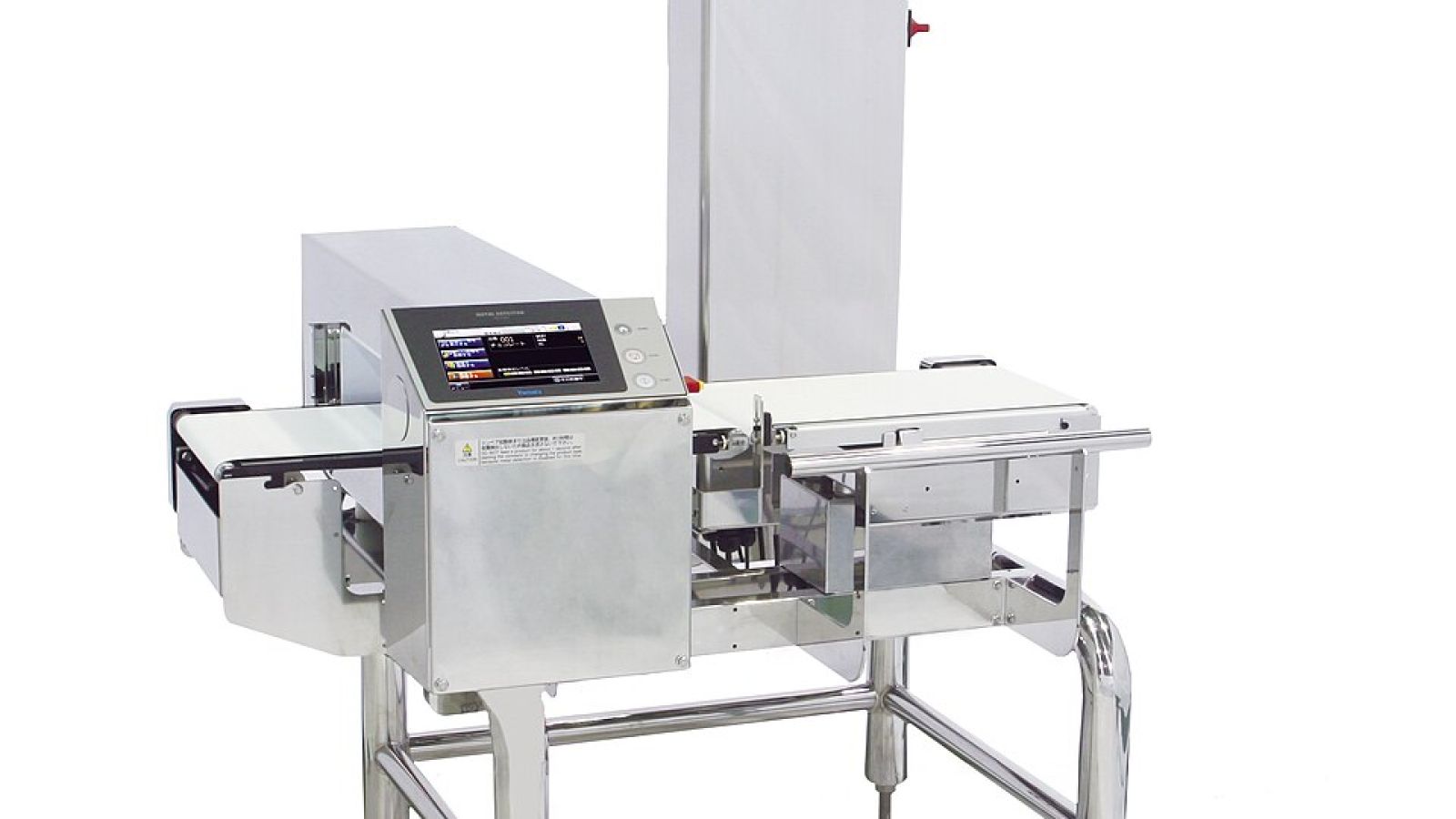
The core idea of this page: a checkweigher catches quantity errors, a metal detector catches contamination. They are not alternatives to each other — they are two different controls that happen to sit next to each other on the same conveyor. Choosing between them only makes sense if you are deciding which risk to control first with a limited budget.
The comparison at a glance
| Dimension | Checkweigher | Metal detector |
|---|---|---|
| Failure it catches | Underfill (legal and customer risk), overfill (giveaway), missing components that change weight | Ferrous, non-ferrous and stainless contamination |
| Coverage | Every pack, in motion, at line speed | Every pack, in motion, at line speed |
| Pack constraint | Needs stable presentation and known pack weight; light or unstable packs are harder | Fails on metallised or foil packaging; affected by wet, salty or hot product |
| What it cannot do | Detect contamination that does not change weight | Detect weight errors or non-metal contaminants |
| Output | Weight data per pack: trends, giveaway, capability (CpK) | Detect/reject event; limited diagnostic data |
| Regulatory role | Supports net-content compliance and average-weight rules | Accepted as a HACCP critical control point for contamination |
| Relative capital cost | Moderate | Lower to moderate |
| Recurring cost | Calibration weights, belt wear, reject verification | Test packs, product-effect retuning per recipe |
How to decide
If your risk is legal fill weight, the checkweigher is not optional
Where net-content rules apply, you need a weight control on every pack or a statistically valid sampling scheme. A metal detector does not help with that, and no amount of contamination control substitutes for it.
If your risk is contamination, the checkweigher is not a substitute
A metal fragment small enough to pass a customer's tolerance usually changes pack weight by less than the natural variation of the fill. Weight control cannot find it.
Decision rules that hold up in practice
Retail food, both risks: checkweigher and metal detector, usually combined in one frame with a shared reject — the standard combination on a packaging line.
Legal fill weight only, no contamination hazard: checkweigher alone.
Contamination hazard, no fill-weight obligation (bulk, industrial): metal detector alone.
Foil or metallised packs: checkweigher plus X-ray, because the metal detector is blinded by the pack.
Giveaway is the biggest cost: checkweigher first — the weight data usually pays for it faster than contamination control does.
Where the money actually goes
The case for a checkweigher is usually giveaway reduction: tightening the fill target by a gram on a high-volume line can return the capital cost within a year. The case for a metal detector is risk: one recall costs more than the device by orders of magnitude. These are different kinds of return, which is why the "which one first" question depends on whether you are optimising cost or protecting the brand.
Combined units and shared rejects
Most lines combine both in one frame: weigh, detect, then reject into a single bin with a confirmation sensor. The design details matter more than the technology — reject confirmation, bin-full detection, and a reject that cannot be bypassed. A combined unit also shares one conveyor and one set of guards, which usually costs less than two separate installations.
Failure modes worth designing out
Checkweighers drift with belt tension, product build-up and vibration; metal detectors drift with product effect and nearby metal. Both fail silently when the reject bin is full or the reject confirmation is bypassed. Neither failure is visible in production data unless you test with challenge packs on a defined schedule.
Verification checklist
Confirm: challenge packs and calibration weights used at the specified interval; reject confirmation interlocked and logged; weight target and limits documented per product; product-effect settings recorded per recipe; and records retained for audit.
Source: Check weigher — Wikipedia
"A checkweigher is an automatic or manual machine for checking the weight of packaged commodities."
Frequently asked questions
Can a checkweigher detect metal?
Only if the fragment is heavy enough to move the pack outside its weight band — which for normal tolerances means it cannot. Use a metal detector or X-ray for contamination.
Do I need both if I have X-ray?
X-ray does not certify weight. If net-content rules apply, you still need a checkweigher or a compliant sampling scheme.
Which one should I buy first?
If legal fill weight applies, the checkweigher. If not, buy the one that addresses the hazard with the highest severity in your HACCP study.
Related reading: metal detection vs X-ray, in-line vs standalone inspection, product inspection systems, and the inspection systems category.
Related guides
- Product Inspection Machines: Top 10 Compared (2026) — Ten product inspection machines compared across metal detection, check…
- Metal Detection vs X-ray Inspection — a metal detector finds metal only; an X-ray finds metal plus glass, st…
- In-Line vs Standalone Inspection — in-line inspection sits on the production line and checks every pack a…
- Product Inspection Systems: Metal Detection, Checkweighing and X-ray — product inspection is a set of controls placed on the line to catch wh…
- How a Metal Detector Works — a metal detector creates an electromagnetic field and watches for the …
- Top 10 Product Inspection System Manufacturers (2026) — An independent ranking of the top product inspection system manufactur…
- Top 10 China Product Inspection Machine Manufacturers (2026) — An independent ranking of Chinese product inspection machine builders …