
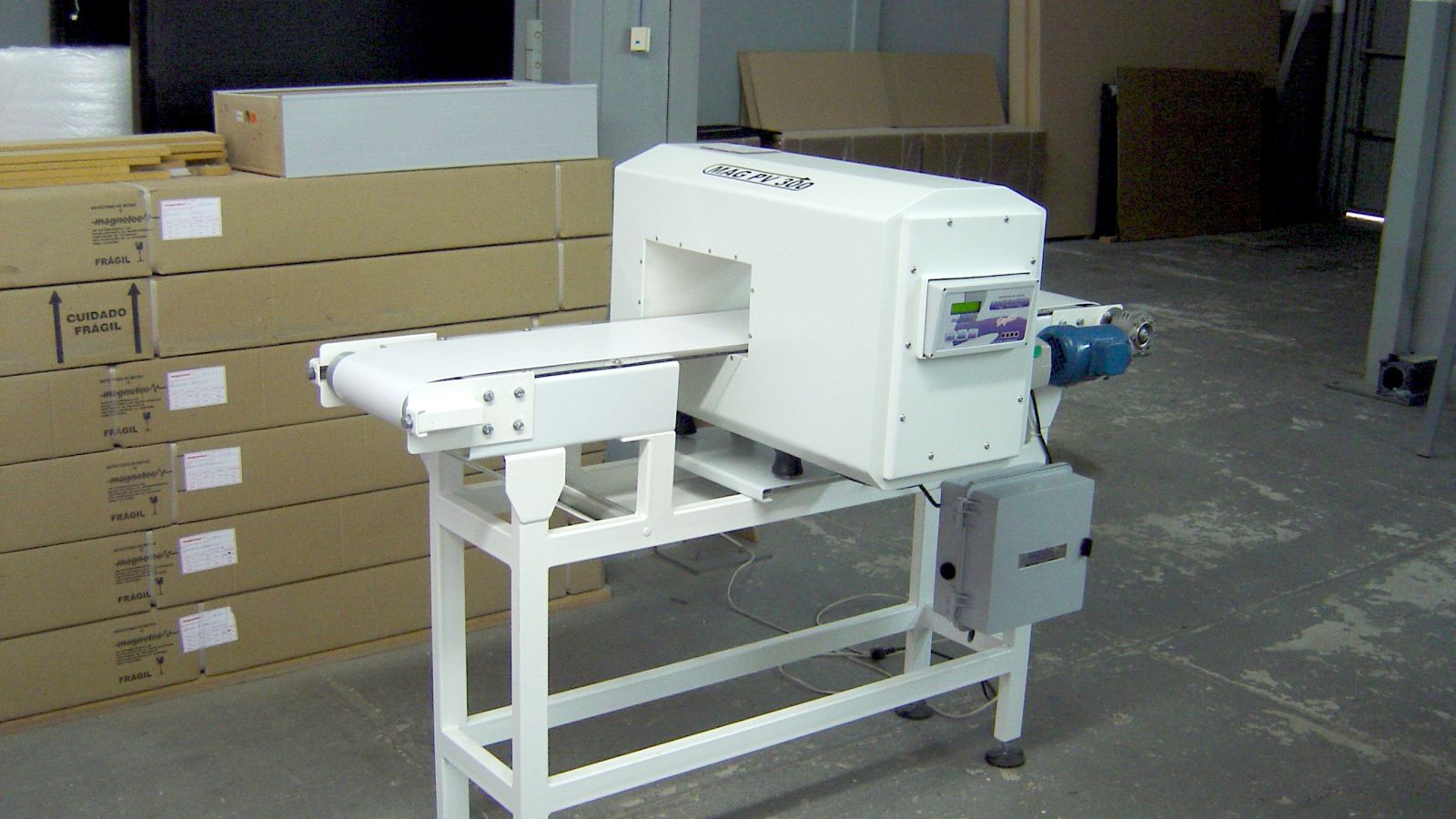
The core idea of this page: metal detection and X-ray inspection answer different questions. A metal detector asks "is there metal here?"; an X-ray system asks "is there anything here that should not be?" If your contamination risk is metal only and your packs are simple, a metal detector is cheaper and faster. If your risk includes glass, stone, bone or dense plastic, or your pack has an aluminium foil lid or a metallised film, X-ray is the only one of the two that works.
The comparison at a glance
| Dimension | Metal detection | X-ray inspection |
|---|---|---|
| What it finds | Ferrous, non-ferrous and stainless steel | Metal plus glass, stone, bone, dense plastics, some calcified material |
| Blind spots | Non-metal contaminants; small stainless in wet or conductive product | Low-density contaminants (wood, most plastics, insects); thin foil layers can mask small metal |
| Pack constraint | Metallised film and foil lids cause false rejects — usually unusable | Works through foil, metal cans and glass; the limit is density contrast, not packaging metal |
| Typical line speed | Very high; rarely the bottleneck | High, but slower on large or dense packs |
| False reject drivers | Product effect (wet, salty, hot product), pack orientation, vibration | Density variation, pack voids, overlapping product, worn detector elements |
| Footprint and shielding | Compact; needs a stable conveyor and metal-free zone | Larger; radiation shielding and interlocked guarding required |
| Operator skill | Moderate: set-up and product-effect tuning | Higher: image interpretation and threshold setting |
| Relative capital cost | Lower | Higher — typically a multiple of a metal detector |
| Regulatory framing | Accepted as a CCP in HACCP schemes | Accepted as a CCP; also used for fill-level and integrity checks |
How to decide
Start from the hazard analysis, not the catalogue
List the realistic contaminants for your process: metal from worn parts and blades, glass from jars and light fittings, stone and bone from raw material, hard plastic from scoops and fittings. A technology only earns its place if it can detect the hazards on that list at the size you specify.
Then check the pack
If the pack contains an aluminium foil lid, a metallised film or a metalised label, a metal detector will reject good packs or be desensitised until it finds nothing. That single constraint usually decides the question before cost does.
Then check the product effect
Wet, salty, hot or conductive products produce a "product effect" that masks small metal. If the product effect is large, either the metal detector's sensitivity drops to the point of being useless, or you move to X-ray or to a multi-frequency detector.
Decision rules that hold up in practice
Metal-only risk, dry product, simple pack: metal detector, positioned as late in the line as possible.
Metal-only risk but foil or metallised pack: X-ray, because the metal detector cannot see through the pack.
Glass, stone or bone risk: X-ray, with the contaminant size agreed against the customer specification.
Both metal and non-metal hazards, high-volume retail: X-ray as the final inspection, with a metal detector upstream if the process generates metal wear.
Regulated fill weight as well: a checkweigher alongside either, because neither inspection device certifies weight.
Cost, and what the number actually includes
The purchase price is the smaller part of the comparison. Include: reject handling (a conveyor, a bin and a lockable reject confirmation), validation and commissioning, operator training, annual radiation safety checks for X-ray, and the cost of false rejects in product and line time. On a high-speed line, one percent of false rejects can exceed the annualised capital difference between the two technologies.
Failure modes worth designing out
Metal detectors fail in practice through unstable conveyors, vibration, nearby moving metal, and product-effect drift when the recipe changes. X-ray systems fail through dirty detector arrays, worn belts, unstable pack presentation and thresholds set once and never revisited. Both fail when the reject device is not interlocked and verified — a detector that finds contamination but cannot remove the pack provides no protection at all.
Verification checklist
Confirm: the hazard list is written and agreed; the test pack sizes are specified and challenged at commissioning and each shift; the reject mechanism is interlocked, alarmed and checked; the product effect or density baseline is recorded per recipe; sensitivity is revalidated after any pack, recipe or line change; and records are retained for audit.
Source: Metal detector — Wikipedia
"A metal detector is an instrument that detects the nearby presence of metal."
Frequently asked questions
Can X-ray replace a metal detector entirely?
Usually yes for detection, but not always economically. If the only hazard is metal and the pack is simple, a metal detector is cheaper to buy, run and validate.
Why does my metal detector reject good packs?
Product effect, metallised packaging, vibration, or metal nearby. Fix the installation and the product-effect setting before blaming sensitivity.
What size contaminant should the specification require?
Set it from the hazard analysis and the customer requirement, then prove the machine achieves it on your product with challenge packs — not from a brochure figure measured on air.
Related reading: checkweighing vs metal detection, in-line vs standalone inspection, how a metal detector works, and the inspection systems category.
Related guides
- Product Inspection Machines: Top 10 Compared (2026) — Ten product inspection machines compared across metal detection, check…
- Checkweighing vs Metal Detection — a checkweigher catches under/overfill by weighing every pack; a metal …
- In-Line vs Standalone Inspection — in-line inspection sits on the production line and checks every pack a…
- Product Inspection Systems: Metal Detection, Checkweighing and X-ray — product inspection is a set of controls placed on the line to catch wh…
- How a Metal Detector Works — a metal detector creates an electromagnetic field and watches for the …
- Top 10 Product Inspection System Manufacturers (2026) — An independent ranking of the top product inspection system manufactur…
- Top 10 China Product Inspection Machine Manufacturers (2026) — An independent ranking of Chinese product inspection machine builders …