
Last updated: September 8, 2026. Tray sealing and vacuum chamber sealing are the two industrial workhorses of food closing, and buyers confuse them because both are used for meat and ready meals. The difference is the package: a tray sealer welds lidding film onto a rigid preformed tray; a vacuum chamber evacuates air from a flexible pouch and seals the bag.
The core idea of this page: this is a pack-format decision before it is a machine decision — rigid retail tray versus evacuated pouch. Name the pack the retailer (or customer) demands, and the machine class is already decided.
How each method closes
A tray sealer places a preformed tray under a sealing tool, draws lidding film over it, optionally gas-flushes the headspace for MAP, and heat-welds the film to the tray flange. The result is a rigid, stackable, retail-ready pack. Representative machines are the Proseal GT2s and Sealpac A7. The machine sequence is covered in How a Tray Sealer Works.
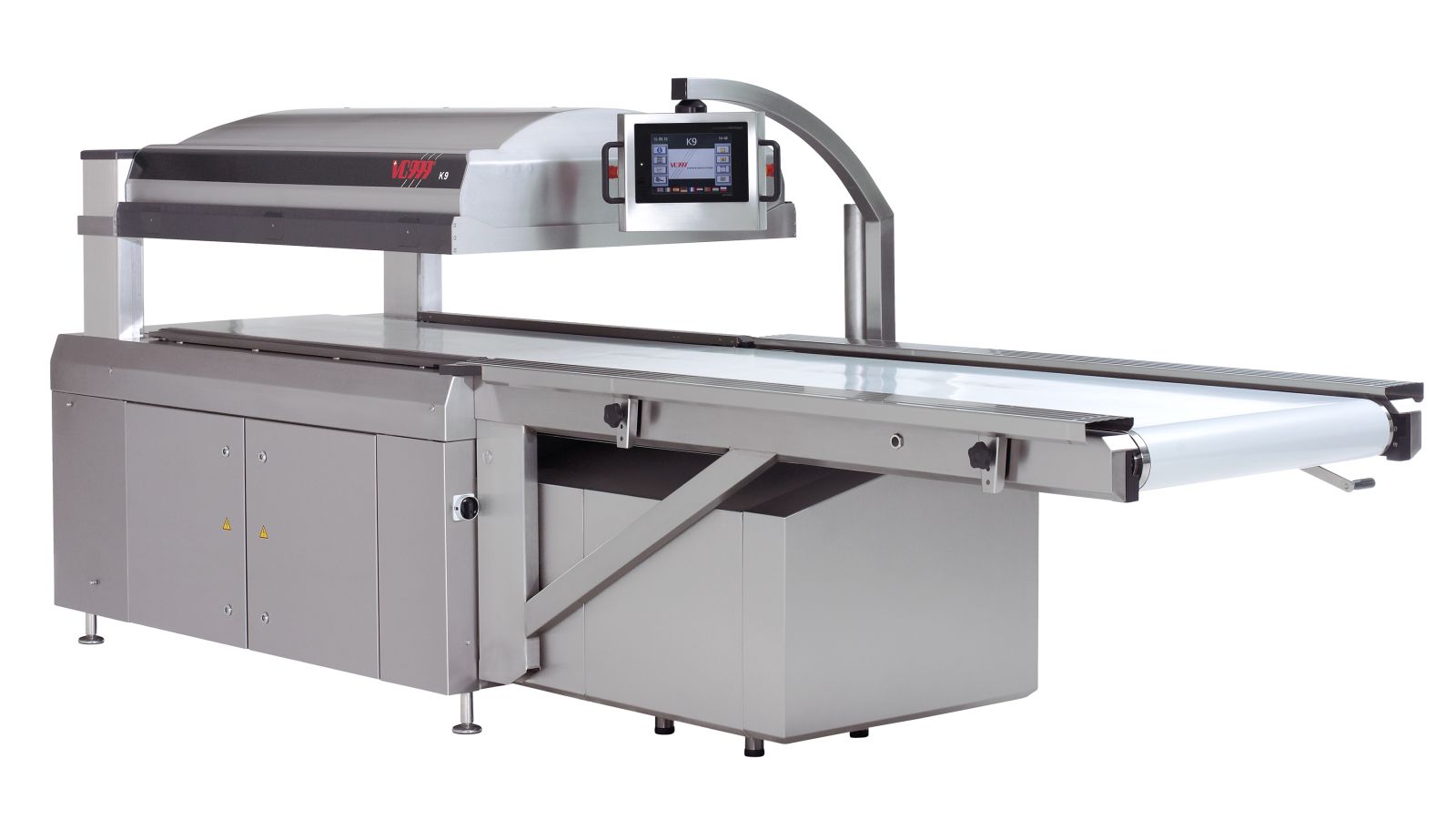
A vacuum chamber sealer places the filled pouch inside a chamber, closes the lid, evacuates the chamber to a hard vacuum, then heat-seals the bag mouth while the chamber re-pressurises. The result is a tight, evacuated pack that collapses around the product — the classic presentation for primal cuts, cheese blocks and processed meat. Chamber machines scale from tabletop units to automatic belt chambers, and suppliers document the chamber machine families in their catalogues.
Where each wins
| Criterion | Tray sealing | Vacuum chamber |
|---|---|---|
| Pack format | Preformed rigid tray + lidding film | Flexible pouch / bag |
| Shelf life | MAP gas flush — long, format-controlled | Vacuum — very long for suitable products |
| Retail presentation | Rigid, stackable, labelled tray | Tight vacuum skin around product |
| Typical products | Ready meals, produce, case-ready meat | Primal meat, cheese, processed meat |
| Throughput | High on automatic sealers | Medium-high on belt/rotary chambers |
| Verification | Seal integrity + headspace gas analysis | Residual oxygen + seal fusion |
| Machine cost | Higher entry (automatic) | Lower entry (tabletop to belt) |
Decision rules
- Choose tray sealing when the pack must stand on a shelf as a rigid tray, when gas flushing is required, or when the line must integrate weigh-price labelling downstream — the case-ready model of Ossid and MULTIVAC lines.
- Choose vacuum chamber when the product is bagged, when the plant already runs pouch formats, or when output is moderate and machine budget is tighter — the territory of WEBOMATIC C-Line machines and VC999 chambers.
- Both can overlap for meat: case-ready retail packs lean tray sealing; bulk or foodservice packs lean vacuum bags. Plants running both formats often need both machines — the cost comparison is then per-pack, not per-machine.
Verification differs, not just the machine
Tray sealing lines are validated by seal-integrity and leak testing plus headspace gas analysis of the flushed pack; vacuum lines by residual oxygen and seal fusion on the bag. Headspace analysers are the documented verification step for MAP gas flushing. Agree the sampling plan and the reject threshold for both before the order. Budget context is in the Sealing Machine Price Guide; the full machine-class map is in What Is a Sealing Machine.
Frequently asked questions
Which gives longer shelf life?
It depends on the pack: tray sealing with MAP extends fresh-food shelf life under a protective gas, while vacuum chamber sealing removes oxygen from a flexible pouch. Choose by pack format, not by machine type.
Are tray sealing and vacuum chamber sealing interchangeable?
No — a tray sealer welds lidding film onto a rigid preformed tray, and a vacuum chamber seals a flexible pouch. You cannot seal a pouch on a tray sealer.
Which is faster?
Tray sealers run higher continuous output, while vacuum chamber machines are batch by nature. Match the machine to the throughput and pack format you actually run.
Related guides
- Sealing Machines: Top 10 Tray Sealers Compared (2026) — Five automatic tray sealers compared across sealing capability, format…
- Heat Sealing vs Induction Sealing: Closing Methods Compared — Heat sealing welds film with heated elements; induction sealing welds …
- MAP vs Vacuum Skin Packaging: Sealing for Shelf Life — MAP gas-flushes a tray headspace; vacuum skin packaging draws the film…
- Modified Atmosphere Packaging (MAP): Gases, Sealing and Shelf Life — modified atmosphere packaging (MAP) extends shelf life by replacing th…
- How a Tray Sealer Works: Film Feed, Gas Flush and Seal — a tray sealer welds a lidding film onto a rigid preformed tray in a se…
- How Induction Sealing Works: Cap Liners and Heat Generation — induction sealing welds a foil liner inside a bottle cap by generating…
- Top 10 Sealing & Tray Sealing Machine Manufacturers Global (2026 Edition) — An independent ranking of the top global sealing machine manufacturers…
- Top 10 China Sealing Machine Manufacturers (2026) — An independent ranking of Chinese sealing machine builders across band…
Last verified: September 8, 2026.