
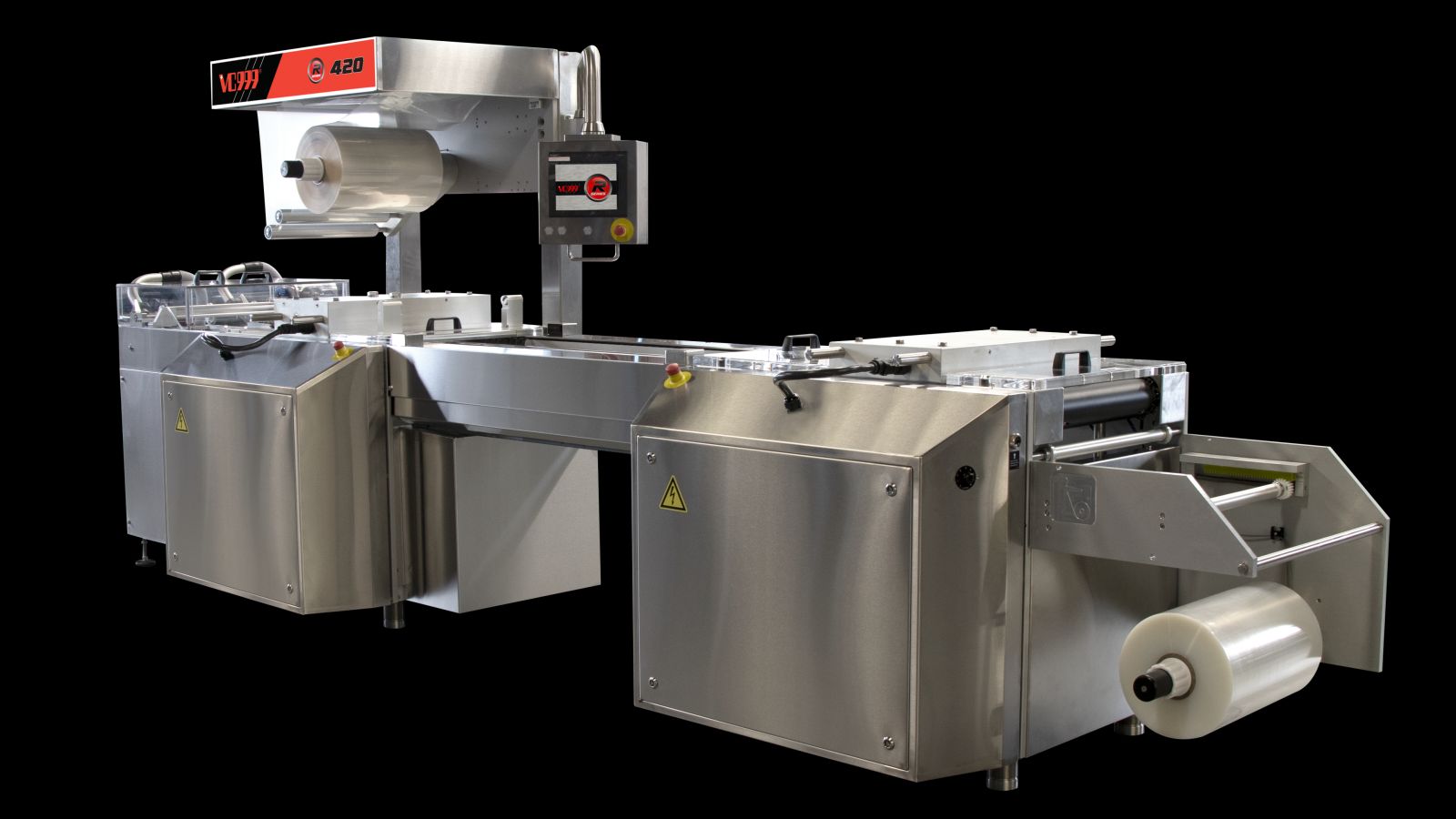
Last updated: September 8, 2026. Modified atmosphere packaging (MAP) and vacuum skin packaging (VSP) are the two premium sealing formats for fresh food, and both start on the same tray sealer. The difference is what happens in the sealing station: MAP flushes the tray headspace with a protective gas mixture and seals a dome of film above the product; VSP evacuates the air and draws heated film down onto the product like a second skin.
The core idea of this page: both formats extend shelf life, but by different mechanisms — MAP by gas composition, VSP by oxygen removal plus product immobilisation. The retail presentation your buyer wants is what actually picks the winner.
How each format works
MAP replaces the air in the tray headspace with a gas mix before sealing. The mixture is product-specific: research on beef steaks documents 70% oxygen / 30% carbon dioxide MAP for keeping the bright red colour, while gas suppliers publish mixture guidance for raw red meat and raw poultry. Because the tray keeps a gas cushion, the film stays above the product — the familiar domed tray. Gas behaviour and mixes are covered in Modified Atmosphere Packaging (MAP).
VSP evacuates the headspace to a controlled soft vacuum and presses heated, softened film down over the product, where it conforms to the surface and seals to the tray across the full base, not just the flange. The film holds the product immobile, protects fragile cuts from movement damage, and presents as a premium skin-tight pack. Sealpac documents its FlatSkin system as the skin-packaging format for poultry and processed meat, and machines like the Sealpac A7 and Mondini Trave LC run VSP tooling alongside MAP.
Side-by-side
| Criterion | MAP | Vacuum skin |
|---|---|---|
| Shelf-life mechanism | Protective gas mixture | Oxygen removal + immobilised product |
| Appearance | Domed film over gas cushion | Film tight against product |
| Best for | Red meat, ready meals, produce, bakery | Premium meat cuts, fish, marinated items, frozen |
| Product protection | Moderate (headspace) | High (product fixed in place) |
| Film / gas cost | Gas supply + lidding film | Formable skin film, no gas mix |
| Verification | Headspace gas analysis of the flushed pack | Vacuum level, film conformity, base-seal integrity |
| Machine requirement | Standard MAP tray sealer | VSP-capable sealer with vacuum tooling |
Decision rules
- Choose MAP when the product needs a bright oxygenated look (red meat), when the range is broad and formats change often, or when gas composition is the shelf-life lever.
- Choose VSP for premium cuts and marinated proteins, for products that must not shift in transit, or when the retail brief demands a skin-tight premium presentation.
- Both on one machine is common: pick a sealer with switchable MAP/VSP tooling (Sealpac A-series, Mondini Trave, Proseal GT) if the product range will span both formats.
Verification and cost
MAP packs are validated by headspace gas analysis and leak testing — the documented verification step for MAP flushing; VSP by vacuum level, film conformity and seal integrity across the base seal. Film and gas consumption dominate running cost differences — request both from the supplier in the same quote scope. Machine budget bands are in the Sealing Machine Price Guide; the machine-class map is in What Is a Sealing Machine.
Frequently asked questions
Which is better for red meat?
MAP with a high-oxygen mix keeps red meat looking red, while vacuum skin packaging extends shelf life with a tight, oxygen-free skin. Both have trade-offs — the choice follows the retail format and shelf-life target.
Do both need a gas supply?
MAP requires gas flushing with a protective mixture; vacuum skin packaging uses vacuum only, with no gas mix.
Which has better shelf appeal?
VSP shows the product through a tight, transparent skin, while MAP shows it under a gas dome. The better look depends on the retail format and product.
Related guides
- Sealing Machines: Top 10 Tray Sealers Compared (2026) — Five automatic tray sealers compared across sealing capability, format…
- Tray Sealing vs Vacuum Chamber Sealing: Which Closure Fits Your Pack — Tray sealing and vacuum chamber sealing solve different closure proble…
- Heat Sealing vs Induction Sealing: Closing Methods Compared — Heat sealing welds film with heated elements; induction sealing welds …
- Modified Atmosphere Packaging (MAP): Gases, Sealing and Shelf Life — modified atmosphere packaging (MAP) extends shelf life by replacing th…
- How a Tray Sealer Works: Film Feed, Gas Flush and Seal — a tray sealer welds a lidding film onto a rigid preformed tray in a se…
- How Induction Sealing Works: Cap Liners and Heat Generation — induction sealing welds a foil liner inside a bottle cap by generating…
- Top 10 Sealing & Tray Sealing Machine Manufacturers Global (2026 Edition) — An independent ranking of the top global sealing machine manufacturers…
- Top 10 China Sealing Machine Manufacturers (2026) — An independent ranking of Chinese sealing machine builders across band…
Last verified: September 8, 2026.