
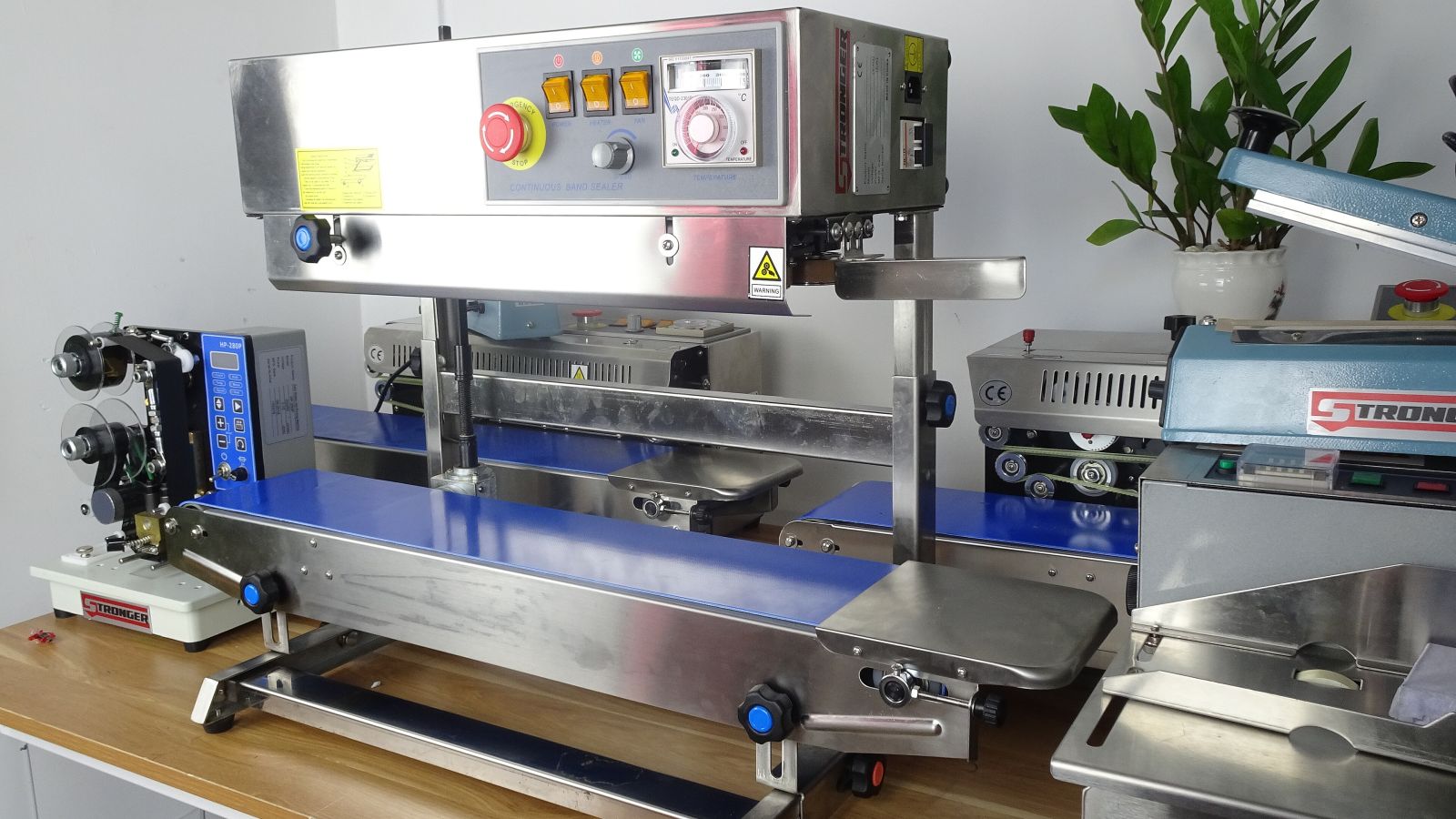
Last updated: September 8, 2026. Heat sealing and induction sealing both close packages with heat — but they generate the heat in completely different ways and close different package features. Heat sealing presses heated elements or bands against thermoplastic film and welds two film layers together. Induction sealing generates heat inside a foil liner within a bottle cap, bonding the liner to the container lip without any contact. Mixing them up in a specification leads to the wrong machine for the wrong package.
The core idea of this page: heat sealing closes film; induction sealing closes caps. They are complements on different parts of the same plant, not rival technologies — pick by what you are closing, not by which is “better”.
The mechanics
Heat (conduction) sealing transfers heat from a hot jaw, bar or band through the film to the interface between two film layers. The film surfaces reach their sealing range, flow together under pressure, and set as they cool. The sealing window is film-specific — it is set by the seal-layer polymer and thickness — and the three variables, temperature, pressure and dwell, must be developed together on the real film. It closes bags, pouches, sachets and tray lidding — any thermoplastic film-to-film or film-to-flange joint. Machines range from hand impulse sealers to the Hualian FR-900 band sealer to automatic tray sealers.
Induction sealing places a foil liner inside the cap; a sealing head under the conveyor emits an electromagnetic field that induces eddy currents in the foil, heating it until the polymer coating melts and bonds to the container lip. No contact, no adhesive, and the seal forms inside an already-closed cap. Equipment makers document the multi-layer liner structure — backing layer, release layer, aluminium foil and heat-seal coating — in their reference manuals. The full physics is in How Induction Sealing Works; the benchmark machine is the Enercon Super Seal Max.
Where each belongs
| Criterion | Heat sealing | Induction sealing |
|---|---|---|
| What it closes | Film-to-film or film-to-flange joints | Foil liner to bottle/jar lip inside a cap |
| Packages | Bags, pouches, trays, lidding | Bottles, jars, closures |
| Heat source | Heated jaws / bands (conduction) | Electromagnetic field (eddy currents) |
| Contact | Direct contact with film | None — through the cap |
| Tamper evidence | No | Yes — foil liner is tamper-evident |
| Film requirement | Thermoplastic seal layer | Foil-containing liner |
| Speed | Impulse: per-piece; band sealers run bags continuously; tray sealers scale to automatic lines | Inline heads are sized to track conveyor speed |
Decision rules
- Choose heat sealing for bags, pouches, sachets, flow-wrapped and tray-lidded packs — whenever the closure joint is film.
- Choose induction sealing for bottle and jar closures when you need a hermetic, tamper-evident seal, leak prevention on liquids, or extended shelf life on caps — pharmaceuticals, beverages, sauces, oils.
- They are complements, not rivals on many lines: a pouch line heat-seals the film while a bottling line induction-seals the caps. A packaging hall commonly runs both.
What to verify
Heat sealing is validated by seal-strength and leak tests on the weld — peel testing to ASTM F88 is the documented method for flexible-barrier seal strength, with water-bath or pressure-decay leak testing alongside. Induction sealing is validated by liner-bond inspection, cap torque checks and leak testing on the finished cap. Both need the acceptance test written into the order — the sampling plan, the measured values and the reject threshold. Related choices: MAP vs Vacuum Skin Packaging and Tray Sealing vs Vacuum Chamber Sealing.
Frequently asked questions
Do I need both on one line?
Possibly — heat sealing closes film and pouches, while induction sealing welds a foil liner under a bottle cap. They close different package features, so a line with both film and bottles needs both.
Which method is tamper-evident?
Induction sealing creates a hermetic, tamper-evident foil seal inside the cap; heat sealing is not inherently tamper-evident on its own.
Can induction sealing be used on any container?
No — induction sealing requires a conductive foil liner and a compatible cap and neck; heat sealing requires thermoplastic film that melts and welds.
Related guides
- Sealing Machines: Top 10 Tray Sealers Compared (2026) — Five automatic tray sealers compared across sealing capability, format…
- Tray Sealing vs Vacuum Chamber Sealing: Which Closure Fits Your Pack — Tray sealing and vacuum chamber sealing solve different closure proble…
- MAP vs Vacuum Skin Packaging: Sealing for Shelf Life — MAP gas-flushes a tray headspace; vacuum skin packaging draws the film…
- Modified Atmosphere Packaging (MAP): Gases, Sealing and Shelf Life — modified atmosphere packaging (MAP) extends shelf life by replacing th…
- How a Tray Sealer Works: Film Feed, Gas Flush and Seal — a tray sealer welds a lidding film onto a rigid preformed tray in a se…
- How Induction Sealing Works: Cap Liners and Heat Generation — induction sealing welds a foil liner inside a bottle cap by generating…
- Top 10 Sealing & Tray Sealing Machine Manufacturers Global (2026 Edition) — An independent ranking of the top global sealing machine manufacturers…
- Top 10 China Sealing Machine Manufacturers (2026) — An independent ranking of Chinese sealing machine builders across band…
Last verified: September 8, 2026.