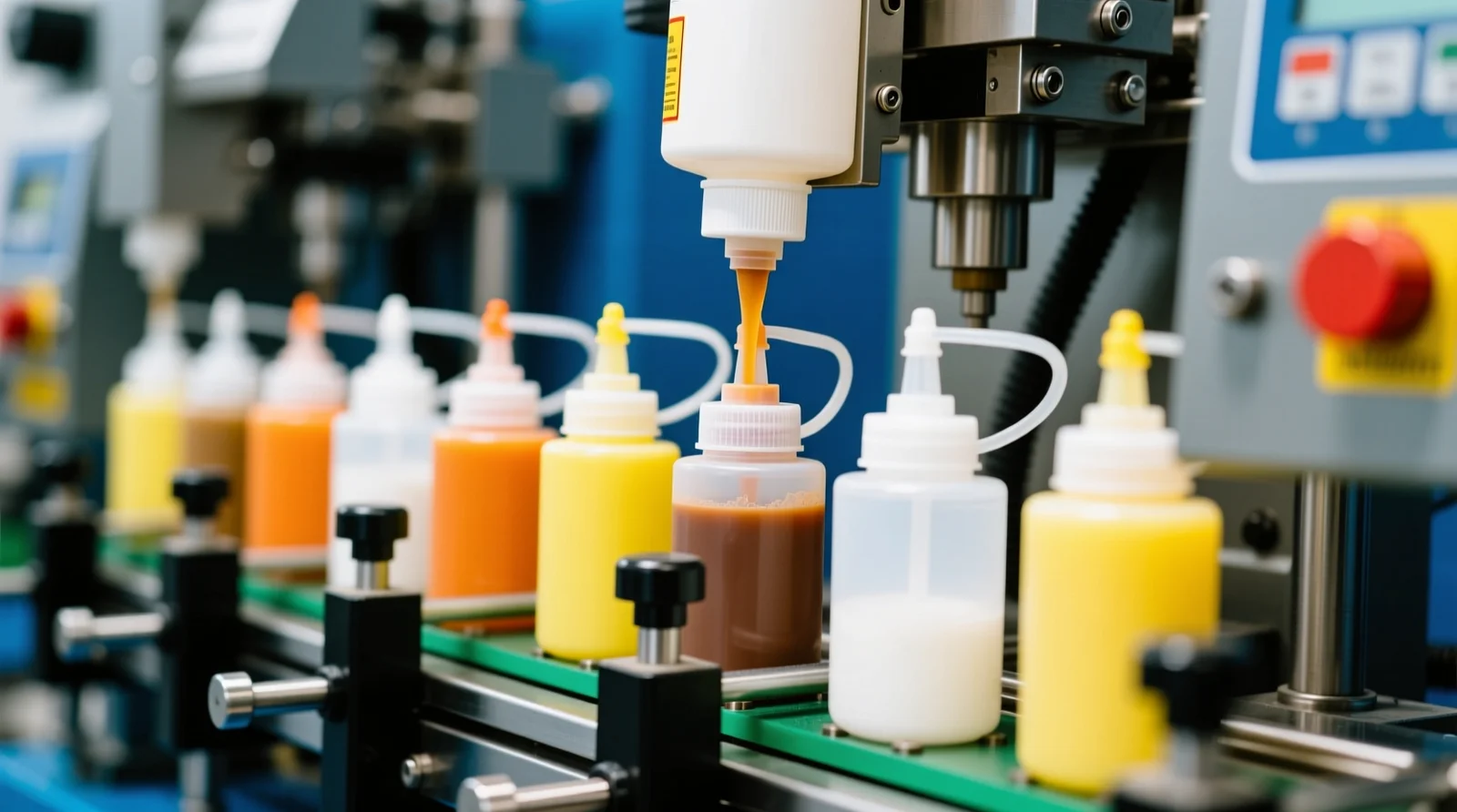
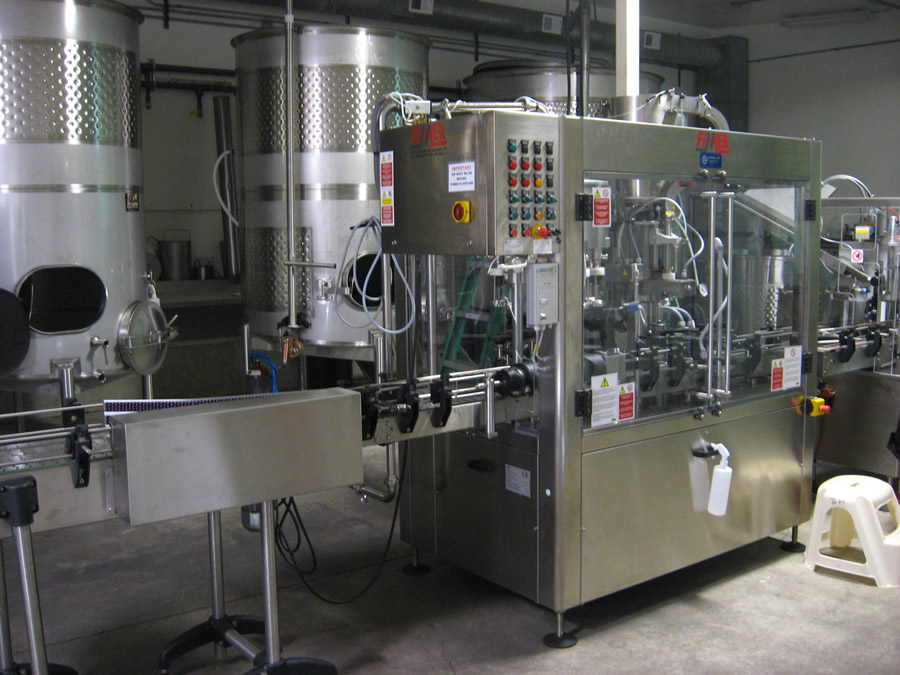
The core idea of this page: the filling principle is chosen by the product, not the machine brand. Gravity suits free-flowing thin liquids, overflow gives a visually consistent fill level, and piston handles viscous products — each trades off accuracy, speed and foaming behaviour. Get the principle wrong and no amount of automation fixes the fill.
For the machine landscape, see Top 10 Liquid Filling Machine Manufacturers.
Gravity filling
Gravity filling lets the liquid flow from an overhead tank into the container under its own weight, filling to a level or a timed volume. It is the simplest and cheapest principle for free-flowing, low-viscosity liquids (water, thin juices) that do not foam. It is not for viscous or foaming products, which fill too slowly or foam over.
Overflow filling
Overflow filling pumps liquid into the container until it overflows back to a reservoir, giving every container the same visual fill level regardless of small container-volume differences. It is chosen for transparent containers where a consistent fill line is the quality signal (e.g. bottled water, cleaning products). The recirculation means the product is in a loop, which suits some products and not others.
Piston filling
A piston filler draws a fixed volume into a cylinder and pushes it out on the fill stroke. Because the volume is fixed by the piston, it handles viscous, chunky and particulate products (sauces, creams, jams) that gravity cannot. Modern servo pistons hold about ±0.5% volumetric accuracy — a vendor specification, not an industry standard.
Source: V-8-E Volumetric Piston Filler — Kaps-All
Kaps-All specifies its servo volumetric piston filler at ±0.5% accuracy.
Flowmeter and net-weight filling
Flowmeter filling measures the liquid passing a magnetic or mass flowmeter to dose a precise volume, and net-weight filling weighs the container during fill — the most accurate approach for products sold by weight, because it is immune to density changes. Net-weight is the choice for oils, dressings and regulated fills.
Failure modes to design around
- Foaming. Foaming liquids misread level sensors and over/underfill; choose a bottom-up fill nozzle and a principle that avoids splashing.
- Viscosity drift with temperature. A product that is thin when warm and thick when cold changes the fill rate; net-weight filling is immune, volumetric is not.
- Drip and stringing. Anti-drip nozzles and a suck-back function matter for clean container tops.
- Accuracy vs speed. Fill accuracy and speed trade off; specify accuracy at your target speed on your product.
How to verify a filling machine
- Fill-weight study: fill a batch and measure mean and spread (σ) to get the real accuracy.
- Foam test: fill your foaming product at speed and confirm no overflow or underfill.
- Legal metrology: if sold by weight, confirm the machine meets OIML/MID in your market.
- CIP reach: confirm which wetted parts the cleaning cycle covers.
Frequently asked questions
Which filling principle is most accurate?
Net-weight filling is the most accurate for weight-sold products because it weighs each fill. Among volumetric methods, servo piston is typically ±0.5%.
Can one filler handle every liquid?
No — viscosity, particulates, foaming and temperature each constrain the principle. Validate on your actual product.
Why does viscosity matter?
Gravity and overflow suit thin liquids; piston and net-weight handle viscous and particulate products. The wrong principle either underfills or foams.
Last verified: September 10, 2026.