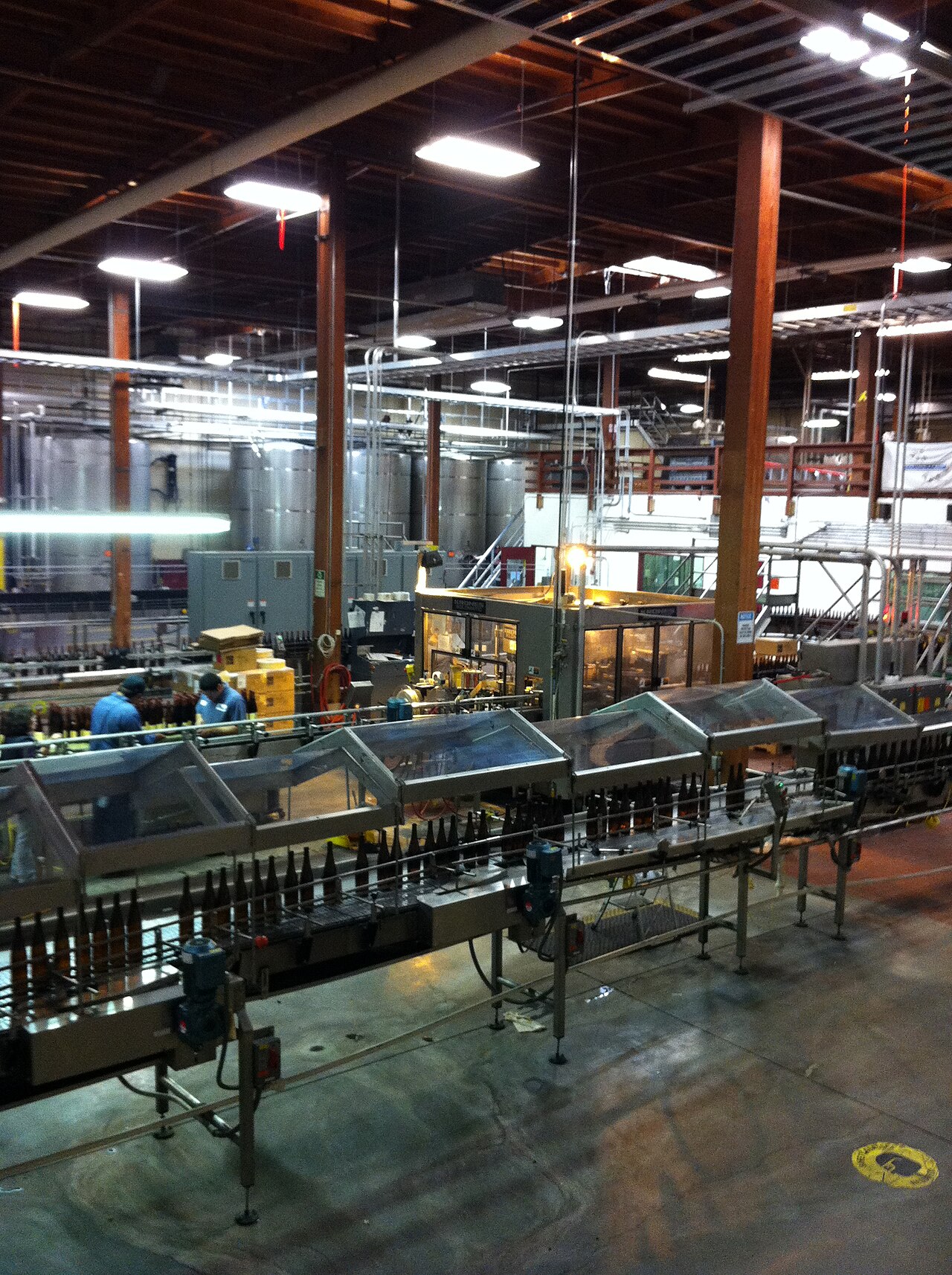
Liquid fillers divide into two architectures: inline machines, where containers stop at filling stations along a straight conveyor, and rotary machines, where containers travel on a carousel through continuously rotating filling valves. The choice drives output, footprint, changeover and price.
Inline filling
Containers index forward, stop under the filling nozzles, and are filled one batch at a time. It is the simpler architecture and the easiest to change over.
- Output: lower — suits mid-output lines, typically below a few thousand containers per hour.
- Footprint: long and straight; needs conveyor length rather than floor area.
- Changeover: fast and simple, because nozzles and guides are directly accessible.
- Best for: viscous products, frequent format changes and lower-budget lines.
Rotary filling
Containers ride a carousel and are filled continuously as the valves rotate. It is the workhorse for high-output beverage lines.
- Output: high — a Krones Modulfill VFS reaches up to 81,000 containers per hour; Fogg and Federal Mfg monoblocks serve mid-to-high output.
- Footprint: compact for the output, but more complex mechanically.
- Changeover: longer — change parts and valve setup scale with the number of stations.
- Best for: water, CSD, juice and dairy at high speed.
How to choose
Start from your sustained output, not the peak. If the line sits in the inline band or formats change often, inline is usually cheaper and simpler; above that band, rotary wins on speed and integration with rinsing and capping. Validate the shortlisted machine with your actual product and container, and time a real changeover before you buy.
Sources
Title: Inline vs. Rotary Filling Systems — Apex Filling Systems · Modulfill VFS — Krones
URL: https://blog.apexfilling.com/inline-vs.-rotary-filling-systems-which-is-right-for-your-operation
Apex places inline machines in the 10–120 CPM band and rotary machines in the 100–500+ CPM band; Krones documents the Modulfill VFS at up to 81,000 containers per hour.
Frequently asked questions
Is an inline filler always cheaper than a rotary filler?
For mid output and frequent format changes, inline is usually cheaper and simpler; above the inline band, a rotary’s speed and integration with rinsing and capping usually justify the higher capital. Confirm with a machine-specific quote rather than assuming.
At what output should I switch from inline to rotary?
Treat the inline band as roughly 10–120 containers per minute and rotary as 100–500+ cpm (published vendor ranges); the crossover depends on your sustained rate, container stability and changeover pattern, so validate on your product and time a real changeover.
Does a rotary filler handle viscous products?
Rotary fillers are optimised for free-flowing beverages; viscous or particulate products often suit piston or positive-displacement dosing, which is available in both inline and rotary configurations — match the dosing principle to the product, not the architecture.
Related guides
- Liquid Filling Machines: Top 10 Compared (2026) — Five liquid filling machines compared across fill accuracy, output, fo…
- Aseptic vs Hot Fill: Choosing the Right Liquid Filling Hygiene — How aseptic and hot-fill liquid filling differ for shelf-stable bevera…
- The 2026 Enterprise Guide to Liquid Filling Machine Selection — liquid filling machine selection is a sequence of eliminations —…
- Gravity vs. Piston vs. Overflow: How to Choose the Right Liquid Filling Principle — the filling principle is chosen by the product, not the machine brand.…
- CIP vs SIP: Clean-in-Place and Sterilize-in-Place Explained — CIP cleans and SIP sterilizes — they are not the same thing, and…
- Top 10 Liquid Filling Machine Manufacturers Global (2026 Edition) — An independent ranking of the top global liquid filling machine manufa…
- Top 10 China Liquid Filling Machine Manufacturers (2026) — An independent ranking of Chinese liquid filling and dosing machine bu…
Last verified: August 27, 2026.