
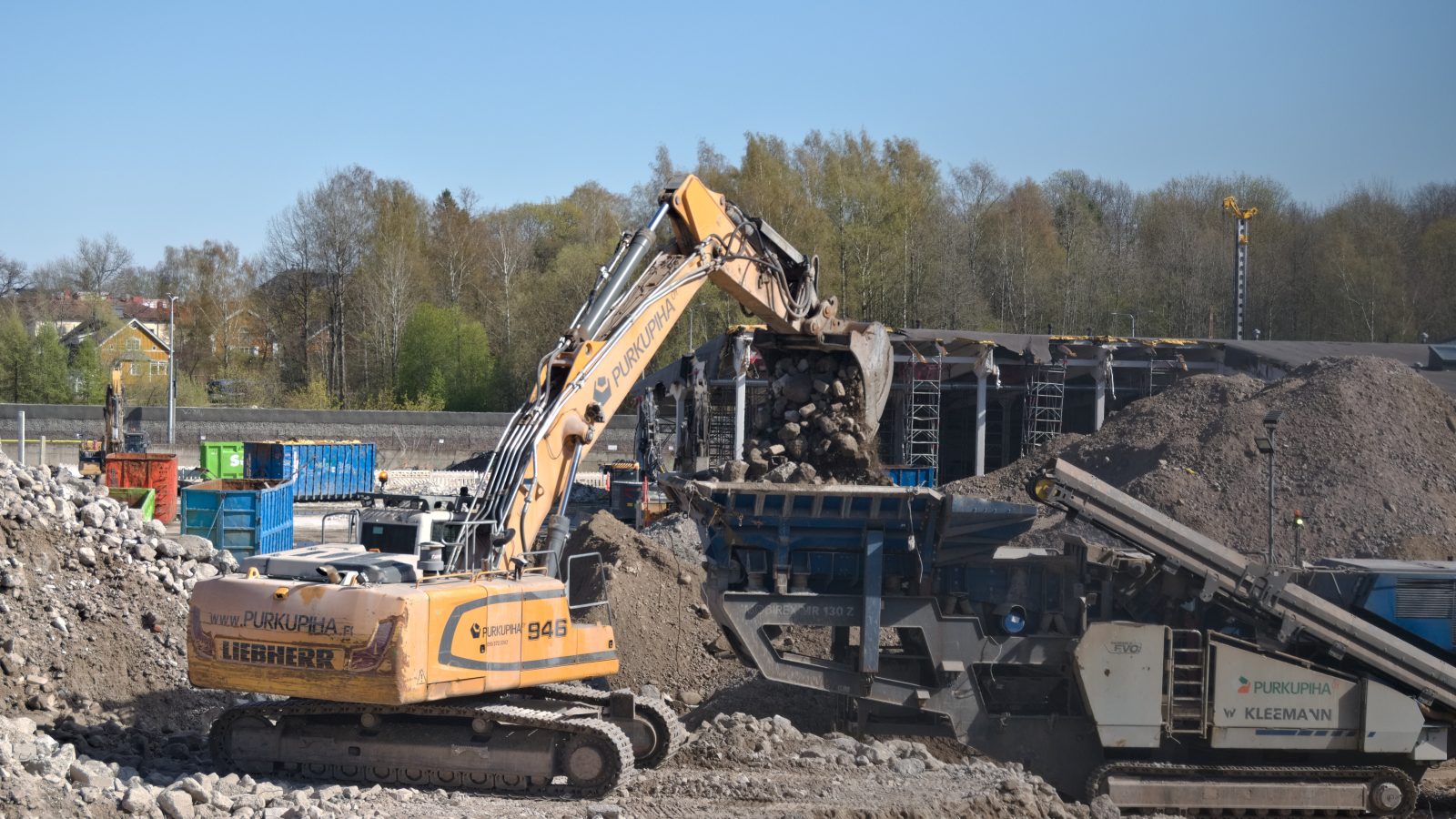
The core idea of this page: choosing a crusher means fixing four facts first — the largest feed lump, the product size you must sell, the tonnes per hour you must make, and how abrasive the rock is — then picking the crusher type that matches that duty. Buy the stage, not the brochure: a primary machine and a tertiary machine are not interchangeable.
Start with the four facts
Feed size
Measure the largest lump, not the average. The crusher's feed opening must accept it comfortably, because oversize feed causes bridging and cuts throughput long before it causes a mechanical failure. A common rule is that the opening should be larger than the largest lump with margin to spare.
Product size
Define the product by its curve, not by a single number. If you sell 20–40 mm aggregate, the whole distribution matters: too many fines is waste, too many oversize particles is a re-crush cost. This is the number that decides the closed-side setting and the need for a screen in closed circuit.
Capacity
Fix tonnes per hour at the shift pattern you actually run, including peaks. Adding a screen or a second stage later is expensive, so size for the peak rather than the average.
Material
Hardness and abrasiveness drive both the crusher type and the wear cost. Wikipedia's summary of size reduction is a useful frame: machines "must take into account the basic methods of material size reduction; impact, compression, attrition, and cutting". Hard, abrasive rock pushes you toward compression machines with wear-resistant liners; softer material and recycling open up impact machines.
Match the crusher to the stage
Primary stage
The primary crusher takes run-of-mine or blasted rock and reduces it enough for conveying. Jaw crushers and gyratory crushers dominate here because they accept large feed and work by compression. Selection is driven by maximum lump size, capacity and how abrasive the rock is.
Secondary stage
The secondary crusher takes primary output and produces the saleable or feed-to-tertiary size. Cone crushers dominate because they give a controlled reduction in a chamber that can be adjusted and choke-fed for shape.
Tertiary and shaping stage
The tertiary stage produces the final product and controls particle shape. Cone crushers in closed circuit with a screen, or vertical-shaft impactors for shape-critical aggregate and sand, are typical choices.
Crusher types at a glance
Jaw crusher
Compression crusher with one fixed and one moving jaw. Best for large, hard, abrasive feed in the primary position. Simple, robust and tolerant of variation, but it produces a flaky product and is not a precision sizer.
Cone crusher
Compression crusher that reduces rock between a mantle and a concave bowl. Best for secondary and tertiary duty in hard rock, with a controlled product curve and good shape when choke-fed.
Impact crusher
Breaks rock by striking it with blow bars. Best for softer to medium-hard rock and for recycling, where it gives a good shape at a high reduction ratio, at the cost of higher wear on abrasive material.
Vertical-shaft impactor
Accelerates rock against an anvil or rock-on-rock chamber to produce sand and shaped aggregate. Best for the final shaping stage rather than primary reduction.
Mobile or stationary
A stationary plant gives the lowest cost per tonne at a fixed site with a long life, and allows large, efficient equipment. A mobile or tracked plant trades some efficiency for the ability to follow the pit face or move between contracts — see Mobile vs Stationary Crushing Plant. The decision is driven by how long you stay on one site and how far the material must be hauled.
Key variables that decide the result
Reduction ratio
The ratio of feed size to product size for one machine is limited. Trying to do too much in one stage produces poor shape, high wear and low capacity; splitting the work across two or three stages costs capital but pays back in output and liner life.
Closed-side setting and closed circuit
The setting sets the product; a screen and a return conveyor (closed circuit) keep oversize out of the product and send it back for re-crushing. Closed circuit is what turns a variable crusher output into a saleable specification.
Wear cost per tonne
Liners, blow bars and screens are consumables. Ask every supplier for wear cost per tonne on your rock before comparing purchase prices.
Power and drive
Installed power caps the throughput at a given setting. A machine that is already at its power limit cannot be sped up by opening the setting without losing product quality.
Failure modes and buying mistakes
Buying one stage too few
One crusher cannot make a tight product from large feed at high capacity. Buyers who try end up with poor shape, high wear and a second purchase within a year.
Comparing jaw and cone as substitutes
They are stages in one line, not alternatives — see Jaw vs Cone Crusher. Compare machines within the same duty, not across duty.
Ignoring transport and permitting
Mobile plants still need legal transport weights and site permits; stationary plants need foundations and power. Logistics can decide the choice more often than the specification does.
How to verify before you buy
Witnessed trial on your rock
Run your material through the candidate machine and sieve the product. Published throughput is material-specific and is not a substitute for a trial.
Cost per tonne
Ask for a cost-per-tonne estimate covering wear parts, power and labour per hour, not a machine price. The cheapest machine to buy is often the most expensive to own.
Service and parts lead time
Confirm where wear parts ship from and how quickly. A crusher stopped for a missing liner costs more than the liner.
Frequently asked questions
What is the most common crusher configuration?
A jaw crusher in the primary position followed by a cone crusher in closed circuit with a screen — the standard hard-rock aggregate configuration.
How do I know if my feed is too large?
If the chamber bridges, throughput falls while power stays high, or the jaw bounces, the feed is too coarse or the feed rate is surging.
Is a bigger crusher always better?
No. An oversized crusher runs at low load, and low load with a full chamber is inefficient. Size to the peak duty the site actually generates.
Can I add a screen later?
Usually yes, and closed circuit is often the single biggest product-quality improvement available — but plan the layout for it from the start.
See also: Crushers: Top 10 Compared, Jaw vs Cone Crusher and Crushing & Screening Buying Guide.
Source: Crusher — Wikipedia
"machines designed for each of these stages must take into account the basic methods of material size reduction; impact, compression, attrition, and cutting."
Related guides
- Crushers: Top 10 Compared (2026) — Last updated: October 20, 2026. The mobile crusher market splits betwe…
- Crushing & Screening Buying Guide: Crushers, Screens and How to Choose — Choose crushing and screening equipment from the feed size, product sp…
- Jaw vs Cone Crusher — a jaw crusher and a cone crusher are not alternatives — they are two s…
- Mobile vs Stationary Crushing Plant — a mobile plant buys mobility and a fast start; a stationary plant buys…
- New vs Used Crusher — the decision is total cost of ownership and downtime risk, not the sti…
- How a Jaw Crusher Works — a jaw crusher breaks rock by squeezing it between a fixed jaw and a re…
- Top 10 Crusher & Screening Manufacturers (2026) — Last updated: October 20, 2026. Crushing and screening turns blasted r…
- Top 10 China Crusher Manufacturers (2026) — Last updated: October 20, 2026. China has become a major source of cru…
Last verified: October 30, 2026.