
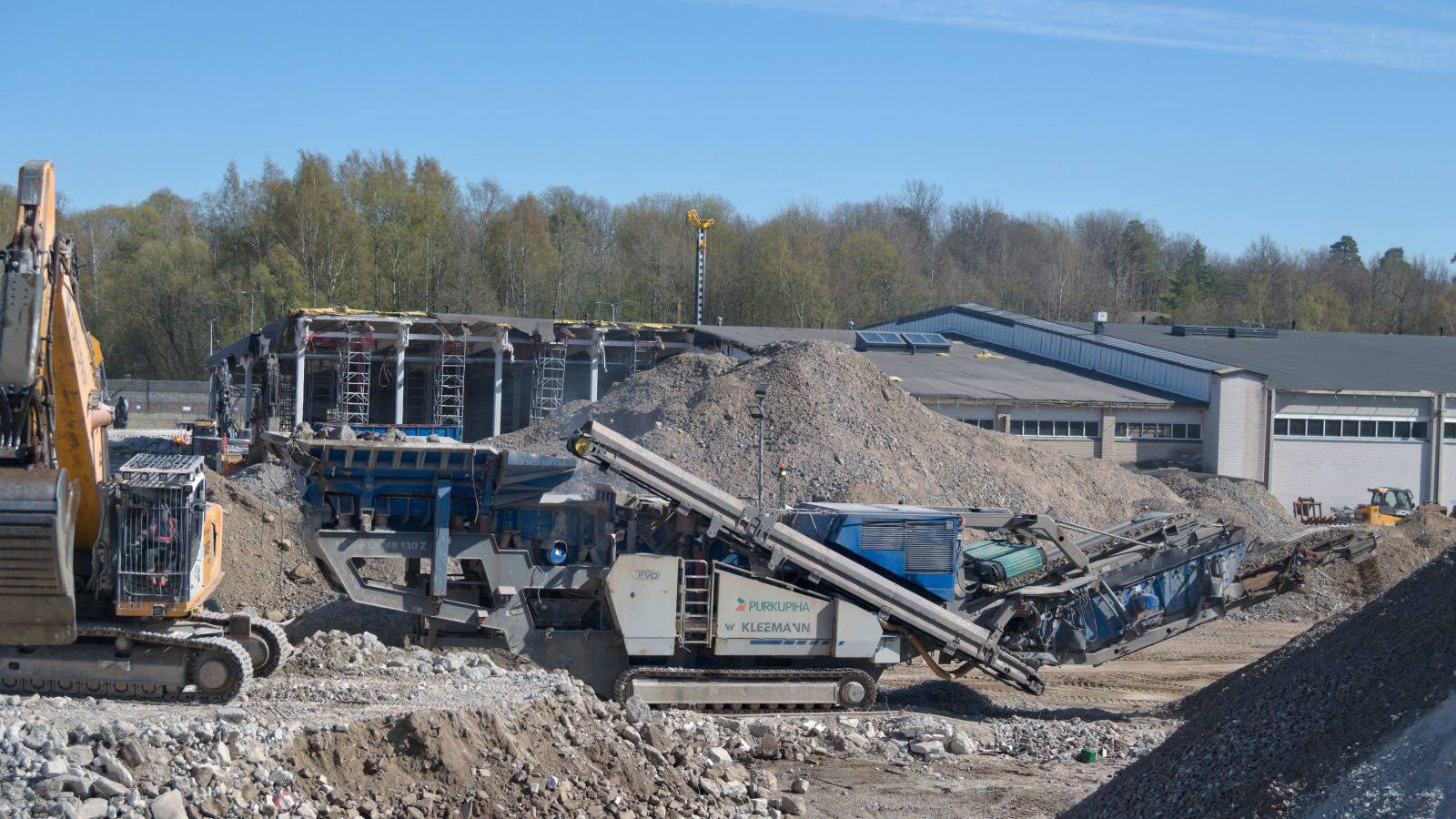
The core idea of this page: a jaw crusher breaks rock by squeezing it between a fixed jaw and a reciprocating jaw, so its output is set by the gap at the bottom of the chamber (the closed-side setting) and its capacity is set by the chamber volume and the stroke. Read that sentence as a checklist: if the product is too coarse, change the CSS; if the machine is too slow, the chamber or the stroke is the limit, not the power.
What a jaw crusher does
A jaw crusher is a primary-stage machine. It accepts large, hard, abrasive feed straight from blasting or demolition and reduces it to a size a secondary crusher can handle. It is not a precision sizer: the product is a distribution of sizes, and the job of the operator is to control that distribution with the setting, the stroke and the feed arrangement. Wikipedia describes the mechanism plainly: "A jaw crusher uses compressive force for breaking of particle. This mechanical pressure is achieved by the two jaws of the crusher of which one is fixed while the other reciprocates."
The crushing chamber and the two jaws
The fixed jaw
The fixed jaw is a heavy, ribbed plate bolted to the frame. Its ribs interlock with the moving jaw's ribs so that rock cannot simply slide through the chamber; it has to be gripped and squeezed. Liner profile matters more than most buyers expect — a coarse, deep-toothed plate grips blocky feed, while a finer profile produces a tighter product at the cost of wear rate.
The moving jaw, eccentric shaft and drive
The moving jaw hangs on an eccentric shaft. As the shaft turns, the jaw swings toward and away from the fixed jaw once per revolution. The eccentric throw sets the stroke: a longer stroke gives more compression per cycle and better grip on slabby rock, while a shorter stroke suits high-capacity, finer settings. The drive is a motor through belts and a flywheel; the flywheel stores energy between strokes so the motor sees a smoother load.
The toggle plate
The toggle plate closes the kinematic chain between the moving jaw and the frame. It is deliberately the weakest structural element: if an unbreakable object enters the chamber, the toggle bends or breaks instead of destroying the frame. It also sets, together with the wedge or shim arrangement, the closed-side setting at the discharge end.
The crushing cycle, step by step
1. Intake
Feed enters from the top through the feed opening. The opening must be larger than the largest lump, and the feed should be graded so fines do not pack the chamber before the coarse rock is gripped.
2. Gripping and compression
As the moving jaw closes, rock is trapped and loaded in compression. The nip angle — the angle between the two jaw faces — must be shallow enough that the rock is gripped rather than pushed upward out of the chamber. This is why a badly over-filled chamber stops crushing and starts bouncing.
3. Discharge and the closed-side setting
When the jaw opens, material smaller than the gap at the bottom falls through. That gap is the closed-side setting (CSS); it is the single most important adjustment on the machine and the number to quote when comparing machines or specifying a product.
Key variables and how they trade off
Feed size versus opening
Oversize feed is the most common cause of poor throughput: if the largest lump approaches the opening width, bridging and reduced capacity follow. Check the feed curve against the opening, not just the nominal tonnage.
Throughput versus setting
Opening the CSS raises throughput and coarsens the product; closing it lowers throughput and shifts the product curve finer. Neither change adds power — the machine simply does more or less work per hour with the same drive.
Liner wear and chamber shape
Wear changes the chamber profile, and a worn chamber produces a coarser product at the same nominal setting. Liner life is therefore a product-quality variable, not only a maintenance cost.
Power draw and motor loading
Power draw is the honest indicator of whether the machine is working or merely running. A jaw crusher running at low power with a full chamber is usually choked or under-fed in a way that limits throughput.
Failure modes to watch
Bridging and choking
Slabby or elongated feed bridges across the chamber mouth and stops the intake. The symptoms are a rising power draw with falling output and rock sitting above the jaws.
Liner and toggle damage
Uneven liner wear points to a feed that is segregated to one side. A broken toggle usually means tramp metal entered the chamber — the repair is the symptom, not the cause.
Bearing overheating
Heat at the eccentric bearings indicates lubrication failure, misalignment or an over-tight belt. Stop and investigate rather than running to failure, because a seized eccentric is a workshop job.
How to verify performance
Product curve test
Sieve a sample of the discharge at the setting you intend to run and compare it with the product you need. This is the only honest way to compare two machines with different chamber shapes.
Throughput and power at the same setting
Measure tonnes per hour and motor power together, at a fixed CSS, on your material. Published throughput figures are material-specific and rarely comparable across brands.
Liner life and cost per tonne
Ask for the wear-liner cost per tonne on your rock. Two machines with the same purchase price can differ by a factor in wear cost, which dominates the lifetime economics of a primary crusher.
Frequently asked questions
What is a closed-side setting?
The CSS is the gap between the jaws at the discharge end when the moving jaw is fully closed. It sets the coarsest particles that can leave the chamber and therefore the product curve.
Can a jaw crusher make sand?
Not efficiently. Jaw crushers are primary reduction machines; producing sand requires a cone or a vertical-shaft impactor in a later stage.
Why does my crusher stop when the chamber is full?
The nip angle cannot grip feed that is already packed, so the jaw bounces instead of crushing. Feed more evenly and avoid surging.
How often do jaw liners need changing?
Liner life depends on rock abrasiveness and feed grading, so quote it as a cost per tonne from your supplier rather than a calendar interval.
See also: Top 10 Crusher Manufacturers, Jaw vs Cone Crusher and How to Choose a Crusher.
Source: Crusher — Wikipedia
"A jaw crusher uses compressive force for breaking of particle. This mechanical pressure is achieved by the two jaws of the crusher of which one is fixed while the other reciprocates."
Related guides
- Crushers: Top 10 Compared (2026) — Last updated: October 20, 2026. The mobile crusher market splits betwe…
- Crushing & Screening Buying Guide: Crushers, Screens and How to Choose — Choose crushing and screening equipment from the feed size, product sp…
- Jaw vs Cone Crusher — a jaw crusher and a cone crusher are not alternatives — they are two s…
- Mobile vs Stationary Crushing Plant — a mobile plant buys mobility and a fast start; a stationary plant buys…
- New vs Used Crusher — the decision is total cost of ownership and downtime risk, not the sti…
- How to Choose a Crusher — choosing a crusher means fixing four facts first — the largest feed lu…
- Top 10 Crusher & Screening Manufacturers (2026) — Last updated: October 20, 2026. Crushing and screening turns blasted r…
- Top 10 China Crusher Manufacturers (2026) — Last updated: October 20, 2026. China has become a major source of cru…
Last verified: October 30, 2026.