
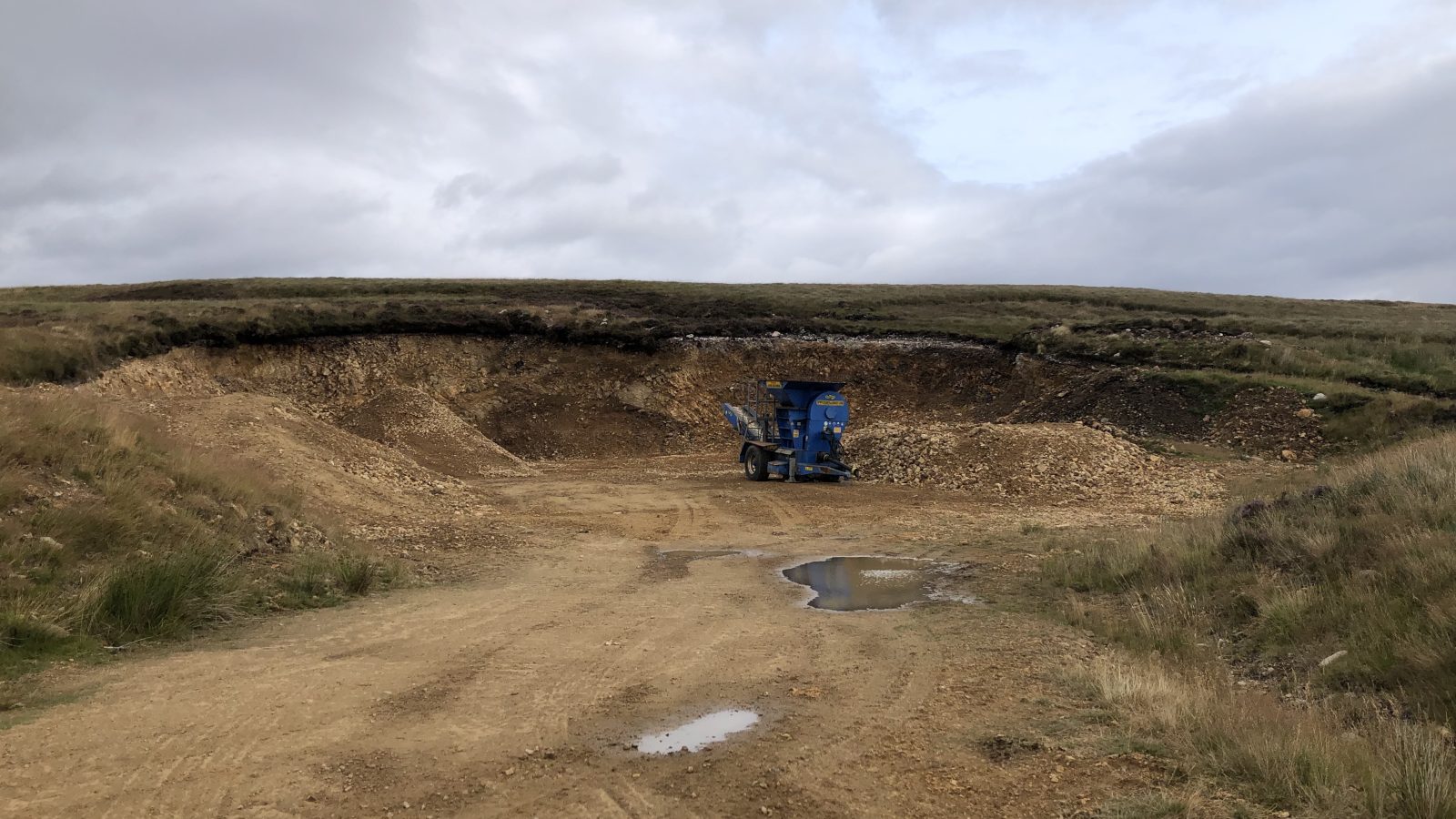
The core idea of this page: a mobile plant buys mobility and a fast start; a stationary plant buys the lowest cost per tonne at a fixed site. The decision is how long you stay on one site and how far the material has to be hauled — not which machine looks more modern.
Mobile crushing plants
A tracked or wheeled plant arrives on a trailer, sets up in hours and follows the pit face or the demolition site. That mobility removes haulage cost between the face and a fixed plant, and it lets a contractor serve several sites with one machine. The trade-offs are a lower output ceiling than a large stationary installation, transport weights and permits, and a higher cost per tonne at very high volumes.
Stationary crushing plants
A stationary plant is designed for a site with a long life and a stable feed. It can use larger crushers, conveyors and stockpiles, and it achieves the lowest cost per tonne at high volume. The trade-offs are civil works, power supply, permitting and the fact that all material must be hauled to it.
Mobile vs stationary at a glance
| Dimension | Mobile / tracked plant | Stationary plant |
|---|---|---|
| Setup time | Hours | Weeks to months |
| Mobility | Follows the face or contract | Fixed |
| Output ceiling | Lower | Higher |
| Cost per tonne at high volume | Higher | Lowest |
| Civil works / power | Minimal | Significant |
| Haulage | Reduced — plant moves to material | Material moves to plant |
| Best for | Contract crushing, pits that move, demolition | Long-life quarry or mine |
Decision rule
- Site life under a few years, or the face moves → mobile.
- Long-life reserve, high volume, stable feed → stationary.
- Both over a project life → mobile for development and stationary for the steady state.
Cost and verification
Compare the two on cost per tonne delivered to the stockpile, including haulage, setup, power, labour and relocation. Verify by checking legal transport weights and permits for the mobile option, and by confirming the stationary layout can actually accept your feed and product transport. A short trial campaign on a mobile unit is the cheapest way to validate the flowsheet before committing to civil works.
Frequently asked questions
Is a mobile plant always more expensive per tonne?
At high volume, usually yes. At low volume or with long hauls, the saved haulage and setup can make it cheaper.
Can a mobile plant be used as a permanent installation?
It can, but you pay a mobility premium for capability you no longer use. A stationary plant is the better long-term choice.
What permits does a mobile plant need?
Transport permits for road movement plus site permits for operation; requirements vary by jurisdiction, so confirm before purchase.
Source: Mobile Crusher or Stationary Plant? — CSP Mühendislik
"On site, light foundations or steel legs are used instead of heavy reinforced concrete, Modules can be rearranged in different combinations, When the project ends, the plant can be dismantled and moved to another site."
Related guides
- Crushers: Top 10 Compared (2026) — Last updated: October 20, 2026. The mobile crusher market splits betwe…
- Crushing & Screening Buying Guide: Crushers, Screens and How to Choose — Choose crushing and screening equipment from the feed size, product sp…
- Jaw vs Cone Crusher — a jaw crusher and a cone crusher are not alternatives — they are two s…
- New vs Used Crusher — the decision is total cost of ownership and downtime risk, not the sti…
- How a Jaw Crusher Works — a jaw crusher breaks rock by squeezing it between a fixed jaw and a re…
- How to Choose a Crusher — choosing a crusher means fixing four facts first — the largest feed lu…
- Top 10 Crusher & Screening Manufacturers (2026) — Last updated: October 20, 2026. Crushing and screening turns blasted r…
- Top 10 China Crusher Manufacturers (2026) — Last updated: October 20, 2026. China has become a major source of cru…
Last verified: October 30, 2026.