
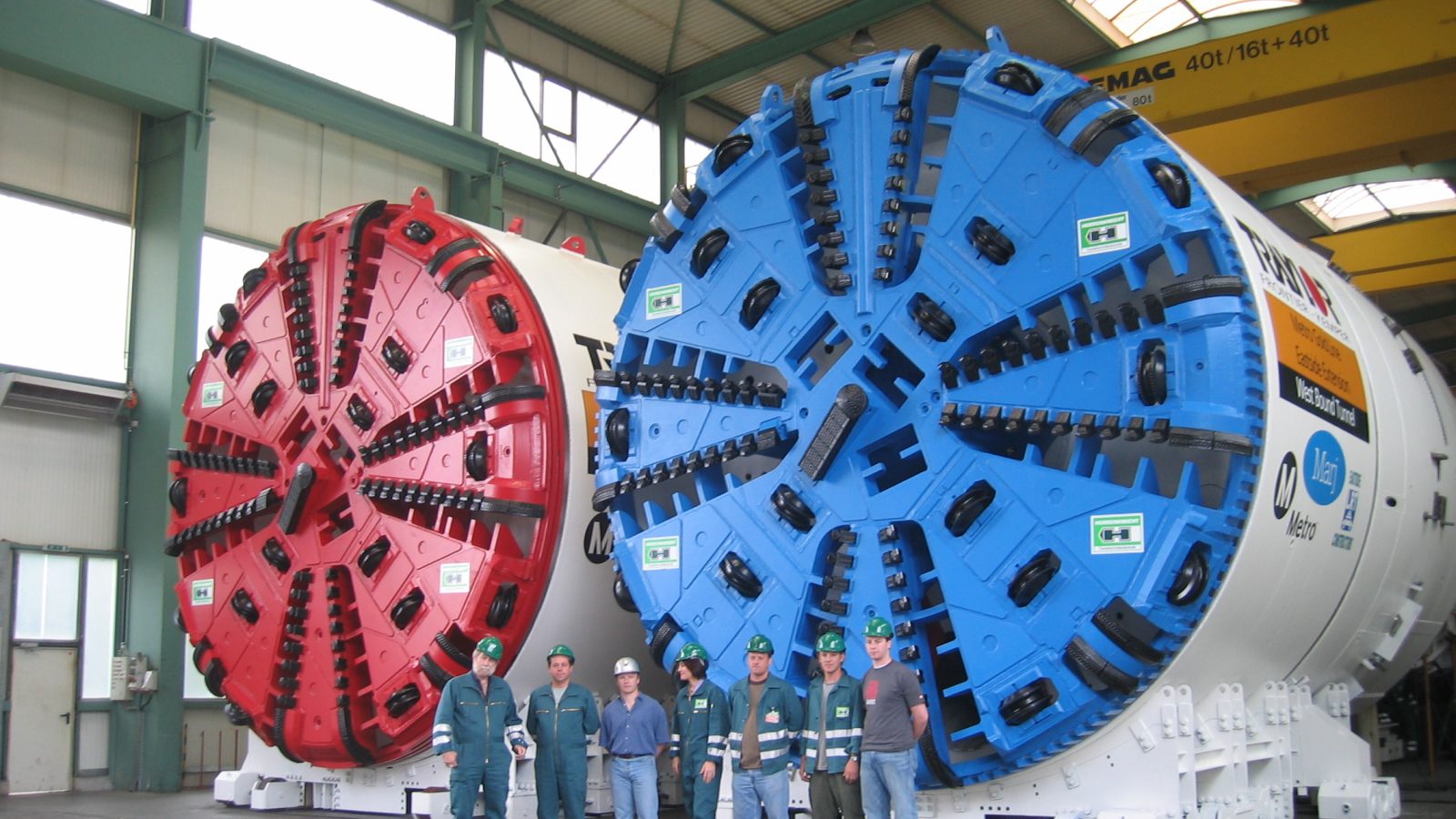
The core idea of this page: a tunnel boring machine bores a full-face tunnel by rotating a cutterhead against the rock face, bracing against the tunnel to thrust forward, hauling the broken rock out the back, and installing the lining as it advances. Understanding that thrust-and-grip cycle is what lets you diagnose slow advance, cutter wear and a stalled machine.
Last updated: October 20, 2026. A TBM is not a single machine but a moving factory: cutterhead, thrust system, muck conveyor, lining erector and a long backup train of support systems. This entry explains each stage so buyers and operators can read a TBM specification and the risk behind it.
How a TBM works, stage by stage
1. The cutterhead and disc cutters
The cutterhead is the rotating face that presses against the tunnel face. In hard rock, disc cutters — hardened steel rings mounted around the cutterhead — roll over the rock and crush a thin strip under each cutter; the cracks propagate and chip the rock away. In soft ground, the cutterhead uses openings, ripper teeth and a pressurized chamber instead of disc cutters. The cutterhead is the most expensive wear surface on the machine.
2. Thrust and grip
In hard rock, gripper shoes brace against the tunnel walls while a bank of thrust cylinders pushes the cutterhead forward. The grip-and-thrust cycle means the machine pushes in bursts rather than continuously. In soft ground, there is no rock wall to grip — the machine pushes off the installed lining segments using the thrust cylinders, so thrust capacity and the lining's ability to take the load both limit the advance.
3. Muck removal
Broken rock falls through openings in the cutterhead into the muck chamber and onto a screw conveyor or belt conveyor that carries it to the back of the machine and out of the tunnel. Muck removal is a common bottleneck — if the conveyor cannot clear the rock as fast as the cutterhead produces it, the machine stalls regardless of cutterhead torque.
4. Segment lining installation
Behind the cutterhead, an erector places precast concrete segments in a ring against the excavated walls. The segments form the permanent tunnel lining and are also what the machine pushes against in soft ground. Lining quality (segment tolerance, gasket sealing) is what makes the tunnel watertight.
5. Steering and guidance
A TBM is steered by articulating the shield and adjusting the thrust cylinders so the machine follows the designed alignment. A laser guidance system measures the machine's position and attitude continuously. Misalignment builds up over long drives, so steering correction is a continuous task, not a one-time setup.
6. The backup system
Behind the machine runs a backup train carrying the hydraulic power packs, electrical switchgear, grout plant, ventilation, water and segment supply. The backup is where most of the machine's utility systems live, and it must keep pace with the advance without choking the tunnel.
Types of tunnel boring machines
The right machine follows the ground, not the tunnel diameter. The main families are:
Hard-rock open gripper TBM
An open machine with grippers that brace against the rock walls and thrust the cutterhead forward. It is the fastest and cheapest per metre in stable, hard rock, but it cannot handle water-bearing or squeezing ground and installs its support behind the machine.
Double-shield TBM
A hybrid that can both grip the rock and push off the lining, so it can install segments while advancing — suited to rock with some instability, where an open machine would stall waiting for support.
Earth pressure balance (EPB) shield
A closed-face machine that conditions the excavated soil into a paste and uses it to balance the face pressure. It suits clays, silts and mixed soft ground under urban areas, where surface settlement must be controlled.
Slurry shield (Mixshield)
A closed-face machine that uses pressurized bentonite slurry to support the face and transport the muck as a slurry. It suits water-bearing sands and gravels under high groundwater pressure, where an EPB cannot hold the face.
Key variables and failure modes
- Cutter wear. Abrasive rock wears disc cutters, which are the largest consumable cost in hard rock. Cutter inspection and replacement must be planned into the schedule.
- Mixed or squeezing ground. A face that changes from rock to soil, or ground that squeezes onto the shield, can stall the machine or trap it — the reason ground investigation is done before a TBM is chosen.
- Water ingress. High groundwater pressure requires a pressurized (EPB or slurry) machine; an open machine in water-bearing ground can flood.
- Torque and thrust balance. If thrust is too high relative to the ground, the machine stalls or the lining is overstressed; if too low, the advance rate collapses.
How to verify a TBM specification
- Ground investigation. Confirm the machine type matches the geological and hydrogeological report — rock, mixed or soft ground, and water pressure.
- Advance rate. Check the realistic advance per shift against the penetration rate, cutterhead RPM and the muck and segment logistics.
- Cutter life. Ask for cutter-consumption estimates per cubic metre on your rock abrasivity, not a generic number.
- Launch and retrieval. Confirm the shaft, launch cradle and retrieval plan are included in the project, not just the machine.
Frequently asked questions
What is the difference between an EPB and a slurry TBM?
An EPB (earth pressure balance) machine conditions the excavated soil into a paste to balance face pressure; a slurry machine uses pressurized bentonite slurry. EPB suits clays and mixed ground; slurry suits water-bearing sands and gravels under pressure.
How fast does a TBM advance?
Advance depends on ground and logistics, but typical metro TBMs advance roughly 10–20 metres per day in good ground. The limiting factor is often muck and segment logistics, not the cutterhead.
Can a TBM be reused for another tunnel?
Yes — machines are routinely refurbished and re-bored for new diameters and projects, but the cutterhead and shield may need modification for the new ground and alignment.
See also: Drill & Blast vs TBM and Top 10 Drill Rig & TBM Manufacturers.
Source: Tunnel boring machine — Wikipedia
"A tunnel boring machine (TBM), also known as a "mole", is a machine used to excavate tunnels. TBMs are an alternative to drilling and blasting methods and "hand mining", allowing more rapid excavation through hard rock, wet or dry soil, or sand."
Related guides
- Drill Rigs & TBMs: Top 10 Compared (2026) — Last updated: October 20, 2026. Drilling and tunneling equipment spans…
- Drilling & Tunneling Buying Guide: Rigs, Jumbos & TBMs — drilling and tunneling equipment is specified from three facts —…
- Drill and Blast vs TBM: Choosing a Tunnelling Method — drill-and-blast and TBM are two ways to drive a tunnel. Drill-and-blas…
- Top-Hammer vs DTH Drilling — top-hammer drilling keeps the hammer on the rig and strikes the rod fr…
- New vs Used Drill Rig: Which Should You Buy? — new drill rigs give warranty, current safety and automation, and a kno…
- How to Choose a Drill Rig — choosing a drill rig is choosing the machine that reaches your penetra…
- Top 10 Drill Rig & TBM Manufacturers (2026) — Last updated: October 20, 2026. Drilling and tunneling equipment bores…
- Top 10 China Drill Rig & TBM Manufacturers (2026) — Last updated: October 20, 2026. China has become the world's largest b…
Last verified: October 20, 2026.