
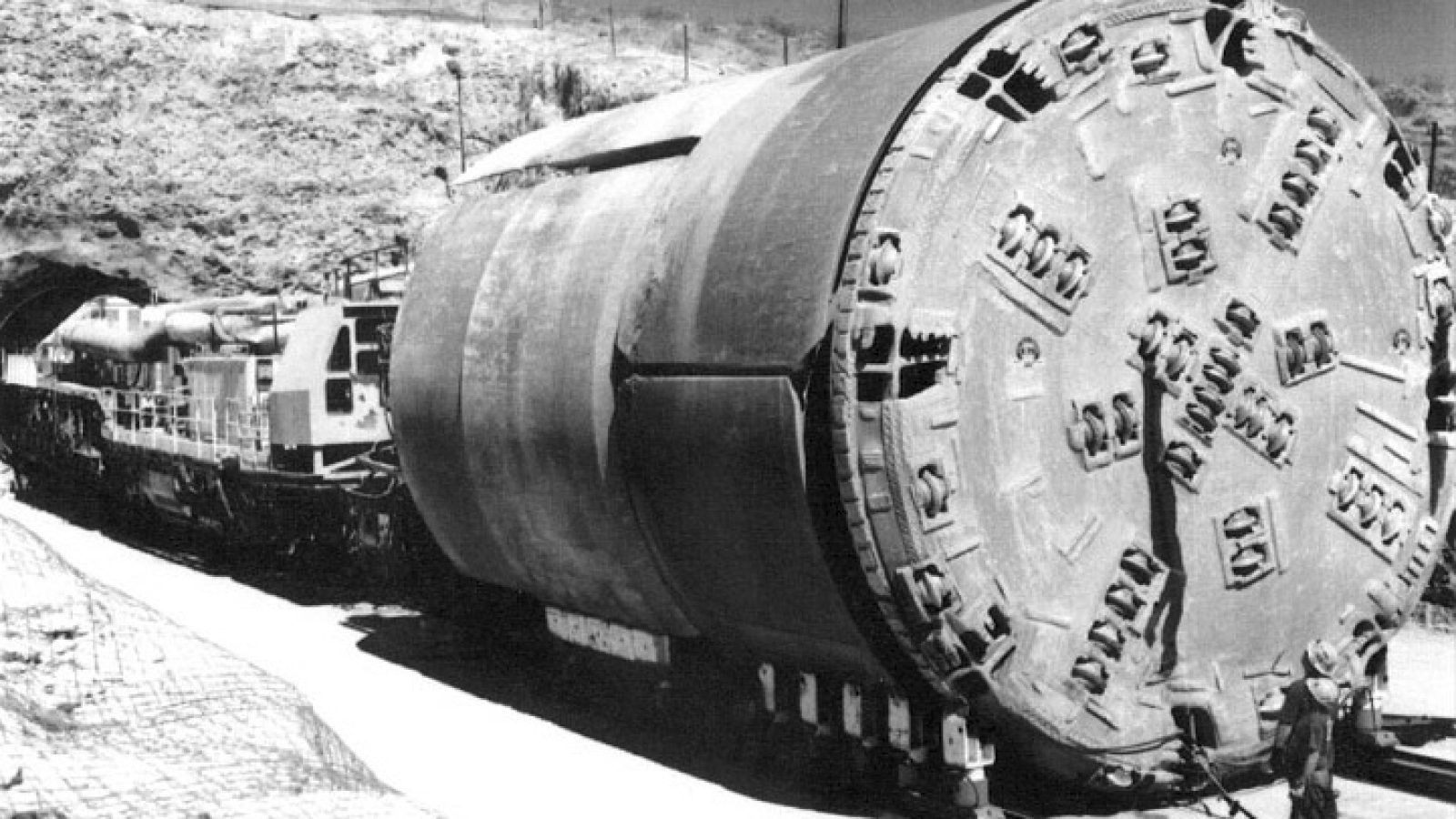
The core idea of this page: drill-and-blast and TBM are two ways to drive a tunnel. Drill-and-blast is cyclical, flexible and cheap to start but slower per metre; a TBM bores continuously and is fast on long, straight, uniform drives but carries a high fixed capital cost and little tolerance for ground change. Choose by tunnel length, geology and schedule.
Last updated: October 20, 2026. The drill-and-blast versus TBM decision is made before detailed design, because the two methods produce different tunnel shapes, support requirements and schedules.
Drill and blast
A drill jumbo drills a pattern of blast holes in the face, the round is charged and fired, then the muck is loaded and hauled out, and the roof and walls are supported with bolts, mesh or shotcrete. The cycle repeats — drill, blast, muck, support — so progress is stepwise rather than continuous. It handles variable and hard ground well and is cheap to mobilise, but blasting brings vibration and ventilation constraints and slower advance.
TBM
A tunnel boring machine bores the full face continuously, installs precast segment lining as it advances, and hauls muck out on a conveyor. It is the fastest method on long, straight, uniform drives and produces a smooth, watertight lining, but the machine is expensive to buy and launch, and a change in ground (a fault, water, squeezing rock) can stall or trap it.
Side-by-side comparison
| Dimension | Drill & blast | TBM |
|---|---|---|
| Advance rate | Cyclical, slower per metre | Continuous, faster per metre |
| Capital cost | Low to mobilise | High (machine + launch) |
| Ground flexibility | High — adapts to change | Low — stalls on change |
| Best length | Short, variable drives | Long, straight, uniform drives |
| Lining | Bolts, mesh, shotcrete | Precast segments |
| Vibration | Blasting vibration | Minimal |
Decision rule
- Short, variable, hard-rock or urban-sensitive tunnels → drill-and-blast.
- Long, straight, uniform drives with high daily advance needs → TBM.
How to verify the choice
Run the comparison on a cost-per-metre and schedule basis for your specific tunnel: ground investigation defines the TBM risk; the tunnel length defines whether the TBM capital cost amortises. For short drives the TBM launch cost dominates; for long drives the TBM's higher advance wins.
Frequently asked questions
Which is cheaper?
Drill-and-blast is cheaper per metre for short tunnels; a TBM spreads its high fixed cost over many metres and wins on long drives.
Can they be combined?
Yes — some projects use a TBM for the main drive and drill-and-blast for shafts, cross-passages or short spur tunnels.
See also: How a Tunnel Boring Machine Works and Top 10 Drill Rig & TBM Manufacturers.
Source: Tunnel boring machine — Wikipedia
"A tunnel boring machine (TBM), also known as a "mole", is a machine used to excavate tunnels. TBMs are an alternative to drilling and blasting methods and "hand mining", allowing more rapid excavation through hard rock, wet or dry soil, or sand."
Related guides
- Drill Rigs & TBMs: Top 10 Compared (2026) — Last updated: October 20, 2026. Drilling and tunneling equipment spans…
- Drilling & Tunneling Buying Guide: Rigs, Jumbos & TBMs — drilling and tunneling equipment is specified from three facts —…
- Top-Hammer vs DTH Drilling — top-hammer drilling keeps the hammer on the rig and strikes the rod fr…
- New vs Used Drill Rig: Which Should You Buy? — new drill rigs give warranty, current safety and automation, and a kno…
- How a Tunnel Boring Machine Works — a tunnel boring machine bores a full-face tunnel by rotating a cutterh…
- How to Choose a Drill Rig — choosing a drill rig is choosing the machine that reaches your penetra…
- Top 10 Drill Rig & TBM Manufacturers (2026) — Last updated: October 20, 2026. Drilling and tunneling equipment bores…
- Top 10 China Drill Rig & TBM Manufacturers (2026) — Last updated: October 20, 2026. China has become the world's largest b…
Last verified: October 20, 2026.