
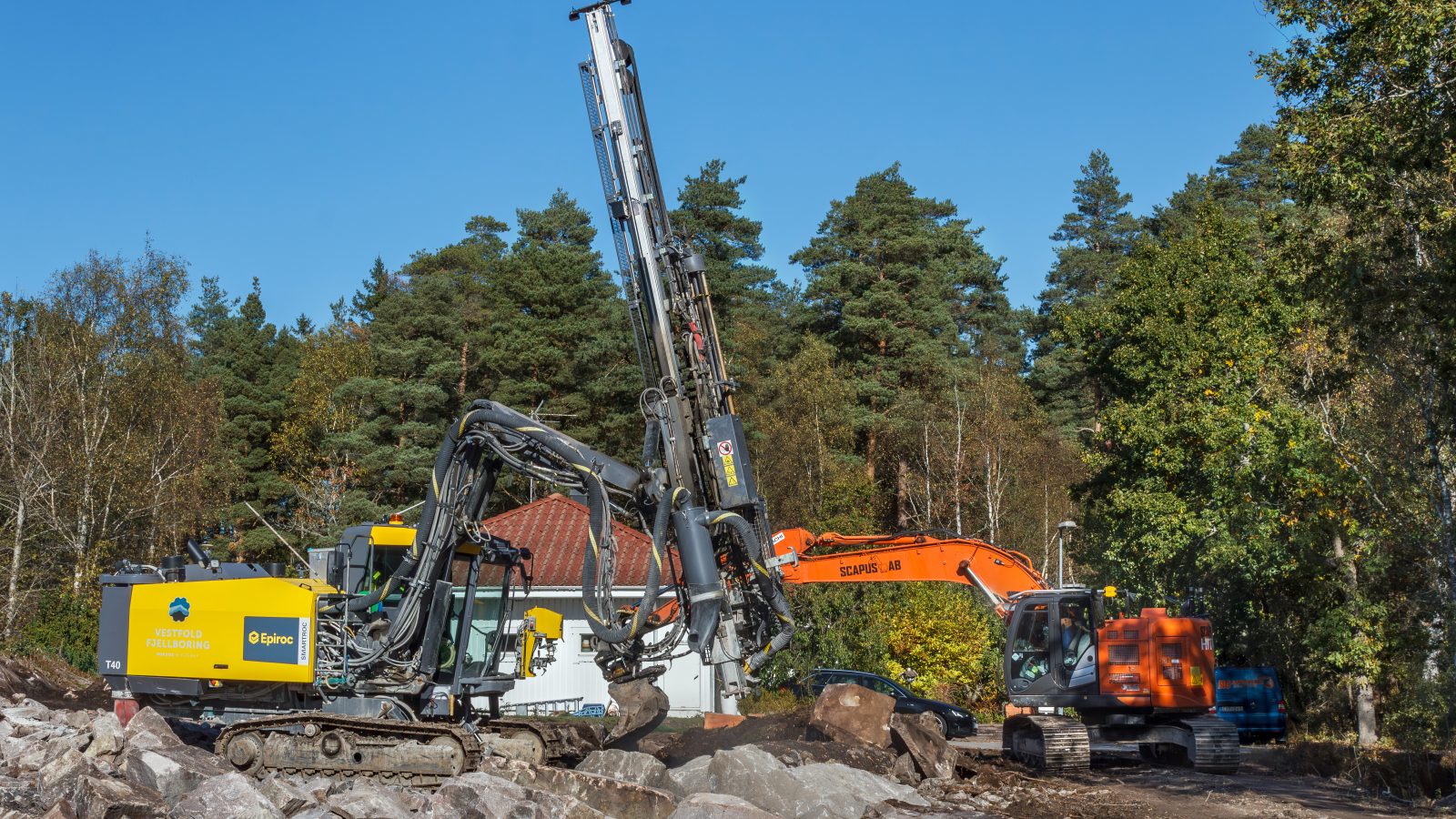
The core idea of this page: top-hammer drilling keeps the hammer on the rig and strikes the rod from above; DTH puts the hammer down the hole behind the bit. Top-hammer is fast in small-to-medium holes in hard rock; DTH keeps energy at the face for straighter, deeper, larger holes. The hole size and depth decide the method.
Last updated: October 20, 2026. The choice between top-hammer and DTH is the single biggest drilling-method decision, because it sets the drill string, the power source and the rig class.
Top-hammer drilling
The hydraulic or pneumatic hammer sits on the rig and strikes the top of the drill string, sending a stress wave down the rods to the bit. Penetration is fast in small-to-medium holes because the energy is delivered from close to the surface, but the shock wave attenuates as the string lengthens, so efficiency and hole straightness fall off with depth.
Down-the-hole (DTH) drilling
The hammer rides down the hole directly behind the bit, so the impact energy is applied at the face regardless of depth. This keeps penetration and straightness in deep, large-diameter holes, at the cost of slower penetration in small diameters and a larger compressor requirement.
Side-by-side comparison
| Dimension | Top-hammer | DTH |
|---|---|---|
| Best hole size | Small-to-medium holes | Large holes |
| Best depth | Shallow-to-medium | Deep |
| Penetration | Fast in small holes | Slower in small, holds up in large |
| Straightness | Fades with depth | Straighter in deep holes |
| Power | Hydraulic | High-pressure air |
Decision rule
- Small-to-medium blast holes in hard rock → top-hammer.
- Large, deep holes or water-well and foundation drilling → DTH.
How to verify the choice
Confirm the penetration rate and hole straightness on your rock and at your target depth. The crossover where DTH wins is a moderate-to-large hole diameter and deeper holes — test both if the hole is near that boundary, and measure the cost per metre including bit and rod wear.
Frequently asked questions
When does DTH win?
Beyond that diameter and in deeper holes, DTH keeps penetration and straightness where top-hammer fades.
Does DTH need a bigger compressor?
Yes — DTH drives the hammer with high-pressure air, so the compressor size and air consumption are higher than a top-hammer rig of the same hole size.
See also: How to Choose a Drill Rig and Drill Rigs & TBMs: Top 10 Compared.
Source: Drilling rig — Wikipedia
"A drilling rig is an integrated system that drills wells, such as oil or water wells, or holes for piling and other construction purposes, into the earth's subsurface."
Related guides
- Drill Rigs & TBMs: Top 10 Compared (2026) — Last updated: October 20, 2026. Drilling and tunneling equipment spans…
- Drilling & Tunneling Buying Guide: Rigs, Jumbos & TBMs — drilling and tunneling equipment is specified from three facts —…
- Drill and Blast vs TBM: Choosing a Tunnelling Method — drill-and-blast and TBM are two ways to drive a tunnel. Drill-and-blas…
- New vs Used Drill Rig: Which Should You Buy? — new drill rigs give warranty, current safety and automation, and a kno…
- How a Tunnel Boring Machine Works — a tunnel boring machine bores a full-face tunnel by rotating a cutterh…
- How to Choose a Drill Rig — choosing a drill rig is choosing the machine that reaches your penetra…
- Top 10 Drill Rig & TBM Manufacturers (2026) — Last updated: October 20, 2026. Drilling and tunneling equipment bores…
- Top 10 China Drill Rig & TBM Manufacturers (2026) — Last updated: October 20, 2026. China has become the world's largest b…
Last verified: October 20, 2026.