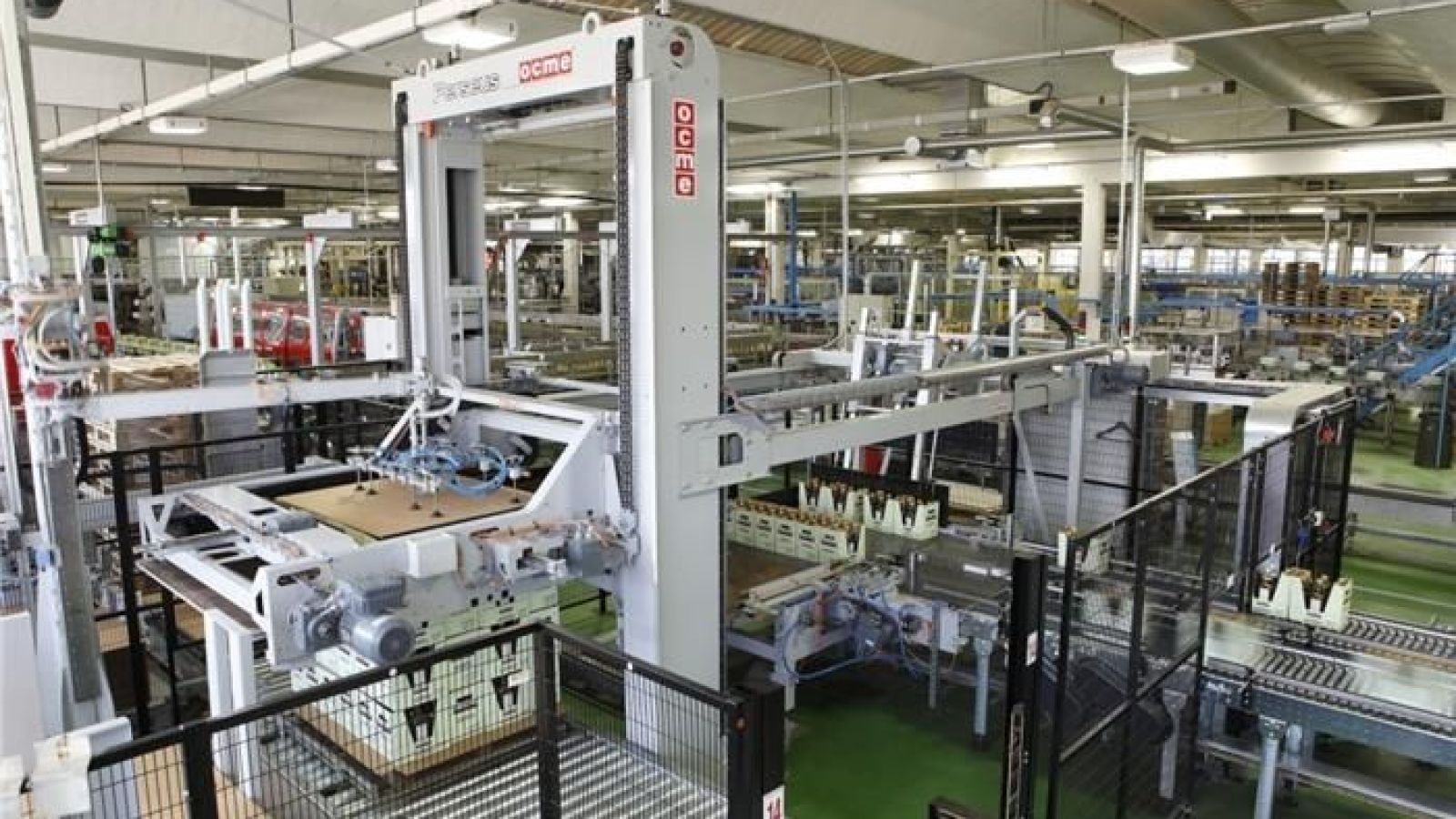
Last updated: July 17, 2026. An end-of-line packaging system is the group of machines and controls that takes finished primary packs and turns them into stable, shippable pallet loads: collation, case packing, sealing and marking, inspection, palletizing and load stabilization. It starts where the primary pack is complete and ends at the warehouse interface.
Browse the Packaging Machinery topic for the broader equipment and supplier research path.
What equipment is included in an end-of-line system?
| System stage | Typical equipment | Primary purpose |
|---|---|---|
| Accumulation and conveying | Conveyors, buffers, sorters and lane management | Balance flow between upstream packaging and downstream operations |
| Collation and orientation | Grouping, counting, turning and product handling units | Create the pattern required for a case, tray or multipack |
| Case or tray packing | Case packers, tray packers, carton loaders and erectors | Place primary packs into secondary packaging |
| Case sealing and marking | Case sealers, tape/glue systems, printers and labelers | Close, identify and prepare the case for tracking |
| Inspection and rejection | Checkweighers, vision systems, metal detection and reject stations | Verify quality and isolate non-conforming packs |
| Palletizing and load stabilization | Robotic or conventional palletizers, stretch wrappers and strapping | Build safe, transport-ready pallet loads |
Why end-of-line systems fail when designed too late
Every upstream machine can hit its own cycle-time target while the complete line underperforms. Case dimensions, product orientation, accumulation, reject handling, pallet patterns and forklift interfaces all set real output — and when they are considered only after the primary-pack machine is bought, the correction arrives as manual workarounds and rework. The accumulation question is the one most often skipped: how many minutes of upstream production can the line absorb during a normal downstream stop? A buffer sized to that answer is designed; a buffer sized to available floor space is guessed.
Design inputs to fix before selecting equipment
Pack and case data: primary-pack dimensions, weight, rigidity, orientation limits, case style and count. Real line output: normal operating rate with expected stops and SKU changes — a single upstream machine’s rated speed is the wrong input. Pallet and warehouse requirements: pallet size, load height and pattern, weight limits, wrap or strap requirements and transport conditions; a load is only complete when it survives handling and shipment. Quality and traceability: which checks run, where rejects go and how they are reconciled — inspection without a reject process is a new bottleneck. People: changeover time, cleaning and maintenance access, guarding and operator tasks for every shift that runs the line.
How to scope the project
- Map the current process — upstream output, manual handoffs, downtime sources, case formats and warehouse flow.
- Set the system boundary and state where supplier responsibility starts and ends, including controls and integration interfaces.
- Agree measurable acceptance criteria for throughput, damage limits, reject handling, pallet quality and changeover before ordering.
- Test representative formats with real packs, cases and pallet patterns at FAT and SAT.
- Plan the first operating period: training, spares, escalation contacts and performance follow-up.
Questions for an end-of-line supplier
- What throughput is demonstrated with our pack and case formats under normal operation?
- How much accumulation is included, and which disturbances is it sized to absorb?
- Which conveyors, controls, guarding and utilities are excluded from the quote?
- How are rejected packs handled, counted and reconciled?
- What is the changeover process per SKU, case size and pallet pattern?
- Which pallet-stability criteria are tested at FAT and SAT?
Related equipment and supplier research
Hualian Machinery Group is linked as a company card for sealing and end-of-line equipment research. Types of Packaging Machines places end-of-line systems in the full packaging workflow, and End of Line Packaging Market to Hit $9.68 Billion by 2035 is linked as a market-news reference.
Frequently asked questions
Is palletizing part of end-of-line packaging?
Yes, in most projects — palletizing and load stabilization are usually the final stages, though the exact boundary belongs in the written project scope.
Do I need automation for every end-of-line step?
No. Output, labor constraints, SKU variation and quality risk decide the level step by step, and a system that mixes automated and manual stations is often the operationally honest answer.