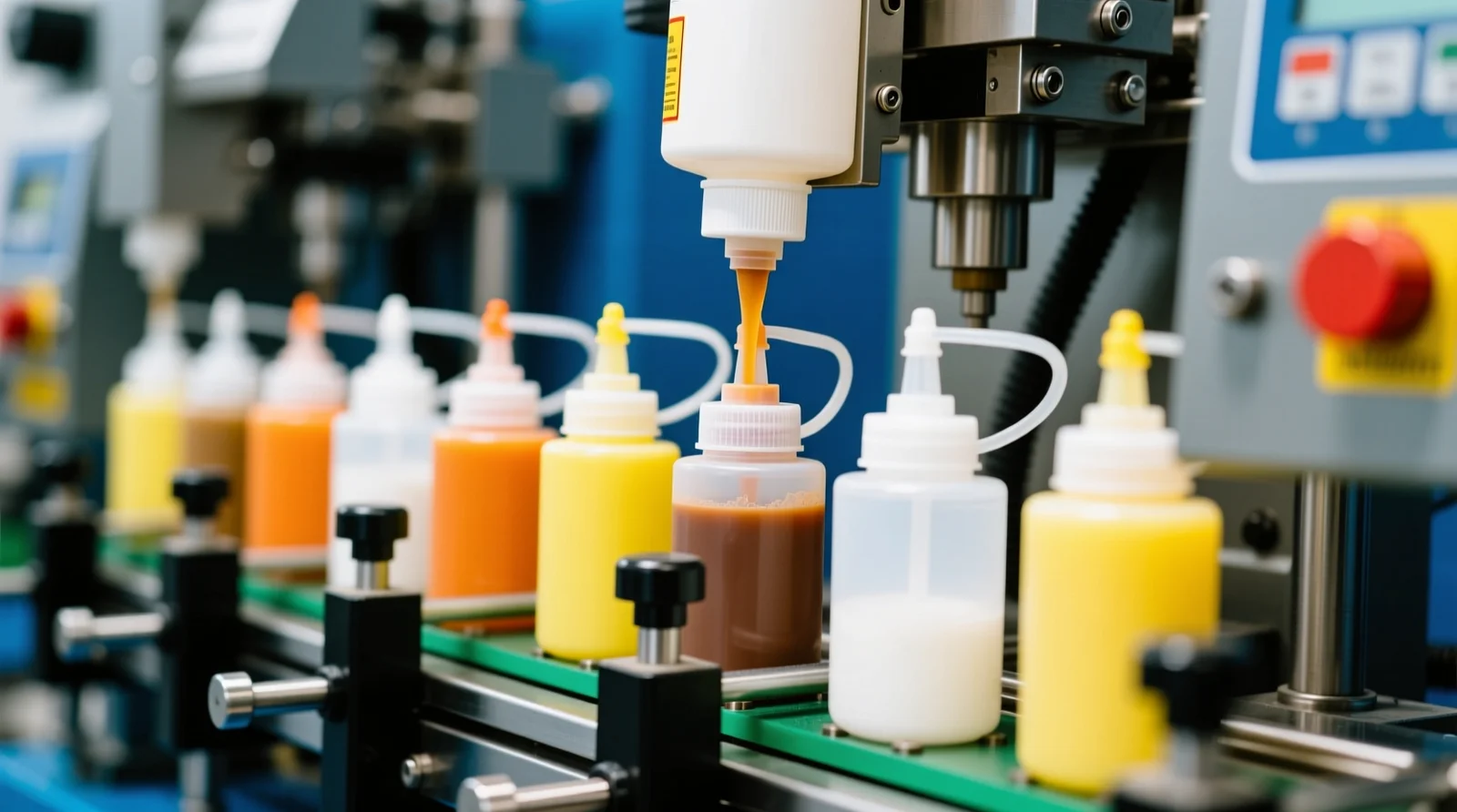
Last updated: July 17, 2026. A liquid filling machine measures and dispenses a liquid or semi-liquid product into bottles, jars, cans, pouches or tubes. The machine itself is the easy part; the engineering lives in the combination — product behavior, container, closure, hygiene process and line integration decide which filling method works at all.
This page explains the equipment category and its working principles. For the procurement stage, see The 2026 Enterprise Guide to Liquid Filling Machine Selection, linked as a Wiki card on this page. Browse the Packaging Machinery topic for related equipment guidance.
Common types of liquid filling machines
| Filling method | Often considered for | Main selection factors |
|---|---|---|
| Gravity filling | Free-flowing, low-viscosity liquids | Liquid behavior, foaming, fill level and container design |
| Overflow filling | Applications needing a visually consistent fill level | Container geometry, recirculation and product suitability |
| Piston filling | Viscous liquids, creams, sauces and products with particulates | Viscosity range, piston size, cleaning and product handling |
| Volumetric or flowmeter filling | Controlled-volume applications across line speeds | Accuracy target, product properties, calibration and controls |
| Net-weight filling | Products sold or regulated by weight | Scale feedback, settling behavior and legal metrology requirements |
| Vacuum filling | Containers or products where controlled vacuum assists filling | Container design, product compatibility and hygiene requirements |
Well-configured volumetric and net-weight systems commonly hold fill accuracy in the low single-digit percent — a servo piston filler is commonly specified at about ±0.5% volumetric accuracy, and a net-weight filler is specified in grams — but the achievable figure depends on the product and the speed, which is why accuracy belongs in the acceptance test rather than the brochure comparison.
Source
Title: V-8-E Volumetric Piston Filler — Kaps-All
URL: https://kapsall.com/solutions/liquid-fillers/v-8-e-volumetric-piston-filler
Kaps-All specifies its servo volumetric piston filler at ±0.5% accuracy. This is a vendor specification, not an industry standard — confirm on your product.
How a liquid filling line works
- Container handling: containers are fed, oriented and positioned under the filling heads.
- Product supply: product moves from tank or process system to the filler through a hygienic supply arrangement.
- Measurement and dispense: the filling method controls the quantity or level delivered.
- Closure: caps, lids, pumps or seals are applied and verified.
- Inspection and downstream packaging: coding, level or weight checks, labeling and secondary packaging complete the process.
Three questions that pick the filling method
How does the product behave? Viscosity, temperature dependence, particulates, foaming and shear sensitivity rule methods out fast — a sauce that pumps easily warm may refuse the same nozzle cold. What does the container demand? Neck size, stability, fill height and closure type constrain the head design; supply physical containers for supplier testing. What must be proven? Decide whether volume, net weight or visual level is the controlled quantity, then agree how it is sampled and recorded during acceptance testing — net-weight applications may also carry legal metrology obligations in the destination market.
What to include in the RFQ
- Product properties and operating temperature range, with samples
- Containers, closures and fill volumes required now and planned later
- Normal output, shift pattern and SKU changeovers
- Fill accuracy, verification method and reject criteria
- Cleaning procedure, contact-material and documentation requirements
- Upstream and downstream interfaces inside the supplier scope
Related supplier and selection research
Yundu is linked as a company card for liquid filling equipment, and Zhengzhou VTOPS Machinery for projects that combine filling with broader packaging-line elements. The next decision stage is covered in the liquid filling machine selection guide.
Frequently asked questions
What is the difference between a filling machine and a capping machine?
The filler measures product into the container; the capper applies and tightens the closure. Lines integrate both, but each has its own acceptance criteria — a perfect fill under a leaking cap still fails.
Can one filler handle every liquid?
No. Viscosity range, particulates, foam and hygiene needs decide whether a method is even a candidate, and the answer changes with temperature. Validate the configuration with the actual product before purchase.