
Introduction

Plastic processing machinery market size and the closely linked internal gear pump market are being reshaped by energy-cost volatility, recycled-content requirements, and Industry 4.0 (connected, data-driven manufacturing using sensors, automation, and analytics). In plastics plants, these shifts show up as faster cycle times, tighter part tolerances, more frequent resin changes, and stricter traceability—conditions that directly influence both machine architecture (all-electric vs hydraulic) and fluid-power components such as internal gear pumps.
Below is a technical, decision-maker oriented review of global trends through 2030, with practical guidance for engineering and procurement teams on what to measure, what to specify, and where pump and machine technology choices most affect OEE (overall equipment effectiveness: availability × performance × quality).
TL;DR: Global plastics processing is moving toward higher precision, more recycled and specialty materials, and smarter factories—pushing machine OEMs and processors to upgrade both molding/extrusion platforms and supporting components like internal gear pumps for controllable flow, lower losses, and better uptime.
Plastic Processing Machinery Market Overview (Global)
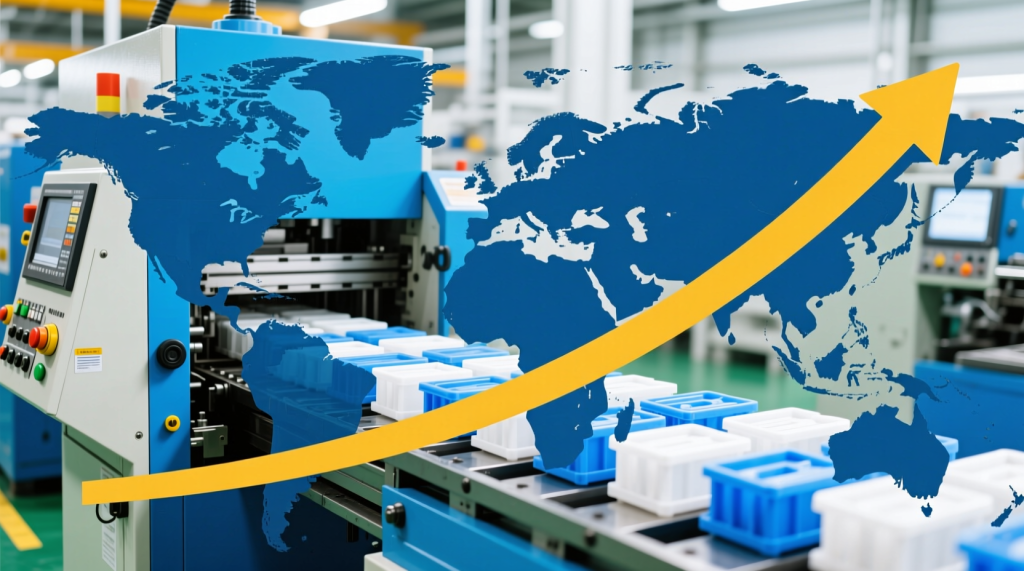
The global plastic processing machinery market is projected to reach approximately $54.61 billion by 2030, growing at about 6.5% CAGR (as reported by The Business Research Company). Unless otherwise stated by a given publisher, market estimates typically assume: (1) nominal USD revenues, (2) OEM equipment sales plus selected auxiliary equipment, and (3) forecasts based on a mix of shipment trends, end-market demand, and capex cycles.
To reduce “single-source bias,” it’s useful to cross-check directionally with industry bodies and standards organizations shaping technology adoption. For example, EUROMAP (European plastics and rubber machinery standards) influences interoperability and connectivity expectations in injection molding and extrusion controls, supporting Industry 4.0 deployment at scale (see EUROMAP). On the sustainability side, PlasticsEurope publishes data and positions that often correlate with investment in recycling-ready extrusion, filtration, and compounding capacity (see PlasticsEurope).
- Where growth concentrates: high-cavitation packaging molds (thin-wall), medical disposables, EV electrification components, pipe/profile extrusion for infrastructure, and compounding lines handling recycled and filled polymers.
- What buyers increasingly require: energy monitoring at machine level, closed-loop process control, lower scrap on material variability, and faster changeovers.
TL;DR: The headline number is global and credible as a directional indicator, but investment decisions should triangulate with standards (EUROMAP) and sustainability roadmaps (PlasticsEurope) because they directly affect machine specs and upgrade timing.
Key Global Trends in Plastic Processing Machinery Market

Across injection molding, extrusion, and additive manufacturing, the most important trend is not just “more automation,” but tighter control under messier inputs: recycled resins, multilayer structures, and high-output tools all increase sensitivity to temperature, pressure, and flow stability.
Trend 1: Recycled Content and Material Variability Are Forcing Better Process Control
Processing PCR (post-consumer recycled) and PIR (post-industrial recycled) resins introduces variability in MFI (melt flow index: a proxy for melt viscosity) and contamination risk (paper, aluminum, gels). In injection molding, these issues typically show up as:
- Higher scrap rates from splay, burn marks, short shots, or dimensional drift when viscosity shifts between lots.
- Cycle-time penalties when processors slow fill/pack to maintain quality.
- More frequent purging and maintenance due to degraded material and deposits.
Machinery implications: processors increasingly specify barrel/screw designs tuned for recycled blends, more robust melt filtration in extrusion/compounding, and advanced closed-loop controls (cavity pressure sensing, adaptive fill profiles). These requirements also raise expectations for stable hydraulic pressure/flow in servo-hydraulic platforms (connected later in “The Role of Internal Gear Pumps…”).
TL;DR: Recycled-content targets translate into real processing instability; machines that maintain stable fill/pack and temperature under variable viscosity directly reduce scrap and protect OEE.
Trend 2: EV and Electronics Demand Precision Molding, Not Just Higher Volumes

EV growth is pulling demand for molded parts where dimensional stability and repeatability matter more than raw tonnage. Common plastic applications include:
- Battery system components: cell spacers, module end plates, connector housings, cable management clips, and thermal interface-related parts (often flame-retardant grades).
- Power electronics: inverter and DC-DC converter housings, sensor housings, and high-voltage connector bodies requiring tight tolerances and controlled shrink.
- Lightweight interior/exterior: thin-wall trims, vents, and brackets where warpage control affects fit and finish.
Process parameter impact: thin-wall molding is sensitive to injection speed stability and pressure response; small deviations can increase short shots and gate blush, and can force longer hold times—directly lowering throughput. This is one reason many automotive and electronics molders adopt higher-response drive systems (all-electric or well-tuned servo-hydraulic).
TL;DR: EV-related plastics growth is increasingly about tolerance control and repeatability—driving investment in faster, more controllable injection and clamping systems.
Trend 3: Industry 4.0 Plastics Manufacturing (Connectivity + Analytics) Is Becoming a Procurement Requirement
MES (manufacturing execution system) connectivity, traceability, and predictive maintenance are moving from “nice to have” to “required,” especially for medical, automotive, and regulated packaging. In practice, plants want:
- Machine-level energy monitoring (kWh/kg), alarm histories, and parameter lock-down
- Condition monitoring on drives, pumps, and lubrication (temperature, vibration, particle counts)
- Automated quality inspection and statistical process control tied to tool cavities
EUROMAP’s work on standardized interfaces supports this direction by reducing integration friction across mixed fleets (EUROMAP standards and guidance).
TL;DR: Industry 4.0 in plastics is increasingly about standardized connectivity and measurable KPIs (scrap, cycle time, energy per part), not just adding sensors.
Trend 4: Packaging and Medical Are Driving High-Cavitation, Thin-Wall, and Clean Production

Packaging formats such as thin-wall food containers, caps/closures, and multilayer barrier films push machines toward high-speed, repeatable cycles. Medical disposables—e.g., syringes, pipette tips, diagnostic cartridges, and inhaler components—add requirements for low particulate generation, consistent shot-to-shot performance, and validated process windows.
All-electric injection molding machines (servo motor-driven axes, no central hydraulic power unit) are often selected here due to clean operation and repeatability. In energy terms, modern all-electric machines frequently report material energy savings on the order of ~30–70% versus conventional hydraulic machines depending on mold duty cycle and baseline condition (best results when replacing older, constantly running hydraulic power units). Actual savings vary by clamp tonnage, cooling time share, and utilization profile; buyers should validate with power logging during a representative production run.
TL;DR: Packaging and medical reward repeatability and cleanliness; all-electric or high-performance servo-hydraulic platforms can cut energy significantly and stabilize thin-wall cycles—but savings must be verified on the specific mold and schedule.
Technology Comparison: Injection Molding vs Extrusion vs 3D Printing (and Where Internal Gear Pumps Fit)
- Injection molding: best for high-volume discrete parts (caps, medical disposables, EV connectors).
Internal gear pump roles: hydraulic power units in servo-hydraulic machines; lubrication systems for toggle mechanisms/gearboxes; additive dosing skids for colorants or process aids. - Extrusion: best for continuous products (pipe, profiles, sheet, film) and compounding.
Internal gear pump roles: lubricant circulation and hydraulic auxiliaries; in some lines, precise dosing/transfer of additives, plasticizers, or specialty fluids used in compounding and downstream converting. - 3D printing (additive manufacturing): best for low-volume production, fixtures, jigs, and rapid iteration.
Internal gear pump roles: typically indirect (support systems, lubrication), but demand for specialty resins/additives can increase dosing/transfer needs upstream in materials production.
TL;DR: Internal gear pumps are most directly tied to servo-hydraulic injection molding and to industrial lubrication/dosing tasks around extrusion and compounding—supporting stability, uptime, and controllability.
The Role of Internal Gear Pumps in Plastic Processing Machinery (Why These Markets Move Together)

The link between the plastic processing machinery market and the internal gear pump market becomes clear when you look at what modern plastics plants are optimizing: response time, stability, energy per part, and uptime.
High-speed thin-wall injection, multi-cavity tools, and frequent material changes increase the need for:
- Fast pressure/flow response during fill/pack transitions (impacts sink, flash, and dimensional stability)
- Low pulsation flow for smoother control and reduced pressure ripple (impacts part weight repeatability and surface quality)
- Variable-speed operation so pumps don’t burn power at idle (impacts kWh/kg and oil temperature management)
This is where internal gear pump technology—especially when paired with servo drives and closed-loop control—supports higher machine performance. As discussed in the “Operating Pressure” segment below, many injection molding hydraulic duties sit in the 100–300 bar range, where pump efficiency and noise/pulsation behavior materially affect machine behavior and operating cost.
TL;DR: Faster, thinner, and more variable plastics processing increases requirements for controllable hydraulic power and stable dosing—pulling demand for higher-performance internal gear pumps and smarter pump-drive packages.
Internal Gear Pump Market: Technical Drivers and Performance Benchmarks
Internal gear pumps (a type of positive displacement pump, meaning they move a fixed volume per revolution) are widely used in industrial hydraulics, lubrication, and dosing because they can deliver stable flow over a broad viscosity range.
What “good” looks like today: Modern, well-designed internal gear pumps can achieve high volumetric efficiency (how much of the theoretical displacement becomes real flow) often in the ~90–95%+ range under rated conditions, depending on viscosity, pressure, speed, and internal clearances. Overall efficiency depends additionally on mechanical/hydraulic losses and drive/control strategy.
Internal Gear Pump Innovations for Plastic Processing and Industrial Markets

Design improvements are increasingly aimed at controllability, noise reduction, and efficiency under variable-speed operation—conditions common in servo-hydraulic injection molding.
How Internal Gear Pump Design Features Influence Noise, Pulsation, and Efficiency
- Gear geometry (tooth profile and meshing quality): smoother meshing reduces flow ripple, which can reduce pressure pulsation and audible noise—helpful for high-speed molding cells where stability affects shot-to-shot weight.
- Clearances and compensation: tighter, well-controlled clearances reduce internal leakage (raising volumetric efficiency), but must be balanced against thermal expansion and contamination risk from recycled-processing environments.
- Materials and surface finishes: hardened steels, coated surfaces, and optimized finishes improve wear resistance and maintain efficiency longer, especially in long duty cycles.
- Bearing design and shaft support: robust bearing arrangements reduce deflection under pressure, stabilizing clearances and lowering vibration—important in continuous high-pressure operation.
For a general technical reference on positive displacement pump principles and how design impacts performance, see the Hydraulic Institute’s resources (Hydraulic Institute).
TL;DR: Lower pulsation and higher volumetric efficiency come from optimized gear profiles, stable clearances, and robust bearings/materials—features that matter most in variable-speed, high-response plastics hydraulics.
Example of High-Response Electro-Hydraulic Integration: 4-Quadrant Internal Gear Pump Systems

“4-quadrant” operation (ability to control torque and speed in both directions, enabling motoring and regenerative behaviors depending on system design) supports more dynamic hydraulics. In injection molding, this can improve control during rapid acceleration/deceleration of clamp and injection axes and can reduce throttling losses compared with constant-speed hydraulic approaches.
Case example: Moog’s EPU-G concept (an integrated pump + servomotor package) has been presented with specifications such as 20–85 L/min and up to 345 bar, targeting efficient variable-speed hydraulics and reduced system complexity. When evaluating solutions like this, processors should request measured data under their duty cycle: energy per part, oil temperature rise, pressure stability during fill/pack, and maintenance intervals.
TL;DR: Integrated variable-speed, high-response pump-drive systems can reduce idle losses and improve dynamic control—benefits that align with thin-wall and precision molding requirements.
Internal Gear Pump Market Segmentation (Practical View for Plastics Buyers)
Segmentation matters most when it maps to real operating conditions: pressure, viscosity, contamination, temperature, and regulatory constraints.
Product Type (Materials) and What It Means in Plastics Plants

- Steel / stainless steel: preferred for corrosive or hygienic duties (e.g., certain additives, process chemicals, cleaning fluids). Stainless is also common where cleanliness and washdown matter.
- Cast iron (ductile/gray): widely used for hydraulic power and lubrication; cost-effective but may be less suitable for corrosive fluids.
- Aluminum / bronze / composites: niche roles (weight, corrosion resistance, specialty compatibility).
TL;DR: Material selection is primarily fluid-compatibility plus environment (corrosion/washdown), with wear life and contamination tolerance as the key cost drivers.
Operating Pressure (and Why It Matters for Injection Molding)
- < 100 bar: circulation and lubrication loops, transfer, lower-pressure dosing.
- 100–300 bar: a common industrial hydraulics band, including many injection molding machine hydraulic architectures; efficiency, noise, and thermal behavior are critical here.
- > 300 bar: high power density requirements; careful attention to bearing loads, housing stiffness, and filtration is required.
TL;DR: For many plastics hydraulics, 100–300 bar is the “workhorse” range where pump efficiency and pressure ripple have a direct impact on cycle stability and energy use.
End-Use Industry (Why Specialty Chemicals Still Matter to Plastics)
Beyond plastics equipment OEMs, specialty chemicals and additive production strongly influences pump demand: stabilizers, colorants, plasticizers, and compatibilizers often require accurate dosing and gentle handling. Internal gear pumps are commonly selected where repeatable metering and viscosity handling matter.
TL;DR: Growth in additives and specialty formulations supports pump demand indirectly—even when the pump isn’t mounted on the molding machine itself.
Operational Challenges in Plastics Processing—and How Machine/Pump Features Mitigate Them
- Processing recycled resins with contaminants: contamination increases wear and sticking in hydraulics and dosing systems. Mitigation: improved filtration (including off-line kidney-loop filtration), wear-resistant materials, and condition monitoring (particle counts).
- Viscosity swings in specialty formulations: viscosity changes alter flow and pressure response. Mitigation: closed-loop speed/pressure control, temperature control of fluids, and pump designs that maintain efficiency across a wider viscosity band.
- Heat management in hydraulic systems: wasted hydraulic power becomes heat, stressing seals and oil life. Mitigation: variable-speed drives, efficient pump geometries, and right-sized reservoirs/coolers.
TL;DR: The “messy reality” (contaminants, viscosity change, heat) is where advanced controls, filtration, and robust pump design preserve uptime and part quality.
How To: Evaluate All-Electric vs Servo-Hydraulic vs Hydraulic Injection Molding Machines
For procurement and engineering teams, a practical comparison framework is:
- Define the duty cycle: clamp tonnage, injection speed requirements, cooling-time share, mold cavitation, and utilization (hours/year). Energy savings are strongly duty-cycle dependent.
- Measure energy in kWh/kg or kWh/part: run a power logger on an existing tool as baseline; demand comparable test data from OEMs on the same mold family.
- Compare controllability metrics: shot weight repeatability, pressure stability during pack/hold, and recovery consistency—especially for thin-wall packaging and medical parts.
- Assess maintenance and environment: oil management (hydraulic/servo-hydraulic), noise limits, cleanroom needs, and spare parts strategy.
- Model total cost of ownership (TCO): include energy, maintenance, downtime, and scrap. A lower-cost machine can be outperformed by higher uptime and lower scrap.
TL;DR: Choose architecture based on your mold duty cycle and measurable KPIs (kWh/part, scrap, uptime)—not generalized claims; require comparable test conditions.
How To: Select Internal Gear Pumps for Plastics-Related Applications
- Viscosity range: specify min/max viscosity over the full temperature window; confirm efficiency and starting torque at worst case.
- Fluid compatibility: confirm seal/elastomer compatibility and corrosion resistance for additives, cleaning fluids, or specialty oils.
- Duty cycle and control: constant-speed vs variable-speed; define response requirements (e.g., fast pressure ramps in servo-hydraulic molding).
- Contamination control: define filtration level and monitoring (particle count targets); recycled-material environments can raise contamination risk in auxiliary systems.
- Maintenance intervals: ask for bearing life assumptions, recommended oil cleanliness class, and field-replaceable wear parts.
TL;DR: Pump selection should be driven by viscosity/temperature extremes, contamination strategy, and control response needs—then validated with efficiency and stability data under real operating conditions.
Implications for OEMs and Tier-1 Suppliers
Cross-market trends have direct design-roadmap implications:
- Machine OEMs: thin-wall, high-cavitation, and recycled-resin processing increases the value of fast control loops and stable hydraulics—accelerating adoption of integrated electro-hydraulic power units and smarter monitoring.
- Tier-1 molders: competitive advantage increasingly comes from OEE and energy per part; investment logic shifts toward standardized data collection (Industry 4.0) and equipment that holds quality windows under resin variability.
- Pump suppliers: differentiation shifts to efficiency under variable speed, low pulsation/noise, and durability under contamination and thermal cycling—plus easier integration into digital maintenance regimes.
TL;DR: Plastics equipment and internal gear pump innovation are converging around controllability, energy transparency, and reliability under variable materials—informing partnerships, platform standardization, and CAPEX timing.
Methodological Note (Data Source Context)
The Business Research Company’s market figures cited above are used here as a directional indicator for the global market outlook. For CAPEX planning, readers typically supplement such reports with: OEM quotations, plant-level energy measurements, and standards/regulatory constraints relevant to the operating region.
TL;DR: Use market forecasts to frame scenarios, but base equipment selection on measured duty-cycle data, regional requirements, and total cost of ownership.
Conclusion
Through 2030, plastics processors are investing less in “capacity at any cost” and more in repeatable quality, lower kWh/part, and stable production under recycled and specialty materials. That shift favors all-electric platforms in clean and precision applications, and high-performance servo-hydraulic systems where power density and dynamic response are critical.
Internal gear pumps—and increasingly integrated pump/drive packages—benefit from the same trend: they enable tighter pressure/flow control, lower idle losses via variable-speed operation, and improved stability in demanding molding and dosing environments. Understanding these connections helps OEMs, Tier-1 suppliers, and plant engineers prioritize upgrades that improve OEE and reduce scrap rather than simply adding automation.
TL;DR: The strongest investment case is equipment that measurably improves OEE (scrap, downtime, cycle time) and energy per part—where machine architecture and internal gear pump performance increasingly work as a single system.
FAQ
Q: What is the plastic processing machinery market size forecast referring to—global or regional?
A: The ~$54.61 billion by 2030 figure referenced here is presented as a global forecast by The Business Research Company. For regional planning, you should validate the split by geography and product category (injection molding, extrusion, etc.) using multiple sources and confirm whether figures are reported in nominal USD and what is included (OEM machinery only vs machinery plus auxiliaries).
Q: What payback period can manufacturers expect when upgrading to all-electric injection molding machines and energy-efficient pump systems?
A: Payback is highly plant-specific, but many processors target roughly 2–5 years depending on electricity price, utilization hours, and baseline machine condition. The most reliable method is to log real kWh/part on the existing tool, then compare to OEM test data under a similar mold duty cycle while also quantifying scrap reduction and downtime improvements (often equal to or larger than pure energy savings).
Q: How can processors adapt existing hydraulic injection molding machines to integrate variable-speed internal gear pump solutions?
A: Many retrofits involve adding a variable-speed drive (typically a servo motor or VFD-driven motor, depending on the control concept) and re-tuning pressure/flow control loops. Key steps include verifying peak flow/pressure requirements, checking reservoir/cooling capacity after reducing throttling losses, upgrading filtration/cleanliness monitoring, and validating cycle stability (pressure ripple, shot repeatability) before full rollout.
A: Focus on required pressure range (commonly 100–300 bar for many hydraulics), flow stability/pulsation, volumetric efficiency across your viscosity/temperature window, contamination tolerance and required filtration level, seal/material compatibility, and expected maintenance interval under your duty cycle.
Q: How do sustainability regulations and recycled-content targets affect machinery and pump specifications?
A: Recycled-content requirements often increase material variability and contamination risk, which pushes machinery toward better closed-loop control, more robust melt handling/filtration (especially in extrusion/compounding), and more rigorous condition monitoring. For pumps and hydraulics, it increases the importance of oil cleanliness management, wear-resistant materials, and energy transparency (machine-level metering) to support both compliance reporting and cost control.