Commissioning Update: Borche BU1800‑V Now in Full Production in the West Midlands

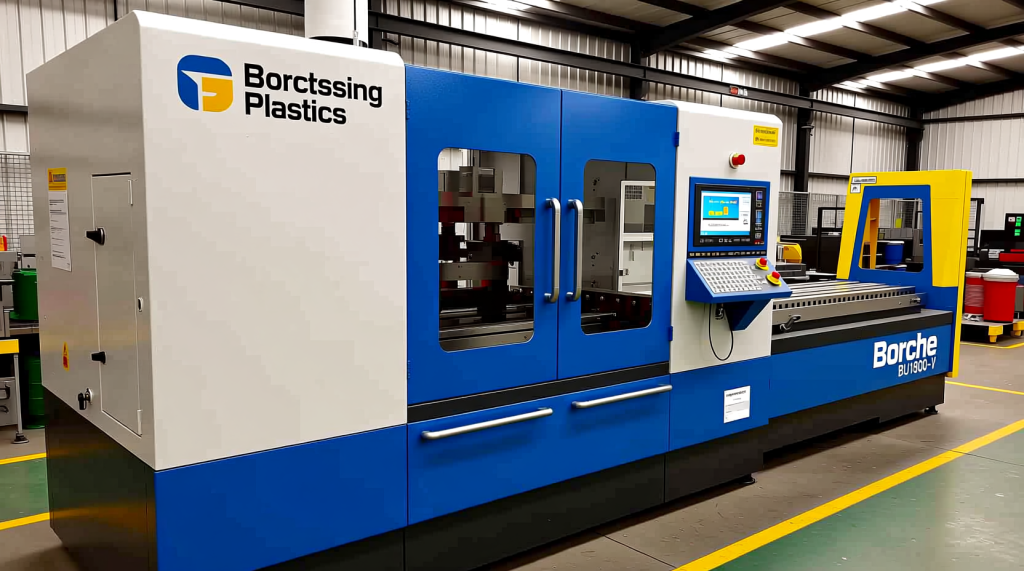
Glendenning Plastics has confirmed that its Borche BU1800‑V two-platen injection moulding machine is fully commissioned and running in full production at its West Midlands facility. The investment expands capability in large-part injection moulding UK projects, supporting both higher output and the process stability expected by engineering, procurement, and brand-owner stakeholders.
As context for non-specialists, a two-platen injection moulding machine uses two main platens (fixed and moving) to generate clamping force, rather than a traditional toggle mechanism. The approach is common in high-tonnage moulding services where large tools, long clamp strokes, or side-loading requirements are priorities.
External reference: For background on injection moulding and the role of clamping force, see the British Plastics Federation (BPF) overview of injection moulding.
TL;DR: A newly commissioned high-tonnage two-platen injection moulding machine is now producing large parts on-site, strengthening supply capacity in the West Midlands.
Key Machine Capability: High Tonnage, Large Tool Envelope, and Repeatable Large-Part Processing
The Borche BU1800‑V is positioned to handle demanding large-format moulds by combining high clamp force with a tool-friendly clamp unit. In the high-tonnage class, engineers typically evaluate a machine on core specifications such as clamp force (tonnes), maximum shot weight, tie bar spacing, and mould height range (minimum/maximum mould thickness).
- Clamp force: 1,800 tonnes (nominal class), aligned with large, stiff tooling and high projected-area parts.
- Injection capacity: dependent on screw diameter and resin; the platform is designed for large shot weights suitable for big components and thick-wall sections.
- Tool accommodation: two-platen architecture typically supports large mould envelopes; tie bar spacing and maximum mould height are key selection criteria for wide tools and automation-clearance needs.
Note on specifications: Exact values such as maximum shot weight (g/oz), tie bar spacing (mm), and maximum mould height (mm) vary by injection unit and clamp configuration. For procurement-grade RFQs, these should be confirmed against the machine nameplate and Borche’s BU-series datasheet for the installed configuration.
In practical terms, this capability improves outcomes for large-part moulding programmes by increasing process margin (less “running on the limit” of clamp or injection capacity), which can translate into more stable dimensions, reduced flash risk on large parting lines, and better repeatability across multi-shift production.
TL;DR: The BU1800‑V sits in the 1,800‑tonne class and is engineered for large tools and large shot volumes—key for consistent large-format moulding and high-tonnage moulding services.
Performance Outcomes: Changeover, Throughput, and OEE Impacts You Can Model

For most large-part moulding operations, the business case is driven by uptime and changeover efficiency as much as raw clamp force. With large tools, the time lost to mould moves, alignment, and safe access can be significant—so features that reduce non-productive time directly support OEE (Overall Equipment Effectiveness).
With the BU1800‑V and its side-loading capability (via automated tie bar removal), typical plants targeting best practice can often model:
- Changeover time reduction: commonly 20–40% for large tools where side-loading reduces crane moves and improves access (actual results depend on tooling, lifting plan, and standard work).
- Higher available hours: even a 30% reduction on a 2–3 hour large-tool change can return 0.6–0.9 hours per change, compounding across seasonal peaks.
- Scrap reduction during start-up: more repeatable tool location and documented start-up settings can reduce first-off variation (best supported by SPC and validated start-up sheets).
Cycle time itself depends heavily on part thickness, cooling design, and resin; large horticultural trays and planters often run in the tens-of-seconds range, but tooling and cooling strategy dominate. A more useful metric for stakeholders is stable throughput during peak demand periods—helping avoid split shipments, backorders, or expedited freight.
TL;DR: The biggest measurable gains are typically less downtime and smoother start-ups—often translating into 20–40% faster large-tool changeovers and improved OEE.
Two-Platen vs Toggle: Practical Trade-Offs for Large-Part Injection Moulding UK
Two-platen and toggle-clamp machines can both deliver excellent moulding results, but they behave differently in ways that matter to maintenance teams and toolmakers.
- Footprint and stroke: two-platen designs generally achieve high tonnage with a shorter overall machine length, while still offering long opening strokes—useful for deep parts, tall cores, or end-of-arm tooling (EOAT, i.e., robot grippers) clearance.
- Platen parallelism: two-platen clamp structures are often selected to support large mould faces where maintaining parallelism helps protect tooling and reduce uneven parting-line loading.
- Maintenance profile: toggle systems involve multiple linkages and pins; two-platen systems reduce linkage complexity but place focus on tie bars, platen guidance, and hydraulic clamp control. In practice, both benefit from planned lubrication, alignment checks, and periodic condition monitoring.
For custom plastic moulding West Midlands programmes, these trade-offs matter because they influence tool longevity, accessibility during mould installs, and how easily a process can be replicated after a mould move or a seasonal restart.
TL;DR: Two-platen machines are often chosen for large mould envelopes, access, and large-platen behaviour—while maintenance priorities shift from toggle linkages to clamp guidance and hydraulics.
Auto Tie Bar Removal: Safer Tool Handling and Faster Changeovers

A standout element of this installation is the integrated Auto Tie Bar Removal System, which withdraws one tie bar to enable side-loading mould installation. Side-loading can be particularly valuable for wide tools, tools with complex water manifolds, or moulds that are safer to handle from the side rather than the front.
From an operational standpoint, the biggest gains are achieved when the feature is paired with robust changeover discipline:
- Standard work instructions for lifting points, bolt torques, and connection checks
- Quick-connect utilities (water, hydraulics, and electrical) where feasible
- Tooling strategy that uses repeatable locating rings, documented clamp setups, and validated start-up parameters
When those controls are in place, plants frequently see meaningful reductions in changeover variability as well as time—improving schedule reliability for OEMs and distributors.
TL;DR: Auto tie bar removal enables side-loading, which—combined with standardised changeover practices—can cut large-tool changeover time and improve safety.
Servo-Hydraulic Drive: How the Control Strategy Saves Energy (and Where It Doesn’t)
The BU1800‑V uses a servo-hydraulic system—meaning a servo motor drives the hydraulic pump and modulates speed/torque based on demand. Unlike conventional constant-speed hydraulics, servo-hydraulic systems reduce pump output when the machine is not actively moving or building pressure.
For technically experienced readers, the practical mechanism is simple: the control system matches hydraulic flow/pressure to the phase of the moulding cycle (e.g., mould close, injection, pack/hold, screw recovery, mould open, ejection). During low-demand phases, the motor slows, reducing wasted energy and heat generation.
- Estimated energy savings: many servo-hydraulic installations report 20–50% lower electricity use versus older constant-speed hydraulic machines, depending on cycle profile, clamp tonnage utilisation, and idle time.
- Secondary benefits: reduced hydraulic oil heating can lower cooling load and improve thermal stability.
- Trade-off: energy savings are highest when the process includes meaningful idle/low-demand periods; if the cycle is extremely aggressive and near-continuous at high load, the percentage improvement may be lower.
Industry organisations consistently highlight energy efficiency as a key lever for improving plastics processing sustainability. See PlasticsEurope for broader sustainability and industry context, and the British Plastics Federation for UK-focused manufacturing information.
TL;DR: Servo-hydraulic control reduces energy use by matching pump output to real demand—often delivering 20–50% savings versus older hydraulics, with the biggest gains in stop-start or variable-load cycles.
Quality, Process Control, and E-E-A-T: Turning High Tonnage into Repeatable Parts

High-tonnage equipment only creates value if the process is controlled. For customers qualifying a supplier for high-tonnage moulding services or large-part injection moulding UK, the reassurance typically comes from how production is managed day-to-day—training, maintenance, and data-driven quality control.
- SPC (Statistical Process Control): tracking key dimensions and process variables to detect drift before parts go out of tolerance.
- Planned preventative maintenance (PPM): structured inspection of tie bars, platen alignment indicators, hydraulic filtration, and lubrication intervals to protect uptime and tooling.
- Operator training: competence-based training for safe tool handling, start-up/shutdown procedures, and parameter control—particularly important on large tools where mistakes are costly.
- ISO frameworks: many moulding operations align their quality and environmental systems with standards such as ISO 9001 (Quality Management) and ISO 14001 (Environmental Management) to support traceability, corrective action, and sustainability governance.
For OEMs and brand owners, these controls reduce supply risk: fewer line-stoppages caused by quality escapes, more consistent deliveries during peaks, and better documentation during audits.
TL;DR: Process control (SPC), planned maintenance, and structured training are what convert a high-tonnage machine into consistent, auditable production performance.
Materials, Tooling Strategies, and Typical Operating Considerations
Large-format moulding often spans a wide resin window depending on stiffness, impact resistance, weathering, and cost targets. In garden/horticulture and industrial applications, common thermoplastics include:
- PP (polypropylene): tough, cost-effective, widely used for trays and containers
- HDPE (high-density polyethylene): impact resistance and chemical resistance
- ABS (acrylonitrile butadiene styrene): higher stiffness and surface finish where needed
- Recycled polymers: used increasingly where specification allows, typically requiring tighter control of melt flow and contamination risk
Tooling and process decisions that strongly influence output and part quality at this scale include cooling circuit design, gate strategy (e.g., valve-gated hot runner vs cold runner), venting to avoid burns, and ejection robustness for large projected areas. Many large parts also benefit from mould-temperature control units (TCUs) to stabilise shrinkage and warpage.
TL;DR: Large-part moulding success depends as much on resin selection and tooling strategy (cooling, gating, venting) as it does on tonnage.
Applications and Industries Served

With the BU1800‑V in production, Glendenning Plastics is better positioned to support a broader range of custom plastic moulding West Midlands and UK manufacturing requirements, including:
- Garden and horticulture: trays, pots, planters, storage, and specialist grower accessories
- Industrial handling: large bins, containers, protective covers, and durable housings
- Construction and building products: robust components requiring high stiffness and repeatable geometry
- Retail and distribution: private-label large plastic products where supply continuity and seasonal responsiveness matter
For OEMs and brand owners, added UK capacity can support reshoring or dual-sourcing strategies that reduce exposure to long lead times and international freight volatility. Distributors benefit from improved availability during peak demand windows and more responsive product change cycles.
TL;DR: The new capability supports multiple sectors—especially seasonal, bulky, or durability-critical products—while strengthening UK supply security.
External Validation: Proven Two-Platen Platforms in Global Manufacturing
Two-platen, high-tonnage injection moulding platforms are widely used across global manufacturing because they scale efficiently for large tools and automation. While specific customer deployments vary by region and programme, Borche as a brand is represented internationally through distributors and industry events, reflecting broad adoption of servo-hydraulic and large-tonnage machine architectures in mainstream plastics processing.
For readers benchmarking the wider market, industry publications and associations such as Plastics News regularly cover machine technology trends, energy efficiency improvements, and investment patterns across injection moulding.
TL;DR: High-tonnage two-platen machines are a globally established route for large-part moulding; independent industry sources track their adoption and efficiency trends.
Conclusion and Call to Action

Bringing the Borche BU1800‑V into full production strengthens Glendenning Plastics’ position in large-part injection moulding UK by combining high clamp force with two-platen efficiency, side-loading changeover capability, and servo-hydraulic energy performance. The result is a platform suited to large, complex moulds with a credible pathway to improved uptime, lower unit energy cost, and more dependable delivery during seasonal peaks.
If you’re planning a large-part moulding project, tooling transfer, or need high-tonnage moulding services in the UK, contact Glendenning Plastics to discuss part size, resin, annual volumes, and tool requirements.
TL;DR: The BU1800‑V expands high-tonnage capacity and improves operational efficiency—enquire for large-part projects or tooling transfers.
FAQ
Q: What clamp force does a Borche BU1800‑V typically provide, and what does “1800” mean?
A: The “1800” generally refers to the machine’s clamp-force class—approximately 1,800 tonnes. Clamp force is the closing force that keeps the mould shut against injection pressure, and it’s a key requirement for large projected-area parts and tools.
Q: What information should I provide when requesting a quote for large-part injection moulding in the UK?
A: Provide part dimensions, estimated weight, material (e.g., PP/HDPE/ABS), annual volumes, cosmetic requirements, and whether a mould already exists. If tooling exists, include tie bar clearance needs, mould height, hot-runner details, and utility connections to confirm compatibility with a two-platen injection moulding machine.
Q: How much can auto tie bar removal reduce mould changeover time for large tools?
A: Many operations see changeover time reductions in the 20–40% range when side-loading improves access and reduces handling complexity. Actual results depend on tool size, lifting plans, quick-connect utilities, and the site’s standardised changeover procedure.
Q: Are servo-hydraulic injection moulding machines always more energy efficient than conventional hydraulics?
A: Often yes, particularly when the cycle includes idle or low-demand phases. Typical reported savings versus older constant-speed hydraulic machines can be around 20–50%, but the exact percentage depends on cycle design, utilisation, and how aggressively the machine is running.
Q: What’s the difference between two-platen and toggle injection moulding machines for high-tonnage moulding services?
A: Two-platen machines are commonly chosen for large mould envelopes, access, and compact machine length at high tonnage. Toggle machines can be very fast and efficient in many applications but involve more linkage components. The best choice depends on tool size, opening stroke, maintenance preferences, and the process window required.