2026 Best Cutting Machinery Innovations and Trends to Watch
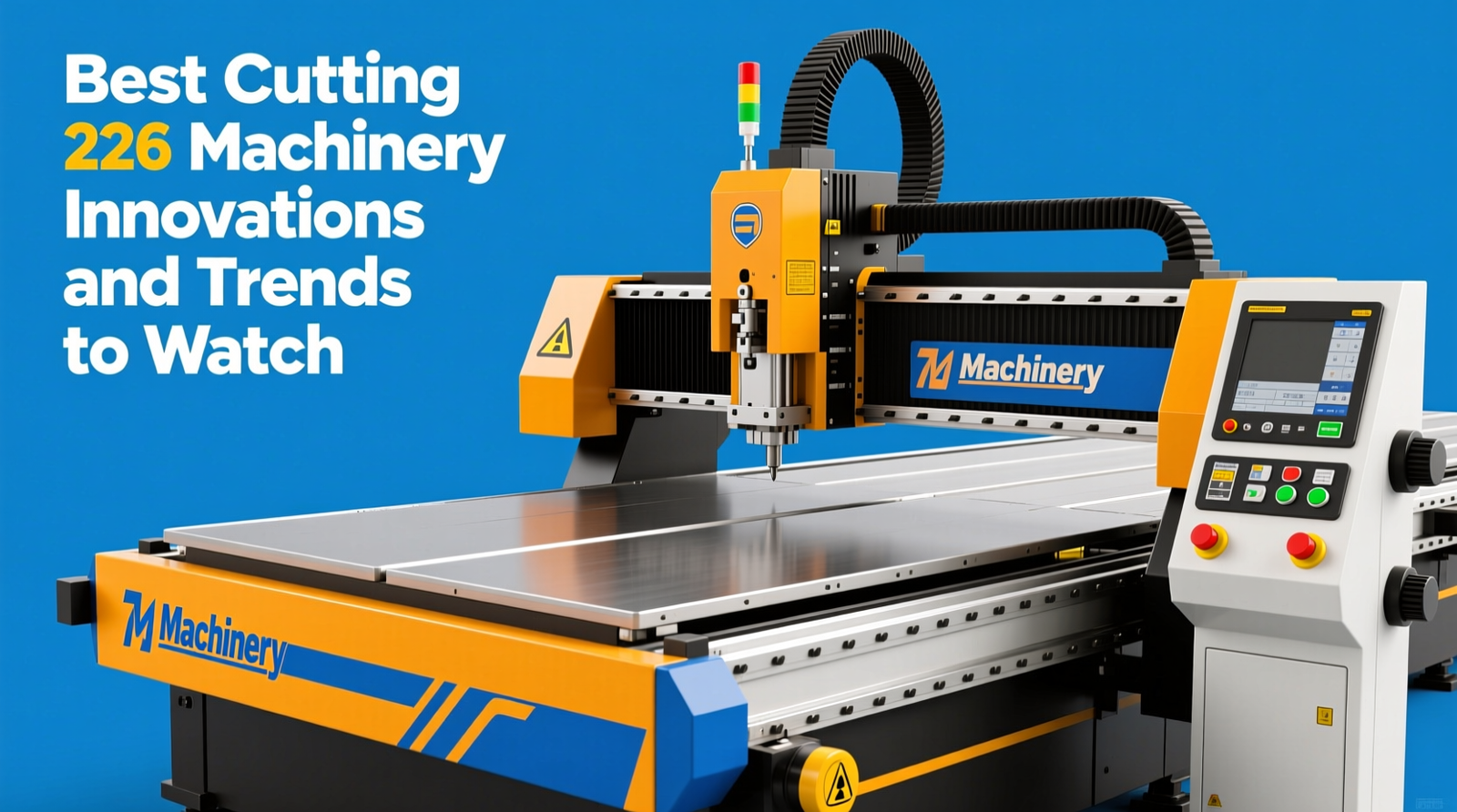
By 2026, cutting machinery buyers will be making decisions in a noticeably different environment than even a few years ago: more mixed-material parts (metals + composites), tighter traceability demands, higher energy costs, and a growing expectation that cutting lines will connect to plant systems—not operate as islands.
Who should read this: operations managers, process engineers, maintenance leads, and plant owners evaluating a greenfield line, a retrofit, or a like-for-like equipment replacement in packaging, automotive, aerospace, or general fabrication.
TL;DR: Cutting equipment decisions are shifting from “fastest machine” to “best system”: material capability, connectivity (Industrial IoT/IIoT), safety standards, and energy-per-part matter as much as speed.
Top Material Innovations Driving Cutting Machinery Advances
Material mix is changing what “good cutting performance” means. Two patterns are driving most engineering changes: (1) more abrasive, layered materials (carbon fiber composites, laminates, coated stocks), and (2) more difficult-to-cut alloys (titanium, high-strength steels) that punish tools and magnify thermal distortion.
Carbon-fiber-reinforced polymer (CFRP) and other composites continue to expand in aircraft structures. Public Airbus materials information highlights that the A350 XWB uses a high proportion of composites (about 50% by weight), which has accelerated demand for waterjet cutting for composites, ultrasonic trimming, and dust-controlled routing cells. (Exact composite percentages vary by airframe and configuration; treat “~50%” as an airframe-level benchmark rather than a universal rule.)
Automotive is also pulling advanced cutting in new directions—especially EV (electric vehicle) battery production. Battery enclosures and trays use aluminum alloys and thin-gauge steel, while pack-level components can include adhesives, foams, and insulation layers. That combination pushes adoption of CNC laser cutting machines for automotive (for consistent edge quality and speed on sheet metal) alongside selective mechanical trimming and sealing workflows.
In packaging, the “material innovation” story is often about coatings and laminates: barrier films, metallized layers, and multi-material structures that cut differently than uncoated paperboard. This is one reason converters increasingly specify servo-driven web handling, better tension control, and tighter registration before die cutting or guillotine cutting.
Practitioner guidance (step-by-step):
- Classify the material stack: monolithic metal vs. layered composite vs. coated/laminated substrate. Layered stacks usually require different chip/dust control and edge-quality inspection.
- Match tooling to wear mode:
- CFRP: abrasive fiber wear + delamination risk → consider polycrystalline diamond (PCD) tooling or diamond-coated cutters, high-efficiency dust extraction, and conservative entry/exit strategies to reduce fray.
- Titanium alloys: heat concentration + work hardening → prioritize rigid fixturing, sharp geometries, appropriate coolant strategy (flood or high-pressure where applicable), and toolpaths that avoid rubbing.
- Run parameter trials with a defined checklist: feeds/speeds (or laser power/speed/gas), edge quality, burr/delamination, tool wear per part, and dust/particulate containment results.
- Lock the process window: document the qualified range and tie it to work instructions and inspection criteria so shifts don’t “tune by feel.”
TL;DR: Material capability is now the buying filter. Expect more composite trimming (dust-managed) and mixed-material workflows (metals + adhesives/coatings), especially in aerospace, EV battery components, and flexible packaging.
Sustainable Practices in Cutting Machinery Design and Production
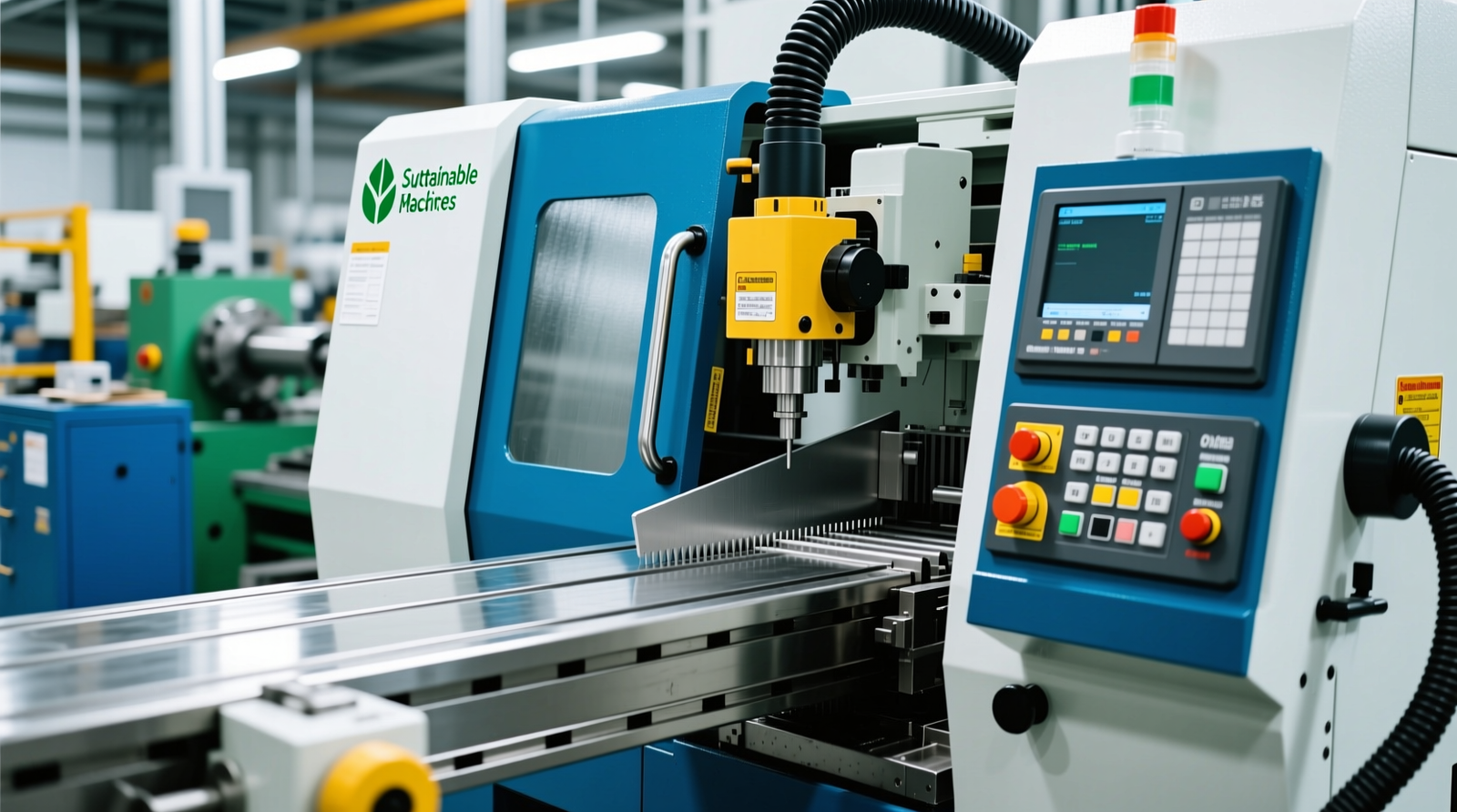
Sustainability efforts are becoming operational rather than purely reputational: energy per part, compressed-air usage, scrap handling, and consumables (tools, abrasives, filters) directly affect cost and capacity. For energy management, many plants use ISO 50001 (energy management systems) as a framework; see the ISO overview at ISO 50001.
Energy claims like “10–30% savings” depend heavily on duty cycle and what you’re upgrading from. Variable-speed drives, servo-driven axes, and standby modes can yield substantial reductions versus older constant-speed hydraulics or poorly tuned pneumatics, but results should be validated with metered data on your parts and shift pattern.
Simple 4-step sustainability audit for cutting lines:
- Baseline energy per part: meter the machine (kWh) and track output for representative jobs; calculate kWh/part (or kWh/m² for sheet work).
- Identify the top 5 energy consumers: drives/spindles/laser source, extraction, compressed air, chillers, and idle time are common culprits.
- Execute quick wins (0–90 days): fix compressed-air leaks, implement auto-idle/standby, optimize extraction duty cycling, and tighten nesting to reduce scrap re-cuts.
- Build a CAPEX funnel: prioritize upgrades by cost per saved kWh and by throughput impact (e.g., servo drive retrofits, higher-efficiency dust collection, or a fiber laser upgrade from older CO₂ if utilization is high).
TL;DR: Sustainability in cutting machinery is measurable: start with energy-per-part and scrap-per-part, then sequence quick wins before major CAPEX.
Automated Systems: The Future of Cutting Machinery Operations
Automation is not one trend—it’s a set of choices: loading/unloading, part identification, in-line inspection, and robotic cutting/trim. The International Federation of Robotics (IFR) tracks industrial robot deployments and market dynamics; see IFR industry statistics and reports for context on where robotics is expanding.
In practice, the strongest automation business cases appear when one of these constraints is present: labor availability, safety risk (sharp parts/dust/noise), high changeover frequency, or expensive scrap. Packaging lines are a common example: automated feeding + registration + die cutting can stabilize quality at high speed. In aerospace, robotic trimming of honeycomb panels and composite edges reduces manual variability and improves repeatability.
ROI framework (quick, usable):
- Annual labor savings = (operators reduced per shift) × (loaded labor rate) × (shifts) × (hours/year)
- Annual scrap savings = (baseline scrap %) − (expected scrap %) × (material cost/year)
- Annual uptime gain value = (OEE gain %) × (contribution margin/hour) × (scheduled hours/year)
- Payback (months) ≈ (total installed cost) ÷ (labor + scrap + uptime savings) × 12
Typical payback ranges for robotic cutting cells in packaging/automotive are often cited in the 18–36 month window depending on shifts, utilization, and scrap reduction (a typical range, not a guarantee).
Implementation steps that prevent “automation regret”:
- Map the process first (current cycle time, queue time, changeover, top downtime codes).
- Automate the constraint: start where throughput is actually limited (often loading, sorting, or rework—not the cutter itself).
- Plan system integration: MES/ERP defined once. MES = Manufacturing Execution System; ERP = Enterprise Resource Planning.
- Train for new failure modes: sensors, end-of-arm tooling, and software recipes need different maintenance skills than manual stations.
TL;DR: Automation pays when it removes a real constraint (labor, safety, scrap, changeovers). Use a simple payback model tied to labor, scrap, and uptime—not just cycle-time claims.
Smart Cutting Solutions: Integrating AI and IIoT Predictive Maintenance for Cutting Lines
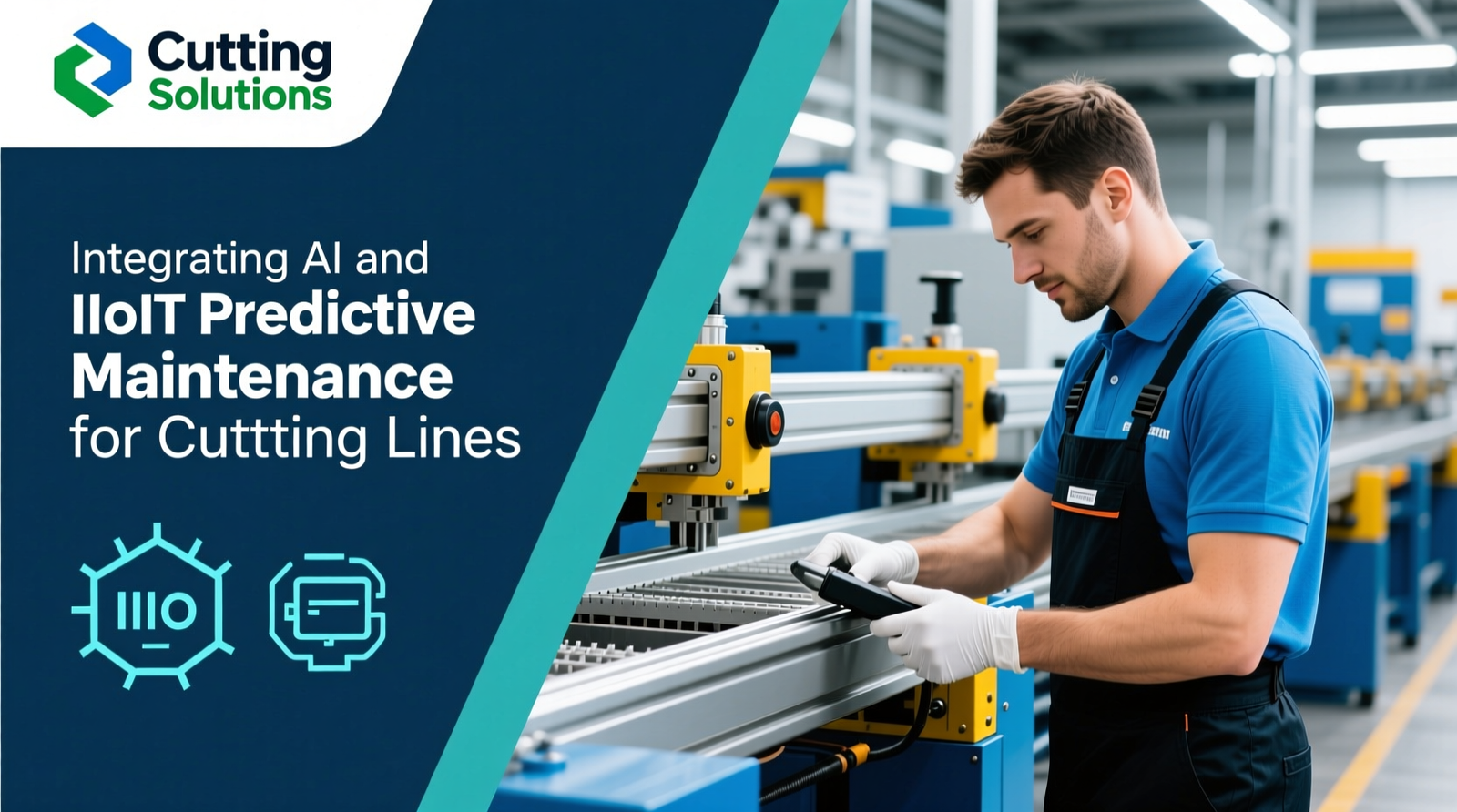
Industrial IoT (IIoT) connects machines, sensors, and software so production data can be used for monitoring and optimization. In cutting, the most practical “first win” is often IIoT predictive maintenance for cutting lines: fewer surprise stoppages, better spares planning, and earlier detection of quality drift.
A minimum viable dataset is usually enough to start—don’t wait for a perfect data lake.
Minimum viable data to start predictive maintenance:
- Cycle time by job/recipe and by shift
- Alarm history (timestamps + fault codes + duration)
- Axis/spindle load (or laser source status/power, pump pressure for waterjet)
- Tool changes/consumable changes (nozzle, abrasive, blade, router bit) with part counts
- Quality signals (scrap reason codes, edge quality rejects, rework triggers)
Where AI helps—concretely:
- Nesting optimization: AI-assisted nesting can reduce offcut and remnant waste (often “a few percentage points” depending on geometry mix and constraints). Treat savings as job-mix dependent and validate with before/after material yield reports.
- Adaptive parameter tuning: detecting drift in kerf, burr, or delamination and adjusting feed/speed/power within the qualified window.
- Anomaly detection: flagging “looks normal to an operator” issues such as gradually rising spindle load or increasing pierce time.
Cybersecurity note: Connected cutting machines expand the attack surface. IEC 62443 is a widely used standard family for industrial automation and control system security; see an overview from the ISA/IEC program at ISA/IEC 62443. Plan for network segmentation, account management, patching, and vendor remote-access governance.
TL;DR: Start smart-cutting projects with a small dataset (cycle time, alarms, loads, consumables). Pair predictive maintenance with basic cybersecurity practices aligned to IEC 62443.
Key Industry Players Shaping the Future of Cutting Machinery
Leading OEMs and integrators are differentiating less on raw mechanics and more on system outcomes: uptime, ease of changeover, integration readiness, and application-specific process knowledge (e.g., waterjet cutting for composites vs. fiber laser sheet cutting vs. die cutting + laminating for packaging).
When comparing suppliers, buyer teams tend to get better results by weighting “operational reality” as highly as headline specifications.
Vendor evaluation checklist (practical):
- Application proof: ask for references in your sector (EV battery components, aerospace honeycomb trimming, flexible packaging lines) and request sample cuts on your material stack.
- Serviceability: mean time to repair targets, spares availability, remote diagnostics policy, and training depth.
- Software openness: export of production data, API availability, and compatibility with your MES/ERP approach.
- Total cost of ownership (TCO): TCO = purchase + installation + energy + consumables + maintenance + downtime risk.
Internal linking cue (do not publish as a link unless you have the page): If your site supports it, add references like “see our guide to selecting industrial laser cutters” or “learn more about laminating vs. die-cutting workflows” to help readers go deeper without repeating content.
TL;DR: The best “industry players” win by proving outcomes: application trials, service depth, data integration, and honest TCO—not just top speed.
2026 Cutting Machinery Innovation Matrix
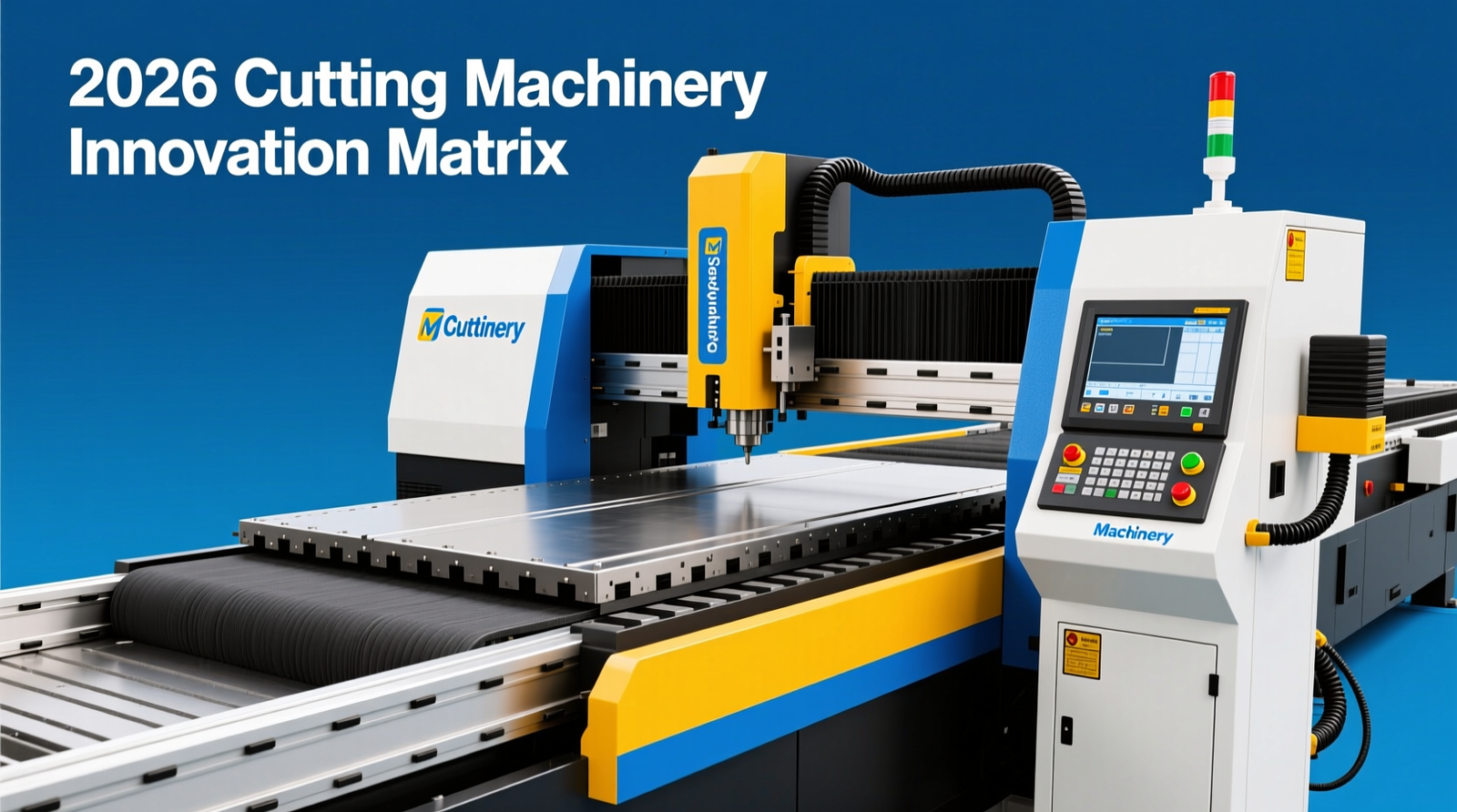
| Innovation/Trend | What it means in practice | Where it shows up first | Adoption status (indicative) |
|---|---|---|---|
| AI-assisted nesting & parameter optimization | Yield-focused nesting, recipe suggestions, and anomaly detection using production history | Sheet metal job shops, flexible packaging, furniture panels | Early adoption → growing |
| Fiber laser upgrades (vs. legacy CO₂) | Higher electrical efficiency and speed on many sheet-metal thickness ranges; simplified optics vs. older systems | CNC laser cutting machines for automotive & metal fabrication | Mainstream (new purchases) |
| IIoT connectivity + predictive maintenance | Remote monitoring, downtime analytics, condition-based maintenance triggers | High-utilization cutting lines and multi-shift operations | Growing toward mainstream |
| Waterjet cutting for composites | Cold cutting to reduce heat-affected issues; abrasive management becomes a key operating cost | Aerospace trims, composite panels, specialty industrial parts | Established in niches |
| Robotic cutting/trim cells | Robots handle part positioning, trimming, and transfer; enables flexible batch sizes | Automotive interiors, packaging finishing, composite trimming | Growing (ROI-dependent) |
TL;DR: Replace “precise adoption %” with what buyers can validate: where each technology is already common (mainstream), expanding (growing), or still niche (established in niches).
Blueprints for Safety and Efficiency in Modern Cutting Machines
Faster axes, higher power density, and more automation raise the stakes for safety design. Safety is not only guarding—it includes control system reliability, risk assessment, and validated safety functions.
Common safety architecture terms:
- Safety PLC: a safety-rated programmable logic controller used for safety functions (e-stop, safe torque off, safe speed monitoring).
- ISO 13849: a key machinery safety standard for safety-related parts of control systems; see ISO’s overview: ISO 13849-1.
- IEC 61508: a foundational functional safety standard used across industries; see IEC’s introduction: IEC functional safety (IEC 61508).
Efficiency and safety increasingly reinforce each other. Better sensing (load, vibration, temperature, position) can reduce crashes, prevent tool breakage, and stabilize quality—while also enabling safer operating modes and quicker recovery from stoppages.
Action steps for practitioners:
- Demand a documented risk assessment and safety function validation plan from the OEM/integrator.
- Audit usability: confirm alarms are actionable, HMI (human-machine interface) workflows are clear, and maintenance access is practical.
- Include safety in TCO: fewer incidents and less damage downtime are measurable benefits, not “soft” gains.
TL;DR: Treat safety as an engineered system (ISO 13849/IEC 61508), not just guarding. Good sensing and usability improve both safety outcomes and uptime.
Laminating Within Cutting Machinery: Servo-Driven Automatic Laminators in Packaging Lines
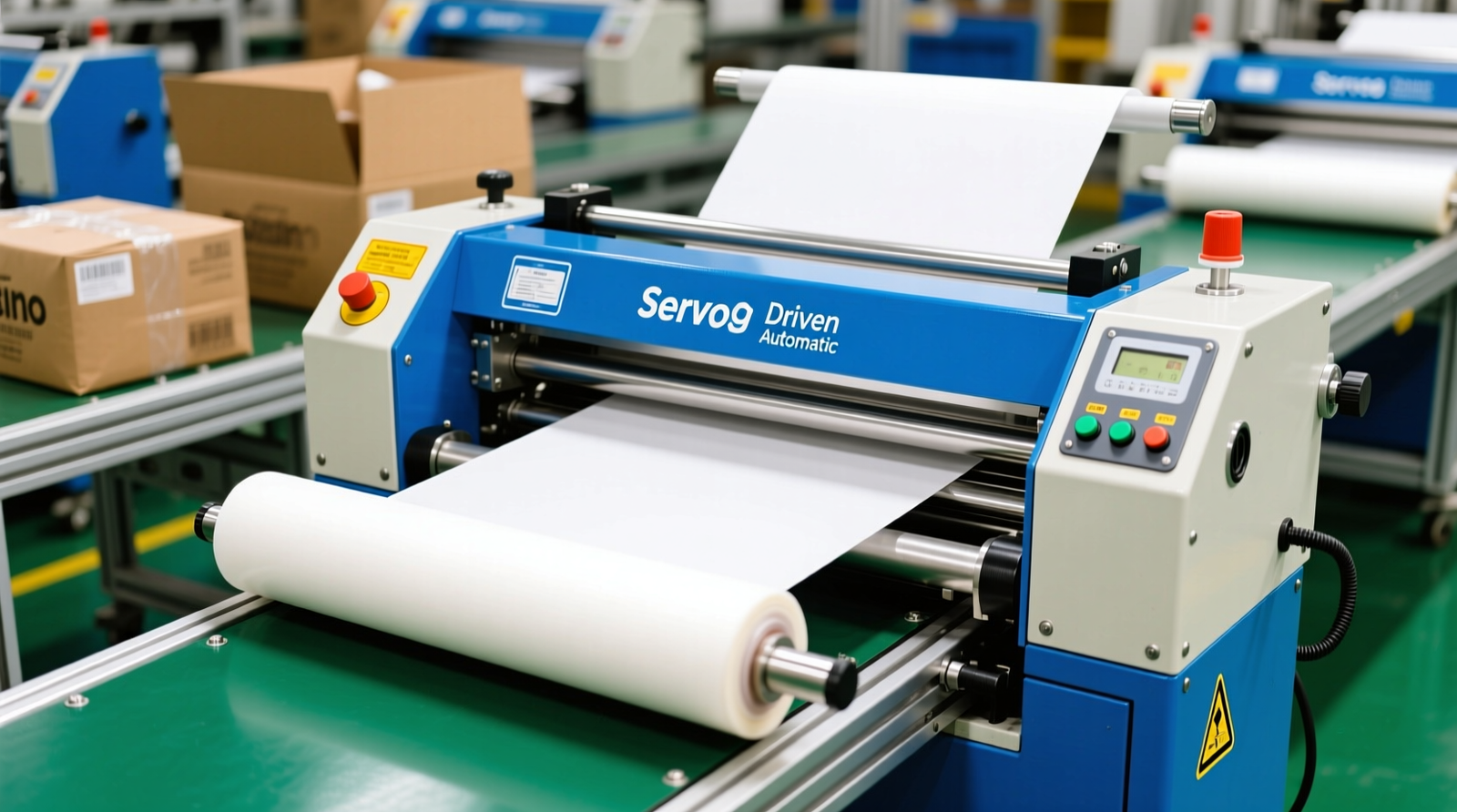
Laminating is part of the broader cutting machinery ecosystem in packaging because it is frequently integrated upstream of die cutting, guillotine cutting, and inspection/stacking. If lamination registration drifts, the die cutter inherits the defect (misregister, poor edge reveal, waste), so converters increasingly evaluate laminators and cutters as one workflow.
The “High-Efficiency Automatic Laminating Machine 1450” is one example of the current high-end direction: servo-driven registration, stable sheet feeding, and tighter alignment control for premium cartons and display packaging. Comparable servo-driven laminators aim to reduce skew and overlap variation to protect downstream die-cut accuracy.
What to look for (practical):
- Registration control: servo-driven lateral/longitudinal correction and how it is verified (sensors, camera marks, encoder feedback).
- Changeover method: recipe management, guided setup, and repeatability when switching substrates.
- Downstream compatibility: ability to hold tolerances required by your die cutter and stripping/blanking stations.
Limitations/considerations (to keep decisions grounded):
- Operator skill still matters: servo control doesn’t eliminate the need for setup discipline and substrate understanding (warp, curl, moisture).
- Maintenance and cleanliness: registration sensors, feeders, and adhesive/coating systems require routine upkeep to sustain accuracy.
- Floor space & infeed/outfeed flow: high-output laminators often need adequate buffer, stacking, and material staging space to avoid bottlenecks.
Balanced equipment symmetry (additional examples): In the same “system thinking” category, many plants pair a fiber laser cutting cell for sheet metal with automated sorting, or a waterjet system for composite trim where heat must be minimized—then tie all assets into a single production reporting layer for OEE (overall equipment effectiveness) tracking.
TL;DR: Laminating matters to cutting because it sets up die cutting quality. Evaluate servo-driven laminators on registration stability, changeover discipline, and downstream die-cut compatibility—and plan for maintenance, space, and training.
Conclusion
The 2026 outlook for cutting machinery is less about one breakthrough and more about execution: qualifying tougher materials, reducing energy per part, automating the true constraint, and using IIoT data to prevent downtime. Buyers that treat equipment as an integrated process (material → cut/laminate → inspect → handle scrap) typically capture the largest gains.
Use sector-specific requirements to steer decisions: EV battery production favors repeatable sheet-metal cutting and traceability, aerospace pushes composite trimming and dust control, and flexible packaging rewards registration stability and servo-driven finishing lines.
TL;DR: Winning cutting lines by 2026 will be those that combine material capability, measurable sustainability, automation with a clear payback model, IIoT-driven uptime, and standards-aligned safety/cybersecurity.
FAQ

Q: Is it worth upgrading from CO₂ laser to fiber laser for sheet metal cutting by 2026?
A: Often yes for high-utilization sheet metal work, because fiber lasers are widely adopted for new purchases and can deliver strong electrical efficiency and speed advantages on many common thicknesses. The decision should be justified with your job mix (materials/thickness), operating hours, assist gas costs, and required edge quality—run sample parts and compare energy-per-part and throughput, not just maximum cutting speed.
Q: How do I justify investment in AI-based nesting software?
A: Start with a baseline of current material yield (usable parts area vs. sheet/roll area) and scrap cost per month. Then pilot AI-assisted nesting on a representative set of jobs for 4–8 weeks and compare yield, programming time, and re-cut/rework rates. Many plants target “a few percentage points” improvement in yield, but the real gain depends on geometry mix, constraints (grain direction, defects), and how well nesting integrates with your CAD/CAM workflow.
Q: What are typical payback periods for robotic cutting cells in packaging or automotive?
A: A common planning range is 18–36 months, depending on shift pattern, labor savings, scrap reduction, and uptime gains (typical range, not a guarantee). Payback is fastest when the robot eliminates a bottleneck (loading/unloading, handling sharp parts) and when scrap is expensive or quality variability is high.
Q: What data do I need to start IIoT predictive maintenance for cutting lines?
A: At minimum: cycle time by job, alarm history with durations, load signals (spindle/axis or relevant process signals like pump pressure), and a log of tool/consumable changes tied to part counts. Add quality outcomes (scrap reasons) as soon as possible so maintenance insights connect to real product impact.
Q: Which safety and cybersecurity standards matter most for modern cutting machines?
A: For machinery safety control systems, ISO 13849 and IEC 61508 are frequently referenced frameworks; for industrial cybersecurity, IEC 62443 is widely used. Ask your OEM/integrator how the machine’s safety functions are validated and how remote access, patching, and network segmentation are handled before connecting equipment to plant networks.