
Introduction
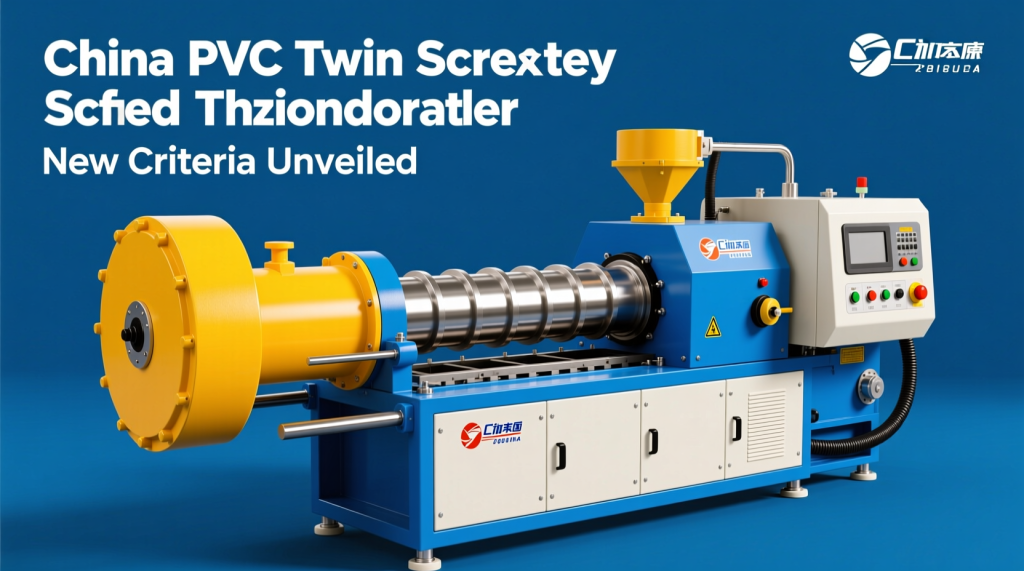
PVC (polyvinyl chloride) extrusion is a high-volume business, but it’s not forgiving: a small mismatch in screw design, drive torque, or temperature control can show up as burn marks, unstable wall thickness, or high scrap. That’s why more buyers now treat the choice of a China PVC twin screw extrusion line supplier as a technical procurement project—not a brochure comparison.
In this guide, you’ll learn how PVC twin screw extruders work in real production, what typically goes wrong with unfamiliar suppliers, how to compare Chinese PVC extrusion machinery suppliers using measurable criteria, and what to ask in an RFQ (request for quotation) before you commit.
- How to size a PVC pipe twin screw extruder from China for your product mix and output targets
- Key screw/barrel materials, gearbox torque, and energy benchmarks to verify
- Common failure modes in poorly designed PVC twin screw extruders (and how to avoid them)
- A practical selection checklist + RFQ questions + FAT (Factory Acceptance Test) acceptance criteria
Note: Examples and performance ranges below are illustrative. Always validate suitability against your own formulation, local standards, and required certifications.
TL;DR: A reliable China PVC twin screw extruder manufacturer is the one that can prove output, energy, wear life, and conformance to your pipe/profile/sheet standard—using data, references, and a test plan.
The Dynamics of Modern PVC Extrusion (and Why Twin Screw Is Often Chosen)
PVC is widely used because it balances cost, stiffness, and chemical resistance. However, PVC is also heat-sensitive: if the melt overheats or stays too long in the barrel, it can degrade and release HCl (hydrogen chloride), causing discoloration, odor, corrosion risk, and unstable mechanical properties. That’s why process stability matters as much as maximum output.
A twin screw extruder (most commonly a counter-rotating conical or parallel twin screw for rigid PVC) is often selected for rigid PVC because it can deliver strong solids conveying, consistent melting, and controlled shear—especially when running:
- High-filler formulations (often CaCO3 / calcium carbonate in the ~10–40 phr range; in some cost-driven pipes it can be higher, which increases torque demand and wear)
- Modern stabilizer packages such as Ca-Zn (calcium-zinc) or tin stabilizers, which can change fusion behavior and processing window
- Regrind/recycled content that increases variability and can raise the risk of gels or volatiles
Typical PVC processing barrel setpoints are often in the broad range of ~160–190°C (exact setpoints depend on formulation and machine design). A good machine design helps keep the melt within a workable “process window” by using properly segmented heating/cooling zones, stable melt pressure, and degassing where required.
For context on PVC piping standards buyers frequently reference, see ISO 1452 (PVC-U piping systems) and ISO 15877 (chlorinated PVC, PVC-C, piping systems). These standards won’t specify your extruder, but they shape dimensional, mechanical, and quality expectations your line must meet.
TL;DR: PVC twin screw extrusion is chosen not just for output, but for stable fusion and temperature control—critical for avoiding PVC degradation and meeting pipe/profile standards.
When a Single Screw Extruder Still Makes Sense (Balanced Comparison)
A single screw extruder can still be appropriate when the process is simpler and the material is more forgiving—for example, some plasticized PVC (P-PVC) applications, certain compounding setups, or situations where mixing demands are modest and the formulation is stable.
That said, rigid PVC pipe and profile production frequently favors twin screw because it can provide stronger solids handling and more consistent fusion at industrial throughput, especially with high filler, recycled content, or stricter dimensional tolerances.
Rule of thumb: If your business depends on rigid PVC pipe/profile consistency (wall thickness, impact, appearance) across multiple formulations and frequent changeovers, a twin screw is often the safer choice.
TL;DR: Single screw can be fine for simpler PVC jobs, but twin screw is typically preferred for rigid PVC with demanding consistency, fillers, or recycled content.
Engineering Excellence and R&D Capabilities (What to Verify, Not Just Hear)
Many supplier websites claim “advanced technology.” A better approach is to evaluate engineering capability through hardware details, measured performance, and the supplier’s ability to explain trade-offs for your exact pipe/profile/sheet requirement. Below are the sub-areas where strong R&D usually shows up.
Screw/Barrel Design Optimization (Materials, Wear, and Common Failure Modes)
L/D ratio (length-to-diameter) is a core design parameter. Many PVC twin screw extruders for pipe/profile fall in the approximate L/D ~22:1 to 36:1 range depending on conical vs. parallel design and application. Longer effective L/D can improve melting and mixing but can also raise residence time—important for heat-sensitive PVC.
Common failure modes in poorly designed PVC twin screw extruders include:
- PVC overheating/degradation: inadequate cooling capacity or poor screw balance causes hot spots, leading to yellowing/browning, odor, and unstable melt pressure.
- Under-degassing: moisture/volatiles remain, showing as surface defects (pitting, bubbles) or weak mechanical performance.
- Rapid wear with fillers: high CaCO3 loading increases abrasive wear; if barrel liners and screw hardfacing are not matched, output drops and melt quality becomes inconsistent.
- Inconsistent fusion: poor screw element geometry leads to unmelted particles (“fish eyes”), dimensional instability, or high scrap during speed changes.
What to ask for in screw and barrel construction:
- Base materials: screws/barrels commonly use 38CrMoAlA (alloy steel) with nitriding (a surface hardening process) for wear resistance.
- High-wear upgrades: bimetallic barrel liners (wear/corrosion resistant alloy lining) and/or hardfacing (wear-resistant weld overlay) on screw flights are often justified when running high filler, recycled content, or corrosive additives.
- Corrosion considerations: some stabilizer packages, recycled streams, or processing upsets can increase corrosion risk—ask what lining/hardfacing is recommended and why.
Practical pitfall with unfamiliar suppliers: the quote may list “nitrided screw and barrel,” but omit nitriding depth, surface hardness range, liner alloy grade, or whether the screw is hardfaced only on certain zones. Those details often determine whether wear life is 6 months or 3+ years in abrasive formulations.
TL;DR: For PVC, screw/barrel design is about controlling heat and wear. Verify L/D, cooling capacity, liner/hardfacing specs, and how the design prevents degradation and abrasion-related output loss.
Drive System Selection (Torque Density, Gearbox, and Output Reality)
For rigid PVC, the drive system is frequently where “paper specs” and real output diverge. Key terms to define and verify:
- Torque density: torque per screw center distance/size (commonly expressed as Nm/cm³ in some contexts). Higher torque density helps maintain output with high filler, lower melt temperature targets, or higher speed. Ask for rated torque and continuous torque limits, not just peak torque.
- Specific energy consumption (SEC): energy per kg of product, typically kWh/kg. For well-optimized rigid PVC pipe lines, buyers often target an SEC benchmark in the rough range of ~0.18–0.35 kWh/kg (depends strongly on pipe diameter, downstream, cooling, plant conditions, and formulation). Ask the supplier to state what is included (extruder only vs. full line).
- Motor efficiency class: IE3/IE4 refers to motor efficiency classes (IEC standards). Higher efficiency reduces running cost, but correct sizing and gearbox matching matter more than the label alone.
Typical output ranges (indicative) for PVC pipe production depend on formulation, pipe standard, screw design, and downstream limitations. As a buyer sanity-check:
- 20–50 mm pipe: often ~80–250 kg/h
- 63–110 mm pipe: often ~200–600 kg/h
- 160–250 mm pipe: often ~450–1,200 kg/h
- 315 mm and above: often ~900–2,000+ kg/h (line design becomes highly application-specific)
Mini case (anonymized): A regional pipe producer running 110 mm U-PVC pressure pipe reported frequent speed reductions due to motor overload alarms and rising melt temperature. After switching to a higher-torque drive with improved barrel cooling and a screw set tuned for their CaCO3 loading, they stabilized at a higher line speed, reducing scrap during ramp-up and cutting measured SEC by approximately ~8–15% over several months (site conditions and measurement boundaries apply).
TL;DR: Validate torque and SEC with clear boundaries and comparable conditions. Output claims are only meaningful when tied to your formulation, pipe spec, and continuous (not peak) drive capability.
Control and Automation Architecture (PLC, Protocols, and Useful Data)

PLC means Programmable Logic Controller, and HMI means Human–Machine Interface. For industrial PVC extrusion, automation quality shows up in repeatability, alarm logic, recipe management, and diagnostics—not screen graphics.
If you plan MES (Manufacturing Execution System) integration, ask what industrial communication protocols are supported, such as OPC UA (Open Platform Communications Unified Architecture), Modbus TCP, or Profinet. Practical data many plants actually monitor includes:
- OEE (Overall Equipment Effectiveness): availability, performance, quality
- Downtime reasons (e.g., die cleaning, haul-off slip, temperature overshoot)
- Batch/lot traceability for raw materials and process parameters
- Energy and output trends for benchmarking and maintenance planning
Mini case (anonymized): A profile producer added recipe control plus automatic ramp-up sequences and improved alarm handling (melt pressure deviation and vacuum instability). They reduced start-up scrap from roughly 3–5% to ~1–2% on frequent color changes by standardizing operator actions and narrowing the start-up window.
TL;DR: Automation should reduce scrap and stabilize start-ups. Confirm PLC/HMI brands, supported protocols (OPC UA/Modbus/Profinet), and exactly which KPIs (OEE, energy, alarms) the system can log and export.
Key Application Scenarios (Pipe, Profile, Sheet) and What “Good” Looks Like
When evaluating a China PVC twin screw extrusion line supplier, ask for references that match your exact product type and standard—not just “PVC pipe line installed.” The same machine family can behave very differently across U-PVC, C-PVC, foamed PVC, or high-regrind recipes.
PVC Pipe Extrusion (Output, Standards, and Process Risks)
PVC pipes commonly include:
- U-PVC (unplasticized PVC): rigid pressure and drainage pipes
- C-PVC (chlorinated PVC): higher-temperature piping
- PVC-O (oriented PVC): typically requires additional orientation steps beyond basic extrusion
Buyers should align equipment capability with relevant pipe norms (depending on market): ISO standards are common globally, while EN standards are widely used in Europe. Start with ISO 1452 for PVC-U and ISO 15877 for PVC-C to frame your dimensional and performance targets.
TL;DR: Pipe extrusion success is measured in stable melt pressure, wall thickness consistency, and standard compliance. Ask for references tied to your diameter range, standard, and formulation.
PVC Profile Extrusion (Dimensional Control and Surface Quality)
Profiles (window frames, wall panels, ducts) are sensitive to:
- melt temperature stability (to prevent gloss/texture shifts)
- pressure stability (to avoid dimensional drift)
- downstream calibration (vacuum calibration, haul-off alignment)
A common pitfall is blaming the die when the real issue is melt instability from screw wear or insufficient cooling. Ask suppliers how they diagnose profile defects: do they measure melt temperature, melt pressure fluctuations, and screw/barrel condition over time?
TL;DR: For profiles, small melt fluctuations become visible defects. Choose suppliers who can troubleshoot with measurements, not guesses.
PVC Sheet and Board (Foam, Density Control, and Mixing Requirements)
Sheet/board lines often need screw designs that handle foaming agents, modifiers, and fillers while keeping thickness and density uniform. In foamed PVC board, controlling cell structure and density is a production differentiator—poor mixing or temperature instability can create streaks, weak spots, or warped boards.
TL;DR: Sheet/board applications are mixing-sensitive. Verify screw design intent (foam vs rigid sheet), venting approach, and thickness/density control strategy.
Quality Management, Compliance, and Testing (How to Validate Claims)
Buyers often get surprised by issues that only appear after installation: electrical noise causing sensor drift, inconsistent heater wiring, or gearbox temperature running high under continuous load. The safest way to reduce these risks is to require clear testing and documentation.
- FAT (Factory Acceptance Test): define a witnessed test with acceptance criteria (output, melt pressure stability, power consumption, safety interlocks).
- Traceability: ask for inspection records for critical parts (gearbox, screws/barrels, heaters, sensors).
- CE context: if selling/operating in Europe, machinery needs to align with the EU Machinery Directive (transitioning to the Machinery Regulation). Ask how the supplier approaches risk assessment, guarding, E-stops, and documentation. Official reference: Directive 2006/42/EC.
How to validate performance without flying a team to China:
- Remote FAT: multi-camera live stream + calibrated power meter readings + timestamped data export
- Third-party verification: use an independent inspector for FAT checklist execution
- Reference line visit: request a site running your diameter range and similar formulation (filler %, stabilizer type)
TL;DR: Reduce surprises by specifying a measurable FAT and compliance documentation (especially CE-related). Validate output and energy with test boundaries and recorded data.
Selection Checklist (Actionable Buyer Tool)
| Selection area | What to request | What “good” looks like |
|---|---|---|
| Application references | Customer list by pipe diameter/product, photos/videos, contactable references | References matching your diameter, standard (ISO/EN), and formulation (filler %, stabilizer) |
| Screw/barrel specs | 38CrMoAlA nitriding depth/hardness, bimetal liner grade, hardfacing zones | Wear package matched to filler/regrind; clear life assumptions and rebuild options |
| Gearbox & torque | Rated/continuous torque, bearing brand/spec, oil cooling, temperature limits | Continuous torque supports your target output without overload alarms |
| Energy data | SEC (kWh/kg) test report boundaries: extruder-only vs full line | Comparable test method + realistic SEC benchmark for your product |
| Automation | PLC/HMI brands, recipe management, data logging, OPC UA/Modbus/Profinet | Repeatable start-ups, useful alarms, exportable data for OEE/traceability |
| Certifications & safety | CE documentation approach, risk assessment, guarding/E-stop logic | Clear compliance package; safety designed-in, not added at the end |
| Service model | Commissioning plan, response time, spare parts lead time, remote support | Defined SLA-style expectations and a realistic spare parts recommendation |
TL;DR: Use a structured checklist to compare Chinese PVC extrusion machinery suppliers on measurable items—materials, torque, energy, automation, compliance, and service—rather than marketing language.
RFQ Questions to Ask Chinese PVC Twin Screw Extruder Manufacturers
- Guaranteed output: “What is the guaranteed output (kg/h) for 110 mm U-PVC pressure pipe to ISO 1452, with CaCO3 at __ phr and Ca-Zn stabilizer system, at continuous operation?”
- Energy boundary: “Provide SEC (kWh/kg) for extruder-only and for full line; specify measurement method and operating point.”
- Process window: “What barrel temperature profile do you recommend and what is the melt temperature target range to avoid degradation? How do you manage overheating risk and HCl release?”
- Wear life: “Under high CaCO3 load (e.g., 25–40 phr), what is the expected screw/barrel life until rebuild? What failure signs should we monitor?”
- Materials & treatments: “Are screws 38CrMoAlA nitrided? Is hardfacing applied? Are barrels bimetal-lined? Provide hardness and lining thickness data.”
- Gearbox sizing: “What is continuous torque rating and thermal limit at our target output? Provide gearbox temperature rise data from FAT.”
- Controls & data: “Can you export recipes and trend data? Which protocols (OPC UA/Modbus TCP/Profinet) are supported?”
- FAT plan: “Provide a FAT procedure with acceptance criteria, instrumentation list, and data deliverables (CSV/PDF).”
TL;DR: An RFQ should force comparable, testable answers: output at your formulation, continuous torque, SEC boundaries, wear package specs, and a FAT plan with acceptance criteria.
Warranty, Service Expectations, and Recommended Spares (First Purchase)

Warranty terms vary by supplier and contract structure, but for a first purchase, buyers commonly negotiate:
- Warranty: typically 12 months after commissioning or 18 months after shipment (confirm which comes first), excluding consumables and wear parts unless otherwise agreed.
- Service response: clear response time for remote support (e.g., same/next business day) and an escalation path for on-site support.
- Spare parts package: a starter kit often includes heaters, thermocouples, pressure sensors, seals, contactors/relays, critical drive belts/couplings (if applicable), and a set of commonly failing pneumatic components. For high-throughput operations, consider budgeting for a spare screw set or at least critical screw elements (depending on design) to reduce downtime.
Common pitfall: new buyers under-order sensors and heaters, then lose days waiting for international shipping when a minor failure occurs.
TL;DR: Negotiate warranty language tied to commissioning, define service response expectations, and buy a realistic spare parts kit so small failures don’t become multi-day shutdowns.
How to Evaluate Blesson (or Any Brand) Using Neutral Criteria
Neutral criteria that apply to any China PVC twin screw extruder manufacturer include: verified application references, clear screw/barrel metallurgy and wear strategy, continuous torque and SEC data, documented FAT, and a service model with defined response and spares support.
Guangdong Blesson Precision Machinery Co., Ltd. can be evaluated using those same criteria—request application-matched references, detailed screw/barrel specs, drive sizing data, and a FAT plan. If you want to review the company’s stated product scope and contact channels, you can visit: https://www.blessonextrusion.com/.
TL;DR: Use the same measurable yardsticks for every supplier. Brand claims matter less than verified data, references, and a testable acceptance plan.
Conclusion (Concrete Next Steps for Buyers)
Choosing a PVC pipe twin screw extruder from China is lowest-risk when you treat it like an engineering project: define targets, request comparable data, and verify performance through testing and references.
Next steps:
- Define your product mix (diameters, standards like ISO/EN, target outputs, recyclate %, filler loading, stabilizer system).
- Baseline your current line: measure scrap rate, downtime reasons, and SEC (kWh/kg) with clear boundaries.
- Shortlist 3–5 Chinese PVC extrusion machinery suppliers and request detailed technical proposals including screw/barrel metallurgy and continuous torque ratings.
- Specify a FAT (remote or on-site) with acceptance criteria for output, stability, energy, safety, and data deliverables.
- Plan commissioning + spares: align warranty terms, response times, and a starter spare parts list before shipment.
TL;DR: Define requirements, build a baseline, shortlist suppliers, insist on a measurable FAT, and lock in service/spares upfront—this is how you buy a China PVC twin screw extrusion line with fewer surprises.
FAQ
Q: How do I size a twin screw extruder for my target PVC pipe diameters and output?
A: Start with your target kg/h by diameter range (e.g., 63–110 mm often targets ~200–600 kg/h, depending on formulation and standard). Then match extruder continuous torque and screw design to your filler loading, stabilizer system, and desired melt temperature. Ask the supplier to state guaranteed output for a specific pipe (e.g., 110 mm U-PVC to ISO 1452) at your formulation and to prove it via FAT data.
Q: What typical maintenance schedule should I plan for screws, barrels, and gearboxes?
A: Plan routine checks per shift/day for temperatures, pressures, vibration/noise, and oil levels; weekly checks for heater/sensor function and cooling performance; and periodic oil analysis for the gearbox. Screw/barrel rebuild intervals depend heavily on CaCO3 level and whether you have bimetallic liners/hardfacing—ask for expected wear life under your filler % and what measurements (output drop, melt pressure change, torque rise) indicate wear.
Q: What are the warning signs of an underpowered drive system or poorly matched screw design?
A: Common signs include frequent motor overload alarms, rising melt temperature at constant output, unstable melt pressure (surging), inability to reach target kg/h without discoloration, and a growing gap between set speed and achievable stable speed. These issues often worsen with higher filler load or recycled content.
Q: What specific energy consumption (kWh/kg) is considered reasonable for rigid PVC pipe extrusion?
A: Many well-optimized lines target a rough benchmark around ~0.18–0.35 kWh/kg, but it varies with diameter, downstream equipment, cooling, and what you include in the measurement boundary (extruder-only vs full line). Always require the supplier to define the boundary and provide measured data from a comparable application.
Q: How can I reduce risk when buying a China PVC twin screw extruder from an unfamiliar supplier?
A: Require detailed metallurgy specs for screws/barrels (e.g., 38CrMoAlA nitriding depth/hardness, bimetal liner grade, hardfacing zones), demand a FAT with acceptance criteria (output, stability, energy, safety), and verify references running similar pipe diameters and formulations. If travel is difficult, use a remote FAT with calibrated power measurements and recorded process trends, plus a third-party inspector for checklist verification.