Introduction
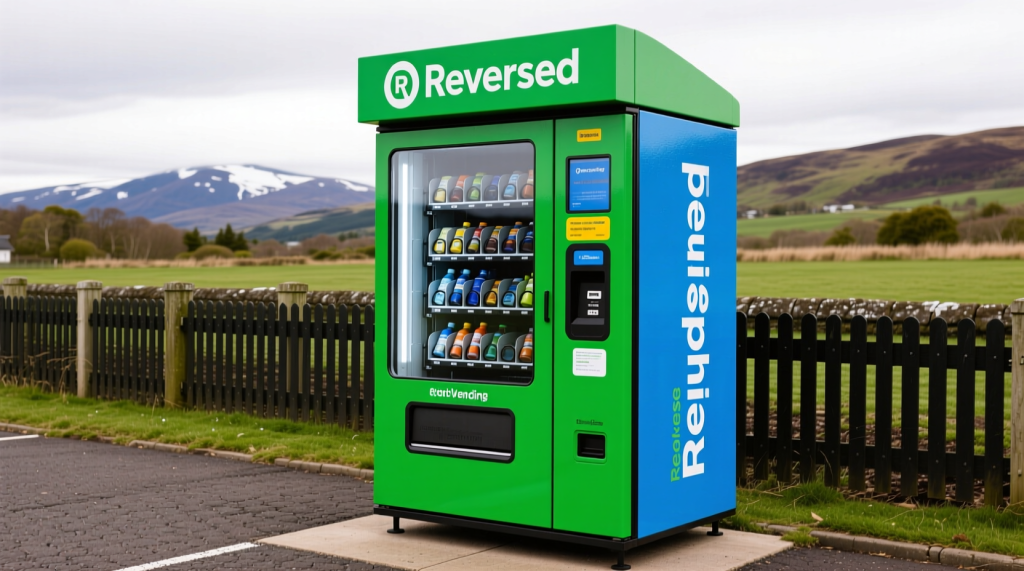
Scotland’s deposit return scheme (DRS) is scheduled to go live in 2027, and many retailers—especially convenience stores and rural shops—are weighing up practical ways to accept returns without turning back-of-house space into a “bag store.” This article looks at a portable reverse vending machine for small shops showcased by CMB RVM Solutions, what “DRS-ready reverse vending machines for retailers” typically need to do (identification, fraud prevention, reporting), and how portable formats can support the circular economy by capturing clean, high-value materials.
For policy context and confirmed updates on timing and scope, see the Scottish Government’s deposit return scheme information: https://www.gov.scot/policies/managing-waste/deposit-return-scheme/.
TL;DR: Scotland’s 2027 DRS deadline is driving demand for Scotland deposit return scheme RVM solutions that work in tight spaces—portable RVMs are one route to meet return obligations while keeping operations manageable.
Portable Reverse Vending Machine Demonstrated in Scotland
CMB RVM Solutions demonstrated a portable reverse vending machine (RVM)—an automated unit that accepts in-scope drink containers and issues a deposit refund—at an event attended by retailers, drinks producers, and policy stakeholders. The emphasis wasn’t “tech for tech’s sake,” but day-to-day usability: can a small shop take returns cleanly, quickly, and with an audit trail?
Unlike full-size, fixed installations that can require dedicated floor space, signage zones, and planned collection routes, a portable RVM is aimed at sites that need mobility and minimal disruption. In practice, portable units in the market are typically designed around:
- Small footprint for front-of-store placement (often near the entrance or by a trolley bay where noise and foot traffic are acceptable).
- Plug-and-play operation (standard mains power, with commissioning done via software setup rather than building works).
- Mobility features such as integrated wheels and/or pallet-base handling so it can be repositioned for cleaning, seasonal peaks, or collection access.
- Contained storage to keep returned containers in an enclosed, more hygienic environment than loose bagging.
Note: Specific numbers such as exact weight, dimensions, and power draw vary by model and configuration. Retailers should request a model datasheet and confirm the final installation plan with the DRS operator and the RVM provider.
TL;DR: The portable RVM format is designed for real retail constraints—tight floor space, limited back room, and the need to move equipment for cleaning or collections—rather than large, fixed “one-size” installs.
How Portable RVMs Work Under a Deposit Return Scheme (DRS)
Under a DRS, consumers pay a small deposit when buying an in-scope drink and get that deposit back when they return the empty container. In the Scottish scheme, key details such as the final deposit value and the final list of in-scope container sizes/materials should be treated as confirmed only when published by the Scottish Government and the scheme administrator. Historically, Scotland consulted on a 20p deposit and a scope focused on single-use drinks containers; however, retailers should rely on current official updates for what will apply at launch.
Operationally, an RVM supports DRS compliance by automating four steps:
- Identification: verifying a container is eligible (commonly using barcode recognition; some systems also use shape/geometry checks to reduce fraud).
- Acceptance & deposit refund: issuing a voucher/receipt or triggering a digital refund flow depending on retailer setup.
- Storage: holding accepted containers securely to reduce handling, odours, and contamination.
- Reporting & reconciliation: logging transactions so deposits can be reconciled with the DRS clearing system (the “clearing system” is the back-end mechanism that validates returns and manages financial settlement between retailers, producers, and the scheme administrator).
Material handling is usually designed around common DRS streams such as PET (polyethylene terephthalate) plastic bottles and metal beverage cans. (Steel cans exist in some markets; the confirmed Scottish material scope should be checked against official scheme documentation.)
Best-practice fraud prevention in RVM deployments typically includes a combination of barcode validation, anti-tamper storage doors, transaction logging, and exception alerts (e.g., repeated attempts with damaged labels). Guidance and evidence on deposit systems and performance is compiled by organisations such as Reloop: https://reloopplatform.org/.
TL;DR: A DRS-ready RVM doesn’t just “take bottles and cans”—it must verify eligibility, issue refunds, secure the material, and produce reliable data for auditing and clearing.
What Makes a Portable Reverse Vending Machine Useful for Small Retailers
For many independent retailers, the make-or-break factor is not whether an RVM can scan a barcode—it’s whether the unit fits the store and the workflow. A portable reverse vending machine for small shops is typically chosen when:
- Space is limited: a smaller unit can sit near the entrance, beside a window line, or at the end of an aisle without requiring structural work.
- Returns are “lumpy”: rural shops often see peaks (weekends, paydays, tourist season). Portability helps reposition the unit to reduce queue interference.
- Collections need flexibility: being able to roll or pallet-move a machine can make it easier for staff and collection teams to access storage without blocking customer areas.
Portable units can also reduce the operational burden compared with manual take-back (bags behind the till, staff counting, hygiene issues), but they introduce practical considerations such as noise, queue management, and ensuring the machine is reachable for users of different heights and abilities.
TL;DR: Portability matters because it supports store layout realities—peak-time queues, cleaning, and collections—rather than forcing a small retailer into a fixed, high-disruption installation.
Mini Case Scenario: A Rural Convenience Store Integrating a Portable RVM
Scenario: A rural convenience store with a single main entrance, two tills, and limited back-room storage expects returns to ramp up after the DRS launch. The shop averages 150–300 returned containers per day in summer (tourist season) but closer to 60–120 per day in winter. (These are example planning ranges; actual volumes vary by catchment and scheme behaviour.)
Placement: The store positions a portable RVM just inside the entrance, angled so the user stands out of the main queue line. A small “return here” floor marker helps prevent customers blocking the doorway.
Staff workflow:
- Morning: staff wipe down the user-facing surfaces, check the internal storage level, and confirm the printer paper (if voucher-based).
- During the day: the unit handles acceptance automatically; staff intervene only on exceptions (e.g., unreadable barcode, crushed container).
- End of day: a shift lead checks the transaction report for anomalies (spikes, repeated rejects) and confirms the day’s totals for reconciliation.
Collections: On collection day, the portability helps: staff roll the unit a short distance to allow safe access, or move it slightly to give the collector clear working space. This reduces the temptation to store overflow bags in customer areas.
Operational watch-outs: peak-time queues can still happen; the store mitigates this by posting simple instructions (e.g., “empty, not crushed, barcode visible”) and by keeping the unit accessible but not obstructive.
TL;DR: A portable RVM can fit into a small rural shop without a refit—if you plan placement, queue flow, and collection access from day one.
Key Considerations for Retailers (Practical Checklist)
If you’re evaluating Scotland deposit return scheme RVM solutions, this retailer-focused checklist helps turn “DRS readiness” into an implementable plan:
- Space & footprint: measure the intended location and keep a standing area clear for users. Ask the supplier for the exact footprint and required clearance for doors/service panels.
- Power supply: confirm a standard mains socket location and avoid trailing cables across walkways. Request the unit’s rated power consumption and any requirements for surge protection.
- Noise: RVMs can generate audible noise during validation and internal handling. Consider positioning away from quiet zones (e.g., cafés) and ask for typical operating dB(A) values if available.
- Access for collection: plan how full containers are removed and where the collector will stand. Ensure safe manual handling and avoid blocking fire exits.
- Staff training: train staff on common rejects (damaged barcode, crushed containers), jam-clearing procedures (if permitted), and escalation to service.
- Cleaning & hygiene: set a cleaning schedule (daily wipe-down; periodic deeper clean) and specify what products are safe for machine surfaces.
- Maintenance cycle: agree service intervals, response times, and remote diagnostics. Clarify what counts as user-maintainable (e.g., paper roll) versus engineer-only access.
TL;DR: Retail success depends on basics—space, power, noise, access, training, and cleaning—more than marketing claims.
Data, POS Integration, and Compliance Reporting
For retailers and policymakers, “does it accept containers?” is only half the question. The other half is data integrity—how returns are recorded, audited, and reconciled.
Common data and integration features in DRS-ready reverse vending machines for retailers include:
- Transaction logs & audit trails: time-stamped records of accepted/rejected items to support dispute resolution and compliance checks.
- Retailer reporting dashboards: daily/weekly summaries for operational planning (collections frequency, peak return times).
- Voucher/POS workflows: vouchers can be redeemed at the POS (point of sale) like a coupon, which helps track refunds and reduce manual errors.
- Clearing-system readiness: export formats and connectivity aligned to scheme requirements (final details depend on the DRS administrator’s technical specifications).
From a compliance perspective, better data reduces the risk of mismatched refunds, improves forecasting for collections, and supports more transparent reporting to the scheme administrator.
TL;DR: Choose an RVM setup that produces clear, auditable data and fits your voucher/POS process—reconciliation is where many retailers feel the real operational pressure.
International Performance Benchmarks (Why RVM Design Matters)
Well-run deposit systems consistently deliver high return rates, but the results depend on convenience, reliability, and fraud controls. For example:
- Norway: Infinitum (the Norwegian DRS operator) reports return rates around the low-to-mid 90% range in recent years (commonly cited at roughly ~92%). Source: Infinitum statistics and annual reporting—see https://infinitum.no/.
- Lithuania: USAD (the Lithuanian DRS administrator) reports return rates above 90% after rollout maturity. Source: USAD—see https://uzstatas.lt/en/.
These benchmarks matter for Scotland because they show what’s achievable when the consumer experience is straightforward and the retail network has adequate, reliable return infrastructure—including options suitable for small-format stores.
TL;DR: High return rates (90%+) are not theoretical—countries with mature DRS systems achieve them, typically with widespread, easy-to-use return points and strong operational controls.
CMB RVM Solutions: What’s Distinct (and What to Verify)
CMB RVM Solutions is presented as a joint initiative backed by CMbE (Crown), Returmatic Solutions, and Pure Recycle, aiming to supply multiple RVM sizes including portable formats. For buyers comparing providers, the most useful differentiators to confirm in writing are not slogans—they’re operational commitments and measurable specs.
When assessing CMB RVM Solutions (or any competing vendor), request verifiable detail on:
- UK service coverage and response times: engineer availability, spare parts, and target restoration times (often expressed as SLA—Service Level Agreement).
- Uptime expectations: typical availability targets and what’s included (remote monitoring, proactive maintenance).
- Mobility and handling method: whether the unit is designed for wheeling by staff, pallet movement by pump truck, or both.
- Commissioning process: how quickly a site can go live (network setup, voucher configuration, reporting setup).
- Data & security features: authentication, audit logs, and tamper-resistant storage access.
Important: If a supplier claims a machine is “British-made” or “built for Scotland DRS,” ask for manufacturing location details and a compliance mapping to the scheme’s published technical requirements once finalised.
TL;DR: The meaningful differentiators are service model, uptime, mobility/handling, commissioning speed, and data security—get these as written commitments, not brochure language.
Total Cost of Ownership (TCO) and Commercial Options
Total cost of ownership (TCO) is the full cost to run an RVM over time, not just the upfront price. For DRS deployment, TCO discussions typically include:
- Purchase vs lease: leasing can reduce upfront capital but may include contract terms for service, consumables, and minimum periods.
- Service and maintenance: planned maintenance, call-outs, parts, and whether remote diagnostics are included.
- Consumables: printer paper/labels (where applicable) and cleaning supplies.
- Operational impacts: staff time for exception handling, cleaning, and end-of-day checks.
- Collection logistics: how often collections are needed based on capacity and local return volumes.
To avoid surprises, decision-makers should ask vendors for an “all-in” cost model tied to a realistic weekly container volume and a site-specific collection plan.
TL;DR: The cheapest machine is rarely the cheapest programme—compare lease/purchase, service, consumables, staff time, and collections as one TCO model.
How Retailers Can Implement Portable RVMs Ahead of 2027 (Step-by-Step)

Retailers aiming to be ready early can use this practical rollout sequence:
- Confirm obligations and store role: track official scheme updates and clarify whether your site must offer returns and what exceptions may apply. Start with the Scottish Government DRS page: https://www.gov.scot/policies/managing-waste/deposit-return-scheme/.
- Estimate volumes: forecast daily/weekly container returns based on footfall, nearby competitors, and seasonality.
- Choose the right format: decide whether a portable reverse vending machine for small shops fits best, or whether a higher-capacity fixed unit is needed.
- Plan the store layout: map customer flow, queue space, accessibility, and collection access. Include signage and “how to return” instructions.
- Define refund method: voucher-at-till versus other approaches, and how it will be processed at POS.
- Set operating procedures: cleaning routines, exception handling, paper roll changes, and end-of-day reconciliation checks.
- Test and iterate: run a pilot period, monitor rejects/jams/peak-time queuing, then adjust placement and instructions.
TL;DR: Start with obligations and volume forecasting, then design layout + refund workflow + SOPs; a short pilot period usually pays for itself in fewer operational headaches later.
Conclusion
Portable RVMs won’t solve every challenge—peak-time queues, storage capacity, and collection routing still need planning—but they can make DRS participation achievable for space-constrained sites that would struggle with fixed installations. With Scotland targeting a 2027 go-live, retailers and policymakers can use portable deployments to expand coverage, improve consumer convenience, and increase the likelihood of return rates approaching the 90%+ outcomes seen in mature international DRS systems.
TL;DR: A portable RVM is a practical route to widen Scotland’s retail return network ahead of 2027—provided service support, data reporting, and on-site workflow are planned as carefully as the machine choice.
FAQ
Q: What is a portable reverse vending machine for small shops, and what makes it “portable”?
A: A portable reverse vending machine (RVM) is a compact DRS return unit designed to be moved within a store (or between locations) more easily than a fixed installation. “Portable” typically means features like integrated wheels and/or a pallet-base handling design, plus plug-and-play power and quicker commissioning—so retailers can reposition it for cleaning, peak periods, or collection access.
Q: What containers will be in scope for Scotland’s deposit return scheme, and what deposit value will apply?
A: The final scope (materials and container size range in ml/litres) and the deposit value should be treated as confirmed only when published in official Scottish DRS documentation. Retailers should monitor Scottish Government updates here: https://www.gov.scot/policies/managing-waste/deposit-return-scheme/.
Q: What are the installation and maintenance requirements for a portable RVM?
A: Most portable RVMs are designed for minimal installation: a suitable floor location, standard mains power, and enough clearance for users and servicing. Maintenance typically includes daily wipe-down cleaning, periodic deeper cleaning, replacing consumables (e.g., voucher paper if used), and scheduled servicing. Retailers should ask for the supplier’s service intervals, remote monitoring options, and target response times (SLA).
Q: How does RVM data integrate with POS systems and DRS clearing for compliance?
A: Commonly, the RVM issues a voucher that can be redeemed at the POS (point of sale), creating an auditable record of refunds. The RVM also generates transaction logs and reports that can be shared with the DRS clearing system (the scheme’s reconciliation platform) based on the administrator’s technical specifications. This helps retailers track returns, reconcile refunds, and support audits.
Q: How long does a typical return transaction take, and is it accessible to all users?
A: Transaction time varies by machine and user behaviour, but returning one container is typically a matter of seconds; returning a bag of items can take a few minutes depending on queueing and reject rates. Accessibility depends on placement and interface height/visibility—retailers should leave clear standing space, ensure instructions are readable, and position the unit so it doesn’t block entrances or create unsafe crowding during peak times.