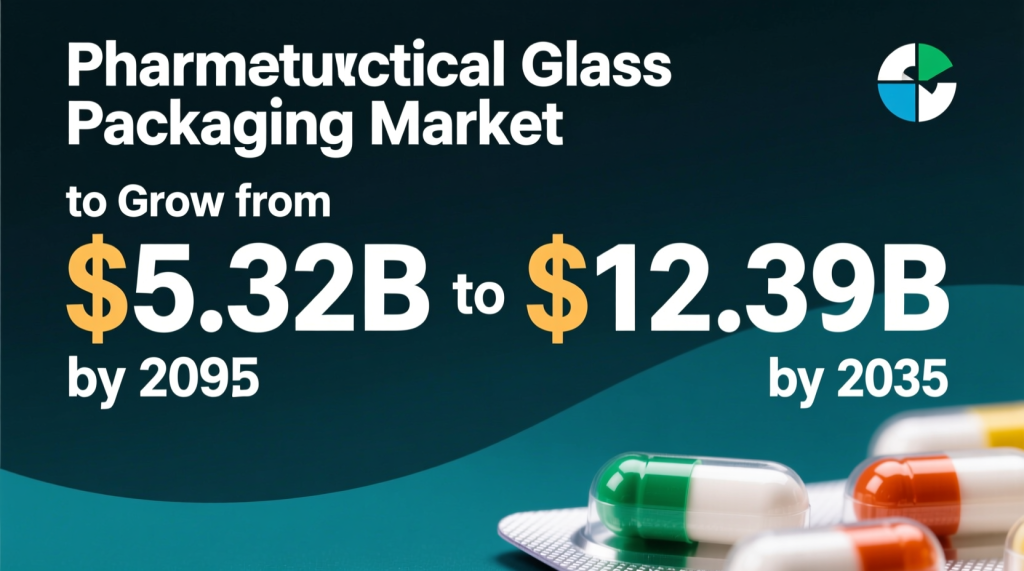
Europe Pharmaceutical Glass Packaging Market Snapshot (2025–2035)

- Market size & outlook: The global pharmaceutical glass packaging market was estimated at USD 5.32 billion in 2025 and is projected to reach ~USD 12.39 billion by 2035 (Towards Packaging/Precedence Research).
- Growth signal (CAGR): Based on those endpoints, the implied global compound annual growth rate (CAGR) for 2025–2035 is approximately 8.8%.
- Europe’s role: Europe is a mature, highly regulated market shaped by EU packaging rules, anti-counterfeiting requirements, and strong demand for sterile injectables.
- Key demand drivers: Biologics, vaccines, GLP-1 therapies, self-administration formats (prefilled syringes/cartridges), and ready-to-use components for aseptic fill-finish.
- Leading countries: Germany is a major hub; France, Italy, Spain, and the UK also contribute materially.
Pharmaceutical glass packaging in Europe supports drug stability, sterility, and patient safety across vaccines, biologics, and other high-value injectables. As regulatory scrutiny tightens and supply chains are re-evaluated for resilience, European demand is increasingly focused on high-quality primary containers, faster lead times, and compliance-ready traceability features.
TL;DR: The market outlook to 2035 is strongly tied to sterile injectables growth, EU regulation, and investment in higher-quality, more traceable, lower-carbon glass manufacturing.
What Is Europe Pharmaceutical Glass Packaging?
Pharmaceutical glass packaging in Europe refers to medical-grade glass containers and systems used to store and deliver medicines under EU and national quality requirements.
At the outset, it helps to distinguish:
- Primary packaging: Materials that directly contact the drug product (e.g., vials, ampoules, prefillable syringes, cartridges, bottles).
- Secondary packaging: Outer packaging that does not contact the product but carries labeling and security features (e.g., cartons, tamper-evident seals, serialization labels).
Typical primary pharmaceutical glass formats include:
- Vials (small and large) for injectables and vaccines
- Ampoules for single-dose sterile injectable drugs
- Cartridges and prefillable syringes for self-administration and chronic therapies
- Bottles for oral liquids, syrups, and specialty formulations
Glass remains widely selected in primary packaging because it offers low permeability to gases/moisture, high temperature tolerance for sterilization processes, and a long track record with sensitive parenteral (injectable) products. Within procurement discussions such as “Type I vs Type II glass for injectables,” the choice typically comes down to formulation risk, stability requirements, and cost/availability.
TL;DR: Primary glass touches the drug (vials/ampoules/syringes), while secondary packaging carries labeling and anti-counterfeiting—EU rules affect both, but in different ways.
Regulatory Landscape for Pharmaceutical Glass in Europe

European policy affects pharmaceutical glass packaging through three main levers: (1) product safety and quality, (2) anti-counterfeiting/traceability, and (3) sustainability and waste rules. Many requirements land on secondary packaging (e.g., serialization on cartons), but they increasingly influence primary packaging choices and design controls (e.g., pack integrity, inspection, labeling compatibility, and data carriers on primary packs).
Falsified Medicines Directive (FMD) and EMVS
The Falsified Medicines Directive (FMD) is implemented via Commission Delegated Regulation (EU) 2016/161 and requires safety features for most prescription medicines. In practice, compliance is enabled by the European Medicines Verification System (EMVS), a network used to verify authenticity at dispensing points. Official reference: European Commission – Falsified Medicines Directive and EMVO – EMVS.
While FMD is primarily executed on secondary packaging (2D code + tamper-evident device on the carton), Europe is also seeing more demand for primary-pack traceability features (especially for hospital injectables and clinical supply chains) such as serialization-compatible labeling and machine-readable marks on vials.
EU Pharmaceutical Legislation Reform (“Pharma Package”, 2023 proposals)
The EU’s 2023 pharmaceutical legislation proposals (often called the “Pharma Package”) aim to update rules affecting medicine access, security of supply, and environmental considerations. Official proposal pages: European Commission – Pharmaceutical Strategy for Europe.
Note on proposals and ongoing negotiations
Some initiatives referenced in market discussions—such as elements of the evolving packaging framework and supply security measures—may be proposals under negotiation and can change during the legislative process. Buyers and manufacturers should monitor final delegated acts, implementation timelines, and guidance updates.
TL;DR: FMD/EMVS drives traceability (mainly on cartons), while EU pharma reforms and supply-security initiatives influence packaging expectations and investment plans—some measures are still evolving.
Sustainability Requirements for Pharmaceutical Containers in the EU
EU sustainability policy increasingly impacts both primary and secondary pharmaceutical packaging through recyclability targets, packaging minimization, and emissions pressure on energy-intensive glass melting.
Packaging and Packaging Waste Regulation (PPWR) (proposal; under negotiation)
The Packaging and Packaging Waste Regulation (PPWR) is intended to replace the current Packaging and Packaging Waste Directive and introduce EU-wide requirements such as recyclability and packaging waste reduction measures. Because the PPWR has been under negotiation, organizations tracking “EU PPWR impact on pharma packaging” should treat dates and obligations as subject to final text. Official reference: European Commission – Packaging waste.
Circular Economy Action Plan (CEAP) (2020)
The Circular Economy Action Plan (CEAP) (adopted in 2020) is a major pillar of the European Green Deal and influences packaging design rules and recyclability expectations. Official reference: European Commission – CEAP.
EU Emissions Trading System (EU ETS)
The EU Emissions Trading System (EU ETS) puts a carbon price on emissions for covered sectors. For glass manufacturing, this increases the business case for furnace efficiency upgrades, electrification, and greater cullet (recycled glass) use where quality requirements allow. Official reference: European Commission – EU ETS.
TL;DR: EU sustainability policy pressures packaging design (PPWR/CEAP) and manufacturing emissions (EU ETS), accelerating lightweighting, recycled-content strategies, and furnace upgrades—while pharma quality constraints remain non-negotiable.
Quality Standards and Technical Terms Buyers Should Know

European purchasing and QA teams frequently align container decisions to pharmacopeial and regulatory expectations for container-closure systems.
- Ph. Eur. = European Pharmacopoeia, which includes quality standards for materials and containers. See: EDQM – European Pharmacopoeia.
- GMP = Good Manufacturing Practice, the baseline quality system for pharma manufacturing and packaging.
- EMA = European Medicines Agency, which publishes guidance relevant to quality, including packaging and container-closure expectations. See: EMA – Quality guidelines.
- E&L = Extractables and Leachables (chemicals that can migrate from packaging into the drug under certain conditions).
TL;DR: Procurement decisions in Europe are anchored to Ph. Eur. expectations, GMP, and EMA quality guidance—especially around container-closure performance and chemical compatibility (E&L).
Latest Key Trends in the Europe Pharmaceutical Glass Packaging Market
1) Injectable and Biologics Demand Is Reshaping Formats
As pipelines skew toward biologics (large-molecule medicines such as monoclonal antibodies) and injectable delivery, demand is increasing for:
- High-quality tubular vials and ampoules suitable for sensitive formulations
- Cartridges and prefillable syringes used in autoinjectors and pen systems
- RTU = ready-to-use components (washed/sterilized/nested) and RTF = ready-to-fill formats that streamline aseptic operations
2) Decarbonization Is Moving from Pledges to Capex
Instead of generic “green innovation,” the market is increasingly shaped by concrete investments: furnace rebuild cycles, hybrid/electric melting pilots, energy-efficiency retrofits, and more rigorous supplier carbon reporting—driven by EU ETS economics and customer procurement requirements.
3) Smart, Secure, and Compliance-Ready Packaging Features
Beyond carton-level serialization, several European supply chains are adopting more granular features for hospital workflows and high-value injectables:
- 2D Data Matrix codes on labels (and in some pilots directly on primary packs) to carry identifiers such as GTIN, serial number, expiry, and batch
- Serialization and aggregation schemes aligned to EMVS processes (verification at dispensing and decommissioning)
- RFID = radio-frequency identification and NFC = near-field communication enabled closures/labels for authentication and inventory control (use case dependent)
TL;DR: Europe’s growth is led by injectables and biologics, capex in lower-carbon manufacturing, and more sophisticated traceability tools (2D codes, serialization workflows, RFID/NFC) tied to compliance realities.
Technical Challenges in Pharmaceutical Glass (and How Europe Mitigates Risk)

Performance failures in primary packaging can lead to batch rejection, recalls, or regulatory findings. The most discussed technical risks include:
- Delamination: Flaking of thin glass layers into the product, often linked to surface chemistry, forming conditions, and certain formulations.
- Breakage: Mechanical failure during filling, freeze-drying (lyophilization), transportation, or use—especially relevant for high-speed lines and cold-chain logistics.
- Extractables/leachables (E&L): Potential chemical interaction between product and container/closure system that can impact stability or safety.
- Particulate contamination: Particles from glass, elastomers, processing, or environment; critical due to injectable safety expectations and visual inspection requirements.
European providers and users mitigate these issues through:
- Surface treatments/coatings to reduce friction, improve break resistance, and lower interaction risk for certain products
- Improved forming controls (thermal profiles, annealing) to reduce internal stresses and cosmetic/critical defects
- Higher automation and 100% inline inspection (camera/laser-based dimensional and defect checks) to lower defect escape rates
- More stringent incoming QC and stability studies, including E&L assessments at the container-closure system level
TL;DR: The biggest glass risks are delamination, breakage, E&L, and particulates—mitigated through coatings, tighter forming control, robust inline inspection, and container-closure focused qualification.
Growth Outlook: How Fast Is the Europe Pharmaceutical Glass Packaging Market Growing?
Across 2025–2035, growth is expected to be supported by chronic disease burden, aging demographics, and continued expansion in sterile injectables and self-administration devices.
CAGR context:
- Global CAGR (implied): ~8.8% from the 2025 estimate (USD 5.32B) to the 2035 projection (USD 12.39B) based on the cited study endpoints.
- Europe CAGR (indicative): Many industry forecasts place Europe in a mid-to-high single-digit CAGR range over similar horizons, typically slightly below the global rate due to market maturity. If you share your Europe base and 2035 forecast values, this section can be updated with an exact Europe CAGR for 2025–2035.
Germany remains a key contributor due to its manufacturing base and strong quality culture, while France, Italy, Spain, and the UK support demand through hospital networks, immunization programs, and biopharma activity.
TL;DR: The global market implies ~8.8% CAGR (2025–2035); Europe typically tracks mid-to-high single digits, with Germany and major Western European markets leading demand for sterile formats.
Country Analysis: Europe Pharmaceutical Glass Packaging Market

Germany
Germany is a major hub for pharmaceutical manufacturing, CDMOs (contract development and manufacturing organizations), and packaging operations, supporting sustained demand for high-quality sterile containers. A notable trend is greater automation in forming and inspection systems to reduce particulate/defect risk and support high-speed fill-finish.
United Kingdom (UK)
The UK market is supported by a strong life sciences ecosystem and strict oversight by the MHRA (Medicines and Healthcare products Regulatory Agency) alongside continued alignment with many EU quality expectations. Demand is steady for injectable formats, especially where Type I borosilicate is specified for sensitive drug products.
TL;DR: Germany leads through manufacturing scale and automation; the UK remains a steady, quality-driven market aligned to stringent regulatory expectations.
Segment Analysis of the Europe Pharmaceutical Glass Packaging Market
By Product Type
Bottles remain important for oral liquids and certain specialty formulations, but sterile formats (vials/ampoules/syringes) increasingly drive value growth due to higher technical requirements.
Ampoules can see faster growth in specific sterile single-dose use cases because of hermetic sealing and contamination control benefits, alongside ongoing improvements in break resistance and usability.
TL;DR: Bottles dominate many oral-liquid volumes, while higher-value growth often concentrates in sterile formats (vials/ampoules/prefillables) due to stricter performance requirements.
By Glass Type
Type I borosilicate glass is widely used for parenterals and sensitive formulations due to high hydrolytic resistance and thermal shock performance (key for sterilization and lyophilization cycles).
Type II (treated soda-lime) glass is often selected for less demanding parenteral formulations where cost and availability are key decision factors, provided compatibility and stability data support it.
TL;DR: Type I is the default for sensitive injectables; Type II can be a cost/availability option for suitable formulations when data demonstrate compatibility.
By Drug Type
Branded drugs often specify tighter performance requirements and qualification depth for container-closure systems, particularly for specialty injectables and global supply chains.
Generic drugs grow quickly in high-volume categories, pushing buyers to balance compliance and stability requirements with cost, lead time, and supply resilience.
Biologics continue to increase demand for higher-quality sterile primary packaging and RTU/RTF supply, given the sensitivity of many large-molecule formulations.
TL;DR: Branded products tend to drive higher-spec packaging; generics drive volume and cost focus; biologics drive the tightest performance and qualification expectations.
Recent Innovations and Breakthroughs

Innovation is increasingly focused on label/closure systems compatible with recyclability goals and digital traceability needs. For example, Avery Dennison has showcased wash-off label technologies and connectivity-oriented concepts at industry events, reflecting how secondary components are being redesigned to reduce recycling friction and support authentication.
When evaluating such launches, buyers should ask practical questions: Does the label adhesive wash off in standard recycling processes? Is the data carrier robust under cold-chain, sterilization, or abrasion? Does it integrate with warehouse and EMVS-related workflows?
TL;DR: Innovation is shifting toward recyclable label systems and traceability-ready components—buyers should validate recyclability performance and data durability in real operating conditions.
Leading Companies in the Europe Pharmaceutical Glass Packaging Market
Europe is served by global and regional suppliers spanning tubular conversion, molded glass, RTU platforms, and inspection/quality systems. If you are benchmarking “pharmaceutical glass vials manufacturers in Europe,” focus less on marketing claims and more on differentiators such as tubing quality control, forming capability, coating options, RTU capacity, and defect-detection performance.
- SCHOTT Pharma – Borosilicate containers and systems for sterile injectables; notable for RTU offerings and pharma-grade processing capabilities.
- Gerresheimer – Broad portfolio across vials, syringes, and drug-delivery-related packaging; active in ready-to-fill supply and integrated solutions.
- Stevanato Group – Tubular conversion and RTU platforms (e.g., EZ-fill® ready-to-use configurations), widely used in aseptic fill-finish operations.
- SGD Pharma – Molded and tubular glass with surface-treatment options to support compatibility needs for certain products.
- Bormioli Pharma – Glass containers and packaging systems across oral and parenteral applications, often bundled with closure/dosing components.
- Nipro – Global supplier with sterile packaging systems and high-volume capabilities.
TL;DR: When comparing suppliers, prioritize capacity, RTU/RTF readiness, coating and inspection capability, and documented quality performance—over broad positioning statements.
Implications for Manufacturers and Buyers

For pharmaceutical companies, CDMOs, and packagers, the 2025–2035 period is less about “whether glass” and more about which specifications, which supply model, and how to derisk.
- Align container selection to formulation risk: Evaluate Type I vs Type II glass for injectables using stability/E&L and delamination risk assessments, not only cost.
- Plan for RTU/RTF capacity constraints: RTU demand can tighten lead times; dual-source strategies and early forecast sharing can reduce line stoppages.
- Design packaging with EU sustainability rules in mind: Track PPWR/CEAP developments and validate recyclability impacts of labels, inks, and closures—especially for secondary packaging.
- Upgrade inspection and contamination control: For sterile injectables, invest in inspection capability and QA sampling plans that reflect particulate expectations and defect-criticality.
- Budget for energy-driven cost volatility: Glass costs can be sensitive to energy prices and furnace rebuild cycles; incorporate energy-index clauses and longer-term supply agreements where appropriate.
- Strengthen supply-chain resilience: Map single points of failure (tubing, coatings, sterilization/nesting, stoppers) and qualify alternates before demand peaks.
TL;DR: Buyers should focus on qualification (Type I/II), RTU/RTF supply planning, recyclability impacts (especially secondary components), stronger inspection controls, and cost/resilience planning tied to energy and capacity realities.
Conclusion
Europe’s pharmaceutical glass packaging market outlook to 2035 is shaped by sterile injectable growth, tighter traceability expectations, and EU-driven sustainability and emissions pressures. The most visible shifts are practical: more RTU/RTF adoption, higher automation and inspection intensity, and investment cycles aimed at lower-carbon, more efficient melting and forming.
Because parts of the EU policy landscape (notably PPWR details) may still evolve, companies that combine strong compliance monitoring with rigorous container-closure qualification and resilient sourcing will be best positioned to manage risk and maintain supply continuity.
TL;DR: The winners will be those who pair high-quality sterile packaging capability with compliance-ready traceability and realistic decarbonization/capacity investments—while staying agile as EU rules finalize.
FAQ

Q: How does the Falsified Medicines Directive (FMD) affect pharmaceutical glass packaging in Europe?
A: FMD primarily requires a 2D Data Matrix and tamper-evident features on secondary packs (cartons), verified through the EMVS. However, it indirectly impacts glass packaging by driving compatibility with serialized workflows, label performance requirements, and—in some supply chains—greater interest in primary-pack identification for hospital injectables.
Q: What is the EU PPWR impact on pharma packaging, and does it apply to primary glass containers?
A: The PPWR aims to harmonize EU packaging rules around waste reduction and recyclability. While specific obligations depend on the final text, it can influence both primary and secondary packaging through design-for-recycling expectations, packaging minimization, and documentation requirements. Pharma quality constraints remain paramount, so changes are typically implemented via validated materials and processes.
Q: Type I vs Type II glass for injectables—how do buyers decide?
A: Type I (borosilicate) is often preferred for sensitive or higher-risk injectable formulations due to strong hydrolytic resistance and thermal performance. Type II (treated soda-lime) can be appropriate for certain formulations where compatibility is demonstrated via stability and extractables/leachables studies. The decision should be data-driven and formulation-specific.
Q: What are the main technical failure modes for pharmaceutical glass vials in Europe?
A: Key issues include delamination, breakage, particulate contamination, and extractables/leachables risks at the container-closure system level. European mitigation typically combines coatings or surface treatments, improved forming/annealing controls, and high-coverage inline inspection with robust QA qualification.
Q: How can pharmaceutical companies reduce lead-time and supply risk for RTU vials and syringes in Europe?
A: Practical steps include dual sourcing, early demand forecasting, qualifying alternate configurations (e.g., nested formats, stopper/closure options), and aligning specifications to what suppliers can support at scale. Contracting strategies that consider energy and capacity constraints can also improve supply continuity.