Audience note: This guide is written for in-house counsel, IP counsel, compliance leaders, and business executives at agricultural, construction, and industrial original equipment manufacturers (OEMs) (i.e., companies that design and sell equipment under their own brands) evaluating a Section 337 ITC (U.S. International Trade Commission) strategy.
Innovation at the Intersection of Machinery and Global Trade
Modern agricultural and industrial machinery is reshaping how we produce food, build infrastructure, and manage supply chains. Today’s platforms are no longer “dumb iron.” They are smart, connected systems that blend hardware, embedded software, sensors, and data services.
Examples include:
- Autonomous tractors and precision agriculture platforms
- Digitally controlled harvesters with telematics (remote data collection/transmission for diagnostics, location, and performance)
- Road construction and milling machines integrated with GPS (Global Positioning System) and robotics
- Compact equipment using AI (artificial intelligence) to optimize performance and safety (often protected by software patents, trade secrets, and copyright)
These machines can represent billions of dollars in cumulative R&D (research and development), dealer/service networks, and compliance investments (safety, emissions, and increasingly cybersecurity). OEMs typically protect that investment with a layered intellectual property (IP) stack: patents, trade secrets, trademarks, copyrights, and data-driven know-how.
At the same time, globalized manufacturing and faster product cycles increase the risk that infringing, counterfeit, or gray-market goods enter the U.S. quickly—undermining the innovation that differentiates equipment manufacturers.
External reference: For the statutory framework, see 19 U.S.C. § 1337 (Section 337) and the ITC’s overview of Section 337 investigations.
TL;DR: Connected equipment concentrates valuable IP (software + hardware) and raises import-driven infringement risk—making Section 337 ITC for equipment manufacturers a practical, business-critical enforcement option.
Gray-Market Imports: A Persistent Challenge in Heavy Equipment
Gray-market imports are genuine products sold through unauthorized channels—typically units intended for foreign markets that are imported into the U.S. without the OEM’s permission.
Even when the equipment is authentic, the differences can be significant. Foreign-market machines may have:
- Different safety features or operator protections
- Different emissions controls (potentially non-compliant with U.S. requirements)
- Different software/telematics packages or feature locks
- No U.S.-valid warranties or proper dealer service support
- Non-aligned parts, manuals, or compliance labeling
Risk Point: Safety and regulatory mismatch can create real exposure. Customers may not realize they purchased a non-U.S. configuration, but they often blame the brand if an incident occurs.
Because Section 337 remedies operate at the border, OEMs often view the ITC as a primary venue for ITC gray-market enforcement, particularly where trademark rights and “material differences” can be proven.
External reference: For how border enforcement works in practice, see U.S. Customs and Border Protection (CBP) information on Intellectual Property Rights (IPR) enforcement.
TL;DR: Gray-market equipment can be “genuine” but still risky; Section 337 can stop unauthorized imports at entry points when trademark/IP theories and material differences are well documented.
Why the ITC Matters: Speed, Scope, and Strategic Leverage
Section 337 of the Tariff Act authorizes the ITC to investigate “unfair acts” in importation, including infringement of U.S. patents, trademarks, and copyrights (and certain unfair competition theories). For OEMs, the ITC is often the fastest route to market-access relief through enforceable orders directed to CBP.
Powerful Border-Focused Remedies
Unlike federal district courts (which focus heavily on damages), the ITC can issue injunctive-style remedies against imported products, including:
- Exclusion orders (limited or general) directing CBP to block covered imports
- Cease-and-desist orders stopping domestic sale/marketing of covered inventory
Practical Tip: Exclusion orders can be outcome-determinative for ITC exclusion orders for heavy machinery because equipment supply chains often involve imported subsystems, attachments, and replacement parts—not just whole machines.
Faster Resolution Than District Court Litigation
Many investigations proceed on a target schedule of roughly 16–18 months from institution to final determination (timelines vary by case complexity and procedural events). District court cases can take multiple years to reach trial and final judgment.
Practical Tip: Speed matters when the import stream can “tip” dealer relationships or fleet standardization during a single buying cycle.
Public-Interest Review (Usually Favorable, Occasionally Limiting)
The ITC must consider public-interest factors before issuing exclusionary relief, including impacts on:
- Public health and welfare
- Competitive conditions in the U.S. economy
- U.S. production of like or directly competitive articles
- U.S. consumers
Relief is granted in most cases where a violation is found, but public interest can rarely narrow, tailor, or delay relief—for example, where an exclusion order could disrupt supply of a product needed for a critical infrastructure or health/safety application and there is limited alternative supply.
External reference: See the ITC’s public materials describing its Section 337 process (including remedy and public-interest considerations).
TL;DR: The ITC’s value proposition is fast, border-enforceable relief; public-interest review is real but seldom blocks remedies outright.
A Layered IP Landscape: Why Machinery Is in the Crosshairs
Modern equipment platforms combine multiple categories of protectable IP, including:
- Utility patents (functional inventions): mechanical systems, hydraulics, controls, sensor fusion, autonomy stacks, electrified drivetrains, and battery/charging management
- Design patents (ornamental designs): exterior panels, cab layouts, GUIs (graphical user interfaces), and distinctive attachment shapes
- Trade secrets: software source code, calibration parameters, model training data pipelines, manufacturing process settings, and diagnostic logic
- Trademarks/trade dress: brand identifiers and distinctive product appearance
- Copyright: software code, certain UI elements, manuals, and technical documentation
Practical Tip: “Smart equipment” features often create mixed IP issues: e.g., a telematics dashboard may implicate patents (data processing), copyright (software/UI), and trade secrets (back-end analytics). That mix can influence what you assert at the ITC and what you reserve for district court.
Because infringement and unauthorized channels often cross borders, OEMs frequently pair an ITC filing with other proceedings, including district court and foreign enforcement. (If patents are also challenged at the PTAB—the Patent Trial and Appeal Board—coordination is essential because validity disputes can affect leverage and timing.)
TL;DR: Equipment IP is layered (patent + software + brand). The ITC is often the “market access” anchor while other venues address damages, validity battles, or regional sales.
Key ITC Case Studies in Agricultural Machinery (and What They Teach)

Below are examples commonly cited in discussions of ITC enforcement in agriculture and equipment distribution. Because ITC dockets can include multiple Commission opinions, remands, and related proceedings, OEMs should confirm the latest posture directly from the ITC’s official docket system.
External reference (official case lookup): Use the ITC’s EDIS docket system (Electronic Document Information System) to confirm investigation numbers, filings, and final Commission determinations.
Tama Group & John Deere – Wrapping Materials and Harvesting Systems (Inv. No. 337-TA-1210)
This matter is frequently cited for a core Section 337 lesson: even with strong merits positions, complainants can lose if they do not satisfy the ITC domestic industry requirement (explained further below).
Risk Point: Where the Commission concludes the economic prong evidence is insufficient (e.g., inadequate linkage of U.S. investments to articles practicing the asserted claims), exclusionary relief can be denied—regardless of infringement allegations.
Practical Tip: If your domestic industry theory relies on partnerships, integration, or downstream use (e.g., an asserted technology used in a larger harvester ecosystem), you typically still need clear evidence of qualifying U.S. investments tied to an article that practices the asserted claims.
TL;DR: The “economic prong” can decide the case; build domestic industry proof early and tie spend/people/assets directly to claim-practicing articles.
Deere & Company – Gray-Market Forage Harvesters (Inv. No. 337-TA-487)
Deere’s gray-market investigation is widely discussed as an example of trademark-based Section 337 enforcement where material differences (differences consumers would consider relevant) can support relief against unauthorized imports.
Risk Point: In gray-market matters, success often turns on proof of (1) trademark rights, (2) material differences between authorized U.S. goods and imported goods, and (3) harm to consumer expectations, safety/compliance, and brand integrity.
TL;DR: For gray-market disputes, well-documented “material differences” (including safety/emissions/software configuration) are central to winning exclusionary relief.
Kubota Corporation – Small Tractors and Trademark Enforcement (Inv. No. 337-TA-380)
Kubota’s matter is often cited for the ITC’s enforcement muscle after an order issues.
Practical Tip: Section 337 is not only about winning an exclusion order—it’s also about monitoring compliance and using ITC enforcement proceedings and penalties when respondents violate orders.
TL;DR: The ITC can enforce its orders and impose meaningful penalties for noncompliance—useful in repeat gray-market channels.
Industrial Machinery: Section 337 Beyond Agriculture
The ITC’s role in machinery enforcement extends well beyond farm equipment. Construction, mining, and roadbuilding OEMs use Section 337 to protect mechanical inventions, electronics/control systems, and branded distribution.
Bobcat v. Caterpillar – Compact Equipment and Control Systems (Inv. No. 337-TA-1473) (Status Check Needed)
The prior draft referenced “late 2025,” which is future-dated and may be inaccurate depending on when the complaint was actually filed and whether the ITC instituted an investigation. Because investigation status can change quickly (institution, termination, settlement, or procedural orders), this section should be treated as illustrative unless and until confirmed via the ITC’s official docket.
Action for accuracy: Before publishing as a factual case summary, confirm (1) the institution date, (2) the asserted patents and accused products, and (3) the current posture in EDIS. If your intent is a hypothetical scenario, label it explicitly (e.g., “Hypothetical example: Bobcat v. Caterpillar-style dispute”).
TL;DR: Treat this investigation number and “late 2025” timing as unverified until confirmed on the ITC docket; update with official institution/termination details or frame as hypothetical.
Wirtgen America v. Caterpillar – Road Milling Technology (Inv. No. 337-TA-1067)
This investigation is commonly cited as a roadbuilding/heavy equipment example where patent claims directed to complex machinery and control features were litigated in a fast-moving ITC schedule, alongside parallel district court, foreign, and validity proceedings.
Practical Tip: In complex equipment matters, claim charts and source/assembly evidence for imported components can be as important as proof on the finished machine—especially when respondents attempt to shift manufacturing steps across borders.
TL;DR: Patent-based ITC cases can be effective for complex heavy machinery, particularly when imports of machines and key components can be targeted.
Caterpillar – Hydraulic Excavators and Gray-Market Imports (Inv. No. 337-TA-582)
This matter is often referenced in discussions of broad border relief where unauthorized channels appear widespread and hard to police respondent-by-respondent.
Practical Tip: If the evidence shows systemic infringement/unauthorized importation and difficulty identifying all sources, OEMs sometimes seek a general exclusion order (GEO) (a remedy that can apply to infringing goods from any source, not just named respondents). GEO standards are demanding; plan evidence accordingly.
TL;DR: For pervasive gray-market conduct, broad border remedies may be possible—but they require strong proof and careful product identification for enforcement.
Advantages of ITC Actions for Agricultural and Industrial Equipment Companies

For OEMs, the ITC is often the best tool when the primary goal is to stop import-driven unfair competition quickly and protect market access.
Fast, Decisive Relief and Border Control
Section 337 cases often conclude faster than district court litigation. That speed helps equipment manufacturers:
- Interrupt infringing and gray-market import pipelines
- Protect dealer networks and fleet-spec standardization
- Reduce safety/compliance exposure from non-U.S. configurations
TL;DR: If imports are the problem, the ITC’s speed and border remedies can protect market access when timing matters.
Strategic Leverage in Global IP Disputes
Because machinery supply chains are global, OEMs often use the ITC as part of a broader enforcement plan that can include U.S. district court (damages), foreign litigation (regional relief), and administrative validity challenges (e.g., PTAB).
Practical Tip: ITC pressure can accelerate real business outcomes—licenses, supply re-structuring, authorized channel agreements, or design-around commitments—because the risk is exclusion from the U.S. market.
TL;DR: The ITC is a high-leverage venue when the U.S. market matters to the respondent and imports are the choke point.
Protection Against Gray-Market Channels
In gray-market disputes, exclusion orders can shut down unauthorized pipelines that undermine:
- Authorized dealer territory structures
- Pricing models across regions
- Safety, emissions, and support expectations tied to the brand
TL;DR: For unauthorized import channels, Section 337 can be a direct way to align distribution with compliance and brand-control needs.
Challenges and Limitations of ITC Litigation
Section 337 is powerful, but not universal. Understanding constraints early prevents expensive missteps.
Resource-Intensive and Compressed Timelines
ITC proceedings are fast and demanding. Budgets may be comparable to complex district court litigation, but incurred over a shorter window.
Risk Point: The accelerated schedule compresses discovery, expert work, and hearing prep. If internal data (R&D spend, engineering time, import data, product versions) is not organized, you can lose momentum quickly.
TL;DR: The ITC’s speed is an advantage only if you can staff and document the case early.
The Domestic Industry Requirement (Including Licensing-Based Industries)
To obtain relief, a complainant must prove a domestic industry relating to the asserted IP. This generally has:
- Technical prong: at least one claim of each asserted patent is practiced by an article in the U.S. (made, used, sold, or licensed)
- Economic prong: “significant” or “substantial” U.S. investment in plant/equipment, labor/capital, engineering/R&D, or licensing
Nuance: A licensing-based domestic industry can satisfy the economic prong through licensing activities and related investments (e.g., licensing personnel, negotiation efforts, technical support for licensees, and other commercialization activities). Non-practicing entities (NPEs) are not categorically barred, but they may face closer scrutiny on whether their investments are sufficiently tied to exploitation of the asserted IP rather than litigation alone.
Practical Tip: Build your domestic industry narrative like an audit: people, spend, facilities, and projects mapped to the products (or license program) that practice the asserted claims.
TL;DR: Winning often hinges on the economic prong—manufacturing and R&D help, but licensing investments can also qualify when properly documented.
Limited to Imports and No Monetary Damages
The ITC addresses unfair acts in importation; it is not a forum for purely domestic infringement. Also:
- The ITC does not award monetary damages.
- Core remedies are exclusion orders and cease-and-desist orders (plus penalties for violations).
TL;DR: If you need damages, you usually need district court too; the ITC is primarily about stopping imports and controlling market access.
Strategic Considerations for Counsel and In-House Teams (with Scenarios and Timelines)

For equipment manufacturers, Section 337 should be designed into a broader enforcement architecture—especially where product redesigns, component sourcing, and global sales strategies are moving targets.
When to Prioritize the ITC vs. District Court (Example Scenarios)
Scenario A (prioritize ITC): A competing importer is rapidly gaining share with an infringing attachment or subsystem used across multiple machine platforms. You need border relief fast to protect dealer channels and installed-base parts revenue.
Scenario B (prioritize district court): The main harm is lost U.S. licensing revenue and you need damages discovery (and potentially a jury trial), while import volumes are low or uncertain.
Scenario C (dual-track): You need an exclusion order to stop the bleeding and damages for past sales. A common plan is ITC for market access + district court for damages, coordinated with a validity defense strategy at the PTAB where appropriate.
TL;DR: Choose the forum based on business outcomes: market access (ITC), money (district court), or both (dual-track).
Typical ITC Timeline and Milestones (High-Level)
- Pre-filing (weeks to months): investigation, claim charts, domestic industry package, respondent/import mapping
- Complaint filed → Institution: the Commission decides whether to institute an investigation
- Discovery + Markman-like claim issues: fast technical and economic discovery; expert reports
- Evidentiary hearing (trial): before an ALJ (Administrative Law Judge)
- Initial Determination (ID): ALJ decision on violation
- Commission review and final determination: potential review of the ID; remedy/public-interest briefing
- Remedy implementation: exclusion order administration through CBP; potential enforcement proceedings
Practical Tip: Assume respondents will pursue design-arounds. Plan early for how you will evaluate redesigns and, if needed, seek follow-on enforcement (e.g., advisory opinions or enforcement proceedings) and provide CBP with updated guidance.
TL;DR: ITC milestones arrive quickly; build the record early and plan for redesigns and Customs implementation from day one.
Practical Steps Before Filing a Section 337 Complaint (OEM Checklist)
- Run an internal IP audit: confirm ownership, inventorship chain, and enforceability; identify best patents/trademarks for an ITC theory.
- Map patents to product features: build claim charts tied to observable features, teardown evidence, and importable components/subsystems.
- Package domestic industry evidence: quantify U.S. investments (engineering hours, R&D spend, facilities, tooling, testing, and/or licensing investments) and tie them to claim-practicing articles.
- Build an import and respondent map: identify manufacturers, exporters, importers, and key SKUs/part numbers (plus Harmonized Tariff Schedule classifications where relevant).
- Draft a CBP enforcement plan early: start a product identification guide template and anticipate likely design-arounds/circumvention.
- Coordinate with foreign counsel: align claim scope, infringement positions, protective orders, and timing with EU/China/other actions to avoid inconsistent positions.
TL;DR: The strongest ITC filings begin as operational projects: claim charts + domestic industry package + respondent/import mapping + a Customs enforcement playbook.
Working with U.S. Customs After an Exclusion Order Issues (Implementation-Focused)
Winning a Section 337 investigation is only half the job. Real-world success depends on execution with CBP to ensure the exclusion order is enforceable and enforced.
Key steps OEMs often take include:
- Prepare product identification guides: part numbers, photos, distinguishing features, packaging labels, manuals, and known variants; include how to spot design-arounds.
- Train CBP personnel (as appropriate): explain the product family, typical shipping configurations, and the easiest “tells” for covered goods.
- Address misclassification/circumvention: monitor suspicious tariff classifications, transshipment patterns, and component-level imports intended to evade scope.
- Monitor import data: track trade flows, importer-of-record changes, and repeat actors; use findings to support enforcement requests if violations continue.
Risk Point: If the order’s scope is hard to apply at the border, enforcement can become inconsistent. Clear identification materials and rapid updates for redesigns materially improve outcomes.
External reference: See CBP’s general resources on IPR border enforcement and the ITC’s Section 337 overview at usitc.gov.
TL;DR: Treat Customs implementation as a project: identification guides, training, anti-circumvention monitoring, and redesign tracking are what make exclusion orders work.
ITC vs. District Court vs. Foreign Courts (Decision-Maker Comparison Table)
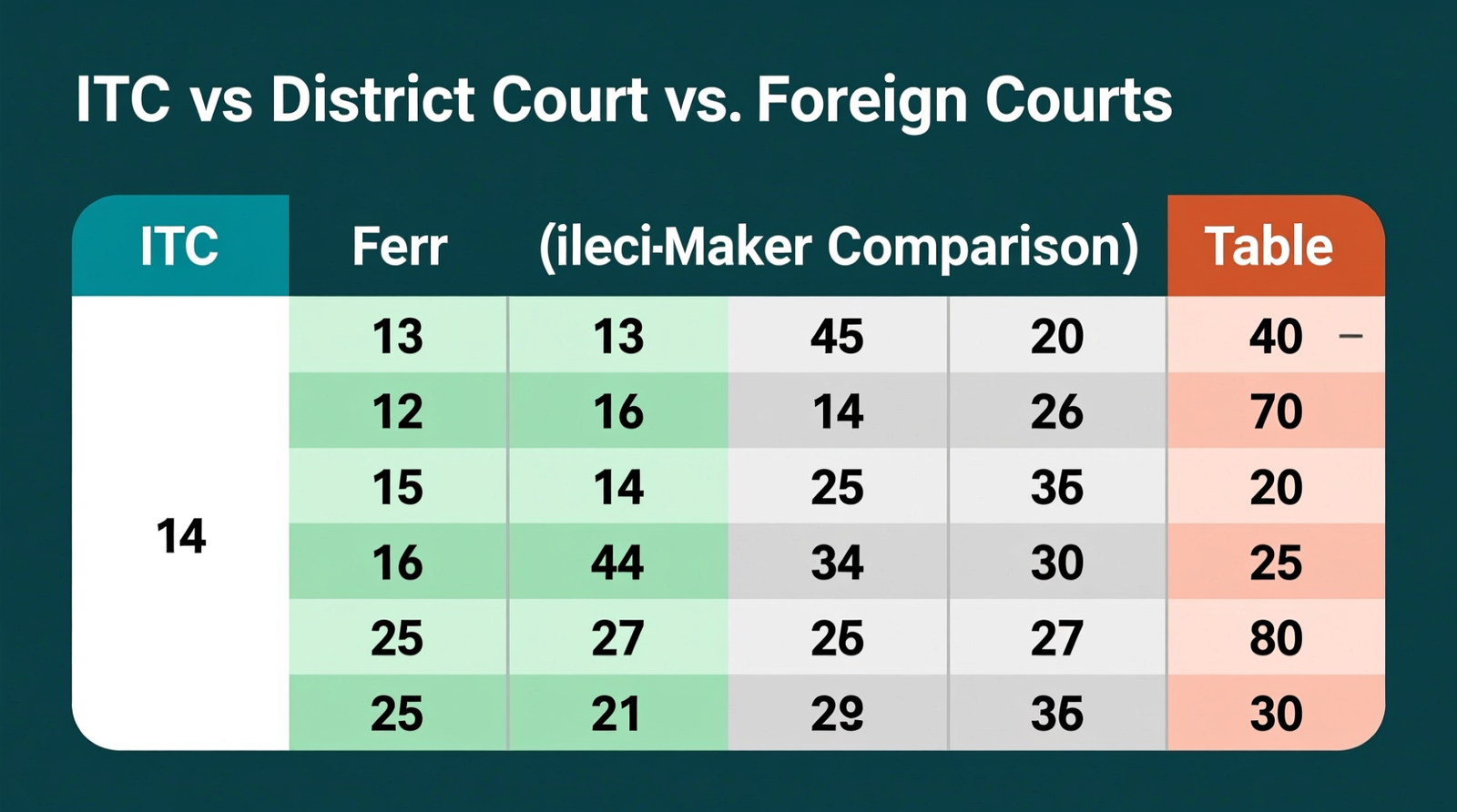
| Factor | ITC (Section 337) | U.S. District Court | Foreign Courts (varies) |
|---|---|---|---|
| Speed | Often ~16–18 months to final determination (varies) | Often multi-year to trial/judgment | Highly variable by country/court |
| Remedies | Exclusion orders + cease-and-desist orders (border-focused) | Damages; injunctions possible under eBay factors | Injunctions/damages depend on jurisdiction |
| Damages | No | Yes | Often yes (varies) |
| Discovery | Fast, intensive, ALJ-managed | Broader discovery tools; slower pace | Varies widely; some jurisdictions are narrower |
| Public-interest review | Required before exclusionary relief; rarely limits relief | Not an ITC-style statutory public-interest test | Varies; competition/public policy can matter in some venues |
| Best for | Stopping import-driven infringement and gray-market channels | Recovering money and litigating broader domestic conduct | Regional market control, local damages, and multi-jurisdiction pressure |
TL;DR: Use the ITC for fast import-focused relief, district court for damages and domestic conduct, and foreign courts to extend pressure and remedies across markets.
Looking Ahead: ITC Enforcement in an Era of Smart, Connected Equipment
As machinery incorporates autonomy, electrification, connectivity, and software-driven optimization, Section 337 disputes increasingly involve mixed technology stacks: sensors, controllers, firmware, cloud connectivity, and UI/UX (user interface/user experience).
In this environment:
- ITC exclusion orders can remain critical for blocking infringing imported hardware, subsystems, and replacement parts.
- Software and telematics claims may require tighter proof strategies—e.g., demonstrating how imported devices practice claim steps or enable infringing behavior after importation.
- Respondents may attempt design-arounds (redesigns intended to avoid infringement). Complainants often need follow-on strategies: updated CBP guidance, enforcement proceedings, or advisory opinions to address near-copy redesigns and circumvention attempts.
Practical Tip: When drafting the complaint and remedy proposals, think ahead about how CBP will identify covered goods and how you will handle iterative redesigns during the investigation and after the order issues.
TL;DR: Smart equipment increases IP complexity and redesign risk—making integrated ITC + Customs execution and redesign monitoring essential.
FAQ

Q: How does Section 337 ITC for equipment manufacturers differ from a normal patent lawsuit?
A: Section 337 investigations focus on imports and can deliver fast, border-enforceable remedies (exclusion orders and cease-and-desist orders). A district court patent case can award damages, but it is typically slower and does not directly instruct CBP to block imports.
Q: What is the ITC domestic industry requirement, and can licensing satisfy it?
A: The domestic industry requirement has a technical prong (a U.S. article practices at least one asserted claim) and an economic prong (significant/substantial U.S. investment in manufacturing, R&D, engineering, labor/capital, or licensing). In appropriate cases, licensing-related investments can satisfy the economic prong if they are well documented and tied to exploitation of the asserted IP.
Q: How do OEMs use the ITC for gray-market enforcement of heavy machinery?
A: OEMs commonly assert trademark-based theories where unauthorized imports are materially different from authorized U.S. versions—differences can include safety features, emissions configurations, software/telematics packages, or warranty/support. If proven, the ITC can issue exclusion orders to block those gray-market imports at the border.
Q: What should an OEM prepare for Customs to make an ITC exclusion order effective?
A: OEMs should prepare a product identification guide (photos, part numbers, variants, distinguishing features), anticipate design-arounds, and establish a process to train and update CBP contacts. Monitoring import data and suspicious tariff classifications can also help detect circumvention.
Q: When is a dual-track plan (ITC + district court) worth it for heavy equipment IP disputes?
A: A dual-track plan often makes sense when the OEM needs quick market-access relief to stop imports (ITC) and also needs damages for past harm (district court). It is most effective when the team coordinates claim positions, discovery strategy, and redesign/circumvention responses across both proceedings.