
Quick snapshot: Caterpillar (NYSE: CAT) and the AI data center infrastructure thesis
Caterpillar (ticker: CAT) is a global manufacturer of construction and mining equipment and a major supplier of power systems (generator sets, engines, and integrated energy solutions). The AI-infrastructure investment angle is straightforward: rapid expansion of hyperscale (very large cloud-provider) and colocation (third-party multi-tenant) data centers is driving demand for (1) heavy equipment used in campus construction and (2) on-site power solutions—especially large standby generators and microgrids—used for reliability, commissioning, and grid-constraint mitigation. CAT shares have also outperformed many benchmarks over the last few years, though returns vary by date window and market regime (investors should compare against indices like the S&P 500 and the S&P 500 Industrials).
Source note: This article is written from an industrials-and-energy infrastructure research perspective and relies on publicly available company filings/presentations plus external industry forecasts (linked).
TL;DR: CAT’s AI link is “picks-and-shovels” (build + power). The key investor question is materiality—how much is actually data-center related—and whether that upside is already priced in.
Caterpillar power systems in hyperscale facilities: what’s actually used (and why)
Data centers are increasingly built like power plants with servers attached. They require redundancy, commissioning support, and sometimes temporary or longer-duration on-site generation when grid interconnect (the high-voltage connection approval/build-out process) is delayed. Caterpillar participates mainly through its Energy & Transportation segment (often abbreviated E&T) via Cat-branded power solutions.
Product lines most directly tied to AI data centers:
- Large diesel gensets (generator sets): commonly deployed for standby/backup and testing. Hyperscale designs frequently use multiple units in parallel (N+1 or 2N redundancy), with per-unit ratings often in the ~2–4 MW class, depending on configuration and emissions requirements.
- Large gas gensets: used where natural gas supply and permitting support lower local emissions vs diesel. Gas can be attractive for longer runtimes where “backup” starts to resemble “behind-the-meter generation.”
- Microgrids: a coordinated system of on-site generation, controls, and sometimes storage that can operate with or without the utility grid. (A microgrid controller optimizes dispatch, load shedding, and synchronization.)
- Energy storage (typically battery energy storage paired with controls): supports ride-through, peak shaving, and smoother generator operation; complements UPS (uninterruptible power supply—batteries/flywheels that bridge short interruptions) rather than replacing it.
- Switchgear (high-power electrical switching and protection equipment): essential for paralleling multiple gensets, isolating faults, and safely transferring loads.
Typical customer types and project scopes (non-confidential examples): hyperscale cloud regions, AI training clusters, and large colocation campuses. Project scopes often involve multiple buildings (“halls”), phased commissioning, and a standardized backup architecture replicated across sites—creating repeat demand for generation packages, controls, and service agreements.
TL;DR: CAT’s clearest AI-data-center exposure is through large standby/prime generation packages + microgrid controls + switchgear, sold to hyperscale and colo developers building multi-phase campuses.
Caterpillar generators for AI data centers vs alternatives (grid, fuel cells, renewable-plus-storage)
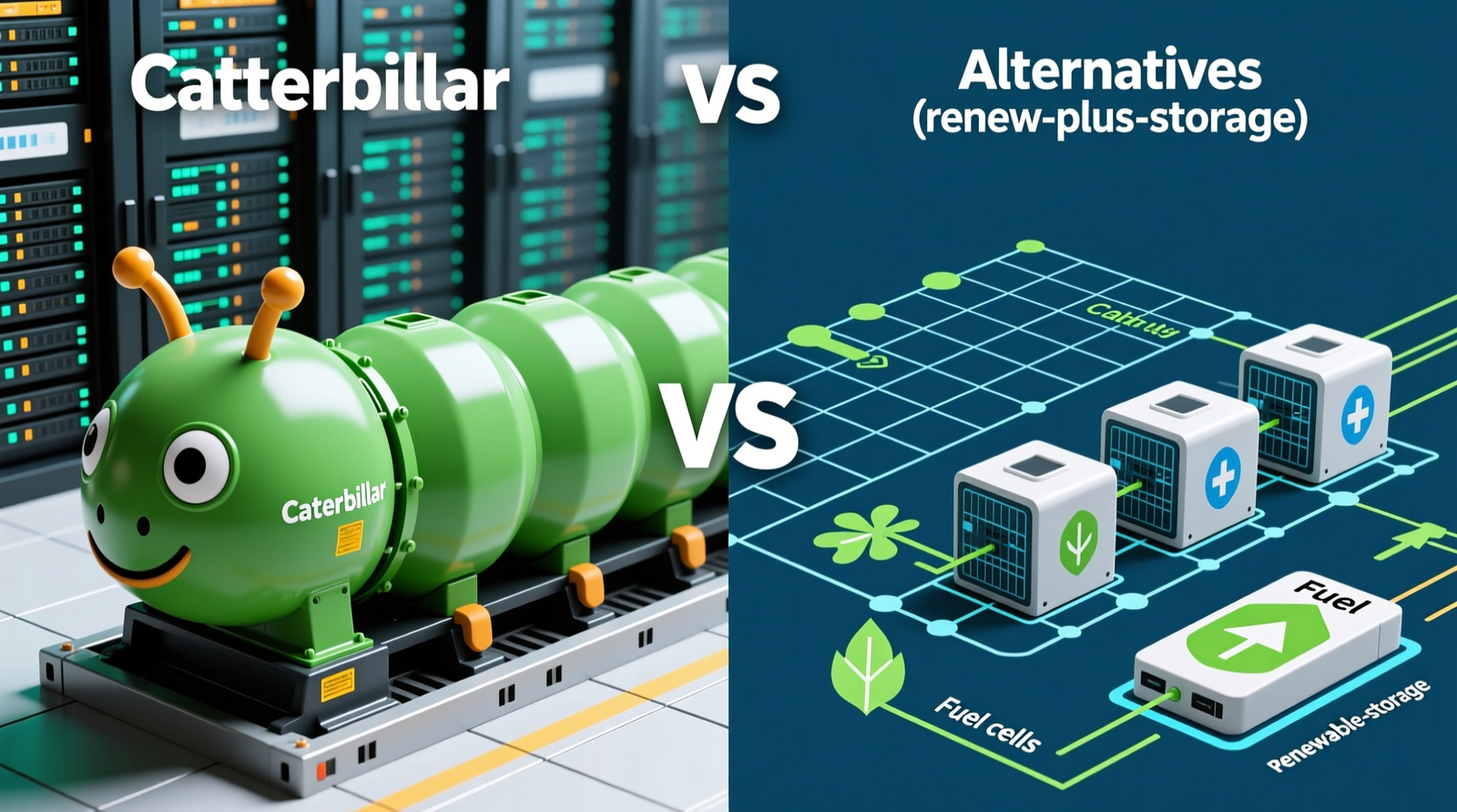
Investors should separate reliability (milliseconds-to-minutes bridging) from energy supply (hours-to-days operation). Many AI campuses need both, but solutions differ by region, permitting, and grid constraints.
- Utility grid + fast interconnect upgrades: often the lowest operating cost if available, but interconnect queues and substation buildouts can take years in some regions. That delay is one reason on-site generation demand has risen.
- Diesel standby generation: widely used for emergency backup and commissioning; mature supply chain and fast deployment. Downsides include emissions, noise, fuel logistics, and regulatory scrutiny.
- Natural gas generation: lower particulate and often lower CO2 than diesel per kWh (site-dependent), can support longer-duration operation. Risks include gas price volatility and pipeline capacity constraints.
- Fuel cells: can offer low local emissions and high reliability, but availability, cost, and hydrogen (or reformer) logistics can be limiting; deployments are more niche and region-specific today.
- Renewables + battery storage: great for decarbonization and some peak management, but long-duration coverage for multi-day grid events remains expensive/complex without very large storage, firm generation, or grid support.
In practice, many sites are trending toward hybrid architectures: UPS for ride-through + standby generators for longer outages + selective storage for smoothing, peak, and emissions optimization.
TL;DR: CAT competes where fast deployment and high-power redundancy matter; the main long-term challengers are improved grids, stricter diesel rules, and credible low-emission firm-power alternatives.
What the industry forecasts say about AI data center growth (with numbers—and caveats)
External forecasts are useful for sizing the “why now,” but they vary widely by assumptions (AI training vs inference mix, efficiency gains, geographic shifts, and permitting). A few widely cited reference points include:
- The International Energy Agency (IEA) Electricity 2024 report discusses accelerating electricity demand from data centers in key markets and highlights uncertainty ranges tied to AI adoption and efficiency.
- Goldman Sachs research (2024) has been cited for estimating a large increase in data center power demand over the coming years (assumption-sensitive and not a guarantee).
- SemiAnalysis frequently publishes detailed, bottoms-up commentary on AI infrastructure buildouts (power, cooling, GPU supply chain), useful for technical context even though it reflects an analyst viewpoint.
Uncertainty note: Forecast dispersion is real. Some analysts expect sustained hyperscaler capex (capital expenditures) growth; others expect normalization as GPU utilization improves, model training becomes more efficient, or builds shift to regions with easier grid/power availability.
TL;DR: Credible sources agree data center load is rising, but the slope and geography are debated—investors should treat “AI power demand” as a scenario range, not a single-number certainty.
Record revenue and backlog: grounding the AI narrative in Caterpillar disclosures
To keep this analysis verifiable, investors should anchor on Caterpillar’s primary sources: quarterly earnings releases, Form 10-Q/10-K filings, and investor presentations. Caterpillar reports results by segments including Energy & Transportation (E&T), which is the most direct home for data-center power systems exposure.
Where to pull the data (authoritative links):
- Caterpillar Quarterly earnings releases & materials (revenue, segment sales, backlog/order commentary in prepared remarks and decks).
- Caterpillar Events & presentations (often contains end-market commentary and demand drivers).
- Caterpillar SEC filings on EDGAR (10-Q/10-K for precise segment sales and risk factors).
Important clarification: Caterpillar does not typically break out “AI data centers” as a standalone line item. When management references “data centers,” it may show up in commentary within E&T (power systems) and sometimes within Construction Industries (site development equipment). Investors should therefore track (a) E&T segment growth, (b) order trends for large power systems, and (c) qualitative call commentary about data centers and grid constraints.
Suggested best practice: When you update this article for a specific quarter, quote the exact line from the earnings call transcript and cite the date (e.g., “Q4 2024 earnings call, Jan. 30, 2025”) and include the reported E&T revenue figure, YoY change, and any backlog/order metric management provides. (Transcripts are often available via the earnings materials page above or major financial transcript services.)
TL;DR: CAT’s AI-data-center exposure is real but not cleanly disclosed as a separate number; investors should use E&T revenue/order signals plus dated management commentary from earnings materials and SEC filings.
Because Caterpillar does not report “AI/data center revenue” explicitly, any figure is necessarily an estimate. A disciplined way to think about it:
- Most direct bucket: E&T revenue tied to large power systems (gensets, switchgear, microgrid controls, service) sold into data centers.
- Secondary bucket: construction equipment used in data-center campus earthworks and site prep (less sticky, more cyclical, and harder to isolate).
Reality check for materiality: Even if data-center power demand is growing fast, it may still be a mid-single-digit (or low double-digit) percentage of E&T for now—and a smaller percentage of total CAT sales—depending on the quarter and region. The more important near-term question for investors may be whether this demand is incremental (adds growth) or substitutional (replaces softer oil & gas or other power-system demand) within E&T.
What would make it “material” in filings? If data centers become large enough, you may see (1) more explicit end-market callouts, (2) disclosed concentration risk, or (3) expanded discussion of regulatory and product roadmap items (emissions, gas vs diesel mix, microgrids).
TL;DR: AI/data centers likely contribute meaningfully to E&T momentum but are not yet a clean, reportable slice of total revenue—track it indirectly via E&T trends and management’s dated commentary.
Stock performance and benchmark context (avoid “numbers in a vacuum”)
When evaluating CAT’s stock returns, compare them to broad and relevant benchmarks to understand whether outperformance is company-specific or simply market beta:
- Broad market: S&P 500 (U.S. large caps).
- Sector peer set: S&P 500 Industrials.
- Industrial economy proxy: indices such as the Dow Jones Industrial Average can also provide context.
CAT’s multiple expansion (valuation rising faster than earnings) can happen when investors believe the company has improved mix, visibility, or resilience. The AI-infrastructure narrative can contribute to that, but it competes with traditional drivers like construction cycles, mining capex, and dealer inventory behavior.
TL;DR: Always interpret CAT’s returns relative to the S&P 500 and industrial benchmarks; AI optimism can lift multiples, but cyclicals can give back quickly when orders cool.
Risks specific to AI data center exposure (beyond generic cyclicality)
A more balanced thesis needs risks that are specific to data centers and on-site power, not just “macro.” Key ones include:
- Customer concentration risk: a small number of hyperscalers and large colocation platforms can drive a large share of incremental demand. If one slows a region build, suppliers can feel it quickly.
- Project timing risk: AI campuses are large, phased, and permitting-heavy. Interconnect delays, transformer shortages, or local opposition can push schedules right (or cancel phases), shifting equipment deliveries and service ramp.
- Fuel price volatility: diesel and natural gas prices influence total cost of ownership for on-site generation, especially where run-hours increase due to grid constraints. Customers may pivot toward different architectures if fuel economics change.
- Regulatory pressure on diesel: tighter emissions rules (NOx, particulate matter) and noise restrictions near populated areas can raise compliance costs, reduce addressable market for certain configurations, or require more expensive aftertreatment and controls—potentially affecting margins and product roadmap.
- Technology disruption: credible low-emission alternatives (fuel cells, renewable-plus-long-duration storage, or “grid-first” designs supported by faster interconnect buildouts) could reduce generator intensity per MW of IT load over time.
- Supply-chain/geopolitics: large power systems depend on global components (electronics, switchgear, alternators, castings). Trade restrictions, shipping disruptions, or single-source constraints can impact lead times and working capital.
Contrarian scenario to consider: AI capex could normalize if model efficiency improves faster than expected, if utilization rises (more inference per deployed GPU), or if buildouts shift geographically toward regions where permitting favors different power architectures—reducing demand for certain standby-heavy designs.
TL;DR: The biggest AI-data-center risks are concentration, permitting/timing slippage, diesel regulation, fuel economics, and technology substitution—not just the usual construction-cycle slowdown.
Actionable investor checklist: what to track in filings, calls, and data
If you want to follow the AI-infrastructure angle without relying on hype, focus on repeatable, checkable indicators:
- E&T segment sales growth and margins each quarter (from earnings releases and 10-Q).
- Management commentary on “data centers” in prepared remarks/Q&A—save dated quotes and see if language strengthens (more specific) or weakens (more cautious).
- Order cadence / backlog signals where disclosed, especially any mentions of large power systems demand, lead times, and capacity constraints.
- Rental utilization and pricing (if discussed) for temporary power during commissioning and grid-delay periods.
- Mix shift: diesel vs gas and any updates on emissions-compliant offerings, aftertreatment, and microgrid/storage integration.
- Hyperscaler capex plans (Amazon, Microsoft, Google, Meta, etc.)—track their earnings decks for data center spend commentary to triangulate supplier demand.
Valuation context (keep it high level): check CAT’s current P/E (price-to-earnings) and EV/EBITDA (enterprise value to earnings before interest, taxes, depreciation, and amortization) versus its own 5–10 year range and versus diversified industrial peers. If CAT is trading well above its historical multiples, the market may already be pricing in some AI-related durability.
Example scenario framework:
- Bull case: sustained hyperscaler + colo buildout, persistent grid delays → higher E&T growth and service pull-through; cyclicality dampened.
- Base case: steady growth but phased/uneven by region → lumpy orders, solid service, modest mix benefit.
- Bear case: AI capex pauses + faster grid solutions + tighter diesel rules → order air-pocket, pricing pressure, and higher earnings sensitivity to traditional cycles.
TL;DR: Track E&T sales/margins + dated “data center” call comments + order/backlog signals; then sanity-check the AI thesis against hyperscaler capex and CAT’s valuation versus history.
FAQ
Q: Which Caterpillar products are most relevant to AI data centers?
A: The most direct exposure is through Caterpillar’s Energy & Transportation segment: large diesel and natural gas generator sets (gensets), integrated microgrids (controls that coordinate on-site generation and storage), and switchgear used to parallel multiple gensets and transfer loads safely. Construction equipment can also benefit during campus site prep, but power systems are the clearer linkage.
Q: Does Caterpillar disclose “AI data center revenue” or backlog explicitly?
A: Usually no. Caterpillar typically reports by broad segments (like Energy & Transportation) rather than by end market such as AI data centers. Investors can still track the trend indirectly via E&T segment performance, any disclosed order/backlog commentary, and dated management remarks on earnings calls. The most authoritative sources are CAT’s quarterly earnings materials and SEC filings (10-Q/10-K).
Q: How do diesel and gas generator solutions compare with fuel cells or renewable-plus-storage for data centers?
A: Diesel and gas gensets are mature, fast to deploy, and scale well for redundancy, which is why they’re common for standby and commissioning. Fuel cells and renewables-plus-storage can reduce local emissions, but economics, permitting, fuel logistics (e.g., hydrogen), and long-duration coverage can be limiting depending on site conditions. Many operators use hybrid architectures (UPS + gensets + selective storage) rather than a single technology.
Q: What are the biggest risks to the “Caterpillar AI infrastructure” investment thesis?
A: Key risks include customer concentration (a few hyperscalers/colos), project delays or cancellations (interconnect and permitting), tighter emissions/noise regulation for diesel, fuel price volatility affecting on-site generation economics, and technology substitution if grids improve faster or lower-emission alternatives scale more quickly.
A: Income investors should monitor free cash flow generation, payout ratio (dividends as a share of earnings or free cash flow), and balance sheet discipline across cycles. AI/data-center-related demand could support cash flow if it adds service pull-through and steadier utilization, but it may also come with working-capital swings and cyclicality if large projects slip. The best place to verify dividend capacity is Caterpillar’s cash flow statements and capital allocation commentary in earnings materials and the annual 10-K.