Introduction: Cotton Spinning Machinery Market (2026–2035)
The global cotton spinning machinery market is estimated at USD 2.6 billion in 2025 and is projected to reach approximately USD 3.3 billion by 2035, implying a 2.40% CAGR (compound annual growth rate) from 2026–2035.
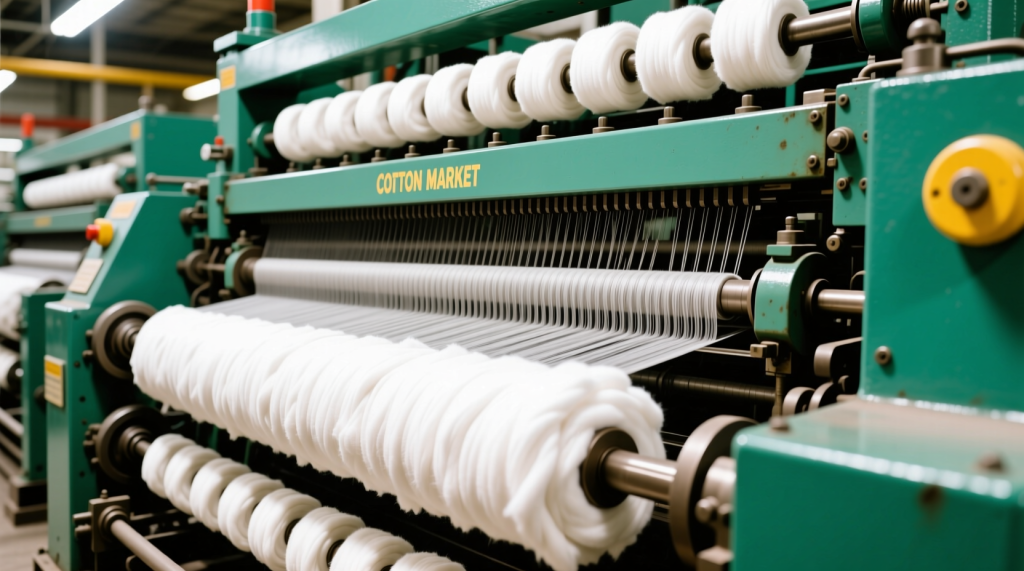
Cotton spinning machinery refers to industrial equipment that converts cotton fiber into yarn through a sequence of steps such as opening/blowroom (fiber opening and cleaning), carding (fiber alignment and impurity removal), drawing (sliver leveling), roving (attenuation with light twist), spinning (final twist into yarn), and winding (package formation for downstream use).
This report covers major spinning technologies—ring spinning, compact spinning (a ring-based system that condenses the fiber strand before twist), rotor/open-end spinning, and air-jet spinning. These technologies differ materially in yarn count range (thickness/fineness), speed, energy profile, operator intensity, and the types of fabrics they serve.
What is changing in 2026–2035 is not “more textiles” in the abstract; it is how mills compete: reducing kWh/kg (energy per kilogram of yarn), stabilizing yarn quality for fewer downstream stops, and making lines flexible enough to run cotton blends and recycled cotton without unacceptable waste or claims.
TL;DR: The market is growing modestly in value, but purchase decisions are increasingly driven by measurable operating-cost deltas (energy, labor, waste) and the ability to meet tighter yarn specs for demanding customers.
Market Overview: What Mills Are Actually Buying For
Across most spinning regions, procurement is shifting from “replace old frames” to optimize total cost of ownership (TCO): energy, maintenance, spare parts lead time, and quality losses. In practice, mills are prioritizing:
- Energy-efficient cotton ring spinning machines with improved drive efficiency, suction optimization, and lower-endbreak rates (less rework and waste).
- Compact spinning upgrade for existing ring frames where feasible, because it can push yarn into higher-margin segments without rebuilding the entire mill.
- Automation solutions for cotton spinning mills (doffing, transport, clearer settings, centralized monitoring) to offset labor scarcity and reduce variability between shifts.
Performance claims should be read carefully. For example:
- Energy concentration in ring departments is widely recognized; one published analysis notes that ring spinning can represent a large portion of mill electricity use and that spindle drives account for a major share of that department’s consumption (see: Journal of Universal Science and Technology (JUSST) — site archive of textile energy studies; figures vary by configuration and product mix).
- Rieter has reported energy and efficiency improvements in winding optimization in its product literature (e.g., Autoconer-related brochure/technical documentation statements; users should validate against their own mill settings and yarn types). Rieter’s corporate and technology information is available at rieter.com.
- High delivery speeds (e.g., ~250 m/min) are typically referenced in manufacturer brochures or product pages for modern equipment; actual mill output depends on yarn count, raw cotton parameters (length, micronaire), and acceptable quality limits. Manufacturer references can be verified on official channels such as Muratec (Murata Machinery) and other OEM product documentation.
In short, the buying logic is increasingly “prove the delta”: reduced kWh/kg, improved yarn CV% (coefficient of variation), fewer endbreaks, better winding efficiency, and fewer customer claims.
TL;DR: Mills are investing less for “capacity” alone and more for provable operating gains—energy, quality stability, and automation—validated under their own yarn mix and fiber variability.
Methodology & Data Sources (Base Year, Model, and Assumptions)
Base year: 2025. Forecast window: 2026–2035.
Market sizing approach: The USD market values and CAGR in this article are based on a combined research model that triangulates:
- Secondary research: public company reporting, OEM product literature, trade publications, and macro textile indicators (e.g., apparel and textile trade context from the World Trade Organization (WTO) and fiber context from organizations such as the International Cotton Advisory Committee (ICAC)).
- Primary inputs (typical for this type of market model): interviews or informal consultations with mill managers, maintenance heads, and OEM/service personnel to validate replacement cycles, upgrade rates, and price bands by technology.
- Bottom-up logic checks: shipments and installed-base refresh assumptions (where available), typical capex per 1,000 spindles/positions, and modernization cadence by region.
Important note on shares: All “share” figures in this article are treated as revenue share (not installed base) unless explicitly stated otherwise. Revenue share can diverge from installed base because compact systems, automation packages, and advanced winders often carry higher average selling prices than legacy machines.
TL;DR: 2025 is the base year; projections come from a triangulated model using public sources plus industry validation. Shares are presented as revenue share unless otherwise noted.
Key Market Takeaways (With Consistency Notes)
- Market size (2025): USD 2.6 billion
- Projected market size (2035): ~USD 3.3 billion
- Forecast CAGR (2026–2035): 2.40%
- Asia Pacific revenue share (2025): ~54.1% (~USD 1.4 billion)
- Ring spinning revenue share (2025): ~49.1%
- Apparel & garments application revenue share (2025): ~54.6%
Consistency check: Not all segment shares across different cuts (region vs. machinery type vs. application) are additive, because each is a separate distribution of the same total market revenue.
TL;DR: The headline forecast is modest growth, with APAC leading. Shares are directional revenue splits, not meant to sum across different segmentation dimensions.
Machinery Type Analysis: Ring Spinning Machinery, Compact Spinning Systems, Rotor Spinning Machines, and Air-Jet
Ring Spinning Machinery (Versatility First)
Ring spinning remains the backbone technology with ~49.1% revenue share in 2025 because it is the most versatile across cotton grades and yarn counts, and it integrates well with established downstream processes (weaving/knitting) and mill skill sets.
Where ring frames win in real procurement meetings is not a generic “high quality” claim—it’s that ring can be tuned to run a broad product portfolio (counts, twists, end uses), which helps mills hedge order volatility. For mills serving mixed buyers (domestic, export, brands), that flexibility lowers commercial risk.
TL;DR: Ring dominates because it is the most adaptable platform for shifting yarn programs, not because it is the newest technology.
Compact Spinning Systems (Premium Differentiation and Downstream Efficiency)
Compact spinning is a ring-based method that condenses the fiber strand before twist insertion. The practical benefit is yarn with lower hairiness and improved structure, which can translate into fewer loom stops, cleaner fabric appearance, and reduced pilling—especially valuable in premium knits and shirtings.
Commercially, compact spinning is often justified when a mill can monetize the quality uplift (higher realization) or capture downstream savings (less sizing, fewer stoppages, lower waste). That is why “compact spinning upgrade for existing ring frames” is a common modernization pathway: it targets margin expansion without rebuilding the entire spinning department.
TL;DR: Compact systems are less about “better yarn” in theory and more about monetizable premium positioning and measurable downstream efficiency.
Rotor (Open-End) Spinning Machines (Cost/Throughput for Medium Counts)
Rotor spinning (also called open-end spinning) is chosen when mills need high throughput, reduced labor per kg, and robust economics on medium/coarser count programs (e.g., denim, towels, basics). In many mills, rotor also functions as a “volume stabilizer” when ring capacity is reserved for higher-value counts.
Rotor is not a universal replacement for ring; it is a portfolio tool. The winning case is usually a stable order book where cost per kg and speed matter more than ultra-fine yarn capability.
TL;DR: Rotor is a deliberate economics play for stable, higher-volume yarns where ring’s flexibility is less critical.
Air-Jet Spinning (Speed, But Narrower Windows)
Air-jet spinning uses high-velocity air streams to form yarn. It can deliver very high productivity, but the process window is narrower for 100% cotton and certain yarn counts. In mills that adopt it, the motivation is often “hit the cost target on specific fabric programs,” not broad substitution.
Air-jet is best viewed as a specialized engine: extremely fast when the fiber/yarn spec is right, but less forgiving when raw material variability is high or when ultra-soft handfeel and certain structures are required.
TL;DR: Air-jet growth is niche and program-specific—high speed, but limited flexibility compared with ring/compact.
Quick Comparison Table: Ring vs Compact vs Rotor vs Air-Jet (Typical Ranges)
Note: Values below are typical industry ranges and vary by OEM model, raw cotton quality (staple length, micronaire), twist, and required quality KPIs.
| Technology | Typical yarn count range (cotton) | Relative speed | Relative energy use | Relative CAPEX | Best-fit applications |
|---|---|---|---|---|---|
| Ring | Wide (medium to fine counts) | Medium | Medium–High | Medium | Broad: apparel, home textiles, fine yarn programs |
| Compact (ring-based) | Wide, strong in fine/premium | Medium | Medium–High (often justified by quality gains) | Medium–High | Premium knits, shirting, reduced hairiness/pilling targets |
| Rotor (open-end) | Best in medium/coarser counts | High | Medium | Medium–High (per position varies) | Denim, towels, basics, volume programs |
| Air-jet | Narrower (program-dependent) | Very high | Medium (compressed air considerations) | High | Selected knits/technical programs where structure fits |
TL;DR: Ring/compact win on versatility and premium quality; rotor wins on medium-count economics; air-jet wins on speed when the product window is right.
Application Analysis (Where Machinery Value Concentrates)
Apparel & garments account for ~54.6% of revenue in 2025, but the more important point is that apparel-driven programs often impose tighter KPIs: yarn evenness, hairiness, shade consistency, and contamination control. That pushes investment toward better carding/clearing, stable drafting, and winding quality management.
TL;DR: Apparel is the biggest segment because it is spec-driven; mills upgrade to avoid claims, not just to increase output.
Yarn Manufacturing (Flexibility and Changeover Economics)

Independent yarn makers live or die on changeovers—different counts, blends, and customer specs. Here, the value of automation is practical: fewer operator-dependent adjustments, faster stability after lot changes, and better traceability for disputes.
TL;DR: Yarn suppliers buy flexibility and repeatability—automation and monitoring often matter as much as spindle speed.
Home Textiles (Durability, Consistency, and Cost Control)
Home textiles (towels, bed linen) prioritize durability and consistent performance across large lots. Rotor is often used in towel/terry programs, while ring/compact are chosen when softer handfeel or finer counts are needed.
TL;DR: Home textiles reward stable long-run production and predictable quality across big lots—technology choice follows the fabric construction.
Industrial & Medical Textiles (Standards, Traceability, and Contamination Control)
Industrial and medical applications are smaller in pure cotton spinning but can be strategically important because they emphasize repeatability, cleanliness, and documentation. For medical-related supply chains, mills may need documented hygiene controls, lint management, and traceability systems.
Relevant standards and frameworks that influence machinery selection and mill systems include:
- ISO 9001 (quality management systems): ISO overview
- ISO 50001 (energy management systems), often used to structure energy-reduction programs in mills: ISO overview
- CE marking expectations in Europe for machinery safety compliance (implemented through EU rules and harmonized standards): European Commission guidance
TL;DR: Industrial/medical programs pull machinery decisions toward repeatability, contamination control, and auditable systems—not just speed.
Market Drivers (Why Investment Happens)
Three drivers explain most capex timing in the cotton spinning machinery market:
- Energy economics: mills modernize when electricity tariffs rise or when they can clearly reduce kWh/kg via drives, suction optimization, and fewer quality-related stops.
- Labor availability and consistency: automation reduces dependence on scarce skilled operators and lowers shift-to-shift variation.
- Quality-risk management: tighter customer specs and claims costs make monitoring, clearing, and stable process windows financially important.
TL;DR: Mills invest when energy, labor, and claims risk reach a point where the “do nothing” option becomes more expensive than modernization.
Market Restraints & Risk Factors (What Delays Capex)
Modern spinning projects are capital-intensive and operationally demanding. The most common restraints are:
- Financing and FX (foreign exchange) risk: machinery is often imported; currency swings can change project IRR (internal rate of return) mid-negotiation.
- Cotton price volatility: swings in fiber cost and availability can compress margins and delay machinery orders even when demand is stable.
- Geopolitical and trade policy uncertainty: sanctions, tariffs, and rules-of-origin changes can shift sourcing and stall investment cycles.
- Skills and maintenance gaps: advanced systems require stronger preventive maintenance and data discipline; otherwise, expected OEE gains do not materialize.
TL;DR: Capex is delayed less by lack of “interest” and more by financing/FX exposure, cotton-cycle uncertainty, and the risk of underutilizing sophisticated equipment.
Growth Factors (How Growth Manifests in Projects)
Growth through 2035 is expected to come more from modernization intensity than pure greenfield expansion:
- Upgrade kits and retrofits: especially compact attachments, suction/drive upgrades, and clearer/winding automation.
- Mill-level digital systems: practical deployment of sensors and dashboards to improve OEE (overall equipment effectiveness) and reduce unplanned stops.
- Process stability for blends: more mills running cotton with man-made fibers and recycled content need wider process windows and better cleaning/contamination management.
TL;DR: Most value growth is likely to come from upgrades, digital controls, and blend-capable stability rather than a boom in brand-new mills.
Emerging Trends (What’s New vs. What’s Repeating)
To avoid repeating “digitalization” in every section, here is what is concretely trending now:
- Data-driven spinning control: centralized dashboards that connect blowroom-to-winding to pinpoint where quality drifts start (raw cotton lot, carding settings, drafting, winding).
- Predictive maintenance: condition monitoring that triggers interventions before failures—particularly relevant for high-speed rotor and winding.
- Modular modernization: mills increasingly demand upgradeability (software, drives, compacting modules) rather than full line replacements.
TL;DR: The trend is not “Industry 4.0” as a slogan; it is connected quality/maintenance systems and modular upgrades that reduce downtime and stabilize yarn KPIs.
Regional Analysis (With Indicative Growth Differentiation)
Note: Regional CAGRs vary significantly by modernization funding, export competitiveness, and installed-base age. The ranges below are indicative (directional) and reflect typical model outcomes when triangulating installed-base refresh and capacity additions.
Asia Pacific: Largest Base, Fastest Modernization Mix
Asia Pacific holds ~54.1% of 2025 revenue (~USD 1.4 billion). The region’s growth is driven by a blend of (1) replacing aging capacity and (2) selective expansion where export competitiveness is strong.
Indicative CAGR (2026–2035): ~2.6%–3.2%, led by India/Bangladesh/Vietnam modernization cycles and continued Chinese upgrades focused on automation and energy.
TL;DR: APAC remains the center of gravity, with growth coming from modernization packages and efficiency projects as much as from new capacity.
Europe: Premium Yarn, Compliance-Driven Upgrades
Europe’s cotton spinning footprint is smaller but technology-forward, with upgrades often justified by energy management (ISO 50001-driven programs), safety compliance, and premium product positioning.
Indicative CAGR (2026–2035): ~1.2%–2.0% (value grows via high-spec equipment and automation rather than volume).
TL;DR: Europe buys high-spec, compliance-ready systems; growth is slower but higher value per installation.
North America: Niche Technical Textiles and Automation Economics
North America prioritizes automation and traceability due to higher labor costs and a focus on niche/technical programs rather than commodity yarn.
Indicative CAGR (2026–2035): ~1.0%–1.8%.
TL;DR: North America’s opportunity is specialized: fewer installations, but strong demand for automation and documented quality systems.
Latin America: Nearshoring Tailwinds, Mid-Scale Modernization
Latin America benefits from proximity to North American markets and selective nearshoring. Demand tends to center on mid-scale mills that need reliable service networks and proven machines.
Indicative CAGR (2026–2035): ~1.8%–2.6%.
TL;DR: Latin America grows through pragmatic modernization tied to nearshoring and regional supply stability.
Middle East & Africa: Cluster Builds and Export Positioning
Middle East & Africa includes both mature players (e.g., Turkey, depending on definition) and emerging textile clusters. Egypt is frequently cited for cotton-linked value chain strategies, with investments aimed at integrated textile parks and export competitiveness.
Indicative CAGR (2026–2035): ~2.5%–3.8% (higher variance due to project-based investments and policy environment).
TL;DR: MEA can outgrow the global average, but growth is lumpy—tied to specific park/cluster projects and export strategy.
Buyer Considerations / Investment Checklist (Practical Procurement Filters)
- Total cost of ownership (TCO): benchmark kWh/kg, spare parts cost, consumables, and maintenance hours.
- Energy and suction design: evaluate fan/suction optimization, drive efficiency, and whether OEM provides measured energy data by yarn program.
- Service network and spares lead time: local support often determines real uptime more than brochure specs.
- Upgradeability: ability to add compact modules, automation, and software features later without major rebuilds.
- Digital integration: compatibility with mill MES (manufacturing execution system) / ERP (enterprise resource planning) and data ownership terms.
- Raw material tolerance: how stable performance remains when cotton quality varies lot-to-lot (a common reality).
- Compliance: alignment with safety and management systems (e.g., CE expectations in EU markets, ISO 9001/50001 frameworks).
TL;DR: The best machine is the one that your local team can keep running efficiently—verify energy, service, upgrade path, and data integration before signing.
Indicative ROI & Mill Upgrade Examples (Anonymized, Typical Outcomes)
The economics of modernization depend on electricity price, utilization, labor costs, and the mill’s quality-loss baseline. As an indicative guideline, many mills target a 3–7 year payback for a compact spinning upgrade for existing ring frames or automation upgrades, assuming stable utilization and the ability to monetize quality gains or reduce waste/claims.
Example 1 (South Asia, ring-to-compact retrofit on a premium program): A mid-sized exporter retrofitted compact attachments on part of its ring section to serve finer-count knitwear yarn. The business case combined (a) price premium realization and (b) fewer downstream knitting stops. Payback was achieved within the target window when the premium order book remained stable; sensitivity analysis showed the project became marginal if utilization dropped below a defined threshold.
Example 2 (APAC, winding/automation and quality monitoring upgrade): An integrated mill upgraded winding controls and added line monitoring to reduce faults and improve package consistency. The largest quantified benefit came from fewer stoppages and reduced rework rather than headline speed. ROI improved further because the mill had reliable local service coverage, keeping commissioning delays low.
TL;DR: Payback is realistic when mills quantify savings beyond speed—waste, claims, downtime, and downstream efficiency—then protect utilization with the right product mix.
Analyst Perspective: Strategic Implications Through 2035
Here is the non-obvious takeaway: the next decade is less about choosing the “best” spinning technology and more about designing a resilient spinning portfolio.
- Ring stays central, but winners will run ring with tighter energy discipline and better monitoring—especially where electricity prices are rising faster than yarn realizations.
- Compact adoption will be rational, not universal: mills that cannot consistently sell into premium channels will struggle to justify the capex, while mills with brand-linked programs will treat compact as a margin-defense tool.
- Rotor remains underappreciated as a hedge: it stabilizes volume economics when ring is allocated to premium counts; it also reduces dependence on operator skill intensity.
- Digital value will shift from dashboards to closed-loop optimization: by 2030–2035, expect more AI (artificial intelligence)-assisted setpoint optimization for drafting, suction, and clearer settings—especially as mills run more variable inputs like recycled cotton.
TL;DR: Strategic winners won’t just “modernize”; they will balance ring/compact/rotor capacity with digital control to stay profitable across cotton cycles and shifting product mixes.
Forward-Looking Outlook (2030–2035): Recycled Cotton, Blends, and ESG
By 2030–2035, machinery specifications are likely to be shaped by two forces:
- More recycled cotton and cotton-blends: recycled content often increases short fiber and variability, raising demands on blowroom/carding cleaning, process stability, and real-time quality monitoring.
- Stricter ESG requirements: ESG (environmental, social, and governance) expectations will push mills to document energy use, reduce waste, and improve traceability—favoring machines and software that can produce auditable performance data.
Potential disruptions include AI-driven process optimization (automatic setpoint recommendations) and tighter integration across spinning-to-fabric workflows (e.g., scheduling and quality feedback loops between spinning, weaving/knitting, and finishing). These changes could shift capex decisions toward platforms that are software-upgradable rather than purely mechanical upgrades.
TL;DR: Future-proofing means blend/recycled tolerance plus auditable energy/quality data—machines that cannot measure and adapt will lose out by the early 2030s.
Key Company Insights (What They’re Known For)
Major suppliers compete on system capability (blowroom-to-winding), automation, energy performance, and service reach:
- Rieter (Switzerland): full-line spinning systems and automation focus. See: https://www.rieter.com/
- Saurer / Schlafhorst (winding, automation and package quality): https://saurer.com/
- Trützschler (fiber preparation and carding leadership): https://www.truetzschler.com/
- Muratec (Murata Machinery) (vortex/air-jet-related systems and automation): https://www.muratec.net/
TL;DR: OEM differentiation increasingly comes down to system integration, software/automation, and local service performance—not just the machine’s peak specification.
Recent Developments (Illustrative Industry Moves)
- May 2025 – Rieter acquisition announcement (synthetic fiber machinery expansion): Reported acquisition activity signals suppliers are broadening portfolios to serve blends and multi-fiber strategies alongside cotton-focused systems.
- October 2025 – Compact system launches: OEM launch cycles continue to emphasize quality uplift and resource efficiency for compact spinning systems.
- October 2025 – Large regional contracts (e.g., Egypt): Big orders tend to cluster around integrated textile investment programs and export competitiveness initiatives.
TL;DR: Supplier strategies and large contracts point toward multi-fiber capability, compact quality differentiation, and region-specific cluster investments.
Conclusion
The cotton spinning machinery market is not a high-growth story; it is a performance replacement story. Through 2035, value will accrue to technologies and suppliers that can prove lower kWh/kg, fewer stops, and more stable yarn KPIs—especially under raw-cotton variability and increasing recycled/blend content.
Ring spinning machinery remains the versatile core, compact spinning systems expand where premium realization is real, rotor spinning machines anchor volume economics, and air-jet stays program-specific. The most defensible investments are those that combine hardware with automation, monitoring, and a service plan that protects uptime.
TL;DR: The winners will be mills that treat modernization as an ROI-engine (energy, uptime, quality) and choose upgradeable platforms ready for recycled/blend inputs and ESG-driven reporting.
FAQ
Q: What are the best automation solutions for cotton spinning mills to reduce labor dependency?
A: The most impactful automation typically includes automated doffing, material transport, winding automation, and centralized monitoring that tracks endbreaks, clearer cuts, and energy use. Mills usually see the best ROI when automation reduces variability between shifts and cuts unplanned downtime rather than only increasing nominal speed.
Q: How do energy-efficient cotton ring spinning machines reduce operating costs in practice?
A: Savings usually come from more efficient drives, optimized suction systems, and better process stability that reduces endbreaks and rework. Because energy is consumed continuously, even small reductions in kWh/kg can materially improve margin—especially in regions with rising electricity tariffs.
Q: Is a compact spinning upgrade for existing ring frames worth it for mid-sized mills?
A: It can be, if the mill has (or can win) customers who pay for lower hairiness and improved fabric performance, or if downstream savings (fewer knitting/weaving stops, less pilling-related claims) are measurable. Typical target payback ranges are often about 3–7 years, depending on utilization, energy cost, and realized price premium.
Q: When should a mill choose rotor spinning machines instead of ring spinning machinery?
A: Rotor is often the better choice for stable, high-volume medium/coarser-count programs (e.g., towels, denim, basics) where cost per kg, throughput, and labor efficiency matter more than ultra-fine count capability. Many mills use rotor to protect ring capacity for premium or more variable orders.
Q: How will recycled cotton and cotton blends affect spinning machinery requirements by 2030–2035?
A: Recycled cotton and blends tend to increase variability and short fiber content, raising demands on cleaning, carding performance, contamination control, and real-time monitoring. Mills will increasingly favor machinery and software that can stabilize quality under variable inputs and produce auditable energy/quality data to meet ESG expectations.