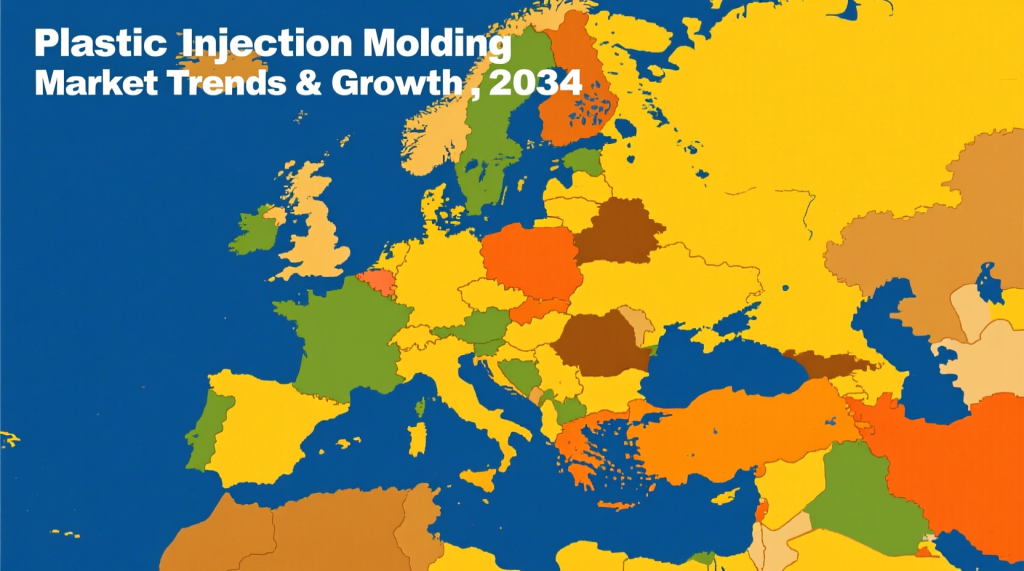
The Europe plastic injection molding market is estimated at USD 46.62 billion in 2025 and is projected to reach USD 65.78 billion by 2034, registering a 3.90% CAGR over the 2026–2034 forecast period.
This trajectory is mathematically consistent with the stated CAGR: starting from USD 46.62 billion (2025), a 3.90% compound annual growth rate over 9 years (2025 to 2034) yields approximately USD 65.8 billion.
Executive snapshot: Demand in plastic injection molding in Europe is being pulled by (1) automotive lightweighting and electrification, (2) regulated, high-volume packaging formats, and (3) precision MedTech manufacturing. The biggest friction points are energy and compliance costs for processors and material volatility, especially when switching to recycled inputs.
TL;DR: Europe’s plastic injection molding market is USD 46.62B (2025) and forecast to reach USD 65.78B (2034) at a 3.90% CAGR (2026–2034), driven by automotive, packaging, and medical demand amid cost and compliance pressures.
Market Overview (Scope, Definition, and Context)

The Europe plastic injection molding market in this report covers the revenue associated with producing plastic parts via injection molding across major European end-use sectors (automotive, packaging, healthcare/MedTech, consumer goods, electronics, and industrial components). Injection molding is a high-volume manufacturing process where molten polymer is injected into a mold cavity to form repeatable parts with tight tolerances.
Included: molding of thermoplastics (polymers that can be remelted, e.g., polypropylene) and, where relevant, thermosets (polymers that cure irreversibly). Both contract molding (parts made for external customers) and captive molding (in-house molding within an OEM’s supply chain) are considered within the broader European injection molding industry value creation.
Excluded/clarified: processes outside injection molding (e.g., blow molding, extrusion) are not the core focus unless they directly affect substitution trends and packaging design decisions.
On the macro side, Europe remains a key plastics-processing region, but the operating environment has tightened since 2022 due to energy and input-cost shocks. For production and waste-system context, Plastics Europe “Plastics – the Facts 2024” provides Europe-wide statistics on production, conversion, recycling, and end-of-life pathways, while Eurostat provides official EU datasets on industrial output, demographics, and trade.
TL;DR: This report frames the Europe plastic injection molding market as injection-molded part production across core end-use sectors, primarily thermoplastics, with contract and captive molding included and non-injection processes treated as secondary context.
Policy, Energy, and Technology Shifts Shaping Plastic Injection Molding in Europe
Regulation is directly influencing materials, tooling, and design rules for the European injection molding industry. The EU’s packaging policy direction is moving toward recyclable-by-design formats and higher recycled content. For the policy baseline, the European Commission’s packaging policy pages (including ongoing reform work) provide the regulatory rationale and targets: European Commission – Packaging waste.
Energy is another structural variable. Injection molding is electricity-intensive (machine drives, barrel heating, dryers, chillers, compressed air). The International Energy Agency (IEA) industry energy analysis is a useful reference point for why industrial efficiency upgrades matter and why electricity prices and decarbonization policies increasingly factor into capex decisions.
Digitization is also changing how European molders run. Industry 4.0 (the use of connected sensors, software, and automation for smart manufacturing) is being deployed to reduce scrap, stabilize processes, and improve traceability demanded by medical and automotive customers.
TL;DR: EU packaging policy, high/volatile energy costs, and Industry 4.0 adoption are jointly pushing Europe’s injection molders toward recyclable designs, more efficient machines, and more data-driven process control.
Market Drivers

Across the Europe plastic injection molding market, demand is primarily driven by high-volume applications where injection molding’s repeatability, tight tolerances, and low unit costs at scale outperform alternative processes.
TL;DR: Growth comes from high-volume, high-spec applications—especially automotive, MedTech, and regulated packaging—where injection molding’s precision and throughput are hard to replace.
Automotive Demand: Lightweighting, EVs, and ADAS Components
Automotive remains a high-throughput anchor segment for plastic injection molding in Europe, particularly for interiors, under-the-hood parts, and functional housings. Plastics content per vehicle is widely cited in the ~150–200 kg range, supporting mass reduction and parts integration (fewer fasteners, fewer assemblies).
Electrification extends this need: EVs (electric vehicles) add battery mass, making lightweighting more valuable, while also increasing demand for molded parts in cable management, connector systems, sensor housings, and thermal-management components. For Europe’s vehicle market direction and registration trends, ACEA (European Automobile Manufacturers’ Association) publishes regular updates and annual reporting (e.g., 2023–2024 datasets and briefs) that help contextualize platform shifts.
Mini-case example (EV/automation): A Tier supplier running a mix of interior brackets and sensor housings implemented in-mold pressure sensing plus closed-loop process control (an Industry 4.0 approach). After standardizing the process window across four presses, the supplier reduced scrap by ~18% and improved average cycle time by ~6% through fewer short shots and less rework—typical outcomes when cavity pressure is used to stabilize part weight and dimensional variation.
TL;DR: Automotive demand is sustained by lightweighting and EV-related component growth; Industry 4.0 controls can deliver measurable gains (e.g., ~18% scrap reduction and ~6% cycle-time improvement in a representative supplier scenario).
Medical Devices (MedTech): Precision, Clean Manufacturing, and Traceability

The European MedTech (medical technology) sector is a major driver for high-precision molding—particularly for single-use consumables and device housings that require repeatability, validated processes, and material traceability. MedTech Europe’s sector resources explain the industry structure and the strong role of SMEs (small and medium-sized enterprises): MedTech Europe.
Demand is reinforced by demographic trends and care-model shifts (more home care, more diagnostics, more drug delivery devices). For Europe’s demographic baseline, official population structure data is available via Eurostat population structure and ageing statistics.
On the production side, medical molders increasingly align with ISO 13485 (a quality management standard for medical devices) and validated molding/cleanroom procedures. Materials commonly include PP (polypropylene), PC (polycarbonate), and ABS (acrylonitrile butadiene styrene), selected for sterilization compatibility and mechanical performance.
Mini-case example (cleanroom efficiency): A European molder producing diagnostic cartridges upgraded from older hydraulics to all-electric presses for cleanroom production. Along with optimized drying and mold-temperature control, the site achieved ~35% lower electricity use per part and ~12% fewer quality deviations (rejections linked to flash/short shots), reflecting the tighter repeatability typical of all-electric platforms in precision applications.
TL;DR: MedTech growth supports precision injection molding in Europe; cleanroom-capable operations and all-electric presses can materially reduce energy per part (~35%) and improve quality consistency (~12% fewer deviations in a representative upgrade).
Market Restraints
The main restraints in the Europe plastic injection molding market are not demand-side only; they are operational—compliance complexity, higher conversion costs, and the investment burden to modernize machines and qualify recycled/bio-based inputs.
TL;DR: Europe’s molders face a cost-and-complexity squeeze: regulatory compliance, energy costs, and the capex required to run recycled and advanced materials reliably.
Environmental Compliance: PPWR, EPR, and Carbon-Related Cost Pressures

EU policy is accelerating the shift toward recyclable packaging designs and recycled content. The PPWR (Packaging and Packaging Waste Regulation) is the core packaging framework shaping design-for-recycling, recycled-content requirements, and reuse targets. For official policy explanations and updates, use the European Commission’s packaging waste resource hub.
In parallel, EPR (extended producer responsibility) schemes shift financial responsibility for end-of-life management onto producers, which often pushes brand owners to demand more recyclable, mono-material parts (e.g., all-PP closures and tubs). For waste and environmental performance context, the European Environment Agency (EEA) provides reporting and indicators that help explain why policy is tightening.
CBAM (Carbon Border Adjustment Mechanism) is also relevant for cost structures across parts of the industrial value chain. While CBAM’s direct scope is specific product categories, it signals a broader trend: carbon accounting and embedded emissions are increasingly commercial variables in European procurement. The official mechanism overview is hosted by the European Commission: European Commission – CBAM.
TL;DR: PPWR and EPR are forcing redesign and recycled-content validation, while CBAM reflects rising carbon-cost visibility—together increasing compliance workload and capex needs, especially for SMEs.
Raw Material Volatility and Supply Risk (Virgin, PCR, and Additives)
European injection molders remain exposed to resin volatility because many core polymers are tied to oil and gas markets. Sudden movements in feedstock costs can compress margins when customer contracts have slow pass-through mechanisms.
Switching to PCR (post-consumer recycled) resin can reduce fossil-based demand and help meet packaging targets, but it may increase process variability (odor, contamination, melt-flow drift, and mechanical-property scatter). That variability can raise setup time and scrap unless filtration, compounding, and process controls are upgraded.
Broader supply-chain disruptions—shipping constraints, geopolitical trade friction, and constrained additive supply—can still affect lead times. For macro risk framing, the International Monetary Fund (IMF) World Economic Outlook provides regularly updated analysis on fragmentation and global trade pressures that influence industrial input markets.
TL;DR: Virgin resin and recycled feedstock volatility can hit margins and stability; PCR helps with targets but often requires tighter incoming QC and process control to avoid scrap and downtime.
Market Opportunities
Opportunities in the European injection molding industry are concentrated where regulation, brand commitments, and performance needs overlap: recycled-content packaging, qualified medical consumables, and smart/automated cells that deliver consistent quality at lower conversion cost.
TL;DR: The best opportunities sit at the intersection of sustainability requirements and high-repeatability production—especially recycled-content packaging and smart, automated precision molding.
Bio-Based and Biodegradable Polymers: Where Growth Is Fastest (and Where It Isn’t)
Bio-based and biodegradable polymers are gaining traction, but adoption is application-specific (composting infrastructure, food-contact rules, performance requirements, and cost). The strongest near-term pull in injection molding tends to be in selected packaging and consumer items where design and certification requirements can be met.
Capacity and market context is tracked by European Bioplastics (market data and capacity outlooks), which provides recurring updates on bioplastics capacity and demand signals.
Within this report’s segmentation, PLA (polylactic acid) and other bio-based polymers are projected to grow at about 12.5% CAGR (2026–2034), materially above the overall market CAGR (3.90%). Even with this faster growth, they remain a smaller base than commodity polymers such as PP—so growth is meaningful but not yet dominant.
TL;DR: Bio-based polymers (e.g., PLA) are projected to grow faster (~12.5% CAGR, 2026–2034) than the total market (3.90%), but they are still scaling from a smaller base and remain application-dependent.
Industry 4.0 Adoption: Scrap Reduction, OEE Gains, and Traceability
Industry 4.0 in injection molding typically includes connected machines, sensor-based monitoring, statistical process control, and analytics to reduce variability. IoT (Internet of Things) connectivity is often the foundation—linking presses, dryers, and metrology to enable traceability and faster root-cause analysis.
In practical terms, European molders use these tools to improve OEE (overall equipment effectiveness: availability × performance × quality), stabilize cycle times, and reduce start-up scrap after tool changes. Many plants prioritize sensor retrofits and MES integration first, then expand into digital twins and AI-driven parameter optimization once data quality improves.
TL;DR: Industry 4.0 investments target measurable factory KPIs—especially scrap, downtime, and OEE—while also improving traceability demanded by automotive and medical customers.
Market Challenges
Beyond compliance and feedstock volatility, two structural challenges strongly shape competitiveness in plastic injection molding in Europe: energy economics and skills availability for advanced automation and process engineering.
TL;DR: The hardest challenges are structural—energy economics and skilled labor—because they directly affect conversion cost and the ability to run advanced processes reliably.
Energy Costs: Conversion Economics and the Payback Logic of All-Electric Presses
Injection molding’s energy load is not only the press; it includes dryers, chillers, granulators, and compressed air. In many plants, energy can represent a meaningful share of conversion cost (often cited in the high single digits to teens depending on part type, utilization, and utility tariffs), so price volatility directly impacts quoting and profitability.
Upgrading to all-electric or hybrid machines can reduce electricity use substantially versus older hydraulics—often cited in the ~30–70% range depending on baseline machine condition, clamp tonnage, and duty cycle. The IEA’s industrial efficiency work provides context on why efficiency measures are among the most cost-effective industrial decarbonization levers: IEA – Energy efficiency.
TL;DR: Energy is a major conversion-cost lever; all-electric upgrades can often cut electricity use by ~30–70% versus older hydraulics, improving competitiveness when energy prices are high.
Skilled Labor Shortages: Process Engineering and Automation Competency Gaps
Modern molding requires technicians who can manage tooling, polymers, robotics, and data. Skills gaps affect commissioning speed, yield, and uptime—especially when processors introduce recycled materials, add robotics, or deploy Industry 4.0 monitoring.
In Germany, for example, the DIHK (Association of German Chambers of Commerce and Industry) regularly reports recruitment difficulties in technical roles, aligning with a broader European manufacturing skills shortage pattern. Where training capacity is limited, technology adoption can be slower and benefits under-realized.
TL;DR: Labor scarcity and training gaps slow automation and data-tool adoption, raising scrap and downtime risks—making workforce development a competitiveness factor, not just an HR issue.
Report Coverage

This Europe plastic injection molding market report provides market sizing, trends, and forecasts from 2025 to 2034.
- Market Size Availability: 2025–2034
- Base Year: 2025
- Forecast Period: 2026–2034
- CAGR: 3.90%
- Segments Covered: By raw material type, application, and region
- Regions Covered: UK, France, Spain, Germany, Italy, Russia, Sweden, Denmark, Switzerland, Netherlands, Turkey, and the Czech Republic
Stakeholders analyzed include polymer producers, compounders, machine manufacturers, mold makers, and contract molding service providers operating in Europe.
TL;DR: The study uses 2025 as the base year and forecasts 2026–2034 at a 3.90% CAGR across materials, applications, and key European countries.
Segmental Analysis
Segment performance in the Europe plastic injection molding market is shaped by resin economics, regulatory design requirements (especially packaging), and qualification barriers in medical and automotive supply chains.
TL;DR: Segments diverge based on resin cost/performance, packaging regulation, and qualification intensity in medical and automotive.
By Raw Material Type Insights

Material choice in the European injection molding industry is dominated by commodity thermoplastics for volume applications, with faster growth in bio-based categories off a smaller base.
TL;DR: Commodity polymers lead by volume, while bio-based polymers grow faster but from a smaller share.
Polypropylene (PP)
Polypropylene (PP) led the Europe plastic injection molding market by raw material, accounting for around 28.5% share in 2025. PP is widely used in packaging and automotive due to cost-to-performance balance, chemical resistance, and low density.
In practice, PP’s dominance is reinforced by the shift toward mono-material packaging designs (easier recycling compared with multi-material structures) and by the availability of filled and impact-modified grades for automotive interiors and semi-structural components.
TL;DR: PP remains the leading resin (~28.5% share in 2025) because it is cost-effective, versatile, and aligns with mono-material packaging and lightweight automotive needs.
Polylactic Acid (PLA) and Other Bio-Based Polymers
PLA and other bio-based polymers are projected to grow at around 12.5% CAGR from 2026 to 2034, outpacing the total market (3.90%). Growth is driven by brand commitments and selected regulatory and retailer requirements, but adoption remains constrained by performance limits in heat exposure, cost premiums, and end-of-life system fit (industrial composting availability and correct labeling/sorting).
Some European automotive and consumer brands are evaluating bio-based content in non-safety-critical interior parts, where tactile and aesthetic requirements matter and where controlled cabin temperatures reduce thermal risk versus under-the-hood environments.
TL;DR: Bio-based polymers (including PLA) are among the fastest-growing materials (~12.5% CAGR, 2026–2034), but they are still niche versus PP and depend heavily on application and end-of-life pathways.
By Application Insights
In plastic injection molding in Europe, packaging drives the largest volume of molded items, while healthcare grows faster due to quality-critical, repeatable demand for device components and consumables.
TL;DR: Packaging leads by share; healthcare grows faster due to precision, regulatory, and demand durability.
Packaging

Packaging accounted for about 35.6% of the Europe plastic injection molding market in 2025. Demand is concentrated in closures, thin-wall containers, reusable crates, and logistics items that benefit from high cavitation and short cycle times.
Food-contact compliance is a key purchase criterion; the EFSA (European Food Safety Authority) provides scientific guidance relevant to food-contact materials and safety considerations: EFSA – Food contact materials.
TL;DR: Packaging is the largest application (~35.6% share in 2025), propelled by closures, thin-wall parts, and reusable logistics formats under tightening recyclability expectations.
Healthcare
The healthcare application segment is expected to expand at about 9.2% CAGR over 2026–2034, driven by sustained demand for diagnostic consumables, drug-delivery components, and single-use items that require validated manufacturing and traceability.
In addition to volume growth, healthcare molding often carries higher specification and documentation burdens, which can support higher value per kilogram of polymer processed compared with commodity packaging.
TL;DR: Healthcare is forecast as the fastest-growing application (~9.2% CAGR, 2026–2034), supported by precision consumables, diagnostics, and drug-delivery demand.
Regional Analysis
Regional performance in the Europe plastic injection molding market depends on automotive production density, packaging conversion clusters, MedTech ecosystems, and the local availability of machinery, tooling, and skilled labor.
TL;DR: Country differences are driven by sector mix (automotive/packaging/MedTech), industrial clusters, and the local capability to invest in efficient machines and process control.
Germany Plastic Injection Molding Market Analysis
Germany accounted for approximately 26.3% of the Europe plastic injection molding market in 2025, supported by automotive supply chains, machinery leadership, and high adoption of advanced automation.
Germany’s machinery ecosystem accelerates diffusion of all-electric presses, robotics, and connected-factory tooling. For manufacturing and mechanical engineering context, the VDMA (German Mechanical Engineering Industry Association) provides sector-level perspectives and technology positioning relevant to industrial equipment and automation: VDMA.
TL;DR: Germany leads (~26.3% share in 2025) due to deep automotive and machinery clusters and comparatively strong uptake of automation and connected production systems.
Italy Plastic Injection Molding Market Analysis
Italy represented about 18.1% of the market in 2025, with strength in packaging, consumer goods, and a broad base of converters and tooling specialists.
Italy’s molding landscape is often characterized by flexible, mid-sized manufacturers serving design-sensitive consumer products and high-throughput packaging components, making cycle efficiency and tool-change discipline key competitive variables.
TL;DR: Italy (~18.1% share in 2025) benefits from dense converter/tooling networks and strong packaging and consumer-goods demand.
France Plastic Injection Molding Market Analysis
France’s demand base spans automotive, packaging, aerospace interiors, and healthcare. Policy emphasis on circularity and eco-design continues to influence resin selection and packaging formats, increasing the need for stable recycled-content processing.
TL;DR: France is supported by diversified end markets and circular-economy policy pressure that increases demand for recyclable designs and recycled-content molding capability.
United Kingdom Plastic Injection Molding Market Analysis

The UK market is supported by packaging and healthcare consumption and by continued demand for e-commerce and distribution packaging components. The ONS (Office for National Statistics) provides official UK retail and e-commerce datasets that help contextualize packaging demand: ONS.
TL;DR: UK demand is anchored in packaging and healthcare, with e-commerce activity sustaining logistics-oriented molded packaging formats.
Spain Plastic Injection Molding Market Analysis
Spain is forecast to post notable growth over 2026–2034, supported by packaging demand, automotive supplier activity, and modernization funding that can accelerate upgrades to efficient presses and automation.
TL;DR: Spain’s growth outlook (2026–2034) is tied to packaging and automotive demand plus investment support for industrial modernization and efficiency upgrades.
Competition Overview

The Europe plastic injection molding market is competitive and fragmented, with differentiation driven by conversion cost, quality performance, and the ability to process recycled/bio-based materials reliably at scale.
Note on the value chain: companies often cited as “key players” occupy different roles—polymer/material suppliers (resins and compounds), machine builders (presses and automation), and component manufacturers/contract molders (part production). They are not always direct competitors, but they shape competitiveness through supply, technology, and capacity.
TL;DR: Competition is shaped by cost, quality, and sustainability capability, and the “player” set spans multiple value-chain layers (materials, machinery, and molded-part manufacturing).
Key Market Players
Major companies active across the European injection molding ecosystem include:
- BASF SE
- Covestro AG
- LyondellBasell Industries N.V.
- INEOS Group
- SABIC
- Arkema S.A.
- Evonik Industries AG
- Solvay S.A.
- Röchling Group
- Faurecia SE
- Magna International Inc.
- Plastic Omnium
- Engel Austria GmbH
- Arburg GmbH + Co KG
- Husky Injection Molding Systems Ltd.
TL;DR: The ecosystem includes resin suppliers, press/automation OEMs, and molded-part manufacturers serving automotive, packaging, and medical supply chains.
Market Segmentation
This research report on the Europe plastic injection molding market is segmented by raw material type, application, and region.
- By Raw Material Type: Polypropylene, ABS, polystyrene, polyethylene, PVC, others
- By Application: Packaging, building and construction, consumer goods, electronics, automotive and transportation, healthcare, other applications
- By Region: Germany, Italy, France, United Kingdom, Spain, Russia, Sweden, Denmark, Switzerland, Netherlands, Turkey, Czech Republic
TL;DR: The report segments the Europe plastic injection molding market by resin, end-use application, and country-level regional coverage.
Conclusion
The Europe plastic injection molding market is projected to grow from USD 46.62 billion in 2025 to USD 65.78 billion by 2034 at a 3.90% CAGR (2026–2034). Outperformers within the mix are expected to include healthcare applications (higher growth rate), recyclable and recycled-content packaging formats, and EV-adjacent automotive components (connectors, housings, and thermal-management parts).
Companies that can consistently run PCR resins, invest in all-electric/hybrid presses, and implement pragmatic Industry 4.0 controls (to reduce scrap and stabilize quality) are better positioned to defend margins under Europe’s energy and compliance cost realities. These themes translate into differentiated performance by material and application—and into country-level advantages where automotive, packaging, and machinery clusters are strongest.
TL;DR: Growth to USD 65.78B by 2034 will be led by healthcare, recycled-content packaging, and EV-related parts; winners will pair energy-efficient equipment with robust recycled-material processing and data-driven process control.
FAQ

Q: What is the Europe plastic injection molding market size in 2025, and what will it be by 2034?
A: The Europe plastic injection molding market is estimated at USD 46.62 billion in 2025 and is projected to reach USD 65.78 billion by 2034, based on a 3.90% CAGR over the 2026–2034 forecast period.
Q: What does the forecast period 2026–2034 mean if the base year is 2025?
A: A 2025 base year means market sizing is anchored on 2025 data. The forecast period (2026–2034) projects year-by-year growth after the base year, culminating in the 2034 market value.
Q: Which applications are growing fastest in plastic injection molding in Europe?
A: Packaging is the largest application by share (about 35.6% in 2025), while healthcare is expected to be among the fastest-growing, at roughly 9.2% CAGR (2026–2034), due to sustained demand for precision consumables and diagnostic components.
Q: How are EU packaging rules like PPWR changing the European injection molding industry?
A: PPWR-driven requirements are pushing packaging toward recyclable designs, mono-material structures, and higher recycled content. For injection molders, that often means more investment in incoming material QC, filtration/compounding, process control, and traceability documentation to run recycled resins reliably.
Q: How much can Industry 4.0 tools reduce scrap or improve molding productivity in Europe?
A: Results vary by part and plant maturity, but connected sensing and closed-loop control commonly target measurable KPIs like scrap, cycle time, and downtime. In representative implementations, molders often report outcomes such as ~10–20% scrap reduction and low-to-mid single-digit cycle-time improvements once process windows are standardized and monitored in real time.