
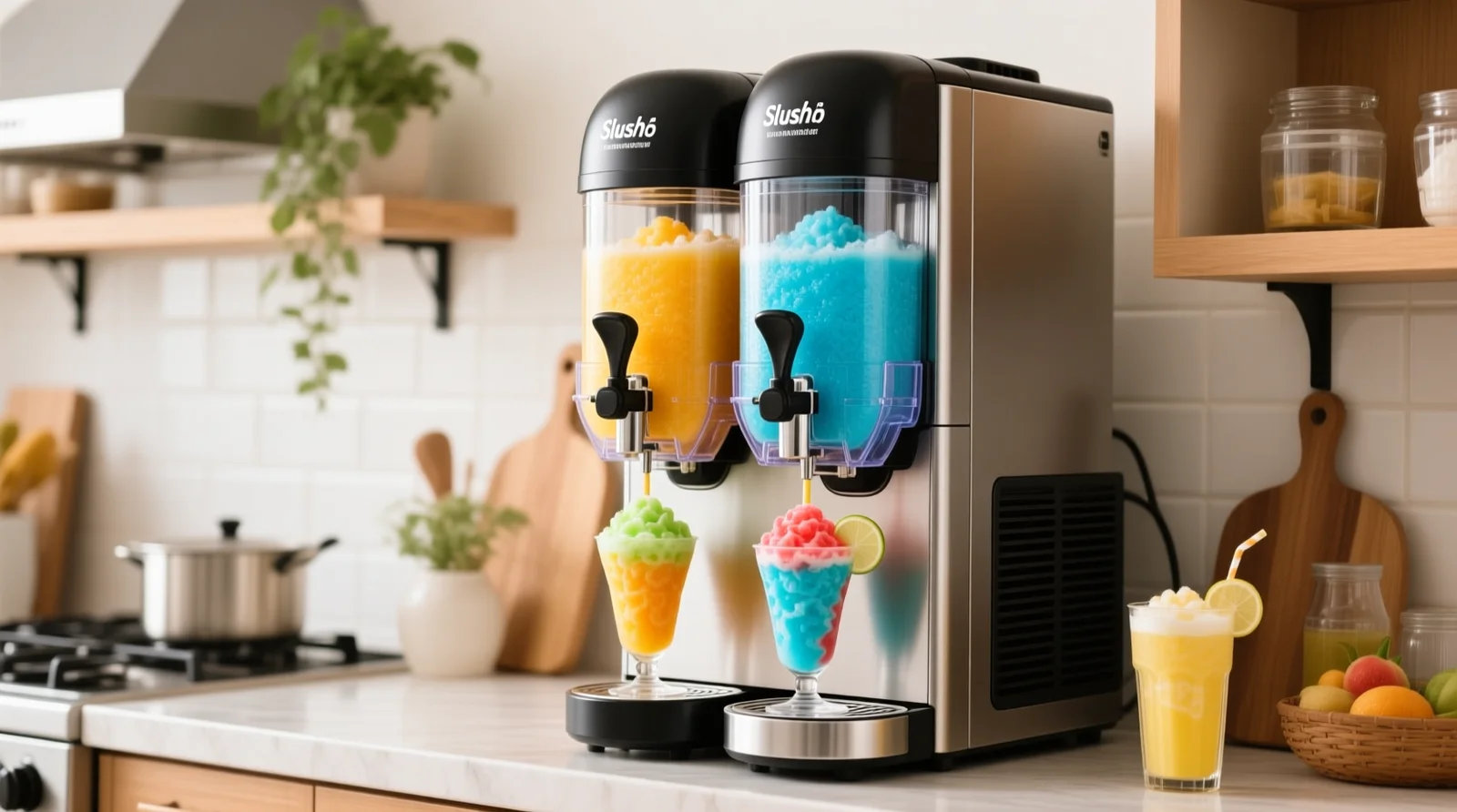
At a Glance: Which Slushie Machine Should You Buy?

Best overall: Cuisinart Frost Fusion — the most versatile and the easiest to get consistently fine, drinkable slush from a wide range of recipes (especially coffee-based drinks), plus it can make soft-serve style desserts.
Best for large families & parties (big capacity): Ninja Slushi FS301UK — the largest jug here and the best choice when you regularly make near-full batches or want more granular control over firmness.
Best affordable option: Tower Slushie Fusion — strong frozen-drink results for less money, but it needs a bit more hands-on learning and is less transparent about run times.
Price note: Prices are correct at time of writing and can change with retailer promotions, colours/bundles, and seasonal sales.
TL;DR: Cuisinart is the easiest “does-everything” pick, Ninja is best when you need maximum capacity and control, Tower is the value buy if you’re happy to tweak ratios and settings.
Why Buy a Slushie Machine?
A good slushie machine doesn’t just “blend ice” like a standard blender. It chills and churns continuously to create smaller ice crystals and a more stable texture (less watery separation in the cup). That’s what makes the difference between “crushed ice drink” and proper slush.
Frozen lemonade, juice and soda slush
Frozen cocktails (e.g., margaritas) and wine-based drinks (e.g., frosé)
Frappé-style iced coffee
Milkshakes and thicker dairy drinks (where supported)
Selected models can also do sorbet or soft-serve style desserts
Many machines also include a “hold” function: once your drink reaches the target texture, the unit intermittently churns to keep it pourable for hours. That’s particularly useful for kids’ parties or hosting, because you can make a batch in advance and serve it gradually.
For food safety basics on chilled dairy drinks and keeping perishable foods out too long, refer to the UK Food Standards Agency guidance: Food Standards Agency (FSA) advice on chilling food safely.
TL;DR: Slushie machines make finer, more stable frozen drinks than a blender and can keep a batch ready-to-pour for hours—ideal for entertaining.
How We Tested the Best Slushie Machines for Home Use

All testing was carried out by Annie Collyer (appliance reviewer with years of hands-on kitchen-appliance testing across major UK consumer titles, including regular testing of countertop drink and dessert machines). Results below reflect timed, real-kitchen use rather than idealised lab-only numbers.
Test conditions (for transparency): We tested in a typical home kitchen at ~20–22°C ambient temperature, using chilled liquids from the fridge where specified. Batch sizes were tested at roughly 500 ml (small batch) and near-full capacity (party batch). Noise was measured with a phone decibel meter at ~1 metre as a comparative indicator (not a calibrated lab reading).
Drink tests (and what they reveal)
Water-based frozen lemonade (baseline): highlights how evenly the machine freezes and whether it leaves large ice clumps.
Alcoholic mix (frosé/margarita-style): alcohol lowers the freezing point, so weak machines turn this into cold liquid or gritty slush. For freezing-point context, see: Encyclopaedia Britannica: freezing point.
Milk-based frappé/milkshake (viscosity test): shows whether the churning system keeps dairy smooth or creates foam, graininess, or separation.
What we scored beyond “does it freeze?”
Texture control: whether steps in “freeze level” actually change mouthfeel (e.g., microcrystal slush vs crunchy ice).
Pour quality: how cleanly the spout dispenses, whether it drips after serving, and whether the handle feels sturdy when the chamber is full.
Recovery after dispensing: how quickly the slush returns to the target texture after you draw off 1–2 servings.
Low-sugar performance: how fussy the machine is with reduced-sugar or sugar-free mixes (a common reason batches freeze solid or turn thin).
TL;DR: We timed small and near-full batches, compared texture at different freeze levels, noted spout/drip behaviour and recovery, and flagged how each model copes with alcohol and low-sugar mixes.
Key Features to Look For in a Home Slushie Machine
Capacity (L): Bigger jugs are better for parties, but take more counter space and can be slower to reach ideal texture when filled to the top.
Freeze/texture levels: More levels can help dial in tricky recipes (especially cocktails), but only if the differences are meaningful.
Hold time: The ability to keep slush ready for hours is a genuine quality-of-life feature for hosting.
Self-clean/rinse cycle: Worth paying for if you’ll make sugary or dairy drinks often.
Noise: If you plan to run “hold mode” for an afternoon, a quieter unit matters.
Energy use: Running for hours will cost more than making one quick batch. (See the “Energy use” note in the How to Use section.)
Recipe tolerance: Some machines are unforgiving with low sugar, high alcohol, or pulpy fruit—check how often you’ll make those drinks.
TL;DR: Prioritise capacity, real texture control, hold time, easy cleaning, and recipe tolerance—those affect day-to-day satisfaction more than extra presets.
Best Slushie Machines at a Glance (2026)

Best overall slushie machine: Cuisinart Frost Fusion (typ. £249–£299)
Best slushie machine for large families: Ninja Slushi FS301UK (typ. £239–£249)
Best affordable slushie machine: Tower Slushie Fusion (typ. £165–£180)
TL;DR: Cuisinart leads for versatility and “easy wins”, Ninja leads for big-batch serving, Tower wins on price.
Cuisinart Frost Fusion (Best Overall)
Available from: Lakeland (£249), Amazon (£249.99), Cuisinart (£299.99)
The Cuisinart Frost Fusion is the most complete option for most households because it’s the quickest to “set and succeed” across different drink types. It also adds an ice-cream/soft-serve style function, which gives it a broader use case than a slush-only machine.
What stood out in testing
Speed (timed): chilled frozen coffee reached a fine, café-frappé texture in ~14 minutes (about 500–700 ml). Frozen lemonade landed in the “spoonable but pourable” zone in ~18–22 minutes at a mid texture level. Near-full batches took longer (typically ~25–35 minutes depending on sugar/alcohol).
Texture: at mid levels, it produced smaller crystals—more “velvety snow-cone” than crunchy ice. Coffee drinks were notably smooth with minimal foam.
Hold time (observed): Cuisinart’s claim of up to 16 hours was achievable for high-sugar mixes in our kitchen when left in hold mode; low-sugar batches tended to stiffen sooner and needed a texture-level adjustment.
Pouring, stability, and day-to-day use
Spout control: clean, controlled pours with fewer “surprise gushes” than cheaper machines; minimal drip after dispensing in our tests (a quick wipe still helps).
When the chamber is nearly full: it stayed stable on the counter, but you’ll want a firm, level surface—full batches are heavy, and moving the machine mid-cycle is awkward.
Controls: presets are genuinely intuitive; you can get good results without constant trial-and-error.
Low-sugar and alcohol notes
Low-sugar or sugar-free mixes can freeze harder and faster because sugar depresses the freezing point. With reduced-sugar lemonade, we got the best results by starting at a lower texture level and increasing gradually once the machine began forming slush. For cocktails, it handled moderate alcohol recipes well; very boozy mixes still need restraint (think “cocktail strength” rather than “spirit-forward”). For background on how sugar affects freezing behaviour, see: Exploratorium: the science of ice cream (freezing point depression).
Pros
Fast slush formation with chilled mixes
Excellent coffee/frappé textures (fine crystals, low graininess)
Useful presets plus meaningful texture levels
Hold mode is genuinely practical for parties (up to ~16 hours with suitable recipes)
Built-in rinse programme simplifies cleanup
Also makes soft-serve style desserts
Cons
Soft-serve/ice-cream style results are less stable for long holding (we saw quality drop after ~30 minutes)
Plastic components feel less premium than glass, even if they’re lighter and less fragile
TL;DR: The easiest machine to get consistently smooth slush (especially coffee drinks), plus a useful dessert mode and a genuinely long hold function for hosting.
Ninja Slushi FS301UK (Best for Large Families & Capacity)

Available from: Amazon (£239.99), Ninja Kitchen (~£240), Very (£249), Argos (£249.99)
The Ninja Slushi FS301UK is the one to buy when you routinely serve a crowd. Its 1.9L capacity is the biggest here, and the extra freeze levels help you “rescue” tricky mixes (colas, cocktails, and milk-based drinks) without starting from scratch.
Pricing clarification
This model launched at around £349.99 in the UK but has since settled to more typical “street pricing” around £239–£249 depending on retailer and promotions.
What stood out in testing
Batch performance (timed): at ~500–700 ml, most drinks hit a good slush texture in ~18–24 minutes. Near-full 1.9L batches tended to take ~30–45 minutes depending on starting temperature and recipe.
Texture control: the 10 freeze levels make a real difference. Lower levels produced a more drinkable “ICEE-style” slush; higher levels moved toward spoonable granita.
Noise (observed): measured roughly 62–67 dB at ~1 m during active chilling/churning in our kitchen—noticeable but not the “vacuum cleaner” effect some countertop machines have.
Pouring, drip tendency, and recovery
Spout and handle feel: sturdy lever action with good control even for kids (supervised). We saw occasional drips if you released mid-pour; a deliberate “full open, full close” motion reduced this.
Recovery after serving: after dispensing 2–3 drinks from a full batch, it regained an even texture quickly (typically within a few minutes on hold), which is exactly what you want at parties.
Recipe realism: sugar-free and cocktails
For low-sugar mixes, the Ninja was slightly less forgiving than the Cuisinart at mid settings—one reduced-sugar cola mix started to form a firmer, crunchy core at higher freeze levels. Dropping 1–2 levels and ensuring the base was well-chilled improved the texture.
For alcohol, it performed strongly with wine-based frosé and standard frozen cocktail ratios. Where it clearly outperformed the Tower was in larger alcoholic batches: texture stayed more uniform and didn’t split into “icy edges + boozy centre” as easily.
Pros
Largest capacity here (better for families and entertaining)
Freeze levels provide genuinely useful control for different recipes
Consistently smooth results on mainstream drinks (cola slush was notably fine-grained)
Quick texture recovery after dispensing multiple servings
Cons
Takes up more counter space; not ideal for small kitchens
Value depends on how often you’ll use the capacity (overkill for occasional solo drinks)
TL;DR: Buy it for big-batch slush and party serving—excellent control, strong recovery, and consistently uniform texture when the chamber is heavily loaded.
Tower Slushie Fusion (Best Affordable)
Available from: Amazon (£165.60), AO (~£166), Tower (£179.99)
The Tower Slushie Fusion is the price-performance pick. It can absolutely produce smooth slush and creamy milkshake-style drinks, but it’s less communicative during operation and more sensitive to recipe balance—especially sugar content.
What stood out in testing
Run-time clarity: there’s no countdown timer, so you rely on visual cues and trial runs to learn what “ready” looks like.
Freezing (timed): with chilled mixes around 500–700 ml, we typically saw drinkable slush in ~20–28 minutes. Near-full batches could stretch to ~35–50 minutes, and it was slower to bounce back after multiple servings than the Ninja.
Noise (observed): roughly 65–70 dB at ~1 m—similar to the Ninja, occasionally a touch higher during heavier mixes.
A failed test (and what it means for buyers)
With a cola slush, an early attempt using a too-low sugar ratio froze into a semi-solid mass before the cycle completed. That’s not unusual: reduced sugar raises the freezing point, so the machine can overshoot and lock the mix. Adding a little more liquid, lowering the thickness level, and restarting produced a smooth, even slush with fewer large crystals.
Compared side-by-side, the Cuisinart was the most forgiving in this situation (it reached “slush” earlier and stayed more pliable), while the Ninja offered the most granular adjustment to steer the texture back.
Pouring and practical use
Spout behaviour: acceptable, but we saw more post-pour drips than on the Cuisinart—keep a cloth handy.
Learning curve: presets exist, but the touchscreen and feedback aren’t as self-explanatory; expect a couple of “calibration” batches before you nail your favourite recipes.
Pros
Good results once ratios/settings are dialled in
Generous capacity for the money (1.6L)
Self-clean function encourages frequent use
Versatile presets (including wine)
Cons
No clear time indicator; you must learn by feel/appearance
More sensitive to low-sugar recipes (greater risk of “freeze solid”)
Packaging used a lot of non-recyclable plastic in our sample
TL;DR: Great value if you don’t mind a short learning curve—excellent slush once dialled in, but less forgiving and less informative than the two pricier machines.
Best Slushie Machine for Your Scenario

Kids’ parties: Ninja Slushi FS301UK (capacity + quick recovery while serving), or Cuisinart if you want the simplest controls.
Cocktail nights: Cuisinart for fast, fine texture on mixed drinks; Ninja for bigger alcoholic batches without texture splitting.
Small kitchens / limited storage: Cuisinart (sleeker footprint and “leave-it-out” looks); Ninja may feel bulky.
Low-sugar households: Cuisinart is the easiest starting point; with any model, expect to experiment with freeze level and stabilising ingredients.
Value-first buyers: Tower (best cost per feature), as long as you’re willing to tweak ratios.
TL;DR: Match the machine to your most common use: capacity for parties (Ninja), plug-and-play versatility (Cuisinart), or best value with more tweaking (Tower).
How to Use a Home Slushie Machine Step by Step
Pre-chill your mix (fridge-cold liquid shortens freezing time and improves crystal fineness).
Mix thoroughly so sugar/syrups dissolve (undissolved sugar can cause uneven freezing and gritty texture).
Fill to the max line (overfilling slows freezing and can cause messy dispensing).
Pick the closest preset (slush/cocktail/frappé/milkshake) and start at a mid freeze level.
Wait for texture, not the clock: slush is ready when it flows slowly and holds peaks briefly in the chamber.
Use hold mode for serving windows, but don’t treat perishable dairy drinks as “all-day safe” at room temperature—follow food safety guidance.
Troubleshooting common slush problems
It froze solid: reduce freeze/thickness level; add a small amount of liquid; increase sugar slightly (or use a sugar alternative designed for freezing stability); restart and watch early.
It’s too runny: increase freeze level; confirm the mix was fridge-cold; check alcohol content (too much alcohol prevents proper freezing).
It separates (watery layer): lower the freeze level and allow more churning time; ensure syrups are fully dissolved; consider a small amount of stabiliser (e.g., a little fruit purée or a recipe designed for slush consistency).
Energy use: what to expect
Running “hold mode” for 12–16 hours will use more electricity than making one batch and switching off. Actual cost depends on the machine’s wattage and your tariff; for a rough calculation method, see the UK government’s guidance on energy bills and usage: GOV.UK energy guidance. If you’re cost-conscious, chill ingredients well, make the batch, serve within a shorter window, then switch off.
TL;DR: Start with fridge-cold mix and mid freeze level; adjust based on texture. If it’s solid, lower the level/add liquid; if runny, raise the level/check alcohol. Hold mode is convenient but costs more to run for hours.
How to Clean a Slushie Machine (Fast, Hygienic Method)

Run the rinse/self-clean cycle as soon as you’re done serving (warm water helps dissolve sugar and dairy residue).
Dispense the rinse water through the spout until it runs clear.
Disassemble key parts (drip tray, spout parts, lid/funnel where applicable) and wash with warm, soapy water; dry fully.
Wipe the exterior and the area around the spout (this is where sticky build-up often starts).
If you regularly make milk-based drinks, don’t leave residue sitting in the system—odours and build-up happen quickly.
TL;DR: Rinse immediately, flush the spout until clear, wash removable parts thoroughly, and dry everything to prevent sticky build-up and smells.
Related Appliance Reviews
If you’re comparing other countertop appliances, these are good next reads (anchors are written to suit future internal linking):
Best air fryers for quick weeknight cooking
Best stand mixers for bread and baking at home
Best food processors for slicing, grating and batch prep
Best bean-to-cup coffee machines for barista-style drinks
Best coffee pod machines for convenience and consistency
Best multi-cookers for hands-off family meals
Best espresso machines for home lattes and flat whites
Best ice cream makers for home desserts
TL;DR: If frozen drinks sparked an appliance upgrade, coffee machines and ice cream makers are the most logical comparisons.
Conclusion

Cuisinart Frost Fusion: best overall for most homes—fast, intuitive, consistently smooth (especially for frappés), and the most versatile thanks to dessert modes and long hold capability.
Ninja Slushi FS301UK: best for large families and entertaining—big 1.9L capacity, strong texture control, and reliable recovery during heavy serving.
Tower Slushie Fusion: best affordable route to proper slush—excellent value, but more sensitive to recipe ratios and less transparent about timing.
TL;DR: Choose Cuisinart for versatility and effortless results, Ninja for big-batch serving, or Tower for value if you’re happy to tweak settings.
FAQ
Q: What is the best slushie machine for home use in 2026?
A: The Cuisinart Frost Fusion is our best overall pick because it’s the most versatile and consistently produces fine, smooth textures across lemonade, cocktails and coffee drinks. If you regularly serve groups, the Ninja Slushi FS301UK is the better buy for its 1.9L capacity and strong texture control.
Q: How long does a home slushie machine take to make slush?
A: In our timed tests with fridge-cold mixes, small batches (~500–700 ml) typically took 14–28 minutes depending on drink type and freeze level. Near-full batches generally took 25–50 minutes. Coffee-based drinks were often quicker to reach a smooth, drinkable texture than large, near-full lemonade or cocktail batches.
Q: Can I use real fruit or homemade syrups in a slushie machine?
A: Yes, but strain or blend well first. Seeds, heavy pulp and fibrous skins can clog spouts and make cleaning harder. For the smoothest texture, use finely blended fruit purée and consider straining through a fine sieve. Homemade syrups should be fully cooled and fully dissolved before adding to prevent grainy texture and uneven freezing.
Q: Do I need special slush syrups, or can I use juice and soda?
A: You can use standard juices, sodas and cordial. Specialist slush syrups can help because they’re formulated for consistent freezing (often with stable sugar levels), which reduces the chance of a batch turning runny or freezing solid. They’re optional—not required—unless you want very consistent results with minimal tweaking.
Q: Why did my slush freeze solid (or stay too runny), and how do I fix it?
A: Solid batches usually mean too little sugar, an overly aggressive freeze setting, or a mix that’s prone to hard freezing. Fix by lowering the freeze level and adding a little liquid (or adjusting sweetness). Runny batches often mean too much alcohol, a warm starting mix, or too low a freeze level—fix by chilling ingredients, reducing alcohol, and increasing the freeze level.