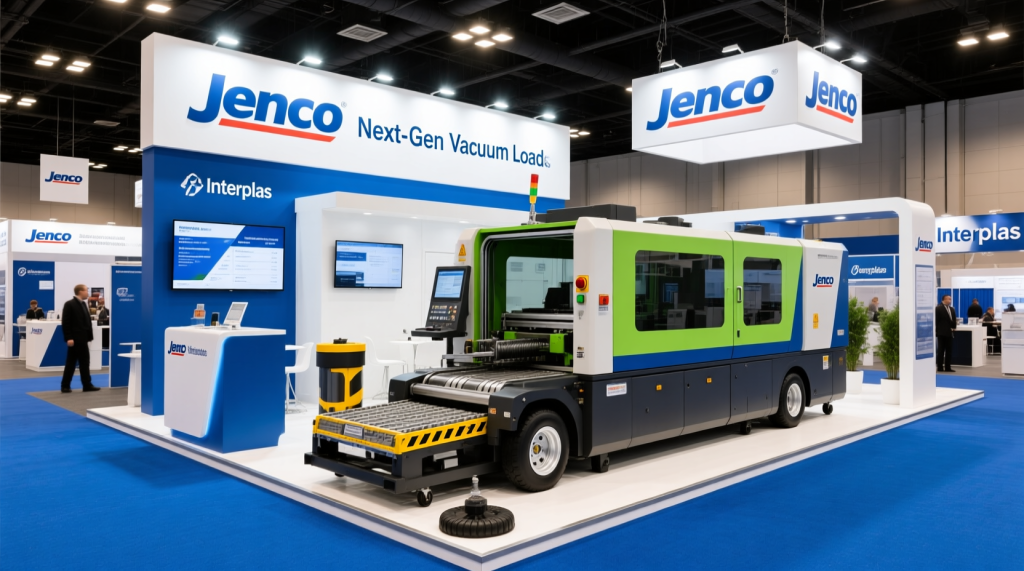
If you’re searching for plastics material conveying systems that can replace manual loading, reduce downtime, and connect to factory automation, Jenco’s next-generation Diamond Range is built for exactly those upgrade projects. At Interplas 2026 (2–4 June, NEC Birmingham), Jenco will demonstrate automatic resin loaders and centralised vacuum loading systems designed for modern polymer processing, including virgin pellets, regrind, and recycled granulate.
Visitors can find Jenco in Hall 9, Stand S120.
TL;DR: Jenco will show Diamond Range vacuum loaders at Interplas 2026 for processors wanting more reliable plastic granule handling equipment, less manual handling, and Industry 4.0 connectivity.
From Interplas 2023 to 2026: The Evolution of the Diamond Range

At Interplas 2023, Jenco marked its 60th anniversary by unveiling the first generation of the Diamond Range. The company’s roots in UK plastics material handling go back to the hopper loaders and conveying systems widely adopted from the 1970s onwards.
For Interplas 2026, the Diamond Range has been re-engineered using operational feedback from installed systems and ongoing in-house development in Northamptonshire. The redesign focuses on measurable plant outcomes: more stable conveying performance, reduced filter handling time, improved seal integrity (to prevent vacuum losses), and clearer diagnostics for faster troubleshooting.
Jenco’s experience spans typical high-uptime sectors such as automotive, packaging, medical manufacturing, and plastics recycling—areas where dust management, traceability, and consistent feed are critical. (For event details, see the official Interplas page: https://www.interplasuk.com/.)
TL;DR: The 2026 Diamond Range is an iteration driven by field feedback and reliability engineering, aimed at improving uptime and diagnostics in real plastics plants.
Diamond Range Vacuum Loaders: What They Are and Where They Fit
Vacuum loaders are automatic resin loaders that use negative pressure (vacuum) to convey plastic pellets/granules from a source (e.g., bag dump station, gaylord, silo receiver, or day bin) to a destination (machine hopper, dryer hopper, blender, or surge bin). In plastics processing, they are used as part of broader plastic granule handling equipment and material flow automation.
In practical terms, Diamond Range configurations typically fall into two categories:
- Stand-alone machine loaders (point-of-use): one loader feeding one machine/dryer. Common for small-to-mid plants, shorter conveying distances, or frequent material changes.
- Centralised vacuum loading systems (multi-receiver): one or more vacuum pumps feeding multiple receivers across a plant, usually with sequencing controls and higher total throughput. Common for multi-machine operations aiming to reduce maintenance points and improve energy management.
Typical vacuum conveying distances in plastics plants are often in the 10–50 m range depending on material bulk density, line diameter, number of bends, and required throughput; longer runs can be engineered but usually require careful pump sizing, air-to-material ratio control, and dust filtration strategy. To support application engineering, Jenco focuses on real conveying variables (line routing, bend count, resin type, regrind fraction, and dust load) rather than relying on nominal “one-size” ratings.
TL;DR: Diamond Range loaders can be specified as stand-alone units or as part of a central system; selection depends on distance, number of machines, and material/dust characteristics.
Key Technical Features for Plastics Material Conveying Systems
The Diamond Range has been developed for modern plastics processors that need predictable material feed, low unplanned downtime, and fast maintenance access. The goal is not just “more efficient” in a general sense, but better performance through specific engineering changes: improved airflow paths (reducing pressure drop), upgraded filtration options (better fine dust handling), and improved sealing interfaces (maintaining vacuum integrity and consistent cycle times).
TL;DR: The Diamond Range targets real conveying KPIs (stable cycles, vacuum integrity, filtration performance, maintainability) rather than cosmetic updates.
Industry 4.0 Integration for Centralised Vacuum Loading Systems
Industry 4.0 refers to connected manufacturing using networked devices, production data, and automation to improve quality, uptime, and traceability. The Diamond Range is designed to integrate into factory control architectures using a Siemens PLC (Programmable Logic Controller) touch interface and common industrial communication methods.
Typical integration capabilities and data points for plastics material conveying systems include:
- Communication protocols: Profinet, OPC UA (Open Platform Communications Unified Architecture), and Modbus/TCP are commonly used for PLC-to-SCADA/MES connectivity (availability depends on final configuration and plant standards).
- Data available for monitoring: loader/receiver status, alarm history, cycle counts, valve/sequence status, conveying time per cycle, filter differential indication (where fitted), and pump runtime hours.
- Alarms and interlocks: low material, convey timeout, vacuum leak indication, filter service alerts, and sequence faults—supporting faster root-cause diagnosis.
- Remote support options: secure remote diagnostics can be implemented for troubleshooting and parameter checks (subject to site cybersecurity policies).
- Predictive maintenance building blocks: tracking pump hours, cycle counts, and alarm frequency helps maintenance teams trend issues (e.g., rising convey time may indicate filter loading, hose wear, or leaks).
For readers new to these terms, OEE (Overall Equipment Effectiveness) is a common manufacturing metric combining availability, performance, and quality. Industry connectivity helps relate material handling performance to OEE losses such as stoppages from empty hoppers or nuisance alarms. For more background, Siemens provides a useful overview of PLC-based automation concepts: https://www.siemens.com/global/en/products/automation/systems/industrial/plc.html.
TL;DR: Diamond Range supports modern plant connectivity (e.g., Profinet/OPC UA/Modbus TCP) and exposes useful diagnostics (alarms, cycle counts, runtimes) to enable faster troubleshooting and maintenance planning.
Brushless Motor Technology: What It Changes in Practice
Diamond Range loaders use brushless motors (electronically commutated motors that do not rely on carbon brushes for commutation). In vacuum loader duty cycles—frequent starts/stops and variable load—brushless designs typically reduce routine wear components and can improve consistency over time versus brushed motors.
In practical plant terms, brushless motor benefits are usually seen as:
- Reduced scheduled maintenance associated with brush inspection/replacement.
- More stable conveying performance across many cycles as motor condition remains consistent.
- Potential energy improvements depending on duty cycle and control strategy (especially when compared with older fixed-speed or inefficient motor setups). Actual savings are application-specific and depend on throughput, vacuum level, and operating hours.
Motor power requirements for point-of-use loaders and small central systems are commonly in the 0.8–5.5 kW range, while larger central vacuum systems may use higher power pumps based on total throughput and number of simultaneous demands. Final sizing depends on line routing, material type, and required kg/h.
TL;DR: Brushless motors mainly reduce wear-related maintenance and help keep conveying performance consistent over high cycle counts; power is sized by layout and throughput needs.
Siemens PLC Touch Control, Modular Architecture, and Faster Troubleshooting
Each system uses a Siemens PLC touch control, giving operators a clear status view and structured alarm handling. This matters in day-to-day production because many “conveying problems” are actually recoverable issues—blocked filters, air leaks, empty sources, bridged material, or incorrect sequencing—where clear diagnostics can reduce stoppage duration.
The modular approach supports staged upgrades. For example, a processor may start with stand-alone machine loaders and later expand into a centralised vacuum loading system with multiple receivers, sequenced control, and plant-wide reporting—without reworking the entire approach to control and operator interaction.
TL;DR: Siemens PLC touch control improves fault-finding speed and standardises operation; modular design supports phased expansion from stand-alone to central conveying.
Materials and Build: Electropolished 304/316 Stainless Steel (Not “340”)
The Diamond Range is manufactured in electropolished stainless steel, typically 304 stainless steel (general corrosion resistance) or 316 stainless steel (enhanced corrosion resistance in more aggressive environments). Electropolishing reduces surface roughness, helping minimise material hang-up and improving clean-down—important when running masterbatch, additives, or frequent colour/material changes.
For dusty or fines-heavy applications (e.g., regrind, powdery reprocessed streams, or dust-laden conveying), filtration strategy becomes the main driver of performance and service life. Design adaptations that may be specified include:
- Filter types: pleated cartridge filters for high surface area; anti-static media options for certain dust profiles; and higher-grade filtration where fines loading is severe.
- Seal and clamp design improvements: better vacuum retention reduces convey time drift and nuisance “timeout” faults.
- Wear considerations: for abrasive regrind, engineered wear points (e.g., elbows/liners) and appropriate hose selection reduce erosion and leak risk over time.
For general material convey guidance and safety considerations around dust management, HSE (UK Health and Safety Executive) resources on dust risks are a useful reference point: https://www.hse.gov.uk/dust/.
TL;DR: The Diamond Range uses electropolished 304/316 stainless steel for cleanability and flow; filtration, sealing, and wear-spec options can be tailored for dusty or abrasive regrind duties.
Material Compatibility: Virgin Resin, Regrind, Hygroscopic Polymers, and High-Temperature Scenarios
Plastics processors often run mixed material types across injection moulding, extrusion, blow moulding, and recycling lines. The Diamond Range can be configured for:
- Virgin pellets and masterbatch: focus on cleanability, low hang-up, and repeatable cycles.
- Abrasive regrind/recycled flake: specify robust hose, wear-resistant elbows/liners where needed, and filtration designed for higher dust loading.
- Hygroscopic materials (polymers that absorb moisture, e.g., PET, PA, PC): integrate with dryers and sealed material paths to reduce moisture pickup between drying and processing. (A dryer hopper interface and closed conveying loop help preserve low dew-point conditions.)
- Dust-laden applications: filtration area and cleaning access become critical; differential pressure indication (where fitted) helps avoid “choking” the system with loaded filters.
- Higher-temperature feed zones: where conveying near hot extruder throats or dryers is unavoidable, specify temperature-appropriate hose, seals, and routing to prevent softening or material smearing.
Compatibility is determined by more than “material name”: bulk density, pellet geometry, fines percentage, and regrind ratio can dramatically change real throughput and stability.
TL;DR: Diamond Range systems can be adapted for virgin, regrind, hygroscopic polymers, and dusty streams by tailoring filtration, wear points, sealing, and integration with dryers/blenders.
Flexible Power Options Explained (Including Compressed-Air Venturi)
The Diamond Range is available with multiple power approaches to suit plant constraints and scale:
- Compressed-air-driven (venturi) loaders: “Air” in this context means a venturi vacuum generator powered by compressed air. These are often selected for low throughput points, short distances, or where electrical installation is constrained—while recognising that compressed air can be energy intensive if used continuously.
- Single-phase electric: common for smaller point-of-use automatic resin loaders.
- Three-phase electric: typically used for higher throughput, longer distances, or centralised vacuum loading systems where pump efficiency and duty cycle control matter most.
Choosing between venturi and electric vacuum generation is a lifecycle decision: energy cost, operating hours, and required throughput usually determine the best option.
TL;DR: “Air” refers to compressed-air venturi loaders; single-/three-phase electric options suit larger throughputs and central systems where energy and duty cycle control are key.
Maintenance and Lifecycle Cost: Service Access, Filters, and Standardisation
For engineering and maintenance managers, the practical questions are: how fast can we service it, how predictable is upkeep, and how quickly can we restore conveying after a fault?
Diamond Range design priorities include maintenance accessibility and repeatable service tasks, typically supported by:
- Fast filter access (to reduce time-to-clean/replace and encourage correct maintenance behaviour).
- Clear service prompts via PLC alarms and runtime/cycle tracking.
- Standardised consumables where possible (filters, seals) to simplify spares strategy across multiple lines.
- Remote diagnostics readiness (where site policies allow) to speed troubleshooting and reduce repeat visits.
Filter maintenance intervals vary widely with regrind percentage and dust content; many plants set inspections by cycle counts or pump hours rather than calendar time to match real load conditions.
TL;DR: Maintenance is designed around fast filter access, clearer diagnostics, and consumable standardisation to reduce downtime and simplify spares management.
Real-World Results: What Processors Typically Improve

Performance outcomes depend on material, layout, and operating discipline, but the re-engineered Diamond Range targets measurable improvements by reducing common causes of stoppages (vacuum leaks, filter loading, unclear alarms, and inconsistent cycle times).
Case snippet (UK injection moulding, anonymised): A mid-size moulder running multiple machines reported a reduction in manual top-ups after moving critical machines to automatic resin loaders and adding clearer alarm handling. With improved fault visibility and more consistent conveying cycles, they estimated ~20–30% less operator intervention on material loading tasks and fewer “machine starved” events during busy shifts (site results vary based on material consistency and housekeeping).
Case snippet (recycling line, anonymised): A processor handling regrind with higher fines content focused on filtration area and service access. After optimising filter media and maintenance prompts, they reported fewer nuisance convey timeouts and more predictable cleaning routines, improving line stability during long production runs.
TL;DR: Users typically see less manual loading, fewer starvation events, and faster fault recovery—especially when filtration, sealing, and diagnostics are engineered to the material stream.
How to Choose the Right Vacuum Loader for Your Plant
To select between stand-alone machine loaders and centralised vacuum loading systems—and to size equipment correctly—use the criteria below:
- Required throughput (kg/h): per machine and total across the plant; include peak rates, not just averages.
- Conveying distance and routing: straight length, vertical lift, number of bends, and available line diameter.
- Number of destinations: one machine vs multiple machines/dryers/blenders requiring sequencing.
- Material type: pellet vs regrind vs powdery streams; abrasive content; percentage regrind; bulk density.
- Moisture sensitivity: hygroscopic polymers may require tighter sealing and dryer integration to prevent re-absorption.
- Dust load and housekeeping: impacts filter selection, service intervals, and whether differential pressure indication is beneficial.
- Expansion plan: expected new machines/materials in 12–36 months; central systems often suit planned growth.
TL;DR: Correct vacuum loader selection depends on kg/h, distance/routing, number of receivers, material/dust/moisture behaviour, and future expansion.
What to Prepare Before Talking to Jenco (Faster Quotations, Better Engineering Fit)

For an accurate specification and smoother commissioning, it helps to bring practical process data rather than only machine model numbers. Useful information includes:
- Material list: polymer types, regrind percentage, additives/masterbatch, and any known dust/fines issues.
- Consumption rates: kg/h per machine (average and peak), plus operating hours per week.
- Plant layout: a simple drawing showing sources (silos/day bins) and destinations (machines/dryers/blenders), with approximate distances and height changes.
- Current problems: bridging, “angel hair” (stringy regrind), frequent filter clogging, vacuum leaks, or inconsistent feed.
- Automation requirements: preferred protocol (Profinet/OPC UA/Modbus TCP), alarm reporting needs, and whether MES/SCADA connection is required.
TL;DR: Bring material data, kg/h rates, a layout sketch, and your automation protocol requirements to speed up correct system sizing and integration planning.
Why Visit Jenco at Interplas 2026
At Interplas 2026 (Hall 9, Stand S120), visitors can review Diamond Range vacuum loader build details, discuss plastics material conveying system layouts, and explore Industry 4.0 integration options for alarms, runtimes, and plant-level visibility. You’ll be able to compare stand-alone machine loaders versus centralised vacuum loading systems based on throughput targets, distances, material type (including regrind), and maintenance expectations.
For those planning upgrades, a practical next step is to request a brief application review using your material list and layout drawing so the conveying concept and controls approach can be sized correctly from the start.
TL;DR: Visit to evaluate loader hardware, filtration/service access, and controls connectivity—and to get an application-led recommendation for stand-alone vs central conveying.
Conclusion
Jenco’s Diamond Range is positioned for processors that need more dependable, maintainable, and connected plastic granule handling equipment—whether upgrading a single machine from manual loading or building a plant-wide centralised vacuum loading system. The 2026 updates focus on engineering fundamentals (air path efficiency, filtration strategy, sealing integrity, and diagnostics) that translate into fewer stoppages and simpler servicing in real production conditions.
TL;DR: The Diamond Range aims to improve conveying reliability and serviceability while enabling modern factory connectivity for better uptime and traceability.
FAQ
Q: How often do vacuum loader filters need cleaning or replacement?
A: It depends primarily on dust/fines content (especially with regrind) and conveying hours. Many plants inspect filters based on cycle counts or pump runtime hours rather than fixed calendar intervals. As a rule, fines-heavy regrind streams require more frequent checks than clean virgin pellets; the best interval is established after commissioning by trending convey time and filter loading.
Q: What noise levels should I expect from centralised vacuum loading systems?
A: Noise varies with pump type, installation method, and whether acoustic measures are used. Central systems can often be made quieter at the point of use because the pump can be located away from operators (e.g., in a services area) with appropriate attenuation, while receivers at machines are typically quieter than having multiple individual motors running on the shop floor.
Q: What level sensor options are available for plastic granule handling equipment?
A: Common level sensing methods include capacitive sensors (good for many pellet materials), proximity-based sensors (application-dependent), and load-cell weighing (often used when gravimetric control or inventory tracking is needed). The best option depends on material dielectric properties, dust, and whether you need a simple “low level” signal or more detailed usage data.
Q: Can Diamond Range vacuum loaders integrate with dryers and blenders from other manufacturers?
A: Yes. Vacuum loaders are commonly installed upstream of third-party dryers and blenders, provided the mechanical interfaces, required throughput, and control signals are agreed. For hygroscopic materials, the key is maintaining a sealed, sensible material path between dryer and machine to limit moisture re-absorption.
Q: How long does installation and commissioning typically take, and what training is provided?
A: Timing depends on scope. A stand-alone machine loader is often quicker to install than a multi-receiver centralised vacuum loading system with new line routing and plant network integration. Commissioning usually includes functional checks, recipe/parameter setup, alarm verification, and operator/maintenance training focused on filter service, fault diagnosis, and safe operation.
Q: Are brushless motors and centralised conveying more energy efficient than older or decentralised setups?
A: They can be, but results are application-specific. Brushless motors may reduce losses associated with wear and can support more consistent operation, while centralised systems can reduce the number of motors running and allow better matching of vacuum generation to demand. The most reliable way to assess energy impact is to compare duty cycle, pump/motor power, and operating hours across the current and proposed layouts.