
What “Plastic Processing Equipment” Includes (and Who Buys It)

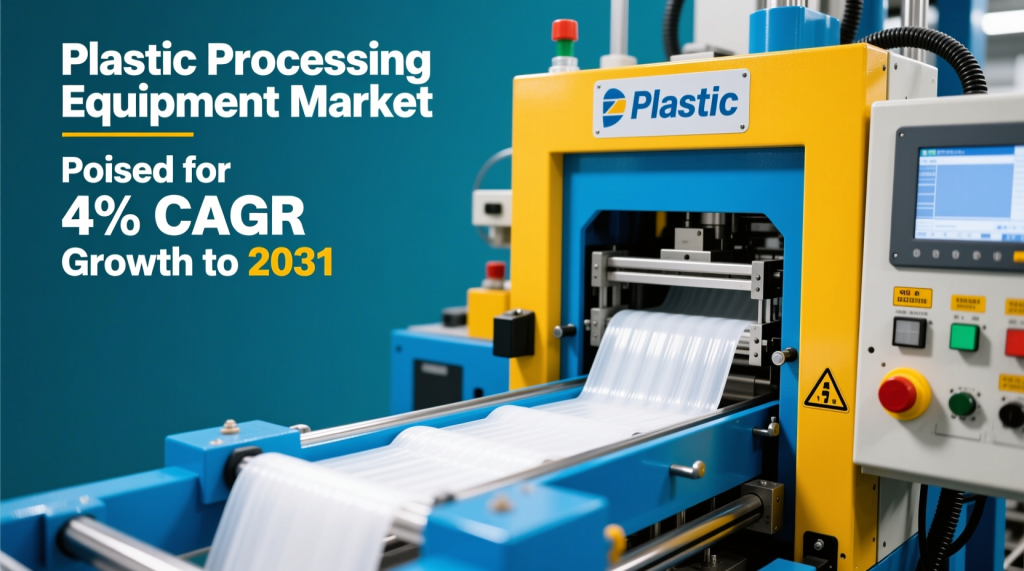
Plastic processing equipment refers to the industrial machines used to convert polymer resins (pellets, powders, regrind) into finished or semi-finished plastic products. In this market context, it mainly includes injection molding, extrusion, blow molding, and thermoforming systems—plus auxiliary equipment such as screws, barrels, melt filtration, dryers, robotics, and process controls.
Typical buyers include packaging converters, automotive tier suppliers, medical molders, electronics manufacturers, and compounders that make customized resin formulations. These buyers evaluate purchases as capital equipment investment decisions, often comparing energy costs, scrap rates, uptime, labor availability, and the ability to process new materials such as PCR (post-consumer recycled) polymers.
TL;DR: Plastic processing equipment is the industrial toolkit (injection molding, extrusion, blow molding, thermoforming + auxiliaries) that processors buy as long-life capital assets to turn resin into products—often with growing requirements for PCR capability and digital connectivity.
Key Takeaways (2022–2031 Forecast Window)
- Market size: ~USD 1.4B in 2021, projected to exceed USD 2.1B by 2031 (about 4% CAGR from 2022–2031).
- Largest machine category: Injection molding machinery remains the largest installed base, while electric and hybrid platforms gain share in new orders.
- Where growth concentrates: Asia Pacific leads unit demand (high-volume packaging and consumer goods), while Europe/North America skew toward premium, energy-efficient, Industry 4.0-ready upgrades.
- What buyers prioritize: Total cost of ownership (TCO), energy intensity, availability of service parts, and ability to run recycled and engineered polymers with stable quality.
- Critical trend: Electrification + digital process control (AI-assisted) is increasingly bundled into modernization programs rather than purchased as standalone “options.”
TL;DR: The market grows steadily to 2031, but “where the money goes” is shifting toward electrified, connected equipment that can process tougher materials (PCR/engineering plastics) with lower energy and scrap.
Market Overview (Size, Growth, and What’s Behind the Numbers)

The global plastic processing equipment market was valued at over USD 1.4 billion in 2021 and is projected to surpass USD 2.1 billion by 2031, expanding at a compound annual growth rate (CAGR) of about 4% from 2022 to 2031. These estimates are typically supported by a blend of primary research (interviews/surveys with OEMs, processors, and component suppliers) and secondary signals such as import/export machinery data, resin capacity additions, and publicly announced plant capex programs.
Demand is not simply “more plastics.” It is increasingly tied to product redesign (lightweighting, part consolidation), compliance-driven packaging changes (monomaterial structures, tethered caps, higher recycled content), and quality/traceability requirements (medical and electronics). For example, packaging converters often replace older hydraulic presses or legacy extrusion lines when brand-owner specifications tighten on wall thickness control, seal integrity, or recycled-content verification.
Plastics continue replacing wood, metal, and glass in selected applications because of weight, corrosion resistance, and design freedom. Common material examples include PVDC (polyvinylidene chloride) for barrier food packaging, PC (polycarbonate) for optical and safety components, and polyester-based fibers for textiles. At the same time, the market is bifurcating: commodity resins like PP (polypropylene) and PE (polyethylene) dominate volume, while engineering plastics (e.g., polyamides/nylons, PC, PEEK—polyether ether ketone) drive higher-value machine requirements due to tighter processing windows and performance demands (e.g., under-hood automotive parts, electrical connectors, medical device housings).
TL;DR: The forecast is steady through 2031, but underlying demand is increasingly driven by redesign, compliance, and quality/traceability—especially where PCR and engineering plastics raise processing complexity.
Analysts’ Viewpoint: Efficiency-Led Modernization (Not Just Capacity Expansion)
Across 2022–2031, many purchases are best described as extrusion line modernization and press replacement cycles aimed at lowering TCO rather than pure capacity growth. Buyers frequently track OEE (overall equipment effectiveness)—a standard metric combining availability, performance, and quality—and tie equipment upgrades to measurable improvements in scrap, downtime, and energy per kilogram of output.
Indicative regional structure (share ranges): Asia Pacific often represents the largest share of unit shipments (commonly ~40–55% range in many industrial equipment categories), while Europe and North America tend to account for a smaller share of units but a higher share of value due to premium configurations (automation, all-electric drives, validated medical packages). Middle East & Africa and Latin America remain smaller but can be “spiky” due to project-based investments (new packaging plants, pipe extrusion capacity, or local automotive programs).
Time context for 2025–2026 within the 2022–2031 window: If capital budgets tighten in early 2025 (higher financing costs, cautious end-market orders), the effect often shows up as delayed acceptance of non-urgent upgrades—especially for small and mid-size processors. Under a baseline forecast, 2026 can mark a return to higher order conversion as interest-rate expectations stabilize and sustainability/compliance retrofits become harder to postpone. The key point: both statements sit inside the same 2022–2031 horizon and describe near-term ordering behavior, not a different forecast period.
Critical perspective on the 4% CAGR assumption: This trajectory is plausible but not guaranteed. Downside risks include (1) stricter or faster-moving single-use plastic restrictions that shift packaging away from plastic faster than equipment can be repurposed, (2) geopolitical fragmentation that increases costs and lead times for servo drives, controls, and precision components, and (3) resin supply constraints or price shocks that reduce operating rates and delay capex. For policy reference, see the EU’s packaging and waste direction-of-travel via the European Commission overview on packaging waste.
TL;DR: Growth is increasingly “efficiency-led”—modernization, not just more machines. The 4% CAGR case can be pressured by policy shifts, geopolitics, or resin volatility that changes capex timing.
Competitive Landscape and How Trends Translate into Vendor Strategy
Technology trends (electrification, Industry 4.0 connectivity, recycling readiness) translate directly into how suppliers position their portfolios and service models. Competition typically hinges on (a) energy and cycle-time performance, (b) ability to stabilize quality with recycled or filled materials, (c) localized service response, and (d) software/control ecosystem maturity.
Leading companies active in the ecosystem include American Screw & Barrel, BOCO PARDUBICE machines, Canadian Feed Screws, Concor Tool and Machine, Lung Chang Machinery, Milacron, Nordson Corporation, Raj Engineering Works, Windsor Feedscrews, and W-J Incorporated.
Many suppliers are also pushing “equipment-as-a-service” style offerings (uptime agreements, remote diagnostics, software subscriptions). These models can change procurement behavior: instead of buying only for lowest purchase price, processors evaluate cost per molded part or cost per kilogram produced, with vendors sharing performance risk.
TL;DR: The market is not just about machine specs—vendors win by bundling electrified hardware, software, and local service into TCO-based offers, increasingly using uptime or subscription models.
Recent Developments (Concrete Signals, Not Just “Innovation”)
Real-world announcements help validate the direction of travel toward all-electric platforms and automation-ready systems.
- Milacron and FANUC ROBOSHOT (all-electric) portfolio expansion: Milacron’s extended partnership announcement (2021) signaled continued North American emphasis on all-electric injection molding machines for packaging, medical, and technical molding. (Company context: Milacron; platform context: FANUC ROBOSHOT.)
- FAKUMA trade fair visibility: BOCO PARDUBICE’s presence at FAKUMA 2021 highlighted ongoing demand for screws, barrels, and extrusion components that enable higher-throughput compounding and better handling of abrasive recycled content. (Event reference: FAKUMA.)
Illustrative modernization examples (anonymized):
- All-electric press retrofit program (EU medical molder): A mid-size medical molder replaced multiple older hydraulic presses with all-electric machines to reduce cleanroom contamination risk and improve shot-to-shot repeatability. The business case combined energy reduction, lower scrap, and reduced validation rework (IQ/OQ/PQ—installation/operational/performance qualification).
- PCR-capable extrusion upgrade (APAC packaging converter): A film converter added melt filtration and degassing to stabilize output when increasing PCR ratios, targeting fewer gel defects and more consistent gauge control to meet brand specifications.
TL;DR: Partnerships and trade-fair launches show the shift to all-electric and PCR-ready upgrades, and real plants are funding modernization to cut scrap, improve repeatability, and stabilize recycled-content production.
Key Technology and Market Trends (Consolidated to Avoid Repetition)
The largest technology shift is the move from purely hydraulic systems to all-electric and hybrid drive architectures, combined with digital control and connectivity. This is reinforced by Industry 4.0 adoption, recycled-material processing demands, and labor constraints.
All-Electric & Hybrid Drives: Energy, Precision, and Payback Logic
All-electric injection molding presses replace hydraulic pumps with servo-electric drives. In practice, they are selected less for “green branding” and more because they can deliver repeatability, clean operation (no hydraulic oil risk), and lower energy intensity—especially in high-cavitation packaging, medical molding, and electronics.
Indicative ROI/payback considerations: Payback depends on electricity price, utilization (hours/year), and baseline machine efficiency. Plants running high uptime (e.g., 24/5 or 24/7) in regions with higher power costs (often parts of Europe, Japan, and some North American markets) can see compelling economics—particularly when energy savings stack with reduced scrap and lower maintenance. In contrast, low-utilization job shops may prioritize hybrid retrofits or targeted upgrades (servo pumps, better controls) instead of full replacement.
TL;DR: All-electric isn’t just “more efficient”—it’s a repeatability + contamination-risk + TCO play, with the best payback typically in high-utilization plants and higher-electricity-cost regions.
AI-Driven Process Control and Quality Stabilization
AI (artificial intelligence) in plastics processing usually means models that detect drift and recommend or apply parameter adjustments (e.g., pack/hold profiles, barrel temperature trims) based on sensor data. The value proposition is concrete: fewer start-up rejects, faster changeovers, and better control when resin lots vary—an increasingly common situation when processors blend virgin resin with PCR.
For industrial buyers, the decision often depends on whether AI tools integrate with existing SCADA (supervisory control and data acquisition), MES (manufacturing execution system), and quality systems, and whether the vendor provides practical commissioning support rather than “black box” software.
TL;DR: AI-based control is adopted to reduce scrap and setup time—especially helpful when PCR variability is high—provided it integrates with plant systems and comes with strong application support.
Industry 4.0 Connectivity: OPC UA, Remote Service, and New Procurement Models
Industry 4.0 in plastics processing emphasizes connected machines, standardized data, and analytics for uptime and quality. A commonly used interoperability standard is OPC UA (Open Platform Communications Unified Architecture), enabling machine-to-machine and machine-to-IT connectivity.
Remote monitoring and predictive maintenance can shift service from reactive to planned interventions, which matters when skilled technicians are scarce. Over the next decade, more procurement teams may evaluate equipment using lifecycle KPIs (energy per part, downtime minutes/month, spare parts consumption) and adopt digital add-ons as ongoing operating expenses rather than one-time options.
For more on industrial connectivity standards, see the OPC Foundation’s OPC UA overview.
TL;DR: Connectivity (often via OPC UA) is becoming a default requirement; it enables remote service and shifts buying decisions toward lifecycle KPIs and potentially subscription-style digital tools.
Recycling and Circularity: Mechanical vs. Chemical Recycling (and Where Traditional Equipment Fits)
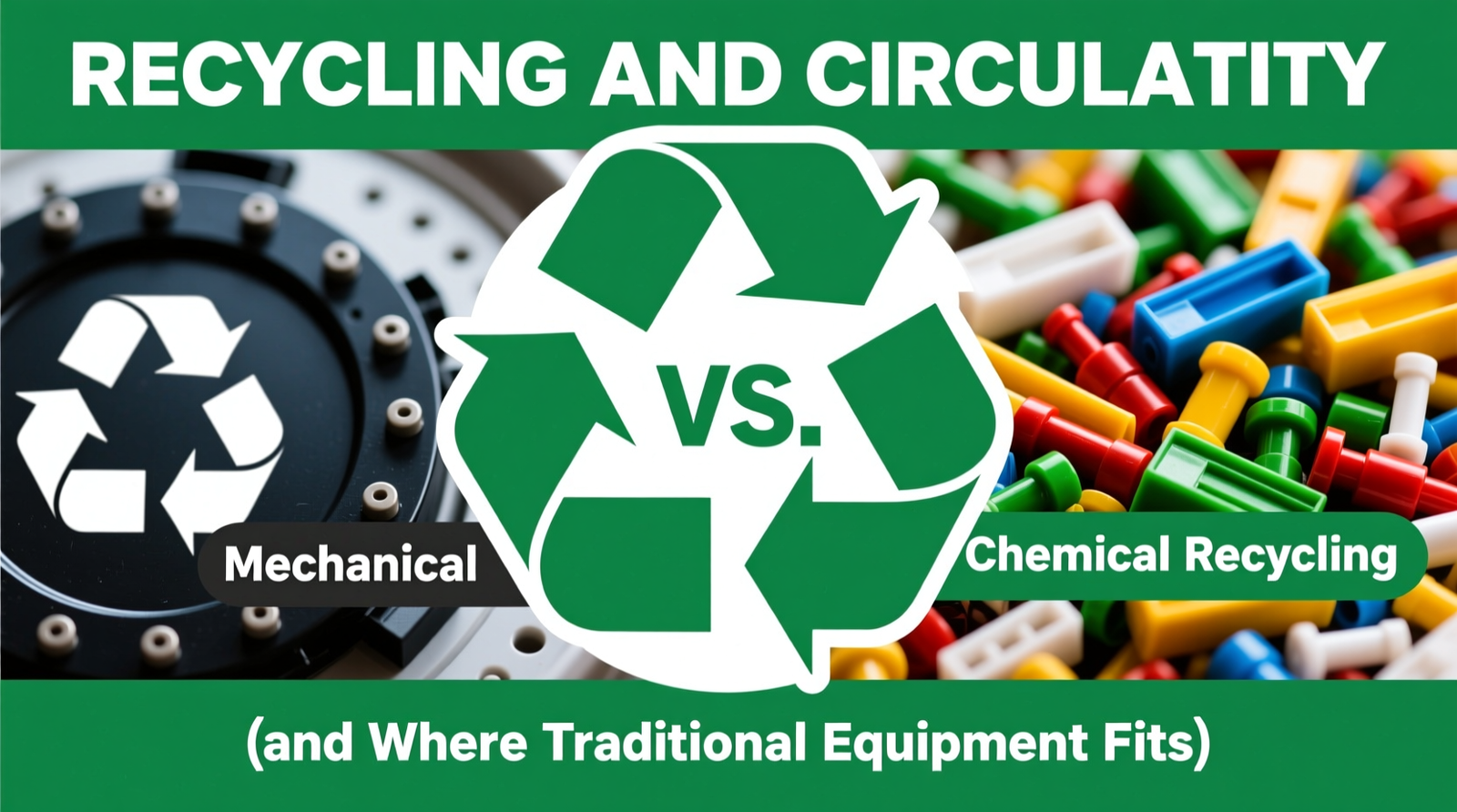
Recycling-driven investment is real, but it is important to separate mechanical recycling from chemical recycling because they rely on different equipment sets.
- Mechanical recycling reprocesses plastics physically (sort → wash → shred → melt-filter → pelletize). Traditional plastics equipment—especially extrusion lines with degassing, melt filtration, and wear-resistant screws/barrels—plays a central role. This is where many processors are investing today to increase PCR usage while controlling gels, odor, and viscosity drift.
- Chemical recycling converts polymers back to monomers or feedstock via chemical processes (e.g., pyrolysis, depolymerization). This space often involves specialized reactors and process plants; plastics equipment suppliers may participate more on the periphery (feed preparation, densification, extrusion-based feeding/compounding of chemically recycled outputs) rather than providing the core chemical conversion system.
For background on global recycling definitions and measurement challenges, see the OECD plastics work.
TL;DR: Mechanical recycling is where classic extrusion-based equipment is most central; chemical recycling is more process-plant-centric, with plastics equipment suppliers typically supporting preprocessing and compounding rather than the reactor core.
Additive and Niche Equipment: Why 3D Plastic Printers and Rotational Molding Appear in Segmentation
3D plastic printers (industrial additive manufacturing systems) and rotational molding machines are included in some market segmentations because they represent alternative plastic shaping routes used in industrial production environments. However, they are generally smaller, niche segments compared with injection molding and extrusion.
Where they matter: additive can reduce lead times for tooling, fixtures, and low-volume parts; rotational molding remains relevant for large hollow products (tanks, bins) with lower tooling complexity and certain durability requirements.
TL;DR: 3D printing and rotational molding are included because they are legitimate industrial plastic processing routes, but they remain niche versus mainstream injection molding and extrusion.
Segment-Specific Buying Nuances (Packaging vs. Automotive vs. Medical)

End-use requirements heavily influence equipment selection and automation levels:
- Packaging converters: prioritize cycle time, cavitation, thin-wall control, fast changeovers, and the ability to process higher PCR content without cosmetic defects. Connectivity and inline inspection can matter because brand audits increasingly require traceability.
- Automotive tier suppliers: often need engineering plastics capability (filled/FR grades), robust process windows, and dimensional stability. They also value uptime and standardized platforms across plants to simplify maintenance and training.
- Medical molders: focus on cleanroom suitability, validation readiness (IQ/OQ/PQ), traceability, and repeatability. Oil-free all-electric presses and controlled process monitoring tend to be favored where regulatory compliance is strict.
TL;DR: Packaging buys for speed + PCR stability, automotive buys for engineering plastics + robustness, and medical buys for validation + cleanliness + repeatability.
Market Challenges and Uncertainties (What Could Change the Trajectory)
Beyond the usual “high capex” narrative, several factors can reshape ordering patterns within the 2022–2031 forecast window:
- Policy and plastics restrictions: Faster-than-expected packaging bans or reuse mandates could reduce demand in some single-use categories, while increasing demand in others (e.g., thicker reusable formats or new materials). Regulatory direction varies; for U.S. context, see the U.S. EPA plastics overview.
- Supply chain and geopolitics: Controls, drives, and precision components can face longer lead times under trade barriers or regionalization, impacting delivery schedules and project ROI.
- Resin volatility and availability: When resin supply tightens or prices swing, processors often run conservative inventories and delay discretionary equipment upgrades—even if long-term modernization is needed.
- Workforce constraints: A shortage of experienced process engineers can limit how quickly plants can adopt AI/advanced controls and realize promised OEE improvements.
TL;DR: The biggest uncertainties are policy shifts, geopolitics-driven lead times, resin volatility, and workforce constraints—any of which can delay or redirect capital equipment investment.
Market Opportunities (Where Capital Equipment Budgets Are Actually Going)

Opportunities cluster around applications that require new materials, tighter tolerances, traceability, or recycling readiness:
- EV and electrification components: higher use of flame-retardant and high-performance polymers for connectors, housings, and insulation parts increases demand for precise injection molding and robust process monitoring.
- Medical and pharma packaging/devices: clean manufacturing, validated processes, and documentation drive adoption of all-electric presses, cavity pressure sensing, and digital batch records.
- Infrastructure and construction: pipe/profile extrusion and insulation applications support investments in high-output lines, improved energy efficiency, and recycled-content compounding.
- Recycling-driven upgrades: melt filtration, degassing, and wear-resistant components to run higher PCR ratios with stable quality.
TL;DR: The most bankable opportunities are in EV/engineering plastics, medical validation-grade molding, construction extrusion, and recycling-driven modernization (filtration/degassing/wear resistance).
Practical Equipment Selection Criteria (Actionable Checklist for Buyers)
For processors planning a capital equipment investment, the selection process is increasingly about risk reduction and future-proofing:
- Material readiness: Confirm capability for PCR variability (MFI drift, contamination), fillers (glass/mineral), and engineering plastics that need tighter thermal control.
- Connectivity standards: Require OPC UA (or equivalent) support, data ownership clarity, and compatibility with existing MES/SCADA systems.
- Energy and utilities model: Compare kWh/kg (or kWh/part), compressed air needs, cooling requirements, and peak power behavior—especially important where demand charges apply.
- Local service capability: Evaluate spare parts availability, response time SLAs, remote diagnostics tools, and training plans for technicians.
- Modularity and upgrade path: Look for modular injection units, screw/barrel options, and control software that can expand with future product changes.
TL;DR: Choose equipment based on PCR/engineering plastic readiness, connectivity (OPC UA), verified energy model, local service strength, and modular upgrade paths—not just nameplate tonnage or throughput.
Market Segmentation (Streamlined, With Context)

By Machine Type
- Injection molding machines (largest share; broadest end-use footprint)
- Extrusion machines (films, sheets, pipes, profiles, compounding)
- Blow molding machines (bottles, containers, tanks)
- Thermoforming machines (trays, cups, packaging inserts)
- 3D plastic printers & rotational molding (niche but growing in specific use cases)
By Operation Mode
- Electric (fastest-growing in many new installations where precision/cleanliness matter)
- Hydraulic (still relevant for some heavy-duty/thick-wall applications and cost-sensitive buys)
- Hybrid (common compromise for performance + capex control)
By Material Focus
- Commodity resins: PP, PE
- Engineering plastics: e.g., polyamides, PC, PEEK (automotive/electronics/industrial)
- Recycled polymers: PCR blends; requires filtration/degassing and wear management
- Bioplastics (consistent terminology): bio-based and/or biodegradable resins, often with narrower processing windows
By Region
- Asia Pacific: high-volume demand and capacity additions; strong role in packaging and consumer goods
- Europe & North America: modernization-heavy; premium configurations (all-electric, automation, Industry 4.0)
- Latin America, Middle East & Africa: smaller base; project-driven investments and localization opportunities
TL;DR: Injection molding leads, electric/hybrid platforms gain in new orders, and segmentation increasingly reflects material complexity (engineering plastics, PCR, bioplastics) and modernization intensity by region.
Market Outlook to 2031 (Connecting the Dots)
By 2031, the market is expected to surpass USD 2.1 billion, supported by modernization and compliance-driven upgrades rather than simple volume growth. The most consistent investment themes map directly to earlier sections:
- Electrification and payback logic (see “All-Electric & Hybrid Drives”): energy and maintenance savings + repeatability are pushing replacement cycles.
- Industry 4.0 connectivity (see “OPC UA, Remote Service”): buyers increasingly require data access, remote diagnostics, and uptime accountability.
- Circularity and recycling readiness (see “Mechanical vs. Chemical Recycling”): extrusion upgrades (filtration/degassing) and wear-resistant components enable higher PCR ratios.
- AI-driven stability (see “AI-Driven Process Control”): used to manage resin variability and reduce scrap during changeovers.
Looking beyond 2031 planning cycles, digital business models—remote monitoring, performance contracts, and software subscriptions—are likely to affect TCO and procurement: processors may choose vendors that can guarantee outcomes (uptime, energy per part, scrap rate) rather than only selling machines.
TL;DR: The 2031 outlook is anchored in three linked drivers—electrification, Industry 4.0 connectivity, and recycling readiness—plus AI to stabilize quality, with more vendors selling outcomes (TCO/uplink services) instead of just equipment.
About Transparency Market Research

Transparency Market Research (TMR) is a market research and consulting company headquartered in Wilmington, Delaware (U.S.). Its market estimates commonly draw on primary research (interviews with OEMs, processors, and industry stakeholders) and secondary research (company disclosures, regulatory databases, trade data, and industry publications) to build forecasts and competitive analysis.
Website: https://www.transparencymarketresearch.com
TL;DR: TMR’s market views typically combine OEM/processor input with secondary datasets (trade, regulatory, company disclosures) to quantify trends and forecasts.
FAQ
Q: What is included in the plastic processing equipment market?
A: It generally includes injection molding, extrusion, blow molding, and thermoforming machines, along with key auxiliaries such as screws/barrels, melt filtration, drying, robotics, and digital controls used to convert plastic resin into products.
Q: How does Industry 4.0 in plastics processing affect equipment buying decisions?
A: Industry 4.0 pushes buyers to require connectivity (often OPC UA), production data access, and remote diagnostics. This shifts evaluation from purchase price to lifecycle metrics like OEE, downtime, and energy per part—often favoring vendors with strong software and service capability.
Q: What is a realistic payback driver for switching from hydraulic to all-electric injection molding machinery?
A: Payback is most compelling when a plant runs high utilization and faces high electricity or maintenance costs. Energy reduction, lower scrap, and less unplanned downtime typically drive the business case more than nameplate speed alone.
Q: What should buyers check when planning extrusion line modernization for PCR materials?
A: Key checks include melt filtration capacity, degassing capability, screw/barrel wear protection, contamination management, and process monitoring for viscosity variation. These features help stabilize output quality when PCR feedstock varies lot to lot.
Q: Why are 3D plastic printers and rotational molding machines sometimes listed in market segmentation?
A: They represent alternative industrial routes for shaping plastics—useful for niche applications like large hollow parts (rotational molding) or low-volume production/tooling (industrial additive). They are typically smaller segments than injection molding or extrusion but are relevant for specific manufacturing strategies.