Introduction

The global market for case packing machines (end-of-line equipment that groups products and loads them into corrugated cases/trays for shipping or retail display) is evolving rapidly as manufacturers pursue higher throughput, lower labor dependence, and more resilient packaging operations. This shift is especially visible in end-of-line case packing automation projects across food, beverage, pharmaceuticals, and fast-moving consumer goods (FMCG).
Who this is for: packaging engineers, operations/maintenance managers, plant managers, OEMs (original equipment manufacturers), and co-packers evaluating semi-automatic vs automatic case packing machines, robotics, and line modernization.
Many investment decisions are now tied to measurable performance targets such as OEE (Overall Equipment Effectiveness, a standard metric combining availability, performance, and quality) and compliance expectations—particularly in food and pharma. In the U.S., packaging-line upgrades are often justified alongside food safety programs under FDA’s FSMA (Food Safety Modernization Act) framework and sanitary design guidance (e.g., equipment hygienic design principles promoted by 3-A Sanitary Standards and EHEDG in Europe).
TL;DR: Demand is rising for faster, more flexible, data-connected case packing machines driven by labor constraints, OEE targets, hygiene requirements, and shifting packaging formats (e-commerce and shelf-ready).
Market Size and Growth Outlook for Case Packing Machines (with source context)
Multiple syndicated research sources forecast steady growth for case packing and broader end-of-line packaging automation. The figures cited in many market summaries (including ~$1.37B by 2030 at ~6.9% CAGR) are typically presented as nominal (not inflation-adjusted) forecasts and generally assume a 2023 or 2024 base year depending on the publisher’s model. For transparency, readers should verify the base year and scope (case packers only vs. secondary packaging/end-of-line systems) in the underlying study.
To ground growth drivers in widely recognized frameworks, two consistent anchors show up in investment business cases:
- OEE improvement benchmarks: Many operations teams use OEE as the primary KPI for packaging lines; guidance and definitions are commonly aligned with standards such as ISO 22400 (manufacturing operations KPIs) and industry best practice.
- Sustainability and packaging regulations: In Europe, secondary packaging redesign and right-sizing efforts increasingly align with the EU’s Packaging and Packaging Waste policy direction and circularity goals published by the European Commission (Packaging Waste). These policies encourage material reduction and recyclability, which can change case styles, board grades, and sealing methods—directly impacting case packer specifications.
What’s structurally pushing demand (beyond generic “automation”):
- High SKU variability: Co-packers and brand owners running frequent changeovers increasingly favor vision-guided robotic case packers and recipe-driven formats (software changeovers).
- Lightweighting and new corrugate designs: Thinner board and shelf-ready packs can increase susceptibility to deformation, demanding better case handling, squaring, and sealing control.
- Labor risk and ergonomics: End-of-line is a common bottleneck and a high-touch area; automation is often justified by reducing repetitive lift/pack tasks and stabilizing staffing.
TL;DR: The commonly cited ~$1.37B/6.9% CAGR outlook is directionally consistent with broad end-of-line automation growth; validate base year/scope in the original study and tie ROI to OEE, regulatory, and packaging redesign drivers.
Where Growth Is Concentrated (granular segmentation insights)

Rather than uniform growth, the strongest near-term opportunities tend to cluster in specific operating profiles:
- Mid-speed, high-mix plants: regional snack producers, nutraceuticals, and co-packers that need flexibility more than extreme speed.
- Greenfield dairy and beverage lines: where hygienic design, washdown capability, and high uptime targets drive investment in servo-driven and stainless designs.
- E-commerce and shelf-ready packaging programs: driving demand for wrap around case packer for shelf-ready packaging and stronger case integrity for parcel networks.
Regional concentration (practical view): North America and Western Europe often lead in robotics penetration and connectivity; Asia-Pacific frequently leads in new capacity additions and greenfield projects. Actual market shares vary by source and scope, but most studies point to North America as the largest installed base today and Asia-Pacific as the highest growth rate region over the next 5–7 years.
TL;DR: The most actionable growth pockets are high-mix co-packing, hygienic food/dairy lines, and shelf-ready/e-commerce case formats—not just “automation in general.”
Leading Companies in the Case Packing Machines Market
The market is moderately consolidated, with global OEMs and specialized suppliers competing on changeover speed, reliability, hygienic design, and integration capability (case erectors, sealers, palletizers, and inspection). Representative suppliers include:
- BluePrint Automation
- Delkor Systems Inc.
- Mpac Group plc
- Somic Verpackungsmaschinen GmbH & Co. KG
- Wayne Automation Corporation
- Aagard Group
- Cama Group
- Premier Tech Systems & Automation
- Pearson Packaging Systems
- Schneider Packaging Equipment Company
- Douglas Machine Inc.
- ADCO Manufacturing
- Krones AG
- Sidel Group
Many vendors actively participate in industry bodies such as PMMI (The Association for Packaging and Processing Technologies), which also publishes workforce and automation trend research relevant to packaging machinery investment decisions.
TL;DR: Competition centers on reliability, fast changeovers, hygienic design, and full-line integration—often influenced by PMMI-aligned best practices and customer OEE targets.
Strategic M&A and Industry Consolidation

Mergers and acquisitions continue to reshape end-of-line portfolios as customers prefer fewer suppliers for integrated lines and digital support. For example, in July 2024, ATS Corporation acquired Paxiom Group to expand end-of-line capabilities (including case packing, tray packing, and palletizing), reflecting the broader push toward single-source automation solutions and standardized service models.
For buyers, consolidation can bring benefits (broader product ecosystems, global service coverage) but also requires due diligence on spare parts continuity, software/controls standardization, and long-term support agreements.
TL;DR: Consolidation is accelerating “full-line” offerings; buyers should evaluate service coverage, controls standards, and parts strategy post-acquisition.
Technology Advancements That Matter on the Plant Floor (explained for non-experts)
Modern case packing machines increasingly combine servo motion, robotics, machine vision, and connected analytics. Three technical concepts drive most performance differences:
- Intermittent vs. continuous motion: Intermittent motion indexes products/cases step-by-step (often simpler and gentler for unstable products). Continuous motion moves products/cases without stopping (often higher CPM—cases per minute—but typically requires tighter infeed control and more stable products).
- Hygienic/washdown design: Washdown-capable case packers use corrosion-resistant materials (often stainless steel), sloped surfaces for drainage, sealed bearings, hygienic fasteners, and minimized horizontal ledges to reduce harborage points. Many teams reference hygienic design principles from EHEDG and 3-A when specifying equipment for dairy, ready-to-eat, and allergen-controlled zones.
- Predictive maintenance: Typically monitors servo drive health, motor current/torque trends, cycle counts, vibration/temperature on critical components, air pressure/flow for pneumatics, and jam/fault frequency—turning “unplanned downtime” into scheduled interventions.
Vision-guided robotic case packing
Vision-guided robotic case packers use industrial cameras and algorithms to locate products and correct for variation in position or orientation. In high-mix environments, this reduces manual rework and supports faster changeovers because patterns can be selected as “recipes” in the HMI (human-machine interface—operator touchscreen).
Example: Delkor Systems EVO Series Case Packer (illustrative of current design direction)
Delkor Systems’ EVO Series (launched November 2024) reflects common design priorities: servo-driven modular mechanisms, vision-guided robotics, and recipe-based changeovers intended to increase uptime and reduce mechanical adjustments.
Real-world results (examples of quantifiable benefits)
Actual outcomes depend on product stability, case style, upstream flow, and line balance, but case packing automation projects often target measurable gains such as:
- Labor reduction: Replacing manual case packing stations can reduce staffing at end-of-line by 1–4 operators per shift in many food/FMCG plants, depending on line count and case rate.
- Downtime reduction: Upgrading to servo/robotic loading and improved infeed control commonly aims to cut jam-related stops by double-digit percentages where mis-collation or product skew is a chronic issue.
- Throughput stability: Automation often increases effective output by maintaining target CPM over long runs (less fatigue-driven variation, fewer quality holds).
Note: For credibility, request documented FAT/SAT (Factory/Site Acceptance Test) results and a baseline OEE study from the OEM/integrator before finalizing ROI.
TL;DR: The biggest technology payoffs come from matching motion type to product stability, specifying true hygienic design for washdown zones, and using vision/analytics to reduce jams, changeover time, and unplanned downtime.
Common Challenges and Failure Modes in Case Packing (and how new designs mitigate them)
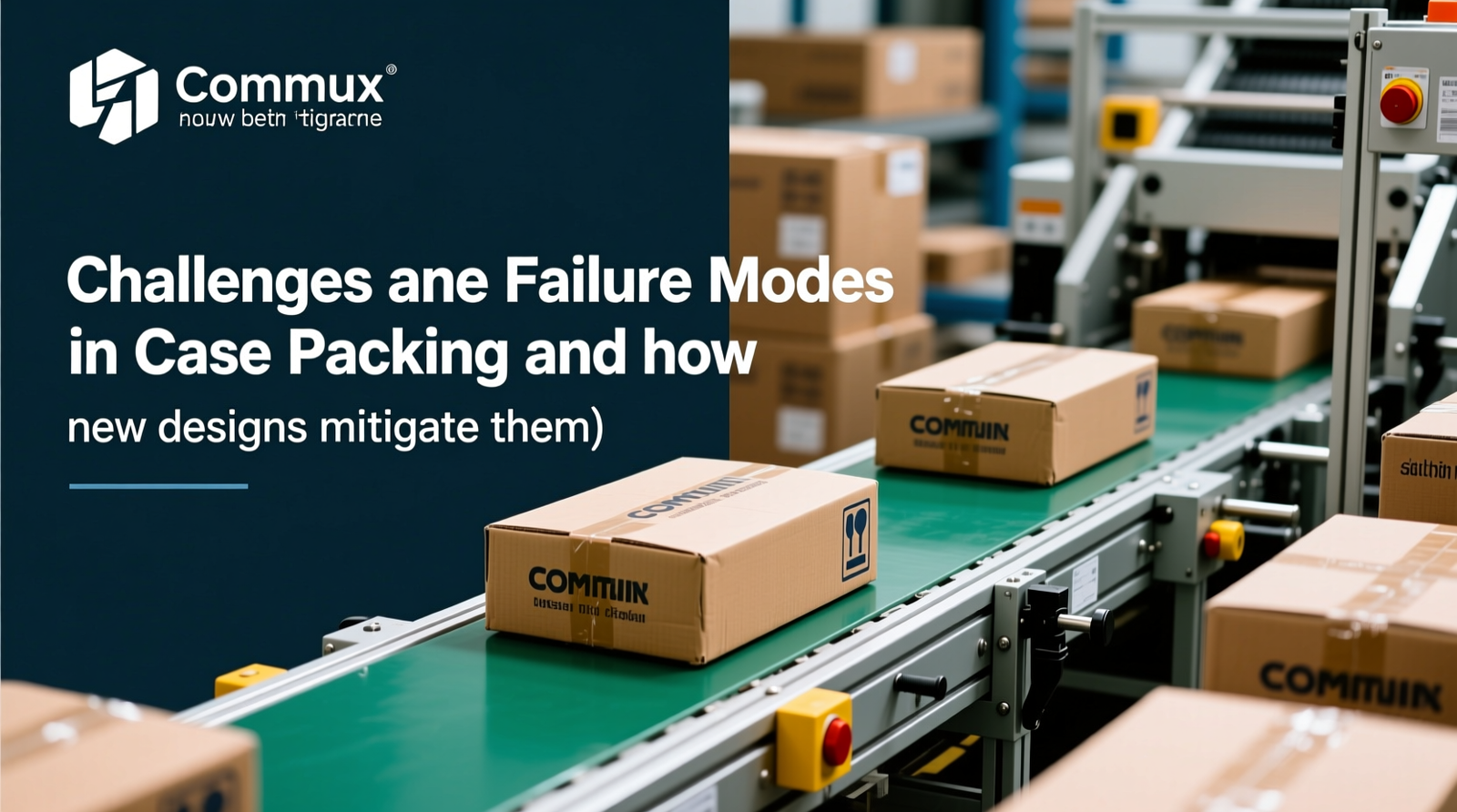
Case packing is mechanically simple in concept but sensitive in execution. The most frequent failure modes include:
- Case deformation or out-of-square cases: Lightweight corrugate can buckle during loading or sealing. Mitigations: improved case squaring, controlled compression, better blank handling, and wrap-around designs that increase rigidity.
- Product misorientation/misorientation accumulation: Skewed cartons, tipped pouches, or unstable multipacks cause jams. Mitigations: servo timing, metering belts, lane management, and vision-guided robotic case packers that adapt pick points in real time.
- Jam frequency at transitions: Infeed merges and pocket transfers are common culprits. Mitigations: buffer conveyors, gentler transfer geometry, and fault analytics to identify recurring root causes.
- Film/carton scuffing or damage: Particularly on glossy cartons or soft packs. Mitigations: reduced push-force loading, robotic pick-and-place, low-friction guides, and controlled acceleration profiles.
- Seal integrity issues (tape/hot-melt): Dust, humidity, and temperature affect closure performance. Mitigations: closure monitoring, controlled adhesive temperature, and preventive maintenance intervals.
TL;DR: Most case packing “mystery downtime” traces back to case quality/geometry, product control at infeed, and transition jams—mitigated through servo control, vision, better case handling, and data-driven root-cause analysis.
Machine Type Comparison: Top Load vs. Side Load vs. Wrap-Around (use-case driven)
| Machine type | Best-fit use cases | Pros | Trade-offs |
|---|---|---|---|
| Top load case packer | Delicate items, mixed packs, variety packs; frequent SKU changes; complex pack patterns | Excellent flexibility; well-suited to robotics; gentle handling; strong fit for high-mix lines | May require more vertical space; can be slower than continuous side-load on very stable products |
| Side load case packer | Carton-in-case; rigid containers; stable products; higher-speed continuous motion lines | High speed potential; efficient footprint; proven for many beverage and personal care formats | Push loading can scuff/damage sensitive packs; less tolerant of random orientation without added controls |
| Wrap-around case packer | Shelf-ready packaging, retail-ready displays, material reduction programs, e-commerce shipping integrity | Material efficiency; strong case rigidity; premium shelf-ready presentation; good for high-speed bundles | Requires blank supply and forming precision; changeovers can be more involved for many blank sizes |
TL;DR: Choose top-load for flexibility and gentle handling, side-load for stable high-speed formats, and wrap-around when shelf-ready strength and material efficiency are core requirements.
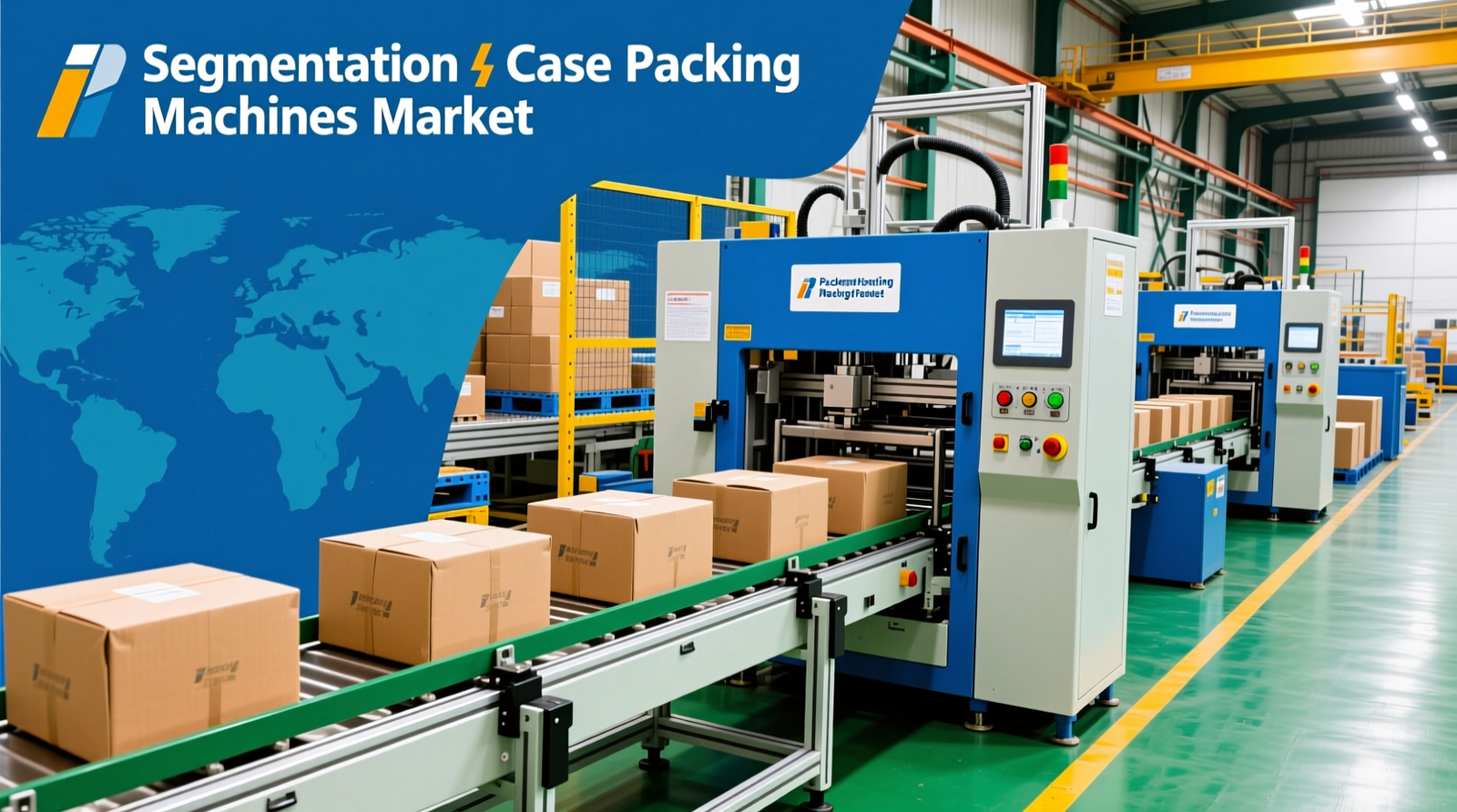
Detailed Segmentation of the Case Packing Machines Market
By level of automation
- Automatic case packing machines: Typically include case erecting, loading, and sealing with minimal manual intervention—best for multi-shift operations where OEE targets and labor risk justify higher CAPEX (capital expenditure).
- Semi-automatic case packing machines: Combine manual and automated steps—often chosen by smaller plants, seasonal producers, and operations transitioning from manual packing while validating product/case formats.
By packaging speed (CPM) with typical plant profiles
CPM (cases per minute) is strongly affected by case format complexity, product stability, collation requirements, and changeover frequency—so “nameplate speed” may not equal sustained rate.
- < 10 CPM: pilot lines, specialty foods, frequent changeovers, and contract packing of short runs.
- 10–25 CPM: regional brands and growing operations; common in snack, bakery, and nutraceutical lines with moderate SKU variety.
- 25–50 CPM: established manufacturers balancing flexibility and throughput; common in frozen foods, cereal, and pet food.
- 50–100+ CPM: high-volume beverage, dairy multipacks, and large FMCG plants; often favors continuous motion side-load or high-speed wrap-around designs when product stability is high.
By end-user industry (requirements that change the machine spec)
- Food & beverage (snacks, bakery, frozen, dairy): washdown/hygienic design, allergen control, and gentle handling often dominate the URS (user requirement specification).
- Pharmaceutical and regulated products: emphasis on validation documentation, traceability, and controlled handling; integration with inspection and serialization is common.
- Pet food and powdered products: dust management, sealing integrity, and robust case control to prevent burst or deformation.
TL;DR: Segment choices should be driven by sustained CPM (not nameplate), changeover frequency, and hygiene/validation requirements that materially affect design and cost.
Regional Outlook (with regulatory/infrastructure factors that influence investment)
- North America: High labor costs and strong automation culture keep demand high for robotics and connected diagnostics. Food producers also align upgrades with preventive controls and traceability expectations under the FDA’s FSMA framework (see FDA FSMA overview: FDA.gov).
- Europe (Western & Eastern): Sustainability policy direction and packaging waste reduction targets drive interest in material-efficient designs (including wrap-around and right-sized cases). EU packaging waste policy context is maintained by the European Commission.
- Asia-Pacific: Fast growth is linked to greenfield capacity, export-driven manufacturing, and modernization of legacy lines. Investment often prioritizes scalable automation modules that can start semi-automatic and expand to fully automatic as volumes stabilize.
- South America, Middle East & Africa: Adoption varies widely by country and sector; value is often strongest in robust mid-speed automation that improves consistency and reduces damage in distribution, supported by local service availability.
TL;DR: North America is pulled by labor/OEE and FSMA-aligned food safety programs; Europe is pulled by packaging sustainability policy; APAC is pulled by capacity expansion and modernization.
ROI, Payback Periods, and What Drives Total Cost of Ownership
ROI (return on investment) for case packing automation typically comes from a combination of labor savings, higher effective throughput (less downtime), reduced damage/scrap, and faster changeovers. While payback varies widely, many end-of-line automation projects are underwritten with a ~12–36 month payback target when labor replacement or overtime reduction is significant; more complex high-mix robotic cells may target longer paybacks if flexibility and SKU agility are the primary value.
Key cost drivers (CAPEX and OPEX):
- Required CPM and number of lanes/robots
- Case style complexity (RSC vs. wrap-around vs. tray + hood, etc.)
- Changeover expectations (mechanical vs. recipe-based)
- Sanitation class (dry, wet, washdown) and material selection
- Integration scope (upstream collation/cartoning, downstream sealing/palletizing, vision/inspection, data connection)
Savings levers to quantify in your model: direct labor, injury/ergonomics risk reduction, scrap and rework, adhesive/tape consumption, downtime (availability), and changeover time (performance).
TL;DR: Many plants justify automation with 1–3 year payback, primarily from labor + downtime + scrap; the biggest ROI swing factors are speed requirements, sanitation level, and integration complexity.
Barriers to Adoption (and how OEMs/integrators are addressing them)
Even when the business case is strong, adoption can stall due to:
- High upfront CAPEX: especially for robotics, vision, and full-line integration.
- Legacy line integration risk: mismatched infeed timing, limited floor space, or outdated controls platforms.
- Operator training and skills gap: servo/robot/vision systems require different troubleshooting skills than purely mechanical equipment.
- Cybersecurity risk: connected machines and remote support pathways create new attack surfaces.
Common mitigations offered today: modular “retrofit” cells, staged automation roadmaps (semi-auto to full-auto), financing/leasing options, standardized training programs, and secure remote access practices aligned with industrial cybersecurity guidance such as NIST Cybersecurity Framework principles.
TL;DR: The main blockers are CAPEX, integration, skills, and cybersecurity—often addressed through modular deployment, training, and secure remote support frameworks.
Provider Profile (separated to reduce bias): About The Business Research Company

Provider profile: The Business Research Company (TBRC) publishes syndicated market intelligence across many industrial categories, including packaging machinery. TBRC states it has more than 17,500 reports covering 27 industries and 60+ geographies, supported by large-scale datasets and ongoing secondary research. Its platform, the Global Market Model (GMM), provides updated forecasts and competitive benchmarking.
TL;DR: TBRC is a market research publisher; treat its market sizing as one input and cross-check base year, scope, and definitions against other sources when building internal forecasts.
Contact Information
Reach out to The Business Research Company for detailed case packing machines market analysis, custom research, and data subscriptions:
Americas: +1 310-496-7795
Europe: +44 7882 955267
Asia & Others: +44 7882 955267, +91 8897263534
Email: info@tbrc.info
TL;DR: Use TBRC contact channels for report access, custom segmentation, and dataset-backed forecasts.
Conclusion

Case packing is becoming a strategic automation priority because it sits at a high-leverage point in the line: it directly affects throughput, labor, damage rates, and shipping/retail presentation. The most competitive solutions increasingly combine servo control, vision-guided robotics, hygienic design options, and connected analytics to improve sustained CPM and OEE—not just nameplate speed.
For manufacturers, the best results typically come from aligning machine type (top load/side load/wrap-around) to product stability and case style, specifying the right sanitation class, and validating performance with OEE baselines plus acceptance testing.
TL;DR: The winners are plants that select case packing technology based on measurable OEE and product/case realities—then de-risk with acceptance testing and a practical ROI/TCO model.
FAQ
Q: What is end-of-line case packing automation, and where does it fit in a packaging line?
A: End-of-line case packing automation is the set of machines (case erector, case packer/loader, and case sealer) that takes finished primary packs (bags, cartons, bottles) and loads them into shipping or display cases before palletizing. It sits downstream of fillers, cartoners, and checkweighers and is often a bottleneck because it combines collation, handling, and case quality control.
Q: How do I choose between top load, side load, and wrap-around case packing machines?
A: Choose based on product stability, desired case style, and the balance between flexibility and speed. Top load is best for delicate packs and frequent changeovers (often robotic). Side load is best for stable products and high-speed lines (often continuous motion). Wrap-around is best when you need shelf-ready packaging strength and material efficiency but can manage blank forming precision.
Q: What should manufacturers consider when choosing a case packing machine (practical checklist)?
A: Use this stepwise checklist: (1) Map your product portfolio and worst-case formats (size, fragility, orientation control). (2) Define required sustained CPM ranges by SKU and case pattern. (3) Select machine type (top/side/wrap-around) and motion style (intermittent vs continuous). (4) Define sanitation class (dry/wet/washdown) and hygienic design needs (EHEDG/3-A principles where relevant). (5) Identify integration points (infeed, collation, case erecting, sealing, palletizing, inspection, data). (6) Confirm changeover targets (minutes) and recipe requirements. (7) Run ROI/TCO (total cost of ownership) using labor, downtime, scrap, changeover time, and consumables. (8) De-risk with FAT/SAT performance criteria, spare parts strategy, and service response SLAs.
Q: What is a realistic payback period for automating case packing?
A: Many projects target ~12–36 months when labor reduction and downtime elimination are significant. Payback can be longer for high-mix robotic cells if the primary value is flexibility, SKU agility, and reduced changeover complexity rather than direct labor displacement. The biggest payback drivers are labor per shift, unplanned downtime cost, scrap/damage, and changeover frequency.
Q: What does predictive maintenance typically monitor on case packers?
A: Predictive maintenance commonly tracks servo motor load/current trends, drive alarms, cycle counts, vibration/temperature on critical bearings and gearboxes, pneumatic air pressure/flow stability, and fault/jam codes over time. The goal is to detect wear, misalignment, or degrading components early—reducing unplanned downtime and improving OEE.