Introduction

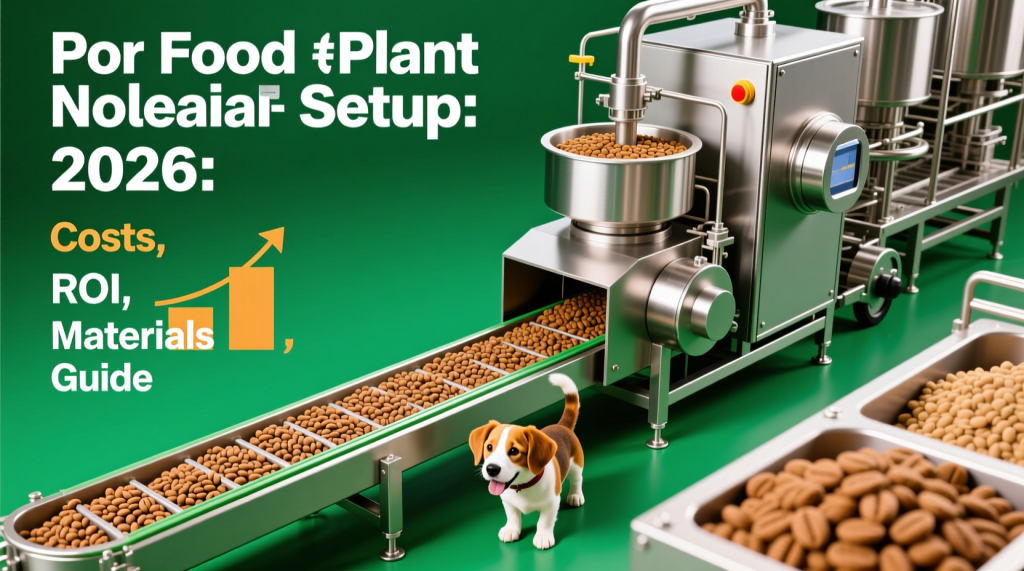
Planning a pet food manufacturing plant DPR (Detailed Project Report) for 2026 requires more than a generic “unit setup” checklist. Decision-makers typically want measurable inputs: machinery cost, a pet food factory CapEx breakdown, operating assumptions (throughput, shifts, utilities), compliance requirements, and realistic ROI and payback timing under different product mixes.
This guide is structured for investors and project teams evaluating dry pet food plant setup (extruded kibble) as the core case, with notes for wet food and treats where relevant. It includes indicative cost brackets (for quick screening), two example project profiles (India vs. Eastern Europe), a sample P&L snapshot, and 2026+ design considerations such as data logging, traceability, and energy-efficient drying.
TL;DR: This 2026-focused pet food manufacturing plant DPR overview explains unit setup, machinery cost, CapEx/OpEx, compliance, and ROI with realistic capacity, utility, staffing, and margin assumptions.
Global Market Overview and 2026–2034 Demand Drivers
Demand growth is still being driven by “pet humanization,” premiumization, and channel expansion (especially e-commerce). For market sizing, refer to widely cited industry trackers such as IMARC’s pet food market coverage and regional trade bodies; always validate with local retail scan data and category penetration for your target country.
In India, pet food growth is frequently linked to increasing formal retail penetration and premium segments in metro and Tier-II cities. For macro context, the India Brand Equity Foundation provides sector snapshots and consumer trends (IBEF).
What changes in 2026+: regulatory scrutiny and retailer requirements are rising—especially around traceability, pathogen control, and label substantiation. This affects both plant design (hygienic zoning, sampling points, data capture) and cost (QA/QC lab capability, audits, and certifications).
TL;DR: Market growth supports new capacity, but 2026+ projects must budget for tighter compliance, traceability, and retailer/export audit expectations—not just production equipment.
What Is Pet Food? Key Product Types, Claims, and Technical Terms
Pet food includes complete and complementary diets for dogs and cats (and sometimes fish/birds), typically sold as dry kibble, wet/canned, semi-moist, freeze-dried, or treats. “Complete and balanced” claims are commonly benchmarked against established nutrient profiles—e.g., AAFCO (Association of American Feed Control Officials) nutrient profiles in the U.S. (AAFCO) and FEDIAF (European Pet Food Industry Federation) nutritional guidelines in Europe (FEDIAF).
For 2026 product strategy, the biggest manufacturing implications are:
Dry kibble (extruded): most scalable, lower logistics cost per kcal, broad SKU flexibility. Requires good control of expansion, density, and fat coating. Wet food (retort/canning): higher CapEx per ton and heavier logistics, but can command premium pricing and supports high-meat positioning. Treats: often higher margin but need separate baking/extrusion/forming systems and different packaging lines.
TL;DR: Define your product mix early because dry vs. wet vs. treats changes your line choice, CapEx per ton, QA requirements, and achievable margins.
Plant Capacity, Line Throughput, Shifts, and Utilization Ramp-Up
Most greenfield projects that target meaningful economies of scale evaluate 30,000–60,000 MT/year for dry pet food (kibble). In engineering terms, this usually translates into 3–8 MT/hour on finished kibble output depending on extruder size, recipe, dryer capacity, and downtime assumptions.
A common operating model is 2–3 shifts/day (16–24 hours), 300–330 operating days/year, with planned shutdowns for preventive maintenance (PM) and deep cleaning. In a realistic DPR for pet food plant 2026, capacity utilization often ramps as commercial demand and distribution stabilize:
Illustrative utilization curve (dry kibble line): Year 1: 45–55% → Year 2: 55–65% → Year 3: 65–75% → Year 4: 75–85% → Year 5: 80–90% (premium and private-label plants with signed contracts may ramp faster).
TL;DR: For a dry pet food plant setup, design around line throughput (MT/hour), shifts, and a 3–5 year ramp-up—these assumptions drive ROI more than nameplate capacity alone.
Technology Choices (Extrusion, Mixing, and Drying) and Their Cost/Positioning Impact
Equipment selection affects both pet food extrusion line cost and what you can sell (commodity vs. premium SKUs).
Single-screw vs. twin-screw extruders: A single-screw extruder is typically lower CapEx and can be excellent for standard kibble. A twin-screw extruder generally offers better mixing intensity and recipe flexibility (useful for high-fresh-meat, high-fiber, or harder-to-process formulas), but usually at higher equipment cost and potentially higher maintenance complexity. Your product plan (grain-free, high-protein, sensitive stomach, etc.) should decide this—not vendor preference.
Batch vs. continuous mixing: Batch mixers can be simpler for multi-SKU plants and smaller runs; they can, however, introduce variability if weighing/dosing and mixing times are not tightly controlled. Continuous mixers can support higher throughput and consistency when paired with automated micro-dosing and proper controls, often aligning better with large-volume private-label or export supply models.
Dryer choice: Dryers are major energy consumers. Multi-pass conveyor dryers with heat recovery and tight moisture control can reduce energy per ton and improve quality consistency—important for 2026+ sustainability reporting and retailer scorecards.
TL;DR: Technology choices (single vs. twin-screw, batch vs. continuous, dryer efficiency) directly influence CapEx, operating cost per ton, recipe flexibility, and the premium SKUs you can credibly manufacture.
Pet Food Manufacturing Plant CapEx Breakdown (2026 Screening Ranges)
CapEx varies sharply by country, building standards (export-ready vs. domestic), automation level, and whether you add wet food/treat lines. For a dry kibble-focused plant, a practical way to estimate is to start with machinery cost per MT/year of installed capacity and then layer civil/utilities and working capital.
Typical CapEx split (dry kibble plant, greenfield) as a planning range:
Machinery & automation: ~45–60% • Civil works & buildings: ~20–30% • Utilities & ETP (Effluent Treatment Plant) / environment systems: ~8–15% • Land & site development: ~5–15% (highly location-dependent) • Engineering, installation, commissioning, pre-op: ~5–10%.
Pet food manufacturing plant cost per ton (capacity-based shortcut): for dry extrusion lines, a common screening band for process + packaging machinery is roughly USD 250–600 per MT/year of installed annual capacity (e.g., 30,000 MT/year line-equivalent machinery could screen at ~USD 7.5–18 million), depending on brand, automation, QC inline instruments, and packaging complexity. Civil works and utilities can add materially on top of machinery, so total project cost is often higher than the “line cost” headline.
Major CapEx components with indicative brackets (dry kibble, mid-scale, indicative only):
Extrusion + preconditioner system: ~USD 1.5–6.0M • Dryer + cooler + conveying: ~USD 1.5–7.0M • Grinding + dosing + mixing: ~USD 0.8–3.0M • Coating (vacuum or standard) + fat handling: ~USD 0.4–2.0M • Packaging (VFFS/FFS, multihead weigher, palletizing): ~USD 1.0–6.0M • QC lab + metal detection/X-ray: ~USD 0.15–1.0M • Utilities (boiler/thermal oil, air compressor, water system, chiller if needed): ~USD 0.8–4.0M (range depends on energy source and redundancy).
TL;DR: For a pet food factory CapEx breakdown, machinery is usually ~45–60% of total CapEx; a screening estimate for dry-line machinery often falls near USD 250–600 per MT/year of installed capacity, with civil and utilities added on top.
Two Example Project Profiles (Realistic 2026 DPR-Style Scenarios)
Example A: 30,000 MT/year dry pet food plant setup (India, domestic + some export)
Assume 4–5 MT/hour line, 2–3 shifts, ramp to 80% by Year 4. Product mix: mid-tier kibble + a small premium range, limited SKUs, 10–20 kg bags for distribution plus some 1–3 kg for e-commerce.
Indicative total project cost: ~USD 18–35M equivalent (location/civil standards drive variance).
Indicative returns: payback often screens at 5–7 years if utilization ramps slowly and product mix is mid-tier; 4–6 years with contracted private-label volumes and stronger premium mix (assuming stable raw material sourcing and controlled recalls/quality costs).
Example B: 50,000 MT/year dry pet food plant (Eastern Europe, export-leaning EU retail/private label)
Assume 6–8 MT/hour effective line output, high automation, strong traceability, audit-ready hygienic design, broader packaging formats (2 kg/10 kg), more stringent retailer specs.
Indicative total project cost: ~USD 30–60M.
Indicative returns: payback often screens at 4–6 years when EU retail/private-label contracts secure high utilization; can extend to 6–8 years if commercialization is delayed or energy costs spike without hedging/efficiency measures.
TL;DR: A 30k MT/year plant can work with simpler automation and fewer SKUs but may see longer payback; a 50k MT/year export-oriented plant usually needs higher compliance CapEx but can achieve faster ROI if utilization is secured through contracts.
Operating Cost (OpEx) Structure: What Actually Moves the Numbers
For most plants, raw materials dominate OpEx, but utilities and packaging can decide competitiveness—especially when selling through modern retail and e-commerce.
Typical OpEx split (dry kibble): Raw materials ~65–80% • Packaging ~5–12% • Utilities ~6–15% • Manpower + maintenance + QA + overhead ~6–12% (varies with automation and audit regime).
Raw material and safety challenges (and mitigation) you should budget for in your DPR for pet food plant 2026:
Mycotoxins (toxins from molds) in corn and other grains (e.g., aflatoxin risk): mitigate via supplier approval, incoming testing plans, proper storage (moisture control), and defined rejection limits. Salmonella risk in animal proteins: mitigate via validated thermal processing, hygienic zoning, environmental monitoring, and supplier verification.
TL;DR: Raw materials drive the cost base, but packaging, utilities, and food-safety controls (mycotoxins/Salmonella/traceability) often determine whether your margin assumptions hold in real operations.
Utilities and Infrastructure Requirements (Power, Steam, Water)

Utility sizing is a frequent weak spot in early-stage DPRs. For extruded dry pet food, energy demand concentrates in grinding, extrusion, and especially drying.
Indicative electrical load: screening range of roughly 20–45 kW per MT/hour of finished kibble throughput for the core process line (actual depends on grinder duty, extruder size, conveying, packaging automation, and dust collection). Plants should validate with a line load list from vendors rather than rely only on rules-of-thumb.
Steam / thermal energy: often required for preconditioning/cooking and may be provided by a boiler (steam) or thermal oil system depending on design. Energy-efficient dryers with heat recovery can significantly reduce fuel per ton and improve moisture consistency.
Water consumption: varies by recipe and cleaning regime; typical needs include ingredient conditioning, sanitation/CIP (Clean-in-Place: automated cleaning of equipment), and domestic use. Where local regulations require, plan for ETP (Effluent Treatment Plant) sizing and monitoring.
Compressed air: typically needed for pneumatic conveying, bagging, and valves; poor air quality can cause downtime and packaging defects, so include dryers/filters and redundancy where required.
TL;DR: For 2026 unit setup, utility design (power, steam/thermal energy, water, compressed air) should be engineered from vendor load lists—dryers and compressors are common hidden OpEx drivers.
Waste, By-Products, and Environmental Management
Environmental planning is not optional for modern projects—especially if you want export approvals or modern retail acceptance.
Typical waste streams: off-spec kibble (density/shape/moisture out-of-range), fines and dust from conveying/sieving, packaging waste, and wastewater from cleaning. Off-spec product is often reworked within defined limits (documented, traceable, and quality-approved) or disposed via approved channels.
Controls commonly expected in 2026+ plants: dust collection at grinders and transfer points (helps safety and housekeeping), odor control (especially if handling higher animal-protein loads), pest control programs, and effluent treatment compliant with local norms. If exporting to the EU, align with the feed hygiene framework under Regulation (EC) No 183/2005 (EUR-Lex).
TL;DR: Budget for dust, odor, off-spec handling, and effluent systems early—these are critical for permits, audits, and stable operations, not afterthoughts.
Regulatory Frameworks (AAFCO, FEDIAF, FSSAI, EU, US FDA/FSMA)

Regulatory compliance shapes both formulation and factory controls. The first time you define your target markets, map them to the required frameworks:
AAFCO nutrient profiles and model regulations are widely used references in the U.S. market (AAFCO). FEDIAF provides recognized nutritional guidelines for Europe (FEDIAF).
India:</strong pet food manufacturing and labeling fall under India’s food regulatory environment. For official regulations and licensing expectations, refer to FSSAI (Food Safety and Standards Authority of India) resources (FSSAI), and ensure your consultant validates the current pet food-specific notifications applicable in 2026.
EU exports:</strong besides feed hygiene (EC 183/2005), exporters may face additional customer/retailer standards on contaminants, traceability, and documentation.
US exports:</strong pet food is regulated under FDA oversight; FSMA (Food Safety Modernization Act) introduced preventive controls expectations. Use the FDA’s official FSMA portal for baseline understanding (FDA FSMA).
TL;DR: A credible pet food manufacturing plant DPR must map product claims and process controls to AAFCO/FEDIAF and country rules (FSSAI/EU/FDA), because compliance affects CapEx (hygienic design, lab, traceability) and time-to-market.
Certifications, Audits, and Why They Matter (Modern Retail + Export)
Certifications are often commercial requirements, not just “nice-to-have.” Commonly requested schemes include:
BRCGS (Brand Reputation through Compliance Global Standards) for food safety: widely recognized by retailers (BRCGS). ISO 22000 (Food safety management systems): globally used framework (ISO 22000 overview). Some supply chains also reference feed-sector schemes such as FAMI-QS (quality and safety for specialty feed ingredients) where applicable (FAMI-QS).
In practical terms, audit readiness pushes design choices: segregated allergen/animal protein handling, controlled rework, calibrated dosing systems, metal detection/X-ray, documented HACCP (Hazard Analysis and Critical Control Points: systematic food safety risk control), and electronic traceability records.
TL;DR: If you want modern retail or exports, plan for BRCGS/ISO 22000-style controls—this impacts layout, documentation, QC capability, and automation requirements in 2026 projects.
Machinery List (Dry Pet Food Line) and What to Specify in a DPR
A DPR for pet food plant 2026 should specify equipment by capacity (MT/hour), automation scope, hygienic design standard, and validation requirements—not just a generic list. For a typical dry kibble line, core sections include grinding, batching/dosing, mixing, extrusion + preconditioning, drying, cooling, coating, conveying, and packaging/palletizing.
Include requirements that materially affect pet food extrusion line cost and consistency:
Micro-ingredient dosing for vitamins/minerals (premix accuracy), inline moisture measurement, metal detection/X-ray in finished product, and data logging for batch traceability. Many 2026+ plants also consider OEE (Overall Equipment Effectiveness: availability × performance × quality) monitoring to reduce downtime and measure line losses.
TL;DR: A good machinery section ties each machine to throughput, control points, and traceability—this is how you justify cost and de-risk quality/recall exposure.
High-Level P&L Snapshot (Representative Dry Kibble Plant)
Below is a simplified, illustrative P&L anchor for a mid-scale plant selling a blended portfolio (economy + mid-tier + limited premium). Actual numbers vary by country, channel, and recipe.
Assumptions (illustrative): average net selling price USD 1,200–1,800/MT; raw material cost USD 700–1,250/MT (protein meals and fats are key drivers); packaging + utilities + conversion costs USD 180–380/MT depending on bag format and energy costs.
Indicative outcomes:
Gross margin: often lands around 25–40% (premium SKUs and efficient sourcing push higher).
EBITDA margin (Earnings Before Interest, Taxes, Depreciation & Amortization): commonly 12–22% for well-run operations with stable utilization and controlled quality losses.
Net margin:</strong frequently 8–15% depending on depreciation, interest costs, and tax structure.
Use this as a sanity check when you model your own DPR: if your plan assumes premium pricing but budgets commodity-grade QA and packaging, lenders and strategic buyers will challenge it.
TL;DR: A realistic DPR should show price/MT, raw material cost/MT, and EBITDA bands; many viable plants target ~12–22% EBITDA and ~8–15% net margin with disciplined sourcing and utilization.
ROI, Payback Period, and Debt vs. Equity Structuring
For 2026 project evaluation, investors usually look at payback period and IRR (Internal Rate of Return: discount rate that makes NPV zero) under conservative utilization.
Typical payback period ranges for a dry pet food plant setup:
4–7 years is a common screening band, driven mainly by (1) capacity utilization ramp, (2) product mix (premium vs. economy), (3) packaging/channel economics, and (4) energy and protein meal price cycles. Plants with signed private-label contracts and strong QA systems often derisk volume and compress payback; plants relying on brand-building alone may see slower ramp and longer payback.
Debt vs. equity note: Higher leverage can lift equity IRR when utilization and margins are stable, but it increases downside risk during raw material spikes or quality incidents (recalls). Many DPRs model base-case financing with a moderate debt component and include sensitivity cases for a 10–15% raw material increase and a delayed ramp-up.
TL;DR: Many dry pet food projects screen at ~4–7 years payback; financing structure matters—debt improves equity returns in the base case but increases risk if utilization or quality performance slips.
Channel Strategy and Competitive Landscape (Including Private Label)
Competitive strategy is inseparable from factory design because channels dictate packaging formats, SKU counts, and service levels.
Modern trade (supermarkets/hypermarkets) tends to demand consistent fill weights, stronger audit requirements, and sharper pricing; pack sizes often skew to mid/large bags. E-commerce increases demand for smaller packs, sturdier packaging (damage rates), more SKUs, and often higher returns logistics—this can increase packaging cost per ton but support better realization/MT. Veterinary channel supports condition-specific diets but requires stronger substantiation and tighter QA; volumes may be smaller but margins can be higher.
Private-label and contract manufacturing are common market-entry routes in 2026: they can secure early utilization (helping ROI), but they also tighten tolerances on QA, documentation, and on-time delivery. If you plan private-label, design for frequent changeovers, robust traceability, and retailer audit readiness from day one.
Key players: Nestlé Purina, Mars Petcare, and Hill’s Pet Nutrition (Colgate-Palmolive) are major global participants; regional manufacturers and private-label specialists also shape pricing and capacity in many markets.
TL;DR: Channel choice changes your plant economics: e-commerce increases SKU and packaging complexity; vet and modern trade increase QA/audit requirements; private-label can secure volume but requires strong compliance and service discipline.
2026+ Design Trends and Future-Proofing the Plant
Plants commissioned in 2026+ are increasingly evaluated on automation, data integrity, and sustainability—by regulators, retailers, and investors.
Traceability-by-design: batch-level data logging (raw material lots to finished goods), barcode/QR workflows, and digital recordkeeping reduce recall scope and speed root-cause analysis.
Energy-efficient drying and heat recovery: dryers are often the largest thermal load; selecting efficient dryers and considering heat recovery can reduce OpEx and improve ESG performance.
Packaging sustainability: recyclable-ready structures and downgauging can become commercial requirements, but must be tested against shelf-life and fat migration risks in pet food.
Future-proofing tactics: modular expansion capability (space and utilities sized for a second line), flexible formulation capability (e.g., grain-free and standard recipes), and digital tools such as OEE monitoring and predictive maintenance (condition-based monitoring of bearings, motors, etc.) to reduce downtime.
TL;DR: 2026+ pet food plants are expected to be traceable, energy-aware, and modular—future-proofing reduces retrofit costs when you expand SKUs, capacity, or export markets.
Staffing and Organization (Mid-Scale Dry Kibble Plant)
Headcount depends on automation and SKU complexity, but a mid-scale plant typically staffs production, maintenance, quality, warehouse, and admin functions.
Indicative headcount (mid-scale, 2–3 shifts, higher automation): Production: 25–45 • Maintenance (mechanical/electrical/instrumentation): 8–15 • Quality (QA/QC, lab, hygiene): 8–18 • Warehouse/logistics: 10–20 • EHS & utilities: 3–8 • Admin/planning/procurement: 6–15. Total often falls in the 60–120 range depending on scale and scope (in-house packaging, in-house premix handling, etc.).
TL;DR: Budget staffing realistically—mid-scale plants often need ~60–120 people across shifts, with QA and maintenance resourcing sized to audit readiness and uptime targets.
Conclusion
If you are preparing a pet food manufacturing plant DPR for 2026, the decision hinges on clear numbers: unit setup scope, machinery cost, a defensible pet food factory CapEx breakdown, and ROI modeled with ramp-up, utilities, and compliance costs included.
As a practical screening view, dry pet food (extruded kibble) remains the most scalable base case, but 2026+ projects must factor in higher expectations for traceability, pathogen/mycotoxin control, retailer/export audits, and energy efficiency. With disciplined sourcing, appropriate technology selection (single vs. twin-screw, batch vs. continuous), and a channel plan that matches your packaging and SKU strategy, many projects target 4–7 years payback—primarily depending on utilization and product mix.
TL;DR: A 2026 pet food DPR should quantify machinery cost, CapEx/OpEx, compliance, and ramp-up; ROI is typically driven by utilization, product mix, and the ability to meet modern retail/export audit standards.
FAQ
Q: What is the pet food manufacturing plant cost per ton of installed capacity in 2026?
A: A common screening method is machinery cost per MT/year of installed capacity. For dry pet food extrusion lines, process + packaging machinery often screens around USD 250–600 per MT/year of annual installed capacity (indicative). Total project CapEx is higher after adding civil works, utilities, ETP, engineering, and working capital.
Q: What is a realistic pet food extrusion line cost for a dry kibble plant setup?
A: For a mid-scale line, the extrusion + preconditioning system can be roughly USD 1.5–6.0 million (indicative), with dryers/coolers and packaging often adding several million more. Final cost depends on throughput (MT/hour), single-screw vs. twin-screw selection, automation, and packaging formats.
Q: What is the minimum feasible plant size for economic viability in pet food manufacturing?
A: Many projects consider 10,000–20,000 MT/year as a practical minimum band for reasonable fixed-cost absorption in dry kibble, but viability depends on utilization and route-to-market. If you have contract manufacturing/private-label volumes secured, smaller plants can work; if you rely on building your own brand from scratch, larger scale can be advantageous once distribution is proven.
Q: What payback period and ROI are typical for a pet food manufacturing plant DPR in 2026?
A: Many dry pet food plants screen around 4–7 years payback. Faster payback is usually linked to high utilization (often supported by private-label contracts), premium product mix, and stable sourcing. Slower payback is typically caused by delayed commercialization, high energy costs, or quality failures leading to rework/returns.
Q: What are the biggest risks (raw material volatility, recalls, regulation changes) and how can they be mitigated?
A: Key risks include protein meal/fat price volatility, mycotoxins in grains, Salmonella risk in animal proteins, and tightening regulatory/audit expectations. Mitigation typically includes multi-supplier sourcing, defined incoming testing plans, validated kill steps and hygienic zoning, strong traceability/data logging, and certification readiness (e.g., BRCGS/ISO 22000) to reduce recall likelihood and limit recall scope if incidents occur.