
Meta-style introduction: CNH Industrial 2026 guidance and the farm equipment demand outlook
CNH Industrial 2026 guidance points to a softer farm equipment demand outlook as the agricultural machinery cycle cools from recent highs. Management is preparing for lower retail demand, cautious dealer ordering, and tighter pricing as farmers respond to weaker crop economics, higher interest rates, and uncertainty around trade and policy.
Key takeaways (quick scan):
- Demand: CNH expects ~5% lower retail demand in 2026 vs. 2025, implying lower factory utilization and more focus on dealer inventory normalization.
- Earnings: Adjusted EPS guidance of $0.35–$0.45 vs. LSEG consensus $0.54 suggests margin pressure from mix, price, and under-absorption of fixed costs.
- Cycle: Management points to 2027 as a recovery year—more likely a gradual rebound led by replacement demand rather than a snapback expansion cycle.
- What to watch: Used-equipment values, dealer floorplans (inventory financing), and North America row-crop conditions will heavily influence pricing power.
TL;DR: CNH’s 2026 outlook reads like a “manage the downturn” playbook—protect channel health, keep production flexible, and lean into parts/service and technology to bridge to a likely 2027 recovery.
CNH Industrial business context: main brands, product mix, and why the cycle matters
CNH Industrial is a global manufacturer of agricultural and construction equipment. In agriculture, its core brands include Case IH and New Holland, spanning high-horsepower tractors, combines/harvesters, planting and seeding systems, and hay & forage equipment. The company also participates in construction equipment markets (which can have different cycle drivers than row-crop agriculture).
This mix matters because demand is not uniform across categories: large row-crop equipment is typically the most cyclical (and most price-sensitive), while aftermarket parts and service tends to be more resilient as farmers keep machines longer in a downturn.
TL;DR: CNH’s exposure to big-ticket row-crop machinery increases cyclicality, but parts/service and tech-enabled upgrades can help cushion results when new-unit demand softens.
CNH Industrial 2026 guidance vs. analyst consensus (LSEG): what the gap implies
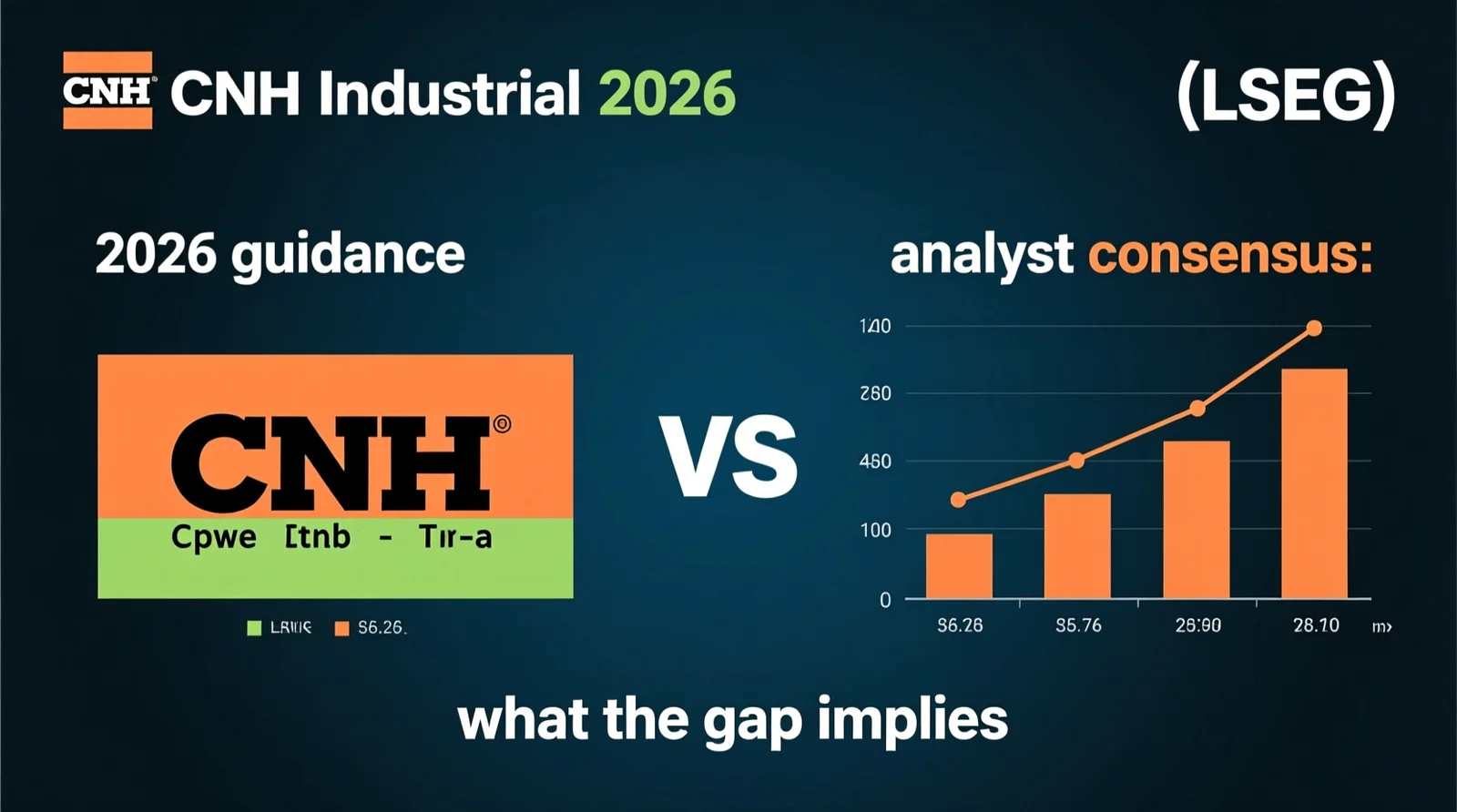
CNH Industrial forecasts adjusted earnings per share (EPS) of $0.35 to $0.45 for 2026, below the $0.54 consensus estimate from LSEG (London Stock Exchange Group; the firm compiles analyst forecasts used widely in financial markets).
Practically, a guidance-to-consensus shortfall often signals management expects some combination of:
- Lower price realization (discounting, incentive spend, or less favorable mix)
- Fixed-cost under-absorption from reduced factory utilization (lower volumes spread fixed costs over fewer units)
- Channel actions (production cuts to rebalance dealer inventories, which can hurt near-term margins but support long-term pricing integrity)
TL;DR: The LSEG gap is less about one quarter and more about CNH preparing investors for margin pressure from lower volumes, tighter price realization, and deliberate channel inventory normalization.
What a 5% demand decline really means: capacity utilization, dealer inventories, and pricing power
CNH expects retail demand for farm machinery to decline ~5% in 2026 versus 2025. A 5% drop can sound modest, but in capital equipment cycles it can have an outsized operational impact because manufacturing has high fixed costs and dealer channels amplify changes in ordering.
- Capacity utilization: If CNH reduces production to match weaker retail demand and to work down channel inventory, factories can run below efficient utilization levels. That typically pressures gross margin due to under-absorption of fixed manufacturing overhead (labor, depreciation, utilities).
- Dealer inventories: When retail slows, dealers often hold more “days of inventory” than planned. CNH’s intention to keep production subdued suggests the company is prioritizing channel health—shipping fewer machines so dealers can sell through existing stock rather than stacking new units.
- Pricing power: Pricing power weakens when dealers have aged inventory and when used-equipment supply rises (trade-ins increase as buyers seek lower-cost options). Discounting or subsidized financing can become more common, compressing margins even if unit volumes do not collapse.
In other words, the 5% retail decline can translate into a bigger swing in wholesale shipments if CNH chooses to cut production more aggressively to normalize dealer inventory.
TL;DR: A 5% retail decline can still drive meaningful margin pressure because lower factory utilization and higher dealer inventory typically reduce pricing power and increase incentives.
How low commodity prices are hitting farm equipment sales (beyond the usual “inputs are high” narrative)
Lower crop prices reduce farm cash receipts and make it harder to justify large capital expenditures, especially for high-horsepower tractors and combines. But in this phase of the cycle, several additional forces often amplify the slowdown:
- Credit conditions and interest rates: Higher borrowing costs increase monthly payments, which can push farmers toward used equipment or delaying replacement. Dealer floorplans (inventory financing lines) also become more expensive, raising pressure to reduce inventory.
- Used-equipment dynamics: When new sales slow, late-model used inventory can rise, putting downward pressure on resale values. That can weaken trade-in economics and slow the replacement cycle further.
- Risk management behavior: With uncertain export demand and policy signals, many producers favor liquidity and flexibility over long-lead-time machinery orders.
For broader context on agricultural market conditions, the USDA provides regular reporting on prices, receipts, and farm sector finances (see the USDA Economic Research Service website: https://www.ers.usda.gov/).
TL;DR: Weak crop economics is the headline driver, but tighter credit, rising floorplan costs, and softer used-equipment values can extend the downturn and intensify pricing pressure.
USDA net farm income outlook (2026): context on where we are in the cycle
The U.S. Department of Agriculture (USDA) has projected U.S. net farm income (a broad measure of farm sector profitability) to fall 0.7% to $153.4 billion in 2026 versus the prior year. This follows a period of significant volatility in farm profitability—after unusually strong years earlier in the decade, net farm income fell sharply in subsequent years before stabilizing more recently.
Even small year-over-year moves in net farm income can meaningfully affect equipment demand because machinery purchases are discretionary and lumpy. When margins tighten, farmers often shift to repairs, component rebuilds, and selective upgrades rather than full fleet replacement.
You can review USDA’s farm sector income methodology and updates via USDA ERS farm income resources (often published as Farm Sector Income Forecast materials): https://www.ers.usda.gov/topics/farm-economy/farm-sector-income-finances/.
TL;DR: USDA’s 2026 net farm income view suggests “not a collapse, but not a rebound” either—enough pressure to delay big-ticket purchases and keep the equipment cycle in a down/flat phase.
Regional differences: North America vs. Europe vs. Latin America (why “global demand” isn’t one story)
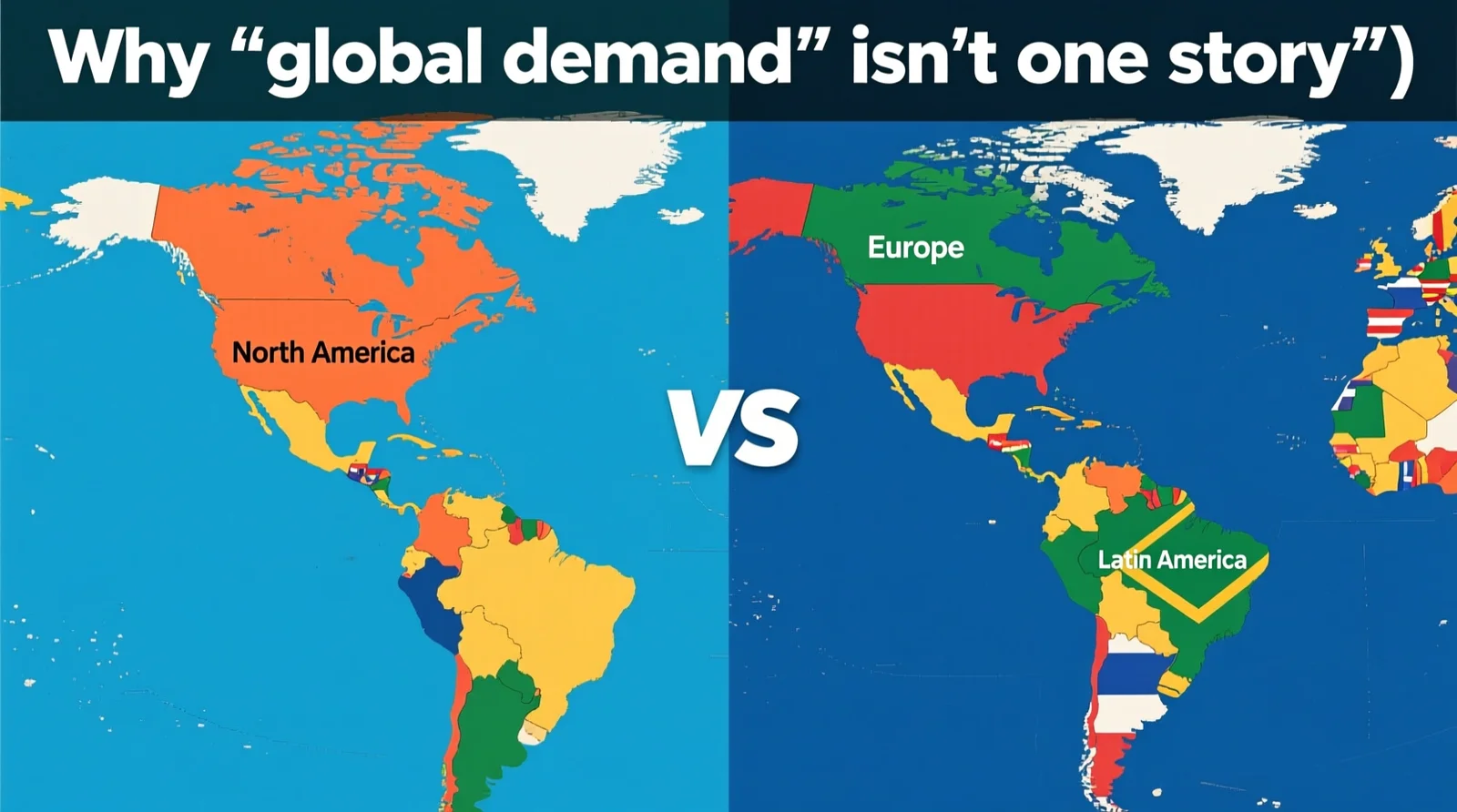
CNH’s demand and pricing outcomes can vary materially by region because crop mix, farm size, credit availability, and subsidy/policy frameworks differ.
- North America: Typically the most influential region for large row-crop equipment cycles. When U.S./Canadian farm income and used values weaken, incentives often rise fastest here, and dealer inventory correction can be most pronounced.
- Europe: Demand can be steadier but is more sensitive to regulatory changes, emissions requirements, and country-specific support programs. Smaller average farm sizes can shift mix toward mid-horsepower tractors and specialty applications, sometimes reducing volatility versus North America’s combine-heavy replacement cycle.
- Latin America: Can be more volatile due to currency swings and local financing conditions, but can also outperform when export-linked crops and acreage trends are supportive. In some years, Brazil/Argentina dynamics may not move in sync with U.S. corn/soy economics.
If CNH’s 2026 decline is driven mainly by North America row-crop, the company may see sharper pricing pressure than if weakness is more evenly distributed globally. Investors and industry readers should watch regional retail registrations, dealer inventory commentary, and order books for signs of where the softness is concentrated.
TL;DR: The cycle is global, but the severity often hinges on North America row-crop; Europe and Latin America can diverge depending on policy, currency, and crop-specific economics.
Competitive positioning in the equipment cycle: CNH vs. John Deere vs. AGCO
CNH’s cautious posture is consistent with a broader late-cycle/downswing pattern seen across major OEMs (original equipment manufacturers—companies that design and build the equipment). While each company has different mix and exposure, the common playbook is similar: protect dealer health, manage production, and defend margins where possible.
- John Deere (Deere & Company): Often seen as having strong brand pricing and a large, high-margin parts/service ecosystem, which can help offset new equipment cyclicality. Deere also invests heavily in precision/automation, supporting longer-term differentiation.
- AGCO: With brands like Fendt, Massey Ferguson, and Valtra, AGCO’s exposure differs by region and product category. In some markets, premium tractor demand can be resilient, but AGCO is still subject to the same farm income and financing cycle.
- CNH Industrial: CNH’s outlook emphasizes inventory correction and subdued production, implying a focus on channel normalization and disciplined shipments to preserve longer-term pricing integrity.
For readers wanting to validate company-level positioning and product coverage, official investor relations pages are useful primary sources (e.g., Deere: https://www.deere.com/en/our-company/investor-relations/, AGCO: https://www.agcocorp.com/investor-relations.html).
TL;DR: CNH is not alone—Deere and AGCO face the same cycle, but differences in mix, aftermarket, and technology leadership can influence who holds pricing power and margins best in a downturn.
Technology trends: precision agriculture, automation, and how they can mitigate (or amplify) a slowdown

Precision agriculture (technology that improves input placement and timing using sensors, GPS guidance, and data analytics) and automation (systems that reduce operator workload or enable semi-autonomous functions) can change downturn dynamics in two ways:
- Mitigate demand weakness: When budgets tighten, some farmers still invest in tech that delivers fast paybacks—e.g., guidance, section control, variable-rate application—because it can reduce seed/fertilizer/chemical waste and improve productivity. That can support attachments, retrofits, and software-driven upgrades even if whole-machine demand slows.
- Amplify replacement deferral: If tech can be added to existing machines (retrofit kits, precision displays, aftermarket automation), farmers may choose to upgrade capabilities without buying a new tractor/combine—supporting aftermarket but delaying new-unit replacement.
Macro research on the role of innovation and productivity in agriculture is widely covered by organizations like the Food and Agriculture Organization of the United Nations (FAO): https://www.fao.org/home/en/. While not company-specific, it supports the structural case for ongoing efficiency investment even through cyclical downturns.
TL;DR: Precision and automation can cushion CNH via upgrades and aftermarket, but they can also extend replacement cycles if farmers modernize old iron instead of buying new.
How dealers and suppliers may respond: floorplan strategy, used equipment, and parts/service resilience
In a downcycle, dealers and suppliers often shift tactics quickly:
- Floorplan discipline: Floorplan (dealer inventory financing) costs can rise with interest rates. Dealers may reduce stock levels, push OEMs for repurchase/support programs, and prioritize faster-turning models and configurations.
- Used-equipment management: Dealers may become more selective on trade-ins, recondition used units aggressively to speed turns, and adjust pricing to prevent excessive aging. Used values strongly influence new sales because trade-in equity affects the buyer’s monthly payment.
- Parts and service focus: As farmers defer new equipment, dealers can see steadier demand for maintenance, wear parts, and repairs—often a margin stabilizer across the channel.
- Supplier planning: Tier-1 and tier-2 suppliers (major component suppliers and sub-suppliers) may face more volatile schedules as OEMs balance production cuts with the need to protect lead-time-critical components.
TL;DR: Expect dealers to prioritize inventory turns and aftermarket revenue, while suppliers brace for more variable production schedules as OEMs protect channel health.
Scenario outlook: where 2026 fits in a multi-year agricultural machinery cycle (bear/base/bull)
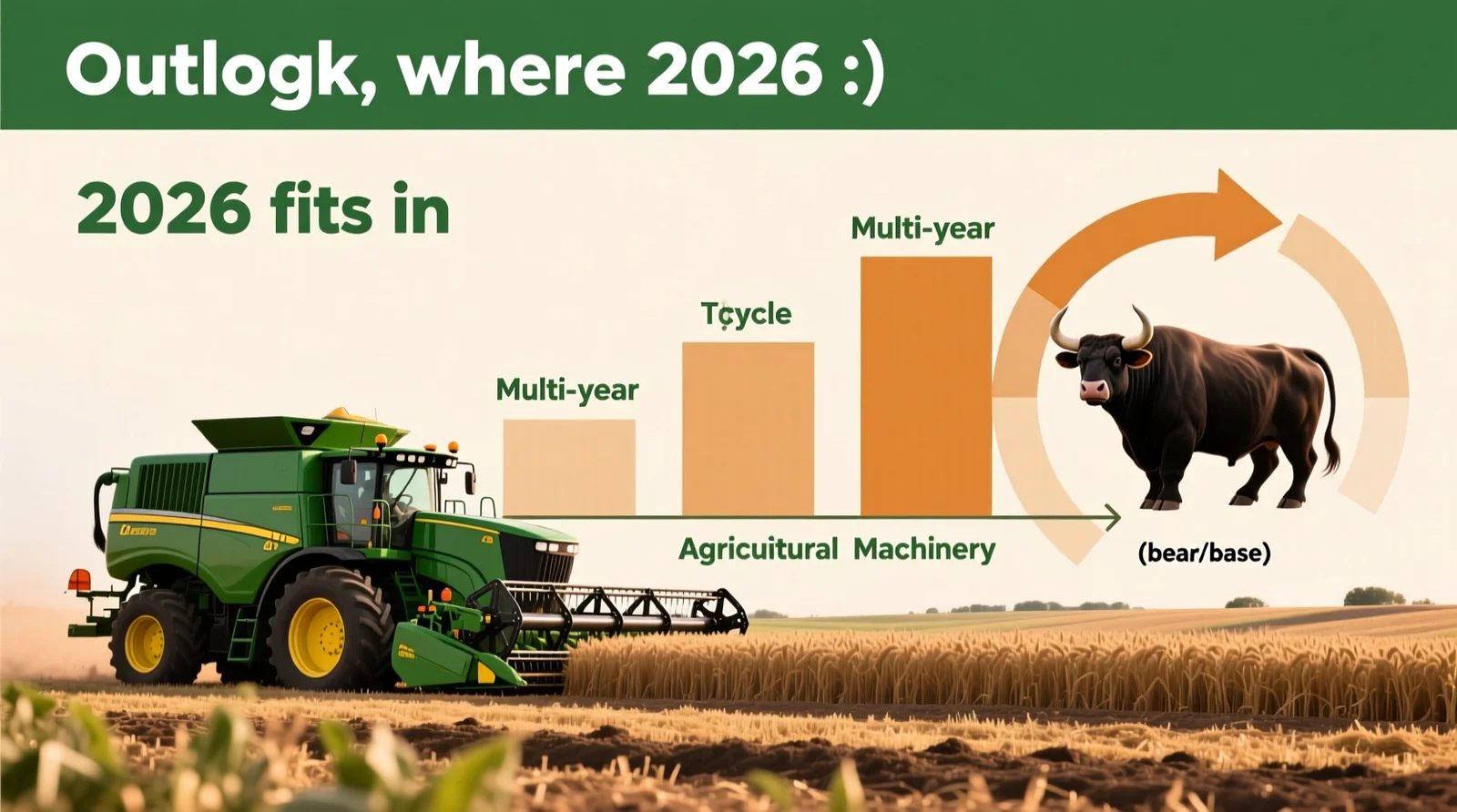
CNH expects demand to resume growth in 2027. Interpreting that as a gradual rebound is usually more realistic than a snapback, because inventory normalization and used-equipment digestion often take multiple selling seasons.
- Bear case (prolonged downturn): Crop prices weaken further, used equipment values slide materially, and credit tightens. Dealer inventory takes longer to normalize, incentives rise, and 2027 recovery is muted or delayed.
- Base case (managed correction): 2026 is a “reset” year—production stays subdued, dealer inventories improve, and price erosion is contained. 2027 shows a measured recovery led by replacement demand (normal fleet renewal) rather than expansion buying.
- Bull case (faster normalization): Input costs ease, farm margins stabilize, and inventory clears faster than expected. Pricing holds better, and 2027 demand improves more visibly—especially if farmers re-engage in technology upgrades bundled with new equipment.
TL;DR: 2026 likely represents the trough/late-downcycle clean-up; 2027 recovery is more plausibly replacement-led and gradual unless margins and used values improve quickly.
Investor lens: key risks and opportunities that could make results worse (or better) than guidance
Potential downside risks:
- Deeper price declines due to excess dealer inventory or aggressive competitor incentive actions
- Faster deterioration in used equipment values, hurting trade-in economics and replacement demand
- Policy shocks affecting export demand, biofuel economics, or tariffs that impact farmer sentiment and OEM costs
- Higher-for-longer rates keeping floorplan and customer financing expensive
Potential upside opportunities:
- Rapid inventory normalization that allows production to stabilize sooner and reduces discounting
- Input cost relief improving farmer margins and confidence
- Technology-led demand (precision/automation adoption) that supports mix and aftermarket revenue
- Execution on cost control that protects operating margin even at lower volumes
TL;DR: The biggest swing factors are price realization, used-equipment values, credit conditions, and how quickly the dealer channel normalizes.
Recent performance and what it signals heading into 2026
CNH reported fourth-quarter revenue of $5.16 billion versus analyst expectations of $4.61 billion and adjusted EPS of $0.19 versus $0.10 expected. Stronger-than-expected results alongside cautious forward guidance often indicate the company is exiting the year with decent execution but sees an approaching volume/margin headwind as the cycle progresses.
TL;DR: CNH’s near-term execution looks solid, but management is signaling the cycle’s headwinds are likely to intensify into 2026.
Conclusion: what to expect from CNH Industrial through 2026–2027
CNH Industrial’s 2026 guidance reflects a classic downcycle posture: plan for lower retail demand, keep production flexible, and partner with dealers to normalize inventory so that pricing does not erode more than necessary. The expected ~5% retail demand decline can still translate into meaningful margin pressure via lower capacity utilization and weaker pricing power—especially if used-equipment values and dealer floorplan costs remain challenging.
The company’s expectation for 2027 growth appears most consistent with a gradual rebound driven primarily by replacement demand and ongoing technology adoption rather than immediate, broad-based expansion buying.
TL;DR: 2026 is shaping up as a margin-and-inventory management year; the quality and pace of dealer normalization will heavily influence whether 2027 looks like a steady recovery or a slower grind.
FAQ
Q: What does “CNH Industrial 2026 guidance” actually tell us about the agricultural machinery cycle?
A: It suggests the industry is in a down/late-cycle phase where farmers delay major purchases, dealers focus on selling through existing stock, and OEMs protect channel health by reducing production. CNH’s expectation for growth in 2027 points to a likely gradual recovery rather than an immediate snapback.
Q: How can a 5% drop in farm equipment demand lead to a bigger profit impact for CNH?
A: Equipment manufacturing has high fixed costs, so lower volumes can reduce factory capacity utilization and increase per-unit overhead (under-absorption). At the same time, higher dealer inventories and softer used-equipment values can reduce pricing power, leading to more incentives and lower margins.
Q: Which regions are most likely to drive CNH’s demand weakness—North America, Europe, or Latin America?
A: North America often drives the most visible swings because large row-crop equipment is highly cyclical and sensitive to farm income, used values, and financing conditions. Europe and Latin America can diverge depending on local policy, currency, and crop economics, so regional mix matters for pricing and margins.
Q: How could CNH’s cost-control or restructuring actions affect margins during a downturn?
A: Cost-control (such as manufacturing footprint optimization, headcount controls, sourcing initiatives, and tighter discretionary spend) can partially offset under-absorption from lower volumes. However, restructuring can also carry near-term costs (charges, inefficiencies during transitions). Net impact depends on speed of execution and whether pricing holds as inventories normalize.
Q: What types of equipment are likely to be most vs. least affected by the 2026 slowdown?
A: Big-ticket, highly cyclical categories—like combines and high-horsepower row-crop tractors—are often most affected because farmers can defer replacement. More resilient areas can include parts and service, some precision-ag/technology upgrades, and certain mid-horsepower or specialty-use machines depending on regional crop mix and local economics.
Q: Could precision agriculture and automation help CNH during a weak demand year?
A: Yes. Precision agriculture (GPS guidance, sensors, data-driven application) and automation can support upgrade spending with clearer productivity paybacks, even when farmers delay full machine replacement. But these technologies can also extend the life of existing equipment if farmers retrofit older machines instead of purchasing new ones.