Introduction
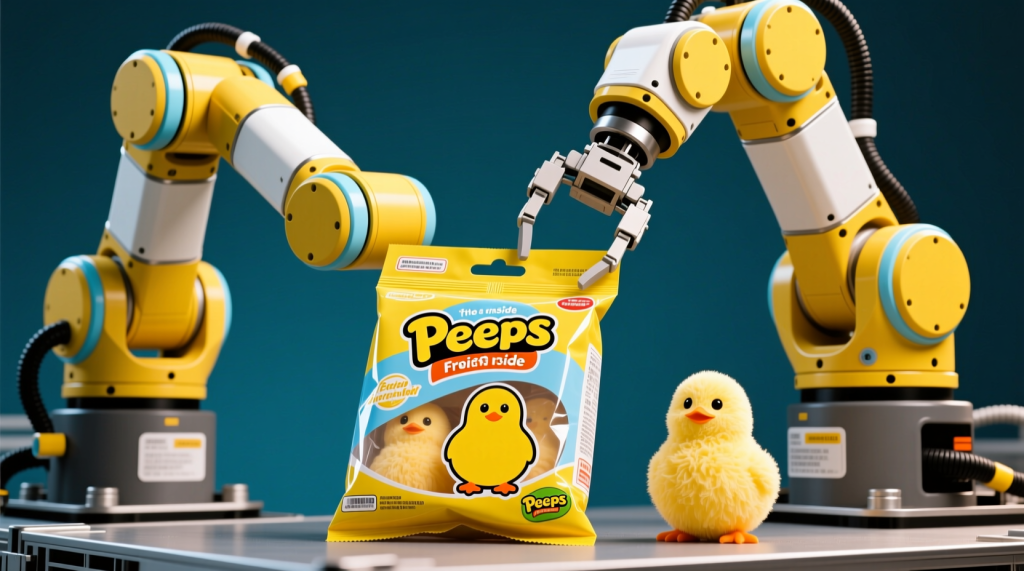
Robotic packaging for marshmallow candy is a specialized form of primary packaging automation that must balance high throughput with ultra-gentle product handling. At Just Born Quality Confections’ Bethlehem, Pennsylvania facility, an automated confectionery packaging line uses a robotic packing system and soft robotic end-of-arm tooling (EOAT) to place freshly made Peeps into trays and cartons with minimal human contact.
That combination of soft robotics, controlled product cooling, and modern line controls helps Just Born protect product appearance, raise throughput, and support fast SKU (stock-keeping unit) changeovers—critical capabilities in today’s growing nonchocolate candy segment.
TL;DR: Just Born uses an automated, soft-robotic primary packaging approach to handle fragile Peeps at production speeds while improving consistency, sanitation, and changeover flexibility.
Why Peeps Need a Gentle Robotic Touch
Fresh Peeps are intentionally soft with a thin, set sugar crust. In the first minutes after forming, small point loads (like a fingertip or a hard gripper edge) can crack that crust or locally compress the marshmallow foam structure, leading to deformation, sticking, and line cleanup downtime. This is why Peeps are a strong use case for soft robotics in confectionery packaging: the product is high-volume, highly variable in compliance (firmness), and easily cosmetically damaged.
Charlotte Ashcraft—who oversees both packaging engineering and graphic development at Just Born—has described the challenge plainly: marshmallow is “gooey…soft…very delicate,” and once the sugar crust is breached it quickly becomes a cleanup and yield issue.
TL;DR: Peeps are fragile immediately after production; even small punctures or pressure points can cause deformation and sticking, driving scrap and downtime—making soft-touch robotic handling a practical necessity.
How Soft Robotics Protects Each Peep (EOAT Details)
Just Born’s robotic packing system uses soft-touch EOAT (end-of-arm tooling)—the gripper mounted on the robot wrist—designed to distribute contact forces over a larger area and reduce peak pressure. In confectionery applications, EOAT is typically built from compliant food-grade polymers (often silicone or similar elastomers) and commonly uses vacuum (negative pressure) or air-actuated channels to create gentle pick forces without rigid fingers.
Compared with rigid mechanical grippers, compliant EOAT can better accommodate slight variability in Peep height, surface texture, and placement on the infeed conveyor. The result is fewer crushed or marred units and less “sticky event” buildup that would otherwise force micro-stops and sanitation interventions.
TL;DR: Soft, compliant EOAT—often vacuum/air-assisted and built from food-grade elastomers—reduces pressure points and better tolerates product variability, lowering damage and cleanup-driven downtime.
Temperature, Set Time, and the 24-Hour Stabilization Step
Even after gentle placement into trays and cartons, Peeps typically need time to cool and stabilize before distribution. At elevated temperature, the marshmallow matrix is more deformable and can take a “set” in the wrong shape during shipping vibration or case compression. Allowing product to rest (about 24 hours as described in the plant process) is a quality safeguard that helps maintain appearance and pack integrity once cases move into warehousing and transport.
TL;DR: Robotic packing is only part of the quality equation—controlled post-pack stabilization helps protect shape and reduce shipping-related deformation.
Inside the Robotic Packing System: Robot Type, Vision, and Line Integration
The Peeps robotic packing system was developed by JLS Automation with soft gripping technology from Soft Robotics (now part of Oxipital). While the exact robot model can vary by line design, high-speed confectionery tray loading commonly uses delta robots (parallel kinematics optimized for rapid pick-and-place), SCARA robots (Selective Compliance Assembly Robot Arm—fast planar motion with controlled Z), or gantry robots (linear-axis systems suited to large work envelopes). These platforms are frequently paired with machine vision (camera-based inspection and guidance) for position correction and quality checks.
In a typical automated confectionery packaging line, the robotic packing cell is integrated with:
- Upstream infeed conveyors and product singulation (to present consistent spacing/orientation)
- Vision-guided picking for real-time product location tracking and reject identification
- Tray denesters (automatically separates nested trays for loading)
- Downstream carton loading, robotic case packing, case sealing, checkweighing, and palletizing
- Controls: PLC (programmable logic controller) for deterministic motion/IO, HMI (human-machine interface) for operator setup and alarms, and line-level controls for performance and OEE (overall equipment effectiveness) monitoring
Just Born first encountered the technology at PACK EXPO International, an industry event where packaging OEMs and automation suppliers demonstrate production-grade systems and validated hygienic designs.
TL;DR: The robotic packing system sits in a broader, integrated packaging line—typically involving vision, conveyors, tray denesting, downstream case packing/palletizing, and PLC/HMI control architecture for high-speed, measurable performance.
Throughput Benchmarks: What “High Speed” Means for Robotic Packing
For industrial readers, “high speed” is best understood in line metrics such as picks per minute (robot pick-and-place cycles) or trays per minute. High-speed delta pick-and-place cells in food and confectionery commonly operate in the range of 100–200+ picks per minute per robot depending on payload, pick distance, vision latency, and placement accuracy requirements. Tray-loading throughput then depends on tray count (e.g., 6-count vs. 12-count), pattern complexity, and buffering.
Just Born has stated the plant can produce roughly 5.5 million Peeps per day and 2+ billion per year at scale; these figures are widely repeated in media and brand storytelling, but readers should treat them as reported company figures/commonly cited estimates unless confirmed in a current Just Born publication. When evaluating any robotic packing system, a more actionable engineering approach is to validate: sustained trays/minute, reject rate, micro-stop frequency, and changeover time under real production conditions.
TL;DR: Robotic packers are typically evaluated in picks/min and trays/min; high-speed cells often run 100–200+ picks/min per robot, while real-world performance should be validated using sustained throughput plus scrap and downtime metrics.
From Manual Packing to Automated Primary Packaging (and What Changed Operationally)
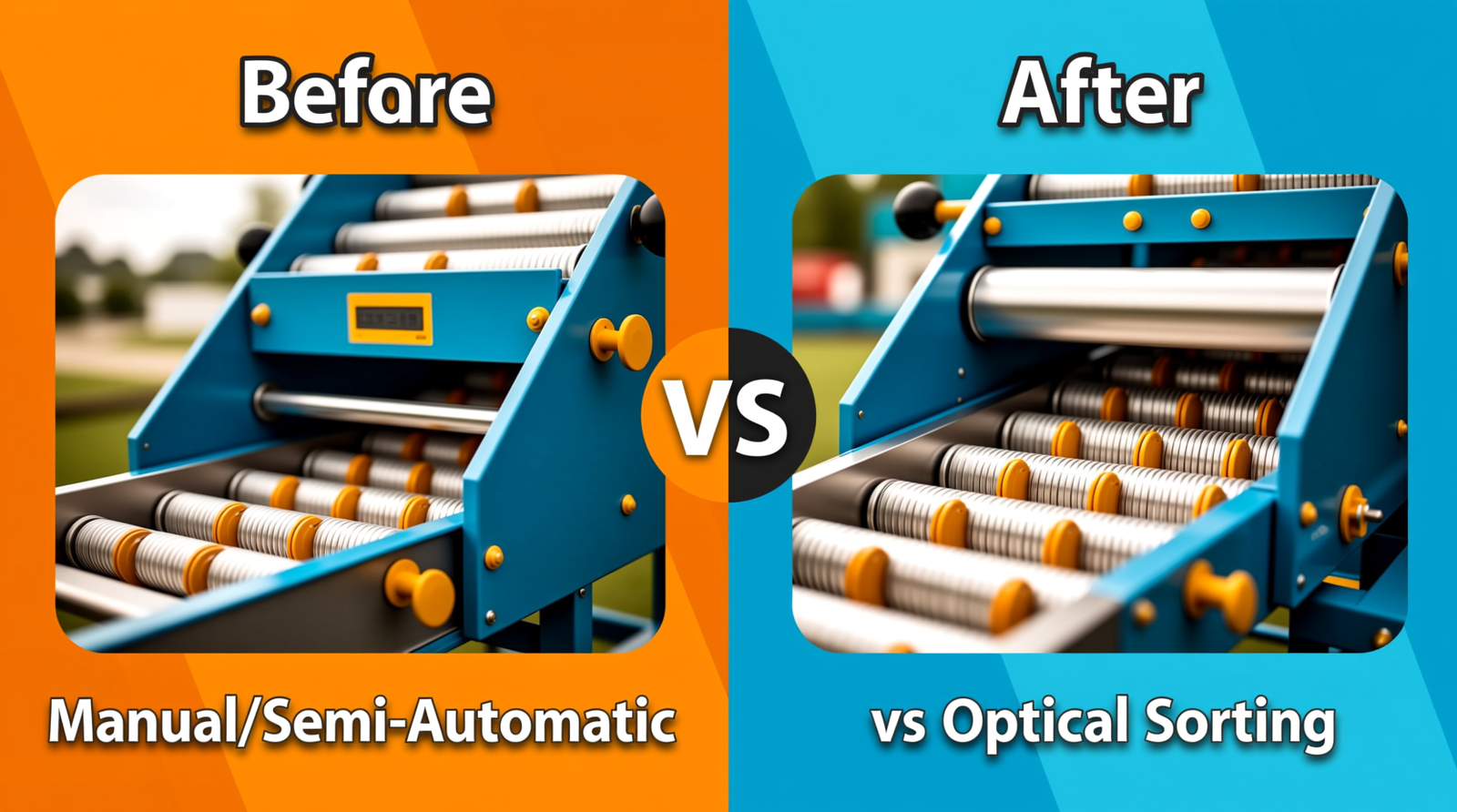
Just Born’s modernization replaced manual packing and hand-intensive end-of-line tasks with automated equipment and a robotic packing system. Operationally, this is less about “removing people” and more about shifting labor from repetitive packing into roles that support line performance: setup, quality checks, replenishment, and maintenance.
In practice, automation can improve OEE (overall equipment effectiveness) by reducing minor stops caused by inconsistent manual placement, fatigue-driven variability, and product damage events that trigger line cleanups. When soft products are involved, even small reductions in handling damage can have outsized effects on uptime because sticky residue often leads to cascading stoppages (sensor fouling, belt tracking issues, tray jams, etc.).
TL;DR: Automation tends to raise OEE by reducing micro-stops and damage-related cleanups while reallocating labor to higher-skill operational roles that sustain line performance.
Benefits of Soft Robotics in Food and Confectionery Packaging
Soft robotics is increasingly used in flexible packaging lines for candy manufacturing because it addresses the biggest constraint in primary packaging: product variability and fragility. Key operational benefits typically include:
- Lower scrap and rework from crushed or cosmetically damaged pieces
- Higher sustained uptime by reducing sticky contamination events and cleanup interventions
- Broader SKU tolerance (shape, size, seasonal variants) with fewer mechanical change parts
- Improved ergonomics by removing repetitive hand-packing motions
For readers exploring soft robotics beyond Peeps, the same advantages apply to gummies, coated candies, baked goods, and other delicate items where rigid tooling drives yield loss.
TL;DR: Soft robotics improves yield and uptime in confectionery primary packaging by handling fragile, variable products with fewer mechanical constraints and less contamination-driven downtime.
Food Safety and Quality: Reduced Contact, Audit Readiness, and Hygienic Design
Automated primary packaging also supports modern food safety expectations by reducing direct human contact with product. This can help facilities align with HACCP (Hazard Analysis and Critical Control Points) programs and broader preventive-controls frameworks under FSMA (the U.S. FDA Food Safety Modernization Act). While robotics is not a substitute for sanitation and verification, it can reduce handling variability and make it easier to standardize hygienic procedures.
In confectionery environments, engineering teams commonly consider: washable or wipe-down EOAT materials, controlled compressed air quality, sanitary guarding, and cleanability around conveyors and denesters. These design choices also support third-party audit expectations (e.g., GFSI-benchmarked schemes such as SQF/BRCGS), where consistency and documented controls matter.
TL;DR: By reducing touchpoints and improving process consistency, robotic packaging can support HACCP/FSMA preventive controls and audit readiness—provided the system is designed and maintained for hygienic operation.
Changeovers, Flexibility, and “Future-Proofing” Capex
In industrial terms, future-proofing means buying automation that can support new SKUs and pack configurations for 8–10 years (typical capital planning horizons) without major mechanical rebuilds. For a robotic packing system, that flexibility usually comes from recipe-driven programming, vision parameter sets, and modular change parts (for trays/cartons) rather than custom hard tooling.
A practical example: switching from a 6-count to a 12-count tray format may be handled via an HMI recipe change plus a small set of change parts (e.g., tray guides, denester adjustments, carton pocket sizing). In well-designed cells, the physical portion of this changeover can often be completed in ~15–45 minutes depending on the number of touchpoints, verification requirements, and whether upstream product spacing also changes. The bigger payoff is minimizing the need to purchase an entirely separate line when marketing introduces seasonal counts, new shapes, or retailer-specific packs.
TL;DR: Future-proofing is about maintaining ROI over an 8–10 year horizon by enabling recipe-based changeovers and modular change parts—often allowing tray/count changes in tens of minutes instead of major mechanical retooling.
Maintenance and Lifecycle Considerations for Operations Managers

Robotic packing systems shift maintenance from frequent manual adjustments to a more planned, reliability-centered approach. Typical practices include:
- Preventive maintenance (PM) on robots (grease intervals, belt/gear inspections per OEM guidance)
- EOAT wear tracking (soft gripper surfaces, vacuum seals, air lines, quick-change couplers)
- Vision system housekeeping (lens cleanliness, lighting stability, calibration checks)
- Spare parts strategy for critical components (vacuum generators, valves, sensors, servo drives)
- Sanitation-compatible reassembly procedures to avoid post-cleaning alignment drift
From a lifecycle cost view, the goal is not only speed but predictable uptime. Monitoring metrics like MTBF (mean time between failures) and MTTR (mean time to repair) alongside OEE helps plants quantify the operational value of robotics versus legacy manual packing.
TL;DR: Sustained performance depends on disciplined PM, EOAT/vision upkeep, and spares planning—robotics pays off when uptime is predictable and repairs are fast.
Industry Perspective: Intelligent Packaging Operations and Reprogrammable Robotics
PMMI, The Association for Packaging and Processing Technologies, has consistently highlighted the move toward more flexible, data-driven packaging operations in its industry reports and event programming. Jorge Izquierdo (PMMI vice president, market development) has described the value of easier programming and reconfiguration as a form of “future-proofing” packaging investments—especially in categories with frequent promotional pack changes.
For manufacturers, the practical takeaway is that reprogrammable robotic cells can reduce the engineering burden of frequent format changes, particularly when paired with line-level controls that track downtime reasons and changeover performance. (Learn more about PMMI and its packaging technology resources at pmmi.org.)
TL;DR: Industry guidance increasingly emphasizes reprogrammable robotics and data-driven controls as the foundation for flexible packaging operations and longer-lived capital assets.
The Growing Nonchocolate Candy Market (Clarified Sourcing)

Demand growth in nonchocolate candy continues to push manufacturers toward higher-throughput, more flexible packaging lines. However, the article’s earlier reference to “2025” nonchocolate candy sales should be treated carefully: unless a specific NCA dataset is explicitly labeled as a forecast, a future-year sales number is not a historical fact.
For credible market context, use NCA’s published market insights and clearly label forward-looking values as projections. The National Confectioners Association regularly publishes category commentary and industry outlook materials (see candyusa.com). If you cite a specific year and dollar value in formal documentation, reference the exact NCA report title/date (or the source dataset, such as Circana/IRI-powered reporting if applicable) so readers can verify the figure.
John Downs (NCA president and CEO) has emphasized in NCA communications and public industry commentary that innovation is central to confectionery growth—particularly as younger consumers drive interest in new flavors, textures, and seasonal formats.
TL;DR: Nonchocolate candy growth supports the business case for flexible packaging automation, but sales figures must be clearly labeled as historical vs. forecast and tied to a specific NCA publication for verification.
Balancing Tradition and Technology at Just Born (Operational Takeaway)
Just Born’s Peeps line shows how soft robotics and primary packaging automation can be engineered around a fragile product: compliant EOAT, integrated vision and conveying, controlled post-pack stabilization, and reprogrammable changeovers that keep up with seasonal demand. The operational outcomes manufacturing teams care about are straightforward: reduced waste, higher sustained throughput, consistent pack quality, and a workforce that increasingly focuses on setup, controls, maintenance, and continuous improvement rather than manual packing.
For manufacturing professionals, the broader lesson is that soft robotics can be a best-practice approach for delicate foods when the project is scoped as a full system—robot + EOAT + vision + sanitation + line controls—not just a standalone robot.
TL;DR: This case exemplifies best practices for applying soft robotics to fragile confections: system-level integration that improves yield, throughput, quality consistency, and workforce upskilling.
FAQ

Q: What type of robots are typically used for robotic packaging for marshmallow candy?
A: High-speed pick-and-place in confectionery often uses delta robots (fast, lightweight parallel robots), SCARA robots (Selective Compliance Assembly Robot Arm for rapid planar moves), or gantry systems (linear-axis robots for larger work areas). The final choice depends on required picks per minute, payload, footprint, and how the robot integrates with conveyors, vision, and tray denesting.
Q: What is end-of-arm tooling for confections, and why is “soft” EOAT important?
A: End-of-arm tooling (EOAT) is the gripper or tool mounted on the robot wrist. For confections like Peeps, soft EOAT—often made from food-grade compliant materials and sometimes vacuum/air-assisted—spreads contact forces and reduces pressure points. This helps prevent crust cracking, deformation, and sticking that can cause scrap and sanitation downtime.
Q: What line speed benchmarks should I look for in a robotic packing system?
A: Look at picks per minute and trays per minute under sustained production, not just peak demos. High-speed food-grade delta cells commonly run about 100–200+ picks per minute per robot depending on payload, travel distance, and vision requirements. Also track OEE, reject rate, and micro-stops to understand true throughput.
Q: How does robotic case packing fit into an automated confectionery packaging line?
A: Robotic case packing is typically downstream of primary packaging (tray/carton loading). After primary packs are formed and verified (often with checkweighers and vision), cases are erected, packed, sealed, coded, and sent to palletizing. Integration is usually coordinated through a PLC and HMI with line-level controls for accumulation, fault handling, and performance tracking.
Q: What are the main engineering challenges in automating marshmallow packaging?
A: The biggest challenges are product variability (softness, temperature, stickiness), sanitation/cleanability, reliable singulation on conveyors, and tooling design that avoids point loads. Engineers also need robust changeover strategies (recipes + minimal change parts), vision tuning for consistent detection, and a controls approach that reduces micro-stops while maintaining food-safety procedures.