
Last Updated: January 22, 2026
Introduction: What Remote IoT Means for Industrial Operations in 2026
Remote IoT (Internet of Things) refers to networks of connected field devices—such as rugged sensors, industrial cameras, gateways, and controllers—deployed in locations that are distant, unmanned, hazardous, or difficult to access. In industrial settings, remote IoT commonly feeds data into a control room, a cloud platform, or an on-premises historian for monitoring and (in some cases) remote control.
In 2026, remote industrial IoT is less about “adding sensors” and more about building remote monitoring and control systems that scale across thousands of assets: pump stations, substations, compressors, haul roads, wind turbines, and temporary construction worksites. These deployments typically rely on a mix of industrial protocols (for example, Modbus, DNP3, OPC UA) and IoT messaging (such as MQTT—Message Queuing Telemetry Transport) bridged through secure gateways.
Remote IoT also increasingly sits alongside legacy automation. SCADA (Supervisory Control and Data Acquisition) often predates modern IoT by decades and is designed for deterministic monitoring/control of industrial processes via PLCs (Programmable Logic Controllers) and RTUs (Remote Terminal Units). Remote IoT usually augments SCADA/PLC/RTU systems with additional sensing (vibration, thermal, video), richer analytics, and modern connectivity—without replacing proven control systems.
TL;DR: Remote industrial IoT in 2026 is about securely connecting remote assets (often alongside SCADA/PLC systems) to enable monitoring, alerts, and selective control—at scale and in harsh environments.
Why Remote Industrial IoT Is a High-Impact Investment (Not Just “More Data”)
Remote industrial operations fail in predictable ways: delayed detection, slow response, and limited context. Remote IoT changes the operating model by shortening the time between a physical change in the field and an informed decision in the control room.
- Earlier fault detection: Condition monitoring (vibration, motor current signature, oil quality) often identifies bearing wear or cavitation days or weeks earlier than periodic inspections.
- Fewer “truck rolls”: Remote diagnostics (including camera verification and sensor corroboration) can prevent unnecessary site dispatches and prioritize visits that actually require hands-on work.
- Operational resilience: Redundant links and edge processing keep key telemetry and alarms available when backhaul connectivity degrades.
- Better KPIs: Teams can track and improve MTBF (Mean Time Between Failures), MTTR (Mean Time To Repair), asset utilization, safety incident rates, energy consumption, and the number of monthly truck rolls.
Mini case example (anonymized): A regional electric utility instrumented ~120 unmanned sites with transformer temperature sensors, door contacts, and IP cameras. By correlating alarms with video verification, the utility reported a ~30% reduction in non-essential truck rolls over two quarters, while improving incident response time for confirmed intrusions.
TL;DR: The value is operational: faster detection, fewer unnecessary site visits, stronger resilience, and measurable improvements in MTTR/MTBF, utilization, and safety.
Key Industry Applications of Remote IoT (Construction, Energy, Mining) with Real-World Context
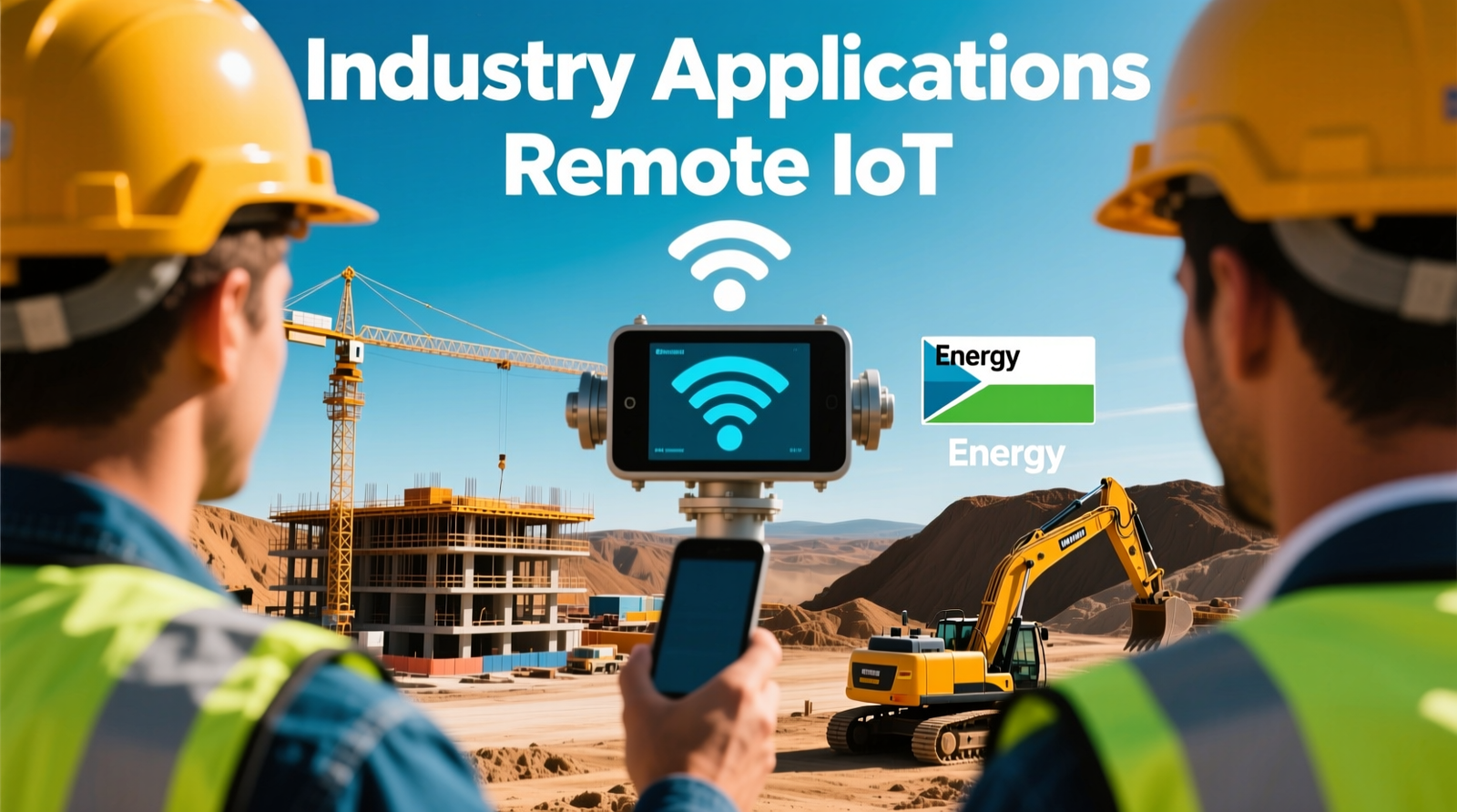
Remote IoT on Construction Sites: Tracking, Safety, and Edge Analytics for Temporary Infrastructure
Construction sites behave like pop-up industrial campuses: fast-changing layouts, temporary power, mixed contractor access, and high theft risk. Remote IoT in construction typically uses rugged trackers and temporary networks to create real-time awareness of where assets and hazards are.
- Asset and materials tracking: GPS trackers and RFID (Radio-Frequency Identification) tags are commonly used on generators, light towers, compressors, and high-value tools—especially when equipment moves between sites.
- Wearable safety and proximity: Wearables and UWB (Ultra-Wideband) tags can enable proximity alerts around cranes, loaders, and exclusion zones, supplementing spotters and signage.
- Temporary works monitoring: Load/strain sensors on scaffolding and shoring can flag abnormal loads early—useful when schedules, weather, and site logistics change daily.
Connectivity on site (what’s typical):
- Private LTE/5G: Strong option for wide-area outdoor coverage and mobility (vehicles, roaming crews), with more predictable performance than Wi‑Fi in large, open sites.
- Wi‑Fi 6/6E: Good for dense areas (site offices, laydown yards) but can be susceptible to obstruction, interference, and frequent reconfiguration as the site evolves.
- Mesh networks: Useful for quick-deploy sensor clusters but can face throughput/latency trade-offs as hops increase.
Digital twins (definition and practical use): A digital twin is a continuously updated virtual representation of a physical asset or site. In construction, twins increasingly blend BIM (Building Information Modeling) with live IoT feeds (equipment locations, environmental sensors, progress imagery) to support schedule risk analysis, logistics planning, and quality checks.
Mini case example (anonymized): A civil contractor used UWB wearables and machine geofencing on an earthworks project. Near-miss proximity alerts increased at first (better detection), then dropped by ~18% after traffic routing changes—measured over 10 weeks—while equipment idle time fell due to improved staging visibility.
TL;DR: Construction remote IoT is most effective when it pairs temporary connectivity (private cellular/Wi‑Fi/mesh) with tracking and safety analytics, feeding digital twins for schedule, logistics, and risk decisions.
Remote IoT in Energy and Utilities: Grid Telemetry, Substations, Renewables, and Pipelines
Utilities and energy operators often already run SCADA networks for critical telemetry and control. Remote IoT expands visibility by adding richer sensing (thermal, acoustic, vibration, video) and modern device management—while keeping core protection and control systems stable.
Smart Grids and Renewable Energy Sites
Electric utilities use AMI (Advanced Metering Infrastructure) for smart metering and feeder monitoring, while line sensors and fault indicators help pinpoint outages faster. For renewables, remote IoT typically focuses on condition-based maintenance:
- Wind: vibration/temperature on gearboxes and generators, yaw system monitoring, blade condition via cameras or acoustic sensors.
- Solar: inverter health, combiner box temperatures, string-level performance, soiling estimation.
Mini case example (anonymized): A wind operator combined SCADA alarms with added gearbox vibration sensors and edge analytics. They reported a ~12% reduction in unplanned turbine downtime over a season by catching developing faults earlier and aligning maintenance windows with weather access constraints.
Oil and Gas: Remote Monitoring for Wells, Compression, and Midstream
In oil and gas, remote IoT commonly complements SCADA with high-frequency condition monitoring and environmental sensing:
- Process telemetry: flow, pressure, temperature for wells and pipelines; often integrated into RTUs/PLCs.
- Rotating equipment: vibration sensors on pumps/compressors; motor current monitoring to detect load changes and early electrical issues.
- Safety and compliance: gas detection, flare monitoring, and site security sensors to support incident response and reporting.
TL;DR: Energy and utilities use remote IoT to deepen visibility beyond traditional SCADA—especially for predictive maintenance, faster fault localization, and improved compliance/safety monitoring.
Remote IoT in Mining and Heavy Industry: Harsh Environments, Mobility, and Safety-Critical Alerts
Mining sites face extreme dust, vibration, temperature swings, and moving equipment—so remote IoT success depends on rugged devices, resilient connectivity, and edge processing for safety-critical use cases.
- Underground safety: air quality (O2, CO, CH4), ventilation status, and geotechnical movement sensors to identify instability risks.
- Fleet and collision avoidance: location tracking and proximity detection for haul trucks, loaders, and light vehicles—especially in poor visibility conditions.
- Condition monitoring: temperature/vibration on conveyors, crushers, pumps, and fans to predict failures and manage spares.
Edge computing (definition): Edge computing processes data near the source (on-site gateways/servers) instead of sending all data to a distant cloud. In mining, edge analytics can trigger alerts and automated responses even if backhaul links are congested or down.
Connectivity on site (typical options and trade-offs):
- Private LTE/5G: Strong mobility and coverage across pits and haul roads; supports QoS (Quality of Service) prioritization for critical traffic.
- Industrial Wi‑Fi: Often used in plants and fixed areas; may be challenged by reflections, obstruction, and changing topology in pits.
- Mesh/LPWAN: Useful for low-data sensors (e.g., environmental) but generally not ideal for high-bandwidth video or low-latency control.
Mini case example (anonymized): An open-pit operator deployed slope stability sensors with edge-based alerting and two independent backhaul links. They reported a ~25% improvement in evacuation drill response times (measured by time-to-notify and time-to-acknowledge) and fewer false alarms after correlating sensor thresholds with rainfall and haul road vibration data.
TL;DR: Mining remote IoT is driven by safety and uptime; private cellular plus edge analytics is often the best fit for moving fleets and harsh, connectivity-constrained sites.
Industrial IoT Connectivity in Remote Locations: Latency, Redundancy, and When to Use Cellular vs Microwave vs Satellite
Connectivity determines what you can safely control and how fast you can respond. Remote IoT architectures typically separate traffic into classes: safety alarms, control/SCADA telemetry, video, and bulk data (logs, firmware updates).
Latency constraints (practical rule): Tight real-time control loops (sub-second deterministic control) are usually kept local on PLCs and on-site control networks. Remote links are better suited for supervisory control, setpoint updates, and monitoring—unless you have engineered low-latency, high-availability networks with clear safety cases.
- Cellular (public LTE/5G): Often the fastest to deploy for remote monitoring; performance varies by coverage and congestion.
- Private LTE/5G: Better control over coverage, QoS, and security on industrial campuses and large sites.
- Microwave backhaul: Strong for line-of-sight point-to-point links; commonly used to connect remote facilities to core networks with predictable latency.
- Satellite: Best for extreme remoteness (offshore, deserts, wilderness). Traditional GEO (geostationary) satellite can have higher latency; LEO (low Earth orbit) reduces latency but still requires careful design for availability and regulatory considerations.
Redundancy patterns seen in critical infrastructure: Dual WAN (e.g., microwave + cellular), diverse carriers, and automatic failover via SD-WAN; plus local buffering/edge decisioning so alarms and critical logic still work during outages.
TL;DR: Use local control for tight loops, remote links for supervisory control/monitoring, and design redundancy (dual paths + edge buffering) based on criticality and site constraints.
SD-WAN for Remote Monitoring and Control Systems (Resilience + Central Policy)
SD-WAN (Software-Defined Wide Area Network) is an overlay that centrally manages multiple WAN links (fiber, broadband, LTE/5G, microwave, satellite) and applies routing and security policies consistently across sites.
In remote industrial IoT, SD-WAN is commonly used to:
- Prioritize critical traffic: ensure SCADA telemetry and alarms take precedence over bulk data transfers or camera archive uploads.
- Improve uptime: steer traffic away from degraded links and fail over quickly during outages.
- Standardize segmentation: keep OT (Operational Technology) traffic separated from IT traffic using consistent policies across remote sites.
Mini case example (anonymized): A water operator connected remote lift stations using dual links (LTE + fixed broadband where available) managed by SD-WAN. By standardizing alarm routing and failover policies, they reduced “blind” telemetry events by ~40% over six months, improving dispatch accuracy during storms.
TL;DR: SD-WAN improves remote IoT reliability and governance by steering traffic across multiple links and enforcing consistent policies, especially for alarm and SCADA telemetry.
Private LTE/5G for Industrial IoT Connectivity: Spectrum Choices and Deployment Models
Private LTE and private 5G are enterprise-controlled cellular networks that deliver wide-area coverage, mobility, SIM/eSIM-based authentication, and QoS—often outperforming Wi‑Fi for outdoor industrial campuses.
Spectrum options (what it means for industrial users):
- Licensed spectrum: highest control and predictable performance, typically coordinated through regulators or carriers.
- Shared spectrum: examples include CBRS (Citizens Broadband Radio Service) in the U.S., enabling more accessible private LTE deployments with defined sharing rules. Reference: FCC CBRS overview.
- Unlicensed spectrum: easier entry but more interference risk; suitability depends on environment and performance requirements.
Standards foundation: LTE and 5G specifications are defined by 3GPP (3rd Generation Partnership Project), which underpins interoperability across vendors and devices. Reference: 3GPP official site.
TL;DR: Private LTE/5G provides predictable, secure wireless for industrial sites, and spectrum choice (licensed/shared/unlicensed) directly affects performance, cost, and deployment feasibility.
Cybersecurity for Remote Industrial IoT and SCADA: IEC 62443, Segmentation, and Secure Remote Access
Connecting remote assets increases the attack surface, especially when IoT data touches SCADA/ICS (Industrial Control Systems). A credible remote IoT program treats cybersecurity as an engineering requirement, not an IT add-on.
Security frameworks and standards:
- IEC 62443 is a widely referenced series for securing industrial automation and control systems, including concepts like zones and conduits, security levels, and lifecycle practices. Reference: ISA overview of IEC 62443.
- NIST guidance is frequently used for ICS risk management and security controls mapping. Reference: NIST SP 800-82 Rev. 3 (ICS Security).
Practical controls commonly used in remote IoT:
- IT/OT segmentation: separate corporate IT networks from OT networks; restrict and monitor traffic between them (often via firewalls and DMZs—Demilitarized Zones).
- Zero trust principles: verify explicitly (identity, device posture), enforce least privilege, and assume breach; especially important for remote access paths.
- Encryption and key management: use TLS (Transport Layer Security) for data in transit; ensure certificates/keys are rotated and centrally managed.
- Secure remote access: prefer brokered access, MFA (Multi-Factor Authentication), session recording, and time-bound approvals for vendor/contractor access to SCADA and gateways.
- Patch and vulnerability management: schedule maintenance windows; validate patches against OT stability requirements; maintain SBOMs (Software Bill of Materials) where possible.
TL;DR: Remote IoT must be designed with IEC 62443-style segmentation, strong identity and encryption, and tightly controlled remote access—especially when IoT integrates with SCADA/ICS.
Smart Physical Security with Remote IoT: Cameras, Access Control, and Evidence-Ready Monitoring
Industrial remote sites (substations, well pads, laydown yards) often need security that is both deterrent and actionable. Remote IoT security systems increasingly integrate video, access control, and sensor alarms into a single operational view.
Industrial Networked Cameras (IP Video + Edge Analytics)
IP cameras stream video over networks and can support analytics at the camera or gateway (edge). In industrial settings, typical features include thermal imaging, low-light performance, and tamper detection.
- Use case: verify whether a perimeter alarm is wildlife, weather, or intrusion—before dispatching security.
- Bandwidth note: cameras are bandwidth-heavy; many teams use edge recording with event-based uploads rather than continuous backhaul streaming.
Electronic Access Control (Auditability for Compliance)
Smart cards, fobs, or mobile credentials integrate with centralized identity systems to enforce role-based access and maintain audit trails—useful for compliance and incident investigation.
Real-Time Notifications and Triage
Remote notifications are most useful when they include context: sensor value + trend + last maintenance event + camera snapshot. This reduces “alarm fatigue” and accelerates triage.
TL;DR: Remote IoT security works best when video, access control, and alarms are integrated and optimized for verification (reduce false dispatches) and evidence collection.
Environmental Sensors, SCADA Sensors, and How IoT Augments Legacy Control Systems
Many industrial organizations already have SCADA telemetry for core process variables. Remote IoT adds breadth (more sensors, more context) and often higher-frequency condition monitoring—without changing the underlying control logic running on PLCs.
Environmental and Condition Monitoring Sensors
Common remote IoT measurements include temperature/humidity in enclosures, vibration/shock on rotating equipment, and strain on structures. These sensors are often battery/solar powered and transmit periodically to preserve power.
SCADA + IoT Integration (What “Good” Looks Like)
SCADA systems typically gather deterministic telemetry from RTUs/PLCs and enable supervisory control (alarms, setpoints, valve operations). IoT platforms can ingest SCADA data (read-only when appropriate) and combine it with:
- additional sensors not historically wired into SCADA
- video verification
- asset maintenance history (CMMS—Computerized Maintenance Management System)
- edge analytics outputs
Result: better diagnostics and prioritization, while keeping safety-critical control where it belongs—on local controllers with engineered protections.
TL;DR: SCADA remains the backbone for process control; IoT layers add extra sensing and analytics to improve diagnostics and maintenance without destabilizing control systems.
Remote IoT in Utility Substations: Visibility, Security, and Condition-Based Maintenance
Substations are critical grid nodes and are frequently unmanned. Remote IoT commonly supports two goals: equipment health visibility and site security.
- Equipment monitoring: transformer temperature, breaker status, partial discharge indicators, and enclosure environmental conditions.
- Perimeter and yard security: cameras, motion sensors, and fence/gate monitoring, often integrated with access logs.
- Communications and time sync: engineered comms paths back to control centers; event correlation is improved when time sources are consistent across devices.
Mini case example (anonymized): A utility added enclosure humidity monitoring and thermal cameras at unmanned substations. Over one summer, they reduced nuisance callouts for suspected overheating and instead prioritized two substations for targeted maintenance, avoiding a potential forced outage during peak demand.
TL;DR: Substation remote IoT focuses on condition monitoring + security, improving dispatch accuracy and reducing outage risk without altering primary protection systems.
Benefits of Remote Industrial IoT in 2026 (KPIs Operators Actually Use)
When remote industrial IoT is deployed with clear operating procedures, benefits show up in measurable KPIs—not just dashboards.
- Maintenance: improved MTBF, reduced MTTR, fewer repeat failures through earlier detection and better diagnostics.
- Operations: higher asset utilization, reduced idle time, improved scheduling of crews and parts.
- Safety: lower recordable incident rates, faster emergency notification and acknowledgment, fewer hazardous-area entries.
- Field efficiency: fewer truck rolls and better “first-time fix” rates due to remote verification and pre-staging.
- Energy/ESG: reduced energy waste (leaks, overheating, poor power factor), better emissions reporting and compliance evidence.
TL;DR: The strongest ROI typically comes from MTTR/MTBF improvements, fewer truck rolls, safety performance gains, and utilization increases—tracked against baseline operations.
Implementation Considerations: Ruggedization, Power, Lifecycle Management, and Integration
Remote IoT succeeds or fails on practical details that don’t show up in concept diagrams.
- Device ruggedization: choose enclosures and connectors suited for dust/water exposure (e.g., IP ratings such as IP66/IP67), vibration, and temperature extremes.
- Power constraints: battery/solar designs require careful sampling rates, sleep cycles, and local buffering; plan for seasonal solar variability and battery replacement intervals.
- Lifecycle management: provision devices securely, manage certificates/keys, monitor firmware versions, and plan end-of-life replacements (especially for cellular modem generations).
- Integration: define how IoT data flows into historians, SCADA, CMMS, and analytics tools; avoid “shadow systems” that create inconsistent truths.
Internal linking suggestion (do not publish as-is): On a company website, consider linking to product/service pages for SD-WAN solutions, private LTE/5G networks, industrial cameras, rugged IoT gateways, and SCADA integration services.
TL;DR: Plan for rugged hardware, constrained power, secure device lifecycle operations, and clean integration into existing SCADA/maintenance workflows.
Remote IoT Checklist: How to Evaluate a Solution for Remote Assets
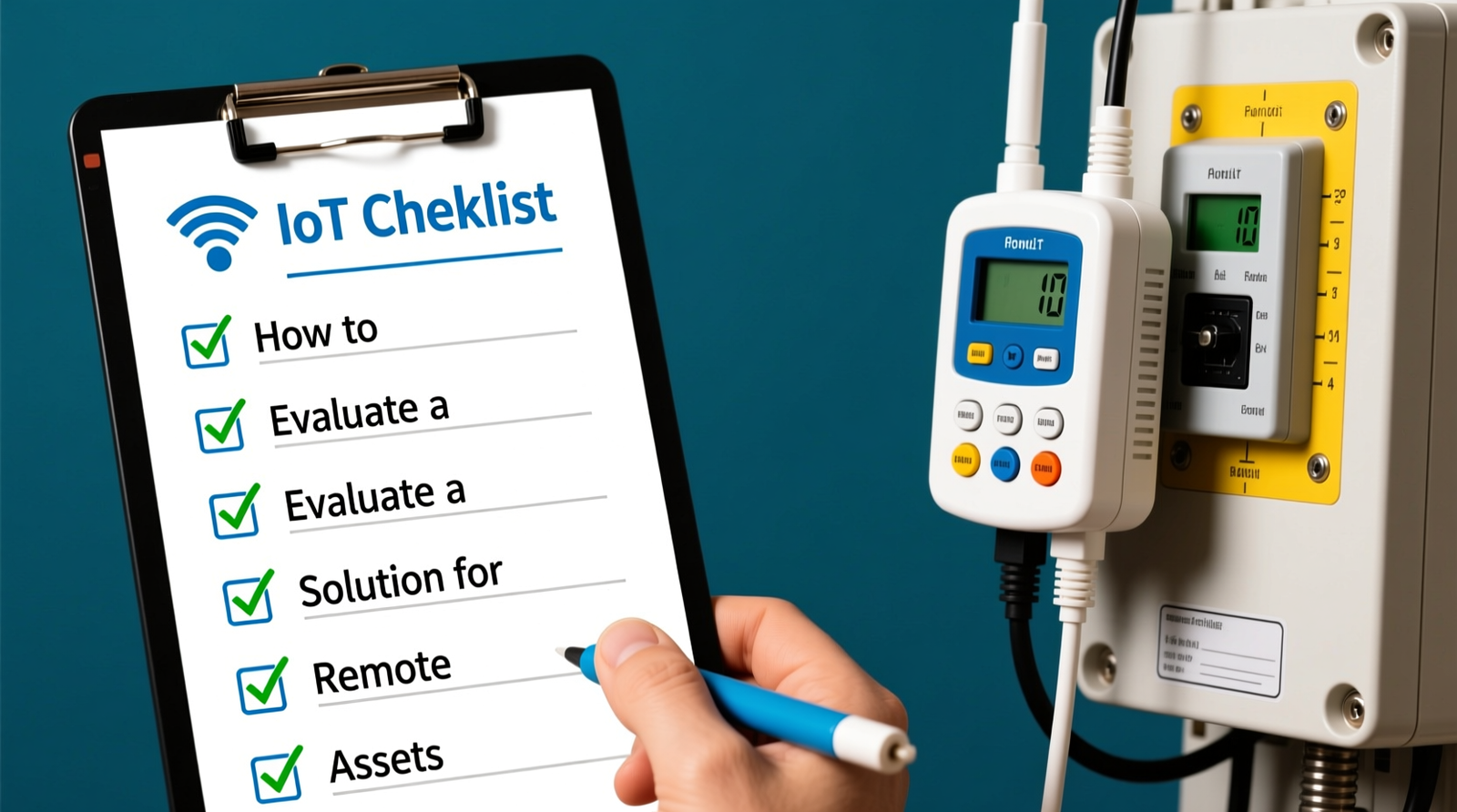
- Coverage: can you reach every asset (including low spots, underground, and perimeter zones)?
- Latency & control: which actions must stay local on PLCs, and which can be supervisory over WAN?
- Bandwidth: do you have enough capacity for video, and is edge recording/event upload supported?
- Resilience: dual paths, diverse carriers, failover behavior, and offline buffering.
- Cybersecurity: IEC 62443-aligned segmentation, encryption (TLS), MFA, secure remote access, logging, and patching model.
- SCADA/PLC integration: protocols supported (OPC UA/Modbus/DNP3), read-only boundaries, alarm management approach.
- Manageability: device provisioning, fleet monitoring, firmware updates, and inventory control.
- Regulatory/compliance: data retention, audit trails, and sector requirements (energy, water, critical infrastructure).
TL;DR: Evaluate remote IoT by coverage, latency, bandwidth, resilience, cybersecurity, SCADA integration, manageability, and compliance—not by sensor counts.
Where Remote Industrial IoT Is Headed (2026–2028): Edge AI, Digital Twins, and Regulatory Pressure
From 2026 to 2028, three shifts are likely to reshape remote industrial IoT programs:
- AI at the edge: More inference (not just data collection) will run on gateways and cameras—detecting leaks, intrusions, overheating, or unsafe behaviors locally to reduce bandwidth and speed response.
- Digital twins moving from pilots to operations: Expect higher adoption where asset complexity and downtime costs are high (utilities, mining, processing). Twins will increasingly link to maintenance systems and parts planning, not just visualization.
- Standardization + regulation impact: Security and reporting requirements for critical infrastructure will continue to tighten, pushing organizations toward stronger segmentation, auditable access control, and formal risk management aligned to recognized standards (e.g., IEC 62443, NIST).
Organizations that treat remote IoT as a governed program—architecture, security, lifecycle, and operations—will outpace those that treat it as a collection of disconnected pilots.
TL;DR: 2026–2028 will emphasize edge AI, more operational digital twins, and stricter security/compliance—making governance and standard-based design central to remote IoT success.
Conclusion: Benefits Are Real, but Prerequisites Matter

Remote industrial IoT can materially improve reliability, safety, and cost control—but only if the program is engineered for real-world constraints: intermittent connectivity, harsh environments, SCADA integration boundaries, and cybersecurity obligations. The biggest risks are usually organizational (skills gaps, change management, unclear ownership) and architectural (poor segmentation, unmanaged device fleets, and fragile backhaul). A disciplined roadmap, standards-based security, and measurable KPIs are what turn remote IoT from “connected devices” into a durable operating advantage.
TL;DR: Remote IoT delivers measurable value when paired with strong governance, secure-by-design architecture, and realistic integration and change management plans.
FAQ
Q: What’s the difference between SCADA and industrial IoT for remote monitoring?
A: SCADA (Supervisory Control and Data Acquisition) typically predates IoT and focuses on reliable process telemetry and supervisory control via PLCs/RTUs using industrial protocols. Industrial IoT usually augments SCADA by adding new sensors (vibration, thermal, video), modern device management, and analytics—often through gateways—while keeping real-time control loops local.
Q: Which connectivity is best for remote IoT: cellular, microwave, or satellite?
A: Cellular (public or private LTE/5G) is often best when coverage exists and you need mobility. Microwave works well for line-of-sight links with predictable latency and is common for permanent remote facilities. Satellite is best for very remote areas; it’s ideal for monitoring and alerting, but latency and availability characteristics must be engineered carefully—often with edge buffering and secondary links.
Q: How do private LTE/5G spectrum options (licensed, CBRS, unlicensed) affect industrial deployments?
A: Licensed spectrum typically offers the most predictable performance but can be harder or more expensive to obtain. Shared spectrum (like CBRS in the U.S.) can enable enterprise private LTE with defined sharing rules. Unlicensed spectrum is easiest to access but carries higher interference risk, which may be unsuitable for mission-critical applications.
Q: What cybersecurity practices should be mandatory for remote industrial IoT connected to SCADA?
A: At minimum: IT/OT segmentation, strong identity and access management (including MFA), encrypted communications (TLS), secure remote access with auditing, continuous logging/monitoring, and a formal patch/vulnerability program. Many organizations align architecture and processes to IEC 62443 concepts (zones/conduits and lifecycle security) and NIST ICS guidance.
Q: What KPIs should I track to prove ROI for remote industrial IoT?
A: Common KPIs include MTBF, MTTR, asset utilization, number of truck rolls (and percent avoided), safety incident rates/near-miss rates, energy consumption, unplanned downtime hours, and first-time-fix rate for dispatched maintenance. Establish a baseline before rollout so improvements are defensible.