Introduction

For Vietnamese manufacturers, importers, and distributors evaluating Italian packaging machinery for Vietnamese manufacturers, Italy offers a practical route to higher productivity, safer food and pharmaceutical packaging, and how to export to EU with ESG-compliant packaging. Through Italy’s trade promotion efforts (including an expected Italian pavilion at ProPak Vietnam 2026) and the OpportunItaly platform for Vietnam, Vietnamese companies can connect with vetted Italian suppliers for packaging lines, automation, and sustainable materials.
TL;DR: This guide explains what Italian packaging machinery is best suited for Vietnam’s key sectors, how to onboard to OpportunItaly, and what it takes to upgrade lines for EU-oriented quality and sustainability requirements.
Italy–Vietnam Economic Cooperation: Why It Matters for Industrial Buyers
Italy and Vietnam have expanded industrial cooperation as supply chains diversify and manufacturers pursue higher-value production. For Vietnamese factories, Italian technology is typically considered when the goal is not only throughput, but also export-readiness—especially for markets with tighter rules on food safety, pharmaceuticals, and sustainable packaging.
Two policy anchors help explain the momentum:
- EVFTA (EU–Vietnam Free Trade Agreement): supports trade growth and encourages compliance with EU product and process expectations. Reference: European Commission overview of EVFTA: https://policy.trade.ec.europa.eu/…/eu-vietnam-agreement_en
- EU sustainability direction (often linked to the EU Green Deal): pushing lower environmental impact across value chains, including packaging. Official Green Deal portal: https://commission.europa.eu/…/european-green-deal_en
TL;DR: Vietnam–Italy industrial ties are increasingly driven by export requirements and EU-oriented sustainability expectations, not just basic trade.
Where Italian Packaging Machinery Fits Vietnam’s Key Sectors (With Concrete Machine Examples)
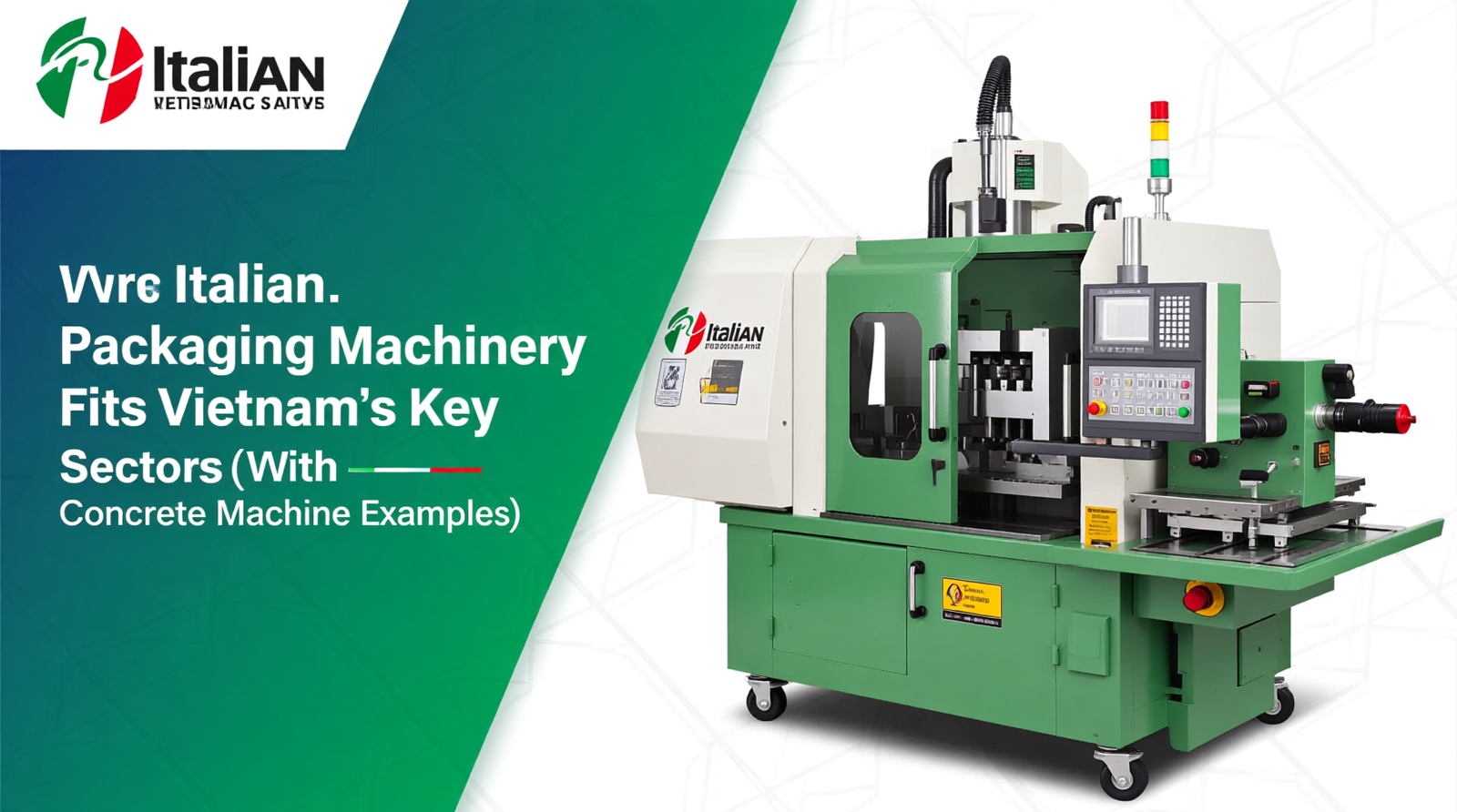
Italian suppliers are known for high-performance automation, customization, and line integration—useful when Vietnamese producers need to run diverse SKUs (stock-keeping units), handle humidity/heat, or meet strict hygiene standards. Below are common machine types and how they map to major Vietnamese industries:
- Vertical form-fill-seal (VFFS) machines (vertical machines that form a bag from film, fill product, then seal): well-suited for coffee (whole beans/ground), snacks, sugar, rice, and dried seafood. Often paired with multihead weighers for speed and accuracy.
- Flow-wrapping (horizontal form-fill-seal) for biscuits, confectionery, and single-serve items used in modern trade and export cartons.
- Bottling and filling lines (rinser/filler/capper monoblocks, aseptic or hot-fill depending on product): strong fit for ready-to-drink (RTD) beverages, juices, functional drinks, and sauces. Add-on modules can include inline inspection, labeling, and secondary packaging.
- Retort and tray sealing / modified atmosphere packaging (MAP) (gas-flush packaging that reduces oxygen to extend shelf life): relevant for seafood, chilled ready meals, and high-value exports where freshness and shelf life are critical.
- Blister packaging (sealed cavities commonly used for tablets/capsules): important for pharmaceutical and nutraceutical manufacturers aiming for controlled, tamper-evident formats.
- End-of-line automation (case packers, palletizers, stretch wrappers, robotic pick-and-place): often where Vietnamese plants unlock rapid productivity gains with fewer bottlenecks.
TL;DR: Italian machinery is a strong match for Vietnam’s coffee, seafood, RTD beverage, and pharma sectors—especially where shelf life, hygiene, SKU flexibility, and export packaging consistency matter.
Performance and Credibility: Italy’s Packaging Machinery Industry in Numbers (With Sources)
Italy is one of the world’s best-known producers of packaging technology. Industry reporting by Italian sector bodies frequently highlights two defining characteristics: high export orientation and large global footprint.
For example, Italy’s packaging machinery turnover has been cited at approximately €10 billion with exports around ~80% of total revenue (recently reported figures). For verifiable references, see Italy’s packaging machinery association UCIMA (Unione Costruttori Italiani Macchine Automatiche per il Confezionamento e l’Imballaggio) and its published market information: https://www.ucima.it/en/. Additional context and country-level promotion resources are also available via Italian Trade Agency (ITA): https://www.ice.it/en/.
Because individual reports can vary by methodology and year, Vietnamese buyers should confirm the latest figures directly in UCIMA annual/market reports or ITA sector briefs when preparing board-level CAPEX (capital expenditure) proposals.
TL;DR: UCIMA and ITA are the most authoritative places to verify Italy’s packaging machinery market size and export share before investment decisions.
How Italian Packaging Technology Supports EU Export and ESG Compliance
ESG stands for Environmental, Social, and Governance—a framework used by buyers, regulators, and global brands to evaluate sustainability and responsible operations. For Vietnamese exporters, ESG increasingly connects to packaging design, recyclability, lightweighting, and traceability of materials.
Italy’s packaging technology can help in practical ways:
- Waste reduction via tighter film control, accurate dosing, and better sealing stability (less rework and fewer rejects).
- Energy efficiency through servo-driven systems, optimized heating cycles, and smart line controls.
- Traceability and data (e.g., OEE dashboards) to document performance and resource use for customer audits.
- Material flexibility to run thinner films or alternative structures when product protection allows.
On the regulatory direction, EU packaging rules are tightening over time. A useful public reference point is the European Commission’s overview pages on packaging initiatives and circular economy actions: https://environment.ec.europa.eu/topics/waste-and-recycling/packaging-waste_en.
TL;DR: Italian lines can directly support ESG outcomes—lower waste, better energy performance, and stronger traceability—which helps Vietnamese exporters satisfy EU buyer expectations and packaging policy direction.
Case Examples: Vietnamese Factories Using Italian Packaging Machinery (Indicative Outcomes)
Exact outcomes depend on baseline line condition, product, film/material quality, and operator skill. However, the following short examples reflect common upgrade paths seen in Vietnam when plants move from semi-automatic or older equipment to modern Italian automation.
Case example 1 (Coffee, VFFS upgrade): A mid-sized Vietnamese coffee packer replaced aging intermittent baggers with an Italian VFFS line integrated with a multihead weigher and checkweigher. After commissioning and operator training, the factory reported ~15–25% fewer packaging defects (seal failures/underweights) and ~20–30% higher throughput on its best-selling 250g and 500g SKUs, mainly due to fewer stoppages and faster changeovers. The same line improved consistency for export cartons, supporting customer audits for EU retail channels.
Case example 2 (RTD beverage, bottling line modernization): A Vietnamese beverage producer added an Italian rinsing–filling–capping block plus inline inspection (fill level/cap presence) to reduce customer complaints and improve hygiene control. Post-stabilization, the plant achieved ~10–15% reduction in product loss from overfill/line spills and ~8–12% higher OEE (overall equipment effectiveness—an availability × performance × quality metric) during peak season, while improving documentation for export-focused quality systems.
Note: These metrics are indicative ranges commonly targeted in modernization projects; buyers should request a site audit and baseline measurement (scrap rate, downtime categories, changeover time) to build a realistic ROI model.
TL;DR: Typical gains from Italian automation in Vietnam come from fewer defects, higher line stability, and measurable OEE improvements—especially in coffee bagging and RTD bottling.
How OpportunItaly Works for Vietnamese Businesses

OpportunItaly is a business promotion and matchmaking initiative supported by Italy’s public trade institutions. In practical terms, it functions as a structured way to identify Italian suppliers, access market/sector content, and arrange B2B connections—especially around trade fairs where ITA organizes national pavilions.
For Vietnamese industrial buyers, the most useful value is usually:
- Finding verified Italian manufacturers and solution providers (machines, line integration, components).
- Receiving guided introductions during events and matchmaking sessions.
- Reducing early-stage sourcing risk when comparing quotes, specs, and supplier capability.
TL;DR: OpportunItaly is most valuable as a structured sourcing and matchmaking channel—helping Vietnamese buyers short-list credible Italian packaging machinery suppliers faster.
Steps to Connect With Italian Suppliers (Registration, Eligibility, Language Support, Timelines)
Below is a concrete, Vietnam-friendly onboarding path that many buyers follow. Because platform procedures can evolve, confirm the latest process with ITA Vietnam at the time of registration.
- Check fit & eligibility (1–3 days): OpportunItaly and related buyer programs are typically designed for importers, distributors, and manufacturers with a clear purchasing plan. Prepare a short buyer profile: sector, products, target capacity, budget range, utilities available (power/air/steam), and timeline.
- Register and build your profile (1–2 hours): Create an account, then complete company details and sourcing interests (e.g., “VFFS for coffee,” “MAP tray sealer for seafood,” “bottling line for RTD beverages”). Use clear keywords to improve matchmaking accuracy.
- Document readiness (3–10 days): Be ready to share business registration, factory address, and basic compliance needs (HACCP, ISO 22000, GMP). HACCP is Hazard Analysis and Critical Control Points (food safety control system). GMP is Good Manufacturing Practice (common in food/pharma).
- Matchmaking & supplier outreach (2–6 weeks): After initial screening, you’ll typically receive introductions or can request meetings. Expect technical calls to clarify: product characteristics, packaging format, target speed, CIP/SIP needs (clean-in-place/sterilize-in-place), and integration with existing lines.
- Commercial + technical alignment (4–12 weeks): Quotes, FAT/SAT planning, and layout review. FAT is Factory Acceptance Test (at supplier site). SAT is Site Acceptance Test (at your factory).
- Delivery to ramp-up (3–9 months typical): Depends on machine complexity and customization. Standard end-of-line modules may be faster; aseptic lines and high-speed systems can take longer due to engineering, validation, and imported components.
Language support: Many Italian suppliers operate in English for technical and commercial work; ITA events often provide facilitation, and local agents/distributors may support Vietnamese for installation and training. During contracting, require bilingual documentation for critical items: user manuals, maintenance plans, and acceptance criteria.
TL;DR: A realistic timeline from first registration to a running line is often 3–9 months, with early success depending on a clear URS (User Requirement Specification) and responsive technical communication.
OpportunItaly Buyers Club: What It Is and Who It’s For

The OpportunItaly Buyers Club is positioned for qualified buyers who want higher-touch support (pre-arranged meetings, curated supplier shortlists, and trade fair scheduling). While criteria can differ by event, the typical target profile includes:
- Established manufacturers planning a capacity expansion or compliance upgrade within 6–18 months.
- Importers/distributors with proven B2B channels (food, beverage, pharma, personal care) and after-sales capability.
- Buyers with credible annual purchasing volume or multi-line investment plans (often demonstrated via project pipeline rather than a single small machine purchase).
TL;DR: The Buyers Club is best for serious Vietnamese buyers with defined projects and the ability to execute—especially when multiple supplier meetings are needed in a short time.
Common Challenges When Adopting Advanced Italian Machinery (And How to Reduce Risk)
Italian machinery can deliver strong performance, but it is not “plug-and-play” in every factory. Common adoption challenges in Vietnam include:
- Upfront investment & cash flow: Mitigate with phased upgrades (end-of-line first), leasing, or structured payment milestones tied to FAT/SAT.
- Operator skills & maintenance culture: Budget for training and preventive maintenance. Require a training plan (operators + maintenance + QA) and a spare parts list for 12–24 months.
- Utilities and layout constraints: Validate power quality, compressed air stability, water, drainage, HVAC, and floor loading early—before machine build.
- After-sales responsiveness: Select suppliers with a Vietnam/ASEAN service partner, remote diagnostics, and defined response times in the contract.
TL;DR: Most “pain points” are predictable—solve them with proper URS, training, utilities validation, and a contract that locks in service levels and spares.
Italy vs. Germany, Japan, and Regional Suppliers: A Practical Buyer’s View
Vietnamese buyers often compare Italy with Germany, Japan, and lower-cost regional suppliers. While each project differs, a practical comparison looks like this:
- Total cost of ownership (TCO): TCO includes purchase price plus energy, consumables, downtime, spare parts, and labor over the machine life. Italian lines often compete well on TCO when flexibility and fast changeovers reduce downtime—despite higher initial CAPEX than regional machines.
- Customization: Italy is widely recognized for tailoring packaging solutions to product specifics (film types, local pack formats, space constraints). German suppliers are often perceived as extremely robust for standardized high-throughput applications; Japanese suppliers are frequently preferred where ultra-high precision and specific process control are required.
- After-sales ecosystem: The best choice depends on local presence. A strong local integrator can make an Italian (or any) system outperform alternatives simply through better commissioning, spares, and training.
TL;DR: Italy often wins when Vietnamese factories need customization, multi-SKU flexibility, and strong performance/TCO—provided after-sales support is contractually secured.
ProPak Vietnam 2026 and Trade Engagement: What to Expect (Clarified as Scheduled)
ProPak Vietnam 2026 is expected to be held in Ho Chi Minh City from March 31 to April 2, 2026, with ITA indicating an Italian presence (e.g., a pavilion/booths) to support business matching. As with any trade show planning, exhibitor counts and booth numbers should be verified closer to the event through official organizers and ITA communications.
For Vietnamese buyers, the most effective use of trade fairs is to arrive with a shortlist and a prepared URS—so meetings produce technical alignment, not only brochure exchange.
TL;DR: Treat ProPak Vietnam 2026 as a sourcing and technical-scoping opportunity—confirm final participation lists in advance and come with clear specifications.
Beyond Packaging: Key “Made in Italy” Sectors Relevant to Vietnam
While packaging and processing are immediate priorities, Italian industrial capability spans multiple sectors that intersect with Vietnam’s industrial upgrading goals:
- Industrial machinery and equipment
- Automation, robotics, and mechatronics
- Automotive and components
- Energy efficiency and renewable energy solutions
- Aerospace technologies
- Design, furniture, and contract interiors
- Agri-food and food processing technology
- Fashion and textiles manufacturing solutions
- Pharmaceutical and medical-related manufacturing technologies
- Chemicals, materials, and advanced manufacturing solutions
TL;DR: OpportunItaly-style sourcing can extend beyond packaging into automation, energy efficiency, and other industrial technologies relevant to Vietnam’s upgrade roadmap.
Italian Design Day 2025 (Scheduled/Reported) and Value-Added Branding
Italian Design Day 2025 has been promoted as a design diplomacy initiative connected to sustainability and innovation. When such events are held in Vietnam (often around late March in various countries), they reinforce a broader message: Italian partnership is not only about machinery, but also about product presentation, brand value, and user-centric design—useful for Vietnamese exporters seeking premium positioning.
For official background on the initiative, see: https://italianembassy-usa.org/italian-design-day/ (global initiative reference; local Vietnam programming varies by year).
TL;DR: Italy’s engagement includes both industrial technology and design-led value creation—relevant for Vietnamese firms upgrading product and brand for export markets.
Conclusion

For Vietnamese manufacturers aiming to modernize packaging lines, improve OEE, and meet EU-facing sustainability expectations, Italian suppliers offer a strong mix of automation, customization, and proven export-oriented packaging know-how. OpportunItaly and ITA-led trade activities can shorten supplier search time, improve supplier verification, and structure B2B meetings—especially when Vietnamese buyers come prepared with clear technical requirements and an implementation plan.
TL;DR: Italian packaging machinery can deliver measurable efficiency and quality gains in Vietnam—OpportunItaly helps you find and qualify the right suppliers, but success depends on clear specs, training, and after-sales planning.
FAQ
Q: How do I choose the right Italian packaging machinery for a Vietnamese coffee, seafood, or RTD beverage factory?
A: Start from your product and format: coffee often fits VFFS bagging with checkweighing; seafood commonly benefits from tray sealing/MAP or retort-ready solutions; RTD beverages typically need an integrated rinsing–filling–capping block plus inspection. Then define target speed, changeover time, utilities, and hygiene requirements, and request a line concept with layout, OEE assumptions, and spare parts plan.
Q: What requirements do Vietnamese companies need to join the OpportunItaly Buyers Club?
A: Requirements can vary by event, but typically include being an established manufacturer, importer, or distributor with a clearly defined sourcing project (e.g., capacity expansion or compliance upgrade), a realistic purchasing timeline (often within 6–18 months), and the ability to conduct structured B2B meetings (technical stakeholders available, budget range, and specification readiness). Confirm the latest eligibility directly with ITA Vietnam during registration.
Q: What is a realistic payback period and financing approach when upgrading to Italian packaging machinery?
A: Payback is often modeled from scrap reduction, labor savings, higher throughput, and fewer customer complaints; many factories target 2–5 years depending on line cost and utilization. Common approaches include phased investment (end-of-line first), leasing, or milestone-based payments linked to FAT/SAT. Ask suppliers for energy consumption, spare parts cost, and preventive maintenance schedules to calculate TCO accurately.
Q: What technical support and training can Vietnamese factories expect (language, spare parts, local service)?
A: Many Italian OEMs provide English documentation and remote diagnostics; some work through Vietnam/ASEAN agents for Vietnamese-language support. Before signing, require a written service plan: commissioning scope, training days for operators/maintenance/QA, response time commitments, and a recommended spare parts kit for 12–24 months. Also confirm where critical spares are stocked (local vs. imported) and typical lead times.
Q: How can Italian packaging technology help with “how to export to EU with ESG-compliant packaging”?
A: Italian lines can improve seal integrity, dosing accuracy, and traceability while reducing material waste and energy use—key inputs to ESG reporting. For EU-focused customers, pair machinery upgrades with packaging design choices (lightweighting, recyclability) and maintain documented process controls (OEE, scrap rate, inspection records) to support audits and buyer questionnaires.