Secondary packaging automation is heading into a pivotal period as manufacturers balance throughput, labor constraints, and cost pressure—while also responding to retail-ready packaging expectations and evolving EPR packaging regulations. In 2026, many plants will treat secondary packaging not as a “back-end” function, but as a strategic lever for overall equipment effectiveness (OEE) (a standard productivity metric combining availability, performance, and quality), material reduction, and retailer compliance.
Introduction

The secondary packaging industry is preparing for a transformative year in 2026. Sustainability targets, automation adoption, and innovative package design are reshaping how food producers and co-packers run operations. Rising labor costs, persistent labor shortages, and new reporting requirements are accelerating the shift toward robotics and advanced packaging machinery.
This guide draws on common practices seen across food, snack, frozen, and bakery environments, plus lessons learned from field deployments—where the “best machine” only wins if the line is laid out well, changeovers are practical, and data is captured consistently.
For broader context on regulatory direction, the concept of Extended Producer Responsibility (EPR) follows producer-responsibility principles long established in the EU. See the European Commission overview of packaging waste rules and EPR direction: https://environment.ec.europa.eu/topics/waste-and-recycling/packaging-waste_en.
TL;DR: In 2026, secondary packaging decisions will increasingly be driven by labor resilience, retailer-ready formats, and packaging reporting requirements—not just speed.
Key Secondary Packaging Challenges Heading into 2026
Before selecting equipment, most teams benefit from framing the real constraints driving performance and cost:
- Labor scarcity and skills gaps: Case packing and hand collation remain high-turnover roles; maintenance bandwidth is often the true bottleneck.
- SKU proliferation: More flavors, pack counts, and promo configurations increase changeovers and error risk.
- Retailer mandates: Shelf-ready/retail-ready packaging (RRP) requirements and easy-open features can drive case style changes and tighter quality expectations.
- Material cost volatility: Corrugated pricing swings can quickly change the economics of RSC vs. wraparound.
- Data expectations: Plants increasingly need reliable packaging-weight and throughput data to support internal sustainability dashboards and external reporting.
Field pitfall to avoid: Automating a “messy” upstream flow (unstable bag spacing, inconsistent checkweigher reject behavior, frequent seal issues) often shifts downtime from labor to jams. Many projects hit targets only after stabilizing primary packaging and accumulation first.
TL;DR: The best ROI usually comes from solving root constraints (SKU changeovers, upstream instability, labor gaps) before or alongside automation.
Retail-Ready Packaging Expands Across Food and Snack Verticals
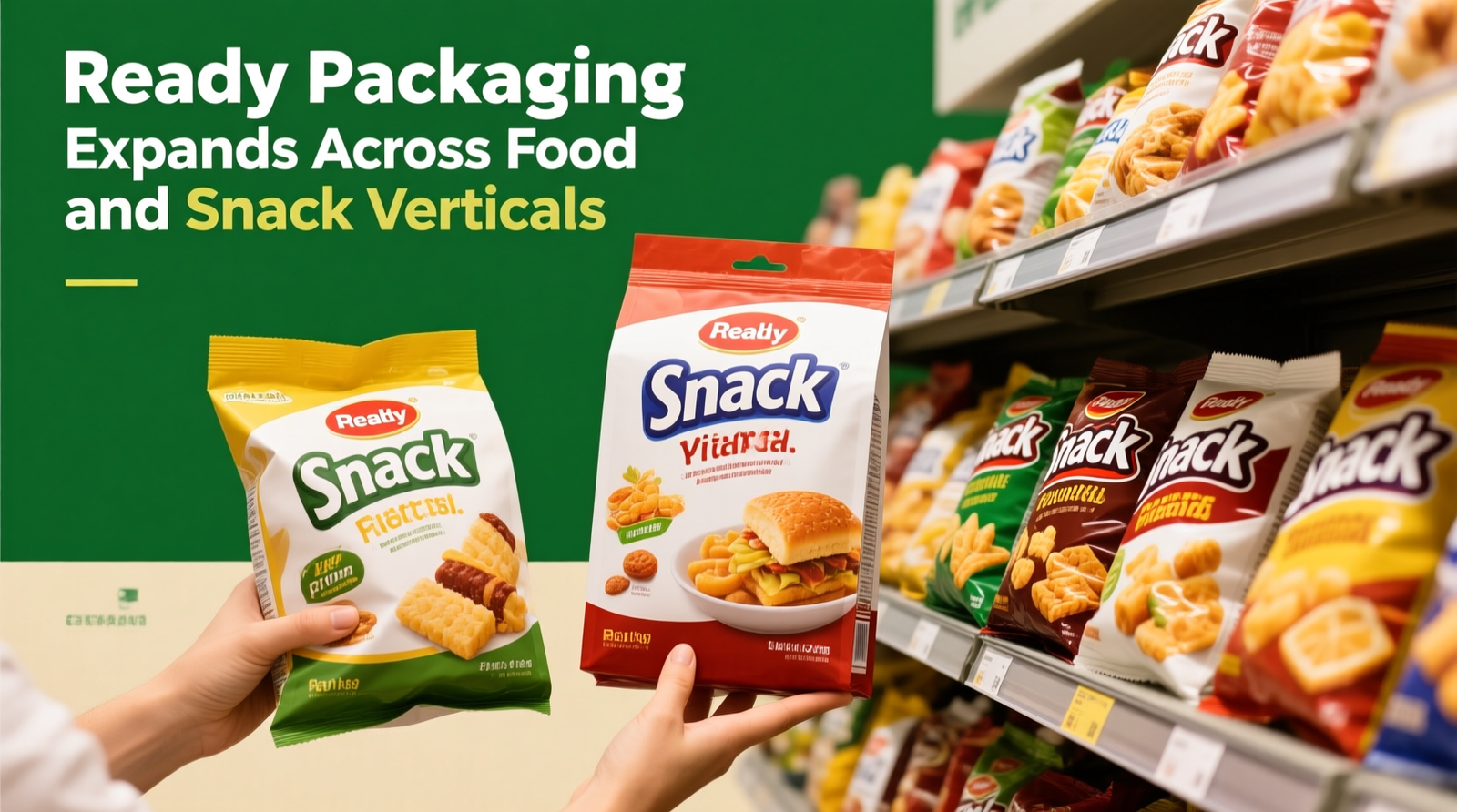
Retail-ready packaging (RRP) (also called shelf-ready packaging) continues to expand across categories. What started strongly in dairy and shredded cheese has broadened into snacks, frozen foods, bakery, and convenience products—especially where retailers want faster shelf replenishment and cleaner shelf presentation.
Retailers often expect packaging that:
- Delivers clear, consistent branding on the shelf
- Is easy to open, stock, and dispose of in-store
- Provides strong shelf appeal and product visibility
- Protects products through distribution and shelf handling
What “good” RRP execution looks like (beyond the graphics)
- Openability with consistency: Tear tape, perforations, and cut lines must work across corrugated lots and humidity ranges.
- Right-sized cases: Too much headspace creates product fall-over; too tight creates scuffing and jam risk at packout.
- Case integrity: Shelf-ready features should not compromise compression strength needed for pallet stacking.
Benchmarks: material and labor impacts
Material savings depend on product geometry and case count, but many plants report ~5–15% corrugated reduction when moving from traditional RSC (Regular Slotted Container, the most common “standard box” style) to well-fit wraparound-style cases—provided cube utilization improves and damage doesn’t increase.
Anonymized snapshot: A snack producer moving from oversized RSC shippers to a tighter shelf-ready case reduced corrugated usage by ~8–12% (range driven by SKU dimensions) and improved shelf stocking time for key accounts by reducing in-store cutting and cleanup complaints. The biggest lesson learned was validating tear performance across seasonal humidity conditions before scaling.
Note on neutrality: Many OEMs and packaging designers offer shelf-ready case designs (wraparound, tray + hood, display-ready shippers). The right choice typically hinges on retailer spec, product stability, and your distribution environment (drop testing, vibration, compression).
TL;DR: RRP is expanding, but success depends on openability, strength, and right-sizing—not just a “display face.”
Variety Pack Production Shifts to Recyclable Cartons
A major 2026 trend is the transition from “bag-in-bag” variety packs toward more recyclable, retail-friendly carton-based or paper-forward formats where feasible. The driver is a mix of retailer scorecards, brand sustainability goals, and consumer preference for easier handling and better shelf presentation.
What automation changes in variety packs
Modern automated variety pack systems can enable producers to:
- Use multi-feeder lines to collate specific flavor mixes into one case
- Achieve precise counts and correct flavor ratios on every pack
- Reduce manual collation labor and repetitive-motion exposure
- Switch faster between different variety configurations (high-SKU environments)
Common technology categories (neutral overview)
- Drop chute systems: Controlled product distribution into cases or cartons for consistent orientation and count.
- Robotic case packing: Flexible SKU handling and gentle placement using vision and configurable patterns.
- Traditional mechanical case packers: Efficient for stable formats at high speed with lower complexity.
Changeover reality: what good looks like
In high-SKU plants, changeovers frequently determine whether automation delivers ROI. Common best practices include:
- Recipe-driven adjustments: Stored settings for case size, pack pattern, and robot paths.
- Quick-change tooling: End-of-arm tools and guides designed for tool-less or low-tool swaps.
- Verification: Barcode/vision checks to confirm correct SKU and case before running at speed.
As a practical benchmark, many teams target single-digit to ~20-minute changeovers for recipe-based adjustments, while tooling-heavy format swaps can run longer depending on guarding, conveyors, and case magazine changes.
TL;DR: Variety packs are growing, and automation value is won or lost on changeover design (recipes + quick-change tooling + verification).
Regulatory Pressure Drives Sustainable Secondary Packaging
Sustainability is no longer optional in secondary packaging. Extended Producer Responsibility (EPR) policies require producers (or “obligated companies”) to fund and/or manage packaging end-of-life costs and, in many cases, to report packaging placed on the market. In the U.S., several states have passed EPR-related laws, and reporting and fee schedules are being phased in over multiple years.
Actionable EPR reference points (publicly available sources)
- California: SB 54 (Plastic Pollution Prevention and Packaging Producer Responsibility Act) establishes major targets and phased implementation. Public overview: https://calrecycle.ca.gov/plastics/packaging/sb54/
- Oregon: Packaging modernization with producer responsibility and staged implementation. Public program overview: https://www.oregon.gov/deq/recycling/pages/packaging.aspx
- Colorado: Producer responsibility program for packaging and paper products. Public overview: https://cdphe.colorado.gov/producer-responsibility-program
- Maine: Stewardship program approach. Public overview: https://www.maine.gov/dep/sustainability/extended-producer-responsibility/
Practical timeline note: In many jurisdictions, EPR programs roll out across multiple years (rulemaking, producer registration, reporting, then fee modulation). Exact effective dates and reporting rules vary by state and are updated as program administrators publish guidance—so compliance teams should track each state’s implementing agency and PRO (Producer Responsibility Organization) updates.
How reporting categories are typically structured
While the details vary, reporting commonly groups packaging by:
- Material type: corrugated, paperboard, rigid plastic, flexible plastic, metal, glass, multi-material
- Format/application: primary vs. secondary vs. tertiary (definitions vary)
- Weight: often reported as total weight placed on the market (e.g., pounds/tons) and sometimes by weight bands or recyclability attributes
Implementation pitfall to avoid: Plants often discover late that packaging-weight master data is inconsistent across SKUs (supplier changes, board caliper variation, or “temporary” shipper substitutions). Establish a formal process to version-control packaging specs and link them to SKU/recipe data in your business systems.
Standardized pack formats and recipes
Standardization makes it easier to track packaging materials and comply with EPR-aligned reporting. Regardless of OEM brand, platforms that support defined case styles, counts, and configurations help producers:
- Generate consistent data for reporting and internal dashboards
- Simplify changeovers between product formats
- Reduce engineering complexity when new SKUs are added
Lightweight and material-efficient packaging
Reducing packaging weight can lower total reported tonnage and may reduce fees where fee modulation is tied to material type and recyclability performance. Lightweighting can also reduce transportation emissions and improve pallet efficiency.
TL;DR: EPR is pushing plants toward better packaging data discipline and material-efficient designs—success depends as much on master data governance as on equipment.
Growing Confidence in Robotics and Automation
Robotics has become a practical option for secondary packaging as vision systems, end-of-arm tooling (EOAT, the gripper/tool mounted on a robot), safety controls, and user interfaces have matured. For many plants, the question is no longer “Will a robot work?” but “Is a robot the simplest way to hit our SKU and labor needs?”
Quick fit guide: RSC vs. wraparound vs. robotic
Rule of thumb: RSC fits long-running, stable SKUs at high speed; wraparound fits plants prioritizing corrugated reduction and tight case fit; robotic case packing fits high SKU variety, irregular products, frequent promotions, or when gentle handling is critical.
1. Traditional RSC case packing
RSC (Regular Slotted Container) case packing remains a workhorse for high-speed lines with stable formats. Proven gravity, lane, or gantry-style systems can provide:
- Reliable, repeatable performance at high speeds
- Well-understood technology that is widely serviceable
- Cost-effective automation for long-running SKUs
2. Wraparound case packing
Wraparound case packing is growing due to material efficiency and stronger product-to-case fit. Compared with many RSC formats, wraparound cases can reduce corrugated usage and improve bundle stability when designed correctly.
Benchmark range: Plants commonly see ~5–15% corrugated reduction versus an equivalent RSC shipper, depending on case count, board grade, and how much void/headspace existed before.
3. Robotic case packing with vision
Robotic case packing with integrated vision is often the best match for complex SKU mixes and flexible packaging (pouches, bags) that challenge purely mechanical packers.
Common benefits include:
- Recipe-driven changeovers: Often faster and less error-prone than manual guide adjustments
- Flexibility: Short-run SKUs and promotions without heavy retooling
- Reduced damage: Controlled placement can reduce scuffs/crushes for delicate packs
Typical performance impact (realistic expectations): After stabilization, many automation projects target ~5–20 OEE points of improvement depending on baseline downtime, quality losses, and staffing constraints. Results vary widely—especially where upstream variability remains unresolved.
Integration and hygienic design considerations
- Upstream/downstream interfaces: Case packing performance often hinges on stable infeed spacing, adequate accumulation, and clear handshakes to downstream palletizing.
- Data connectivity: Many plants connect line events and counts to an MES (Manufacturing Execution System) or ERP (Enterprise Resource Planning) platform to support OEE tracking, material usage, and quality reporting.
- Food environment design: In washdown zones, equipment may require stainless construction, sealed bearings, and appropriate IP (Ingress Protection) ratings for electrical enclosures—plus hygienic guarding and cleanable conveyor designs.
TL;DR: Choose RSC for stability, wraparound for material efficiency, robotics for SKU flexibility—then make integration, data, and hygiene part of the design from day one.
Focus on Total Cost of Ownership (TCO) and ROI
More companies are using Total Cost of Ownership (TCO) (the full lifecycle cost: labor, maintenance, utilities, downtime, parts, and end-of-life value) to guide automation decisions—not just a 24-month payback. The “right” system is often the one that stays stable through staffing fluctuations and SKU changes.
Claim clarity: Depending on baseline labor content and downtime, some manufacturers report modeled or case-study-based lifetime operating cost reductions in the ~10–30% range after modernizing secondary packaging. Actual outcomes depend on line design, maintenance maturity, and product variability.
Reliability and labor resilience
Labor scarcity and high turnover can disrupt packaging lines and create work-in-process (WIP) constraints. Automated systems can help stabilize output and reduce dependence on hard-to-fill manual roles.
Anonymized snapshot: A co-packer running frequent changeovers reduced manual packing positions by ~2–4 FTE (full-time equivalents, a staffing measure) on a shift by combining recipe-driven changeovers with better accumulation and standardized case formats. The key lesson: training plus spare-parts readiness mattered as much as the robot.
Energy and utilities
Utilities can be a hidden driver of operating cost. Common evaluation items include:
- Compressed air: Often one of the costliest utilities; leaky or air-heavy designs inflate TCO.
- Electrical load: Servo-driven motion can reduce air usage but may increase electrical demand.
- Vacuum generation: For suction EOAT, consider vacuum efficiency and filtration maintenance.
Spare parts and maintenance strategy
Lifecycle cost is heavily influenced by maintainability. Evaluate:
- Critical spares list and lead times
- Wear parts replacement intervals (tape heads, knives, suction cups, belts)
- Diagnostic depth in the HMI (Human-Machine Interface) and alarm guidance
- Access for cleaning and maintenance (especially in food zones)
Operator adoption and training
For automation to deliver ROI, operators and maintenance teams must adopt it. Plants increasingly factor in how quickly new operators can be trained, the clarity of troubleshooting steps, and the level of OEM support (on-site and remote).
Machine lifetime value and redeployment
Beyond purchase price, decision-makers consider expected lifetime, serviceability, and whether cells can be redeployed for new SKUs or moved between plants. Modular conveyors and standardized interfaces can reduce downtime during future reconfigurations.
TL;DR: TCO is won through reliability, utilities discipline (especially air), maintainability, and operator adoption—not just initial capex.
Looking Ahead: Secondary Packaging Strategies for 2026
As automation, retail-ready formats, and packaging regulations gain momentum, secondary packaging strategies should be built around flexibility and execution discipline. Most successful programs treat the project as a line system (infeed to palletizing) with data and maintenance plans included—rather than a standalone machine purchase.
Action Plan for 2026 Secondary Packaging
- Baseline performance: Measure current OEE losses by cause (jams, changeovers, staffing, quality holds) before selecting technology.
- Standardize where it pays: Reduce the number of case sizes, pack patterns, and “special” exceptions that inflate changeover time.
- Engineer changeovers: Specify recipe-based adjustments and quick-change tooling for high-SKU lines; validate with real operators.
- Design the interfaces: Confirm accumulation, reject handling, and downstream palletizing handshakes to avoid “automation bottlenecks.”
- Make data usable: Connect counts, downtime reasons, and packaging-weight master data to your MES/ERP to support OEE and EPR reporting.
- Plan hygiene and service: Align equipment materials and IP ratings to the sanitation zone; build a spares and PM (preventive maintenance) plan pre-startup.
TL;DR: Winning in 2026 means treating secondary packaging as a connected line system with standardized formats, fast changeovers, and clean data.
FAQ

Q: What is secondary packaging in the food industry?
A: Secondary packaging is the layer that groups primary packages (like individual bags, pouches, or cartons) into shippers such as cases, trays, or bundles for distribution, palletizing, and sometimes retail display. It supports product protection, shipping efficiency, and retailer requirements.
Q: Why is retail-ready packaging (RRP) important for 2026?
A: RRP is important because retailers want packaging that is quick to open, easy to shelf, and clean to dispose of—while maintaining strong on-shelf branding. As more categories adopt RRP, manufacturers increasingly need secondary packaging automation that can reliably produce these case styles at speed with consistent openability.
Q: How does secondary packaging automation typically improve OEE?
A: Plants often target OEE gains by reducing manual staffing variability, stabilizing pack patterns, and cutting changeover time through recipes and quick-change tooling. A common post-commissioning improvement target is roughly 5–20 OEE points, depending on how much downtime and labor disruption existed before automation.
Q: What are early warning signs that a secondary packaging line is ready for automation?
A: Common signs include chronic staffing gaps on case packing/hand collation, frequent changeovers that consume a large portion of the shift, recurring quality issues (miscounts, poor case presentation), and downstream bottlenecks that cause upstream stoppages. If you have stable primary packaging output but secondary packaging can’t consistently keep up, automation is usually worth scoping.
Q: How much floor space do typical robotic case packing cells require?
A: Floor space varies by infeed method, case erector/sealer inclusion, accumulation, and safety guarding. As a practical planning range, many robotic case packing cells land in the neighborhood of ~200–600 sq ft for the robot cell and immediate conveyors, with additional space needed for case staging, access aisles, and maintenance clearance.
Q: How can manufacturers prepare for EPR packaging regulations in practical terms?
A: Start by standardizing packaging specs (case sizes, board grades, components) and building reliable packaging-weight master data linked to each SKU and pack recipe. Then ensure your systems can report packaging by material type and total weight placed on the market, aligned with each jurisdiction’s guidance. Finally, prioritize material reduction projects (right-sizing, wraparound where appropriate) that don’t increase damage or returns.