Introduction
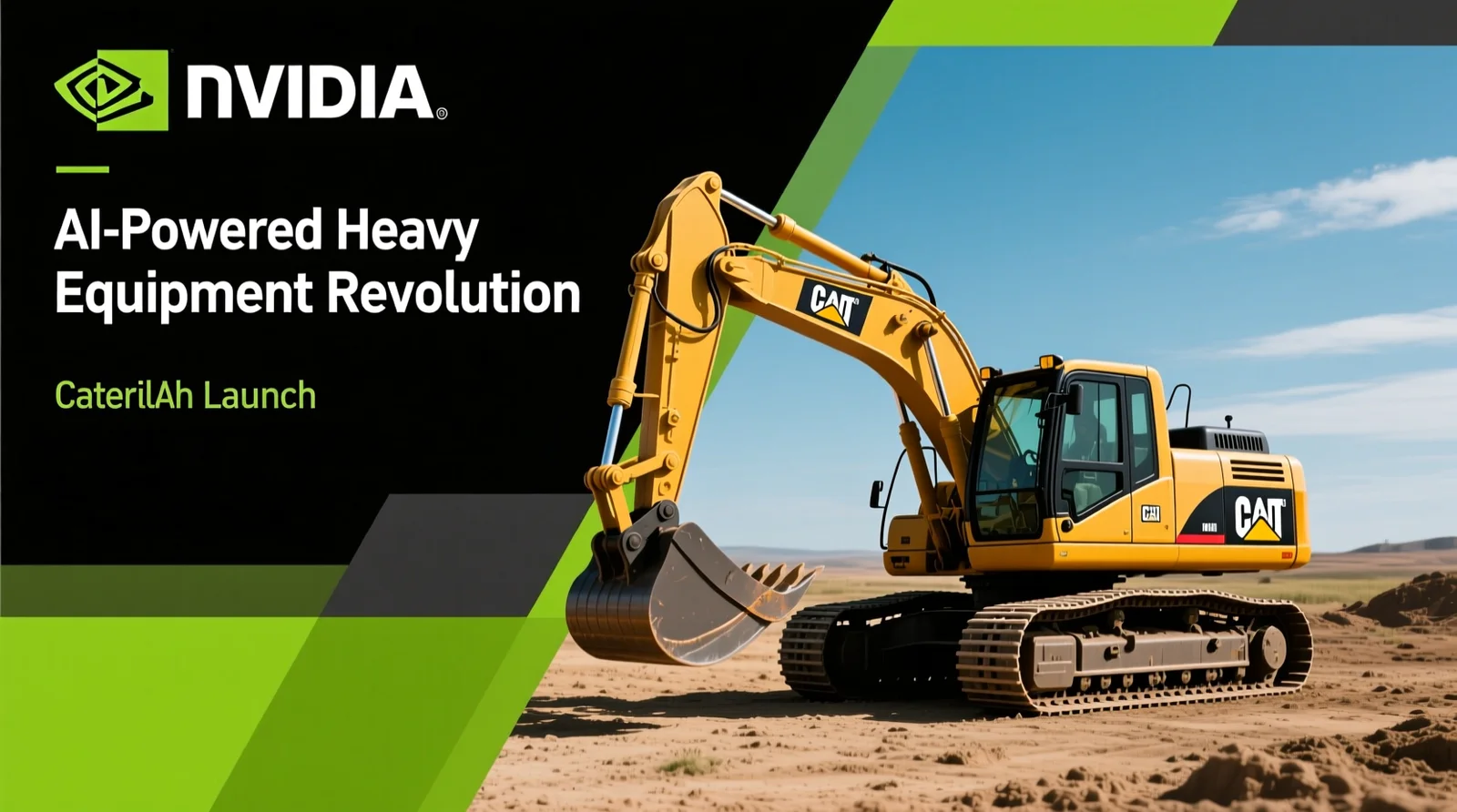
Caterpillar used CES 2026 to detail how it plans to apply AI in construction equipment and mining: a new Cat AI Assistant, expanded autonomous construction machinery demonstrations, and deeper work with NVIDIA on edge computing and industrial digital twins for manufacturing.
In parallel, the company announced a $25 million workforce initiative intended to accelerate training for AI-enabled operations and maintenance roles.
TL;DR: Caterpillar’s CES 2026 update focuses on (1) an operational AI assistant for fleet/maintenance workflows, (2) edge compute for on-machine perception and decision support, and (3) digital twins to reduce manufacturing risk and shorten commissioning timelines.
Cat AI Assistant: What It Does and the Technical Building Blocks
The Cat AI Assistant is positioned as a conversational interface that queries Caterpillar’s connected-asset and enterprise data so fleet managers, technicians, and operators can get actionable answers without digging through multiple dashboards. In practice, that means turning mixed data—telematics, fault codes, work orders, and production metrics—into prioritized recommendations.
Model types (typical architecture for industrial copilots): While Caterpillar has not publicly disclosed the full model stack, assistants of this kind commonly combine (a) a large language model (LLM) for natural-language understanding, (b) retrieval-augmented generation (RAG) to ground responses in approved documentation (service manuals, parts catalogs, maintenance histories), and (c) time-series forecasting / anomaly detection models for sensor and condition monitoring (e.g., gradient-boosted trees, temporal convolution networks, or LSTM-style sequence models). The critical engineering detail is that the LLM should not “guess” machine status; it should be constrained by retrieved records and live telemetry.
Example KPIs the assistant can monitor or explain (common for fleet operations):
- Availability and utilization (engine hours vs. productive hours)
- Mean time between failures (MTBF) and mean time to repair (MTTR)
- Fuel burn (e.g., L/hr) and idle percentage
- Cost per ton (mining/quarry) or cost per cubic yard (earthmoving), based on cycle time, payload, and fuel/maintenance inputs
- Health indicators such as coolant temperature excursions, oil pressure trends, DPF (diesel particulate filter) regeneration frequency, and hydraulic system anomalies
- Maintenance compliance against planned intervals and open work orders
Voice in harsh environments: Caterpillar noted support from NVIDIA Riva, which is NVIDIA’s speech AI SDK for automatic speech recognition (ASR) and text-to-speech (TTS). Riva is often used where background noise is high and where on-prem/edge deployment is preferred for latency and privacy. Reference: NVIDIA Riva.
Integration and interoperability (what industrial teams typically require): For real deployment value, a copilot must connect to the systems where work actually happens. Expect integration patterns such as secure APIs to fleet/telematics portals, maintenance systems (CMMS—computerized maintenance management systems), and enterprise tools. Where applicable, industrial customers also ask for alignment with recognized IT/OT (information technology/operational technology) security guidance such as ISO/IEC 27001 (information security management systems) and the NIST Cybersecurity Framework.
Cybersecurity measures (practical checklist): In heavy equipment and remote ops, the main controls buyers look for include role-based access control (RBAC), multi-factor authentication, encryption in transit (TLS 1.2+), encryption at rest, audit logging, and secure software update mechanisms. Where the assistant touches machine networks, segmentation between IT and OT and hardened gateways are typical requirements.
TL;DR: Cat AI Assistant’s real value comes from grounded answers tied to live fleet KPIs (availability, MTBF/MTTR, fuel, cost-per-unit), backed by secure integration and a model stack that combines an LLM with retrieval plus time-series analytics.
How Cat AI Assistant Integrates with Existing Fleet Management Systems
For fleet managers evaluating edge AI for heavy equipment, integration usually matters more than the chat interface. A practical deployment often follows a “connect → contextualize → automate” path:
- Connect: ingest telematics (location, hours, events), maintenance history (work orders, parts), and operator inputs. Remote sites may require store-and-forward buffering when cellular coverage is inconsistent.
- Contextualize: map assets, components, and fault codes to a unified asset model so the assistant can distinguish “engine overtemp on Unit 23” from “hydraulic overtemp on Unit 23.”
- Automate: convert insights into actions—create a work order draft, recommend inspection steps, pre-stage parts, or suggest a derate/operating change to prevent a failure.
From a standards standpoint, industrial customers frequently ask whether data exchange follows recognized patterns (REST APIs, event streaming) and whether OT integrations can be done through secure gateways rather than direct access to control networks. The goal is to avoid “yet another dashboard” and instead reduce administrative load and response time to emerging faults.
TL;DR: The assistant delivers measurable benefit when it plugs into telematics + maintenance systems, normalizes asset data, and triggers workflows (work orders, parts staging, operating recommendations), even under intermittent connectivity.
Expanded NVIDIA Collaboration: Edge Compute, Latency, and On-Machine Inference
Caterpillar’s NVIDIA collaboration centers on moving perception and decision support closer to the machine—important on jobsites where latency, bandwidth, and uptime are variable. Caterpillar stated it will incorporate the NVIDIA Jetson Thor platform for edge AI inference (running trained models locally rather than in the cloud). Reference: NVIDIA Jetson platform overview.
What “edge inference” enables in practical terms:
- Low-latency safety functions: object detection, proximity alerts, and geofence enforcement without round-trip cloud delays
- Operator assistance: real-time guidance based on machine state (gear/load/traction) and local site conditions
- Autonomy building blocks: perception, localization, and path-planning modules running continuously even when backhaul connectivity drops
Connectivity protocols (what’s commonly used on jobsites): depending on geography and site maturity, connectivity may rely on 4G/5G, private LTE, Wi‑Fi, or local mesh networks. Machines often use CAN bus (Controller Area Network) internally, with gateways publishing selected signals to edge compute modules. In remote mines and large projects, an edge-first design is typically favored to keep safety and control loops local.
TL;DR: Edge compute (Jetson-class platforms) is mainly about keeping safety/perception and key autonomy functions running locally with predictable latency, rather than depending on cloud connectivity.
Digital Twins and AI-Driven Manufacturing with NVIDIA Omniverse
In manufacturing, Caterpillar described using NVIDIA infrastructure and industrial digital twins to reduce risk before changing lines or launching new products. A digital twin is a continuously updated virtual representation of a physical asset, process, or facility—useful when you want to test throughput, ergonomics, safety, and automation logic without stopping production.
Data sources that typically feed manufacturing twins:
- PLC (programmable logic controller) and SCADA (supervisory control and data acquisition) tags for cycle times, faults, states
- MES (manufacturing execution system) for routing, WIP (work-in-process), quality checkpoints
- ERP (enterprise resource planning) for BOMs (bills of materials), inventory, supplier constraints, planned orders
How Omniverse fits technically: NVIDIA Omniverse is a platform for building and connecting 3D workflows; it uses OpenUSD (Universal Scene Description) as the interchange layer so CAD, simulation, and visualization tools can share the same scene graph. References: NVIDIA Omniverse and OpenUSD. In OT/IT environments, Omniverse projects typically connect through existing data historians, MES/ERP APIs, and simulation connectors rather than directly polling PLCs from a design workstation.
Use cases engineering teams actually run:
- Line balancing: test staffing, station takt time, buffer sizes, and AGV/AMR (automated guided vehicle/autonomous mobile robot) routes to reduce bottlenecks
- Changeover optimization: evaluate tooling strategies and sequencing to cut downtime during product mix changes
- Virtual commissioning: validate PLC logic and robot programs in simulation before deployment—often cited as a way to cut commissioning from months to weeks when combined with disciplined model governance
Benchmarks (industry ranges): Digital-twin programs in discrete manufacturing frequently target OEE (overall equipment effectiveness) uplift in the low single digits to low double digits over time, especially when the twin is paired with bottleneck analysis and reliable data capture. Actual results depend heavily on data quality, the fidelity of the process model, and whether the organization changes operating procedures based on the findings.
TL;DR: Digital twins built on Omniverse/OpenUSD are most valuable when they pull from PLC/SCADA, MES, and ERP data and are used for line balancing, changeovers, and virtual commissioning to reduce disruption and speed launches.
Autonomous Construction Machinery: Sensor Suite, Operating Parameters, and Safety Standards
Caterpillar highlighted that it is extending autonomy experience from mining into construction. For buyers evaluating autonomous construction machinery or AI for mining operations, the key questions are operating envelope, sensing redundancy, and safety governance—not slogans.
Typical sensor suite for autonomous earthmoving (varies by machine and use case):
- GNSS/RTK (Global Navigation Satellite System with Real-Time Kinematic corrections) for centimeter-level positioning in open-sky conditions
- IMU (inertial measurement unit) for attitude/acceleration to bridge short GNSS outages
- LiDAR (light detection and ranging) for dense 3D geometry around the machine
- Radar for robust detection in dust, fog, rain, and low light
- Stereo cameras (or multi-camera arrays) for classification (people/vehicles), lane/edge detection, and visual context
- Ultrasonic/proximity sensors for near-field zones (implementation-dependent)
Sensor fusion (how perception is commonly implemented): Most autonomy stacks fuse GNSS/RTK + IMU for localization, then combine LiDAR/radar/camera detections into a tracked “world model.” Fusion can be performed with extended Kalman filters (EKF), factor graphs, or learned fusion networks depending on latency and compute constraints. A practical objective is redundancy: if LiDAR is partially blinded by dust, radar and cameras still contribute to obstacle awareness.
Operating parameters (typical ranges and expectations): Autonomous dozers, graders, and haul units typically operate at low-to-moderate site speeds governed by risk assessment and line-of-sight conditions—often from walking pace up to a few tens of km/h depending on the machine class and zone rules. For grading applications, modern GNSS/machine-control workflows often target centimeter-level elevation guidance under good conditions; real-world final surface tolerance depends on material, compaction, blade wear, and the project specification. (Always validate against the project’s survey control and QA plan.)
Safety and regulatory considerations: Autonomous and semi-autonomous earthmoving equipment is commonly assessed against standards such as ISO 17757 (Earth-moving machinery and mining—Autonomous and semi-autonomous machine system safety). On active jobsites, contractors typically enforce additional controls: geofenced zones, supervised operating modes, exclusion areas, signage, and remote stop procedures. Many deployments also require a remote supervision station with defined intervention thresholds and incident reporting processes.
Benchmarks and realism check: Large-scale mining autonomy programs have historically reported improvements such as higher utilization, reduced variability, and safety exposure reduction by removing operators from high-risk zones. Exact percentages vary widely by site layout, haul profile, and change management; buyers should request site-relevant baselines (cycle time distribution, queuing, spot time, rework rates) before accepting headline claims.
TL;DR: Construction autonomy depends on a redundant sensor stack (GNSS/RTK, LiDAR, radar, cameras), robust fusion/localization, and compliance-driven safety controls (often aligned to ISO 17757 plus site rules and remote supervision).
Mini Scenario: How a Mid-Size Contractor Could Combine Cat AI Assistant + Autonomy on a Roadbuilding Project
Consider a mid-size roadbuilding contractor running a mixed fleet (dozers, graders, compactors, and articulated trucks) on a 12–18 month bypass project with night shifts and intermittent cellular coverage.
- Week 1–4 (pilot setup): The contractor connects telematics feeds and maintenance history to the Cat AI Assistant, defines KPIs (idle %, fuel burn per hour, cycle time, open defects), and configures alert thresholds for common failure precursors (cooling issues, hydraulic temperature, repeated fault codes).
- Month 2–3 (operational use): Foremen use natural-language queries like “Which units had >20% idle yesterday?” and “Show top 5 machines by fuel burn per cubic yard moved.” The assistant suggests targeted coaching and identifies a pattern: two trucks show rising coolant temps correlated with high ambient temperatures and clogged radiators—triggering earlier cleaning and preventing a mid-shift derate.
- Month 3–6 (introduce autonomy in a controlled zone): The contractor designates an exclusion zone for autonomous haul or assistive functions (depending on what’s validated for that machine class), sets geofences, and runs remote supervision during night shifts. The goal is not “full autonomy everywhere,” but consistent hauling and reduced variability where the environment is controlled.
- Business outcome focus: Over a quarter, the contractor targets directional improvements: lower rework (grade corrections), reduced unplanned downtime events, improved cost per cubic yard through lower idle and fewer maintenance disruptions, and more consistent night-shift production.
This scenario highlights the practical path: connect data first, standardize KPIs and response playbooks, then expand autonomy in bounded operating zones with clear safety governance.
TL;DR: A realistic adoption pattern is “assistant for KPI + maintenance triage first,” then autonomy in controlled, geofenced zones—measured by cost-per-unit moved, downtime hours avoided, and rework reduction.
Implementation and Adoption: Steps, Change Management, and Known Limitations
For engineering and operations leaders, adoption success is usually determined by integration effort and jobsite behavior change—not model demos. A practical rollout plan often looks like this:
- 1) Define high-value workflows: start with top downtime drivers, repeat faults, idle reduction, and PM (preventive maintenance) compliance.
- 2) Data readiness: verify sensor coverage, asset IDs, and maintenance coding consistency; poor labeling and inconsistent work orders are common blockers for predictive workflows.
- 3) Pilot with a bounded fleet: 10–30 machines is often enough to validate KPI lift without overwhelming support teams.
- 4) Integrate with maintenance execution: ensure recommendations create tickets/work orders in the system technicians already use.
- 5) Train + standardize response: define who acknowledges alerts, expected time-to-action, and escalation paths.
Common challenges (and how they’re typically mitigated):
- Connectivity constraints: remote sites may require edge-first processing and delayed upload; prioritize local safety functions and store-and-forward telemetry.
- Data quality and labeling: predictive maintenance depends on clean histories; start with a small set of well-understood failure modes.
- Operator acceptance: avoid “gotcha” dashboards; frame coaching as fuel/safety wins and involve senior operators in tuning alerts.
Business outcomes that resonate with fleet owners: If implemented well, AI-driven monitoring and autonomy initiatives typically aim to reduce unplanned downtime hours, lower fuel burn per hour through idle control and operating best practices, and improve cost per ton/cubic yard by stabilizing cycle times and cutting rework. Actual outcomes are site-specific—request baseline-and-after comparisons tied to the same work type and material conditions.
TL;DR: Start with a focused pilot tied to downtime/fuel KPIs, fix data quality early, integrate into existing maintenance execution, and expect adoption to hinge on connectivity and operator buy-in.
Workforce Development: Training Modalities That Match AI-Enabled Jobsites

Caterpillar’s $25 million workforce initiative signals recognition that autonomy and AI shift labor toward supervision, diagnostics, and data-informed planning. For contractors and dealers, the most useful programs tend to be hands-on and role-specific rather than generic “AI awareness.”
Training modalities that map to field realities:
- VR/AR simulators (virtual/augmented reality) for operator practice on grade control, autonomy-supervised workflows, and hazard scenarios without risking equipment
- Remote monitoring labs for technicians to learn triage on live telemetry, fault trees, and guided diagnostics
- Micro-credentials (short, stackable certifications) for topics like telematics interpretation, root-cause analysis, and cybersecurity hygiene for connected equipment
- Dealer-led enablement programs that combine classroom + field shadowing + KPI-based coaching
In practice, the strongest programs tie training completion to measurable site outcomes (reduced rework, improved PM compliance, fewer repeat failures) rather than completion certificates alone.
TL;DR: The highest-ROI workforce training blends VR/AR operator simulation, remote diagnostics practice, and micro-credentials tied to measurable downtime, fuel, and rework KPIs.
Long-Term Investment Claims: Context and How to Validate Impact
The article references “more than $30 billion” in R&D over two decades and a plan to increase digital/technology investment “2.5x through 2030.” Because these appear to be based on Caterpillar communications, they should be read as company-reported, internal disclosures (for example, investor materials and annual reporting). Readers who need auditable sourcing should cross-check Caterpillar’s investor relations filings and annual reports: Caterpillar Investor Relations.
For industrial buyers, the practical takeaway is not the absolute investment number—it’s whether the roadmap translates into fleet-level outcomes: fewer downtime hours per 1,000 operating hours, lower maintenance cost per hour, improved fuel efficiency, and safer operations under real site constraints.
TL;DR: Treat headline investment figures as company-reported; validate value by demanding before/after baselines on downtime, maintenance cost per hour, fuel burn, and safety exposure for comparable operations.
Conclusion

Caterpillar’s CES 2026 announcements connect three operational threads: a conversational assistant that surfaces maintenance and production KPIs, edge computing that keeps perception and decision support close to machines, and manufacturing digital twins that reduce risk during line changes and commissioning.
For engineers and fleet owners, the near-term opportunity is measurable: faster fault triage, fewer surprise shutdowns, reduced idle/fuel burn, and tighter control of production variability—while acknowledging constraints like connectivity, data quality, and the safety governance required for autonomy.
TL;DR: The most credible value path is KPI-driven deployment: integrate data, run edge analytics for latency-critical tasks, use twins to de-risk manufacturing changes, and measure results against downtime, cost-per-unit moved, fuel, and rework.
FAQ
Q: What is the Cat AI Assistant used for in construction and mining fleets?
A: It’s intended to help users query fleet and maintenance information in natural language and get grounded, actionable outputs—such as which assets are trending toward overheating, which machines have high idle percentage, or what actions to take for recurring fault codes—so teams can reduce unplanned downtime and improve cost per ton/cubic yard.
Q: What sensors are typically required for autonomous construction machinery?
A: Most autonomous or semi-autonomous earthmoving systems use a redundant sensor suite that may include GNSS/RTK for positioning, an IMU for motion estimation, LiDAR for 3D geometry, radar for robust detection in dust/fog/rain, and camera arrays (often stereo) for classification and scene understanding. These feeds are fused into a single world model for tracking and path planning.
Q: How do industrial digital twins connect to OT and IT systems in a factory?
A: Digital twins usually ingest OT data from PLC/SCADA tags (cycle times, alarms, states) and combine it with IT data from MES (routing, WIP, quality) and ERP (BOMs, inventory, schedules). Platforms like NVIDIA Omniverse use OpenUSD to connect 3D/simulation workflows while integrating plant data via historians and APIs so engineers can run line balancing, changeover studies, and virtual commissioning.
Q: What safety standards and site controls apply to autonomous earthmoving equipment?
A: Many programs align safety engineering to ISO 17757 for autonomous/semi-autonomous earthmoving systems, then apply site-specific rules such as geofenced operating zones, exclusion areas, remote stop procedures, signage, and remote supervision with defined intervention criteria. Requirements can vary by jurisdiction and project owner policies.
Q: How is customer data security and data ownership typically handled in AI/telematics deployments?
A: Buyers commonly require clear agreements on data ownership and permitted uses, plus security controls such as encryption in transit and at rest, RBAC/MFA access, audit logging, and network segmentation between IT and OT. It’s also common to request documentation aligned to recognized frameworks like ISO/IEC 27001 and the NIST Cybersecurity Framework, along with a process for incident response and account offboarding.