Introduction

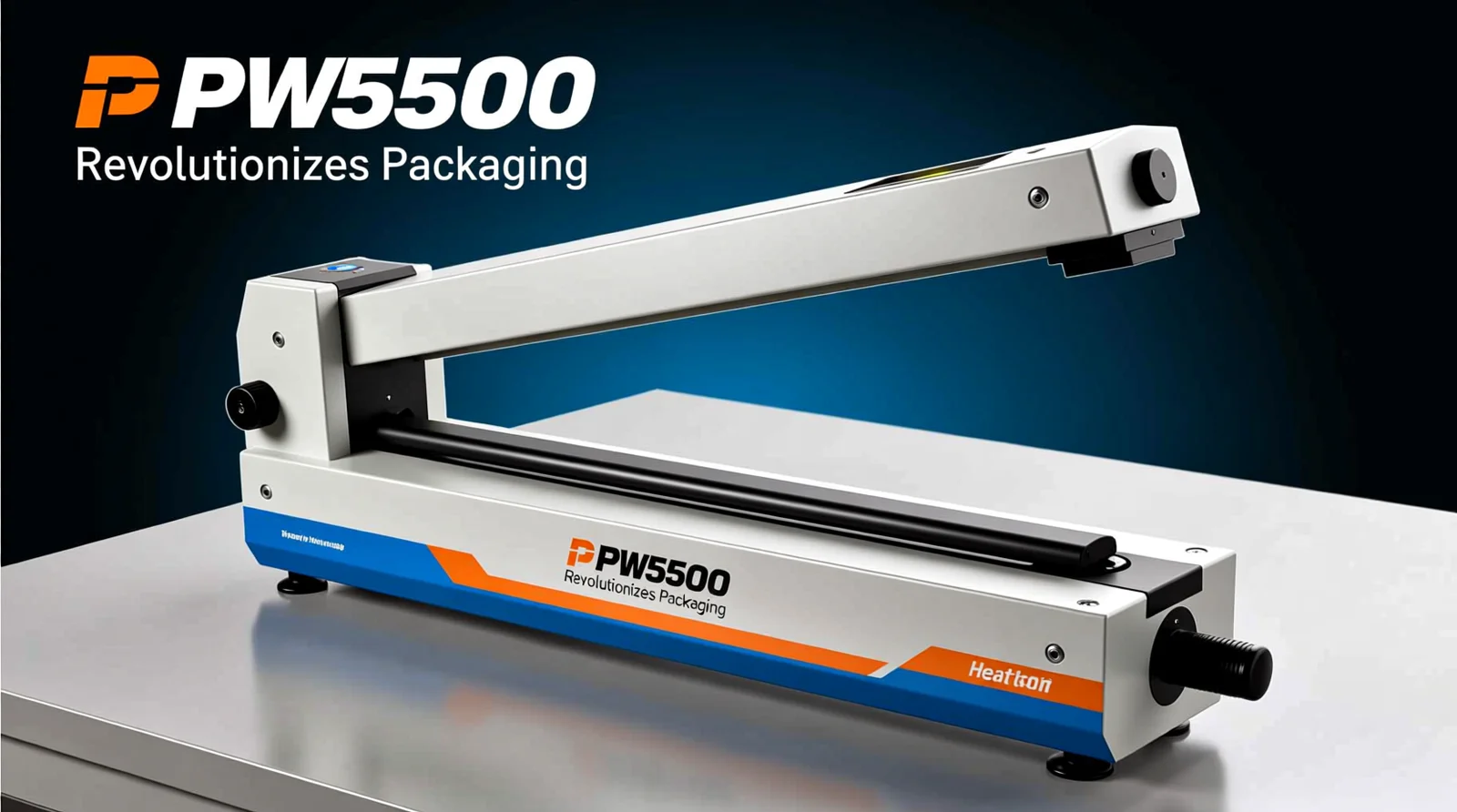
The PackworldUSA PW5500 Series is a large-format, validatable bar sealer designed for controlled heat sealing of bags, pouches, and webs in regulated packaging operations. Its open “C” frame pass-through layout supports oversized packs and long product sets while maintaining repeatable control of critical process parameters (CPPs)—primarily temperature, pressure, and dwell time (the time the seal bars remain closed under heat and force).
For teams building or validating an ISO 11607 heat sealer process (ISO 11607 is the international standard for packaging for terminally sterilized medical devices), the PW5500 Series is positioned to support documentation, traceability, and consistent seal formation for sterile barrier systems (SBS). For background on the standard and its intent, see ISO’s overview: ISO 11607 (Packaging for terminally sterilized medical devices).
- Validatable controls for temperature/pressure/dwell with recipe management
- Large-format capability (36"–72" seal lengths) for wide pouches and long sets
- Cleanroom-oriented design with easy-to-clean surfaces (configuration dependent)
- TOSS PIREG control for fast, stable heater regulation (no thermocouples)
- Options for vacuum/purge (vacuum + gas flush) and knife trimming
- 30-month parts warranty (excluding consumables)
TL;DR: A cleanroom-capable, large-format medical pouch sealer built for repeatable, documentable sealing processes aligned with ISO 11607 expectations.
PW5500 Series Overview and Models
PW5500 sealers use an open “C” frame pass-through architecture to help operators stage and seal long or bulky packs without fighting a closed throat. The series is typically used where wide material handling and tight control of sealing variables are both required.
- PW5536 – 36" seal length
- PW5548 – 48" seal length
- PW5560 – 60" seal length
- PW5572 – 72" seal length
Available seal widths span 2 mm to 12 mm. In practice, wider seals are often selected for higher-risk packs, stiffer laminates, heavier assemblies, or when additional robustness is desired after distribution testing. Narrower seals can be appropriate for smaller/lightweight packs and some porous-material pouches when validated performance targets are met (for example, seal strength and peel behavior).
TL;DR: Choose your model by maximum pouch/web width and product handling needs; choose seal width based on material structure and validated risk/performance requirements.
Cleanroom-Ready Design and “Cleanroom Heat Sealing Equipment” Considerations
For cleanroom heat sealing equipment, design details matter as much as performance. The PW5500’s layout supports wipe-down workflows and controlled material movement for large packs. When specifying a cleanroom-ready configuration, users typically look for:
- Smooth, easy-to-clean surfaces and minimal crevices where particulate can accumulate
- Cleanable finishes such as powder-coated components and/or stainless-steel contact surfaces (depending on configuration and cleaning chemistry)
- Compatibility with ISO cleanroom classifications (ISO 14644 defines cleanroom classification by particle concentration; see: ISO 14644-1 Cleanrooms and associated controlled environments)
Many packaging operations deploy sealers in ISO Class 7 or ISO Class 8 environments (per ISO 14644-1), but the right answer depends on your product/bioburden controls, sterilization modality, and facility contamination strategy. Confirm cleaning agents, surface compatibility, and any facility-specific requirements (e.g., low-shedding accessories, cable management, and maintenance access without generating debris).
TL;DR: “Cleanroom-ready” is mostly about cleanable design and contamination control—specify finishes/surfaces and align to your ISO 14644 cleanroom class and cleaning SOPs.
Touchscreen Controls, Recipes, and Access Security
The PW5500’s touchscreen HMI (human-machine interface) is designed to manage CPPs directly at the point of use, helping teams execute validated “recipes” (stored parameter sets for a specific pouch/material/product). Typical controls include:
- Real-time parameter display for temperature, dwell time, and pressure
- Password-protected access to limit editing of validated settings (supporting role-based control under a quality system)
- Faster changeovers by calling up stored recipes instead of manually re-entering settings
For quality system context, ISO 13485 (medical device QMS) is often used alongside ISO 11607. Reference: ISO 13485 (Medical devices — Quality management systems).
TL;DR: Touchscreen recipe control supports repeatability and reduces setup variation—especially helpful when multiple materials or pack configurations run on one sealer.
Applications and Typical Packaging Materials

As a medical pouch sealer and large-format bar sealer, the PW5500 is commonly applied where pouch/web size and seal uniformity are critical. Typical application examples include:
- Long orthopedic sets (extended pouches; often benefit from longer seal lengths and stable heat control)
- Catheter kits and procedure trays in pouches (repeatable peel characteristics and seal integrity are key)
- Large trays in pouches or wide header-bag formats (wide webs; may prefer wider seals and/or dual band heat)
- Industrial components requiring protective packaging (laminates or thicker films; may drive higher heat/pressure needs)
Common packaging materials include:
- Porous materials such as Tyvek (spunbonded HDPE—high-density polyethylene) and medical-grade paper paired with films for sterilizable packaging
- Non-porous laminates such as film/foil structures (often higher thermal mass; may require different dwell/temperature profiles)
- Specialty films and coated seal layers designed for controlled peel
Validation of seal integrity frequently includes seal strength testing. A widely used method is ASTM F88/F88M (Standard Test Method for Seal Strength of Flexible Barrier Materials): ASTM F88/F88M.
TL;DR: The PW5500 fits long and wide pouch/web work across porous and non-porous materials; material choice drives the sealing window and validation test plan (e.g., ASTM F88/F88M).
Flexible Options: Vacuum/Purge and Knife Trimming
Two common options expand process capability:
- Vacuum/purge (defined here as a vacuum + gas flush cycle): removes air and replaces it with a chosen gas (often inert) to reduce oxygen exposure, manage headspace, or support product protection requirements. This can be useful for oxygen-sensitive components or where pack tightness helps handling.
- Automatic knife trimming: trims excess material after sealing to improve pack consistency and reduce bulky overhang (often helpful for presentation, kitting, and downstream boxing).
Example selection guidance:
- Catheter kits with long pouches → consider PW5560/PW5572; knife trimming can help standardize final pouch length.
- Large tray pouches with high-value contents → consider wider seal widths and, if applicable, vacuum/purge when headspace control is part of the packaging requirement.
- Industrial parts in heavier laminates → dual band heat and longer dwell options are often evaluated during process development.
TL;DR: Add vacuum/purge when atmosphere/headspace matters; add knife trimming when pack uniformity and downstream handling efficiency matter.
Advanced TOSS PIREG Variable Resistance Control (Technical Detail)

PW5500 temperature regulation is built around PackworldUSA’s TOSS PIREG (Variable Resistance Control), part of “The Optimum Sealing System.” Unlike conventional approaches that depend on a thermocouple (a temperature sensor junction) feeding a PID controller (Proportional–Integral–Derivative control loop), PIREG regulates heater power by monitoring resistance characteristics of the sealing element.
How this differs in practical terms (general comparison):
- Response behavior: Thermocouple + PID systems can be limited by sensor placement, thermal lag, and tuning; resistance-based control can react quickly to changes in heater condition and load. (Actual performance depends on machine design and validation outcomes.)
- Control stability: Reducing overshoot/undershoot helps maintain a tighter sealing window, especially on long bars where uniformity is critical.
- Maintenance implications: Eliminating thermocouples removes a common failure/verification point (sensor drift, wiring damage). Temperature verification and calibration remain essential, but there may be fewer sensor components to replace.
- Single vs. dual band: Dual band configurations are often chosen when users want more uniform heat distribution, wider seals, or better handling of thicker laminates—particularly on wide/long seal lengths.
TL;DR: PIREG targets fast, stable heat control without thermocouples—often beneficial for long seal bars, tight sealing windows, and reduced sensor-related maintenance points.
Example Sealing Windows (Quantitative Examples for Process Development)
Actual validated settings depend on your material supplier, seal layer chemistry, pouch construction, tooling, and test results. The examples below illustrate common starting ranges used during development—your team should confirm them through DOE (design of experiments), seal strength testing (e.g., ASTM F88/F88M), and package integrity/distribution validation as applicable.
-
Porous pouches (example: Tyvek/film or medical paper/film)
Temperature: ~120–170 °C (250–340 °F) | Pressure: ~30–70 psi | Dwell: ~0.5–2.0 s
Notes: often tuned to achieve consistent peel without fiber tear or channel leaks. -
Non-porous laminates (example: film/foil structures)
Temperature: ~140–220 °C (285–430 °F) | Pressure: ~40–90 psi | Dwell: ~0.8–3.0 s
Notes: higher thermal mass and foil layers may require longer dwell and stable heat recovery, especially for wide seals.
If you are packaging terminally sterilized devices, align sealing development with ISO 11607 requirements and your overall validation plan (including material qualification and distribution simulation where required). ISO’s ISO 11607 page is a helpful reference point: ISO 11607.
TL;DR: Use these ranges only as starting points; finalize temperature/pressure/dwell through testing and validation (e.g., ASTM F88/F88M + ISO 11607-aligned documentation).
Validation & Documentation Support (IQ/OQ/PQ, FAT/SAT, AUTOCAL)
The PW5500 Series is designed to support validation—the documented evidence that a process consistently produces results meeting predetermined specifications. Common qualification phases include:
- IQ (Installation Qualification): documented verification the equipment is installed correctly
- OQ (Operational Qualification): documented verification it operates as intended across defined ranges
- PQ (Performance Qualification): documented verification it performs effectively under routine production conditions
For decision-stage buyers, it also helps when an equipment supplier can support FAT (Factory Acceptance Testing) and SAT (Site Acceptance Testing) activities to confirm function, parameter control, and documentation expectations before and after installation. PackworldUSA commonly supports validation-aligned documentation needs such as sample IQ/OQ protocols, parameter verification via test ports, and audit-friendly calibration support.
The series also includes AUTOCAL (automated temperature calibration support) to help maintain temperature accuracy over time. Calibration frequency should be set by your quality system, risk assessment, and observed process drift; AUTOCAL can streamline routine checks but does not replace a documented calibration program.
TL;DR: The PW5500 is built to plug into IQ/OQ/PQ workflows, with practical support elements (test ports, sample protocols, FAT/SAT support, and AUTOCAL) that help sustain audit-ready control.
How to Choose the Right PW5500 Model
Model selection by seal length (typical use cases)
| Model | Seal length | Best-fit examples |
|---|---|---|
| PW5536 | 36" | Most standard pouch widths; smaller trays; kitted sets that don’t require oversized web handling |
| PW5548 | 48" | Wider pouches, mid-size trays, and lines needing more pass-through clearance |
| PW5560 | 60" | Long catheter kits, larger tray pouches, and wide web workflows |
| PW5572 | 72" | Very long orthopedic sets, oversized packs, and maximum-width material handling |
Seal width guidance (rule-of-thumb, validate per your specs)
- 2–4 mm: commonly evaluated for smaller/lighter packs where material and distribution risk is lower and peel behavior is the priority
- 6–8 mm: a frequent general-purpose range for many porous and mixed-material sterile barrier pouches
- 10–12 mm: often considered for higher-risk packs, heavier assemblies, stiff laminates, or when extra robustness is desired
When to consider dual band vs. single band
- Consider dual band for thicker laminates, wider seals, very long seal bars, higher throughput where heat recovery matters, or tighter uniformity targets across the full width.
- Single band can be sufficient for many standard porous pouch applications after validation demonstrates stable seal strength and integrity.
Options mapping (quick scenarios)
- Long orthopedic sets → PW5560/PW5572; evaluate dual band for uniformity on long seals.
- Catheter kits → PW5548/PW5560; add knife trimming if standard cut length reduces handling variation.
- Large trays in pouches → PW5560/PW5572; consider wider seal widths and vacuum/purge when headspace control is specified.
- Industrial components → match length to pack size; consider dual band and vacuum/purge when oxidation or movement in transit is a concern.
TL;DR: Pick seal length by max pouch/web width with margin; pick seal width and single/dual band based on material stiffness, risk, and uniformity needs; add options only when they solve a defined packaging requirement.
Productivity and Operator Safety
Productivity, traceability, and operational control
For production environments, the PW5500 supports faster repeatable setups via stored recipes, and it can aid traceability with counters and on-screen process visibility. This can reduce changeover errors and help teams maintain consistent CPP execution shift to shift.
- Recipe storage/recall to standardize setups across operators
- Resettable seal counter for batch tracking and maintenance planning
- Real-time graphical displays to spot drift or anomalies early
Operator safety
- Emergency stop for immediate shutdown
- Safety gate to reduce access to the sealing area during operation
TL;DR: Recipe control and visibility improve repeatability and throughput; integrated safeguards support safer day-to-day operation.
Reliability, Serviceability, and Warranty
PW5500 Series sealers are built for continuous packaging operations where downtime impacts validated processes and production schedules. PackworldUSA backs the line with a 30-month parts warranty (excluding consumables). For long-term ownership, confirm recommended spare parts, wear items (e.g., PTFE covers/tapes where applicable), and any facility requirements for calibration tools and documentation.
TL;DR: The 30-month parts warranty (excluding consumables) supports predictable ownership; plan spares and calibration routines to protect validated performance over time.
About PackworldUSA

PackworldUSA has manufactured heat sealing equipment for 30+ years, with a focus on packaging processes that require repeatability, documentation support, and validation readiness. The company’s platform includes TOSS-based temperature control approaches and configurable options aimed at both sterile barrier and industrial packaging workflows.
Learn more at https://www.packworldusa.com/ or contact [email protected].
TL;DR: PackworldUSA is an established heat-sealer manufacturer (30+ years) with product lines geared toward validation-driven packaging operations.
Conclusion
The PackworldUSA PW5500 Series combines large-format pass-through handling with a control architecture built for repeatable sealing and validation support. With 36" to 72" seal lengths, selectable seal widths (2–12 mm), and options like vacuum/purge and knife trimming, it fits a range of ISO 11607-aligned sterile packaging and demanding industrial applications.
If you’re specifying a validatable bar sealer or ISO 11607 heat sealer, selection should be driven by pouch dimensions, material structure, required seal performance (e.g., ASTM F88/F88M targets), and the documentation you need for IQ/OQ/PQ and ongoing control.
TL;DR: A scalable medical pouch sealer platform for long/wide packs, with validation-ready controls and options—finalize configuration based on materials, pack size, and documented performance requirements.
FAQ
Q: What makes the PW5500 Series a “validatable” heat sealer for ISO 11607 packaging?
A: A validatable heat sealer is one that can control and document critical process parameters (temperature, pressure, dwell) in a repeatable way and support qualification activities (IQ/OQ/PQ). The PW5500 Series includes recipe control, controlled parameter display, verification support via test ports, and calibration support features (including AUTOCAL) that help teams generate objective evidence aligned with ISO 11607 expectations. Reference: ISO 11607.
Q: What cleanroom classifications are typical for a medical pouch sealing operation?
A: Many medical packaging areas operate in ISO Class 7 or ISO Class 8 cleanrooms, but the right classification depends on the product, contamination controls, and sterilization strategy. ISO cleanroom classes are defined in ISO 14644-1 by allowable airborne particle concentrations. Reference: ISO 14644-1.
Q: How do I decide between a 6 mm seal and a 12 mm seal width?
A: It typically comes down to risk, material stiffness, and required robustness after distribution/handling. A 6–8 mm seal is often used as a general-purpose range for many sterile barrier pouches, while 10–12 mm may be chosen for heavier packs, stiffer laminates, or when added margin is desired. The decision should be verified through validation testing—commonly including seal strength testing to ASTM F88/F88M and any integrity testing required by your package validation plan. Reference: ASTM F88/F88M.
Q: How can password hierarchies and recipe structures be set up for validated sealing?
A: A common approach is a multi-level access model: operators can run and select approved recipes; supervisors can create/edit recipes within predefined limits; and engineering/QA can unlock wider ranges for OQ studies. A typical validated recipe structure includes a recipe ID/name, material ID/lot mapping, temperature setpoint, dwell time, pressure setpoint, acceptable min/max tolerances, and a required verification/check step at startup or shift change (per your SOPs).
Q: What are maintenance and calibration best practices for a validatable bar sealer?
A: Most facilities establish (1) routine cleaning and inspection each shift/day, (2) scheduled preventive maintenance (often monthly/quarterly depending on usage), and (3) a documented calibration/verification interval driven by risk and historical drift (commonly semi-annual or annual). Typical consumables can include PTFE (Teflon) cover materials, sealing bands, and cutting components if knife trimming is used. AUTOCAL can streamline temperature calibration checks, but it should be integrated into your formal calibration program with defined acceptance criteria, records, and escalation steps if results fall outside limits.