

At a Glance: Washing Machine Microplastic Filters & the Good Catch
- Main source addressed: microfibre pollution from laundry (especially polyester, nylon, and acrylic).
- What a washing machine microplastic filter does: captures shed fibres before they enter household plumbing and wastewater.
- Good Catch filter performance (what’s known): reported capture down to ~20 micrometres (µm) under test conditions, but efficiency varies by flow rate, fabric type, and wash program.
- Policy direction: France has mandated microfibre filters on new washing machines from 2025 (EU-wide measures are also developing).
- Best immediate actions: install a filter, reduce high-shed washing practices, and dispose of captured lint/fibres in sealed waste.
TL;DR: If you want the most direct way to cut microfibre pollution from laundry, a washing machine microplastic filter is one of the few “at-source” interventions you can add today—just expect maintenance and variable capture depending on how you wash.
Introduction
Plastic production and waste trends are well documented: only a small fraction of plastics are recycled globally, and the rest is landfilled, incinerated, or leaked into the environment. The OECD’s 2022 assessment of global plastics flows reports that just 9% of plastic waste was recycled, with significant leakage to waterways and oceans (OECD, Global Plastics Outlook).
Microplastic pollution is not just “broken-down litter.” It also comes from routine, high-frequency sources—especially microfibre pollution from laundry. That matters because laundry shedding happens daily, in homes and commercial laundries, and it creates fibres small enough to travel through plumbing and, in some cases, wastewater treatment.
This is where washing machine microplastic filters—devices designed to capture fibres before they exit the machine—have become a practical focus of South Australia microplastic research and product innovation.
TL;DR: The most actionable microplastic intervention for households is often “at the drain”—capturing laundry fibres before they enter wastewater.
The Hidden Microplastic Problem in Laundry (Microfibres Explained)
Many everyday textiles are made with synthetic polymers (plastics) such as polyester (commonly PET, polyethylene terephthalate), nylon (often PA, polyamide), and acrylic. During washing, mechanical agitation, temperature, and fabric wear release microfibres—thin strands that behave like microplastics when they are synthetic.
Definitions help clarify what filters can and can’t do:
- Microplastics are commonly defined as plastic particles from about 1 micrometre (µm) to 5 millimetres (mm). (Some publications use slightly different lower limits, but this range is widely cited.)
- Nanoplastics are typically defined as plastic particles <1 µm, and they may interact differently with organisms and filtration media because of their surface chemistry and Brownian motion.
- Cellulose fibres (from cotton/viscose) are not plastic, but they can still carry dyes, finishes, and chemical additives and can contribute to overall fibre pollution—even when the fibre itself is “natural.”
Peer-reviewed work has repeatedly flagged textiles as a significant source of aquatic microplastics. For example, a widely cited review in Environmental Science & Technology (2016) described laundering of synthetic textiles as a meaningful pathway for microfibres into the environment (Browne et al., discussed in many subsequent studies and policy briefings).
For South Australia specifically, Flinders University researchers have reported that fibres dominate microplastic counts in sampled urban waterways flowing into local gulfs—supporting the idea that laundry and other fibre sources are not a niche contributor but a measurable fraction of what reaches coastal waters.
That context leads directly to the question: if fibres are a major fraction of what is measured in waterways, can a washing machine microplastic filter measurably reduce what leaves the home or laundry facility?
TL;DR: Laundry shedding produces microplastics (1 µm–5 mm) and potentially nanoplastics (<1 µm); even “natural” fibres can carry chemical residues, so capture-at-source still matters.
Do Washing Machine Filters Really Work Against Microplastics?
Washing machine microplastic filters are fundamentally mechanical separation devices: they intercept fibres and fragments in wastewater leaving the washer. In practice, performance is influenced by:
- Flow rate and pressure drop (how fast water exits and whether the filter starts restricting flow)
- Wash program (delicates vs heavy-duty agitation)
- Textile type and load mix (fleece and heavily worn synthetics tend to shed more)
- Temperature (hotter cycles can change fibre release depending on fabric construction)
- Maintenance status (a clogged filter can reduce capture consistency and affect drainage)
A key nuance: many products advertise a size threshold (for example, “down to 20 µm”), but capture efficiency is not 100% at that size. Real-world removal tends to be a curve—higher efficiency for larger fibres and lower efficiency as particle size approaches the cutoff, especially under high flow.
Independent, standardized testing across brands is still limited compared with mature filtration sectors (like drinking water). That means you should treat claims as directionally useful but not universally comparable unless test methods, wash conditions, and measurement approaches are clearly stated.
Next, we’ll look at the South Australian device that has been part of local trials and why its design differs from other consumer capture options.
TL;DR: Filters do reduce fibre discharge, but performance varies with wash conditions and maintenance; “down to X µm” is not the same as “captures everything at X µm.”
A Washing Machine Microplastic Filter Made in South Australia: Good Catch (What Research Has Shown)
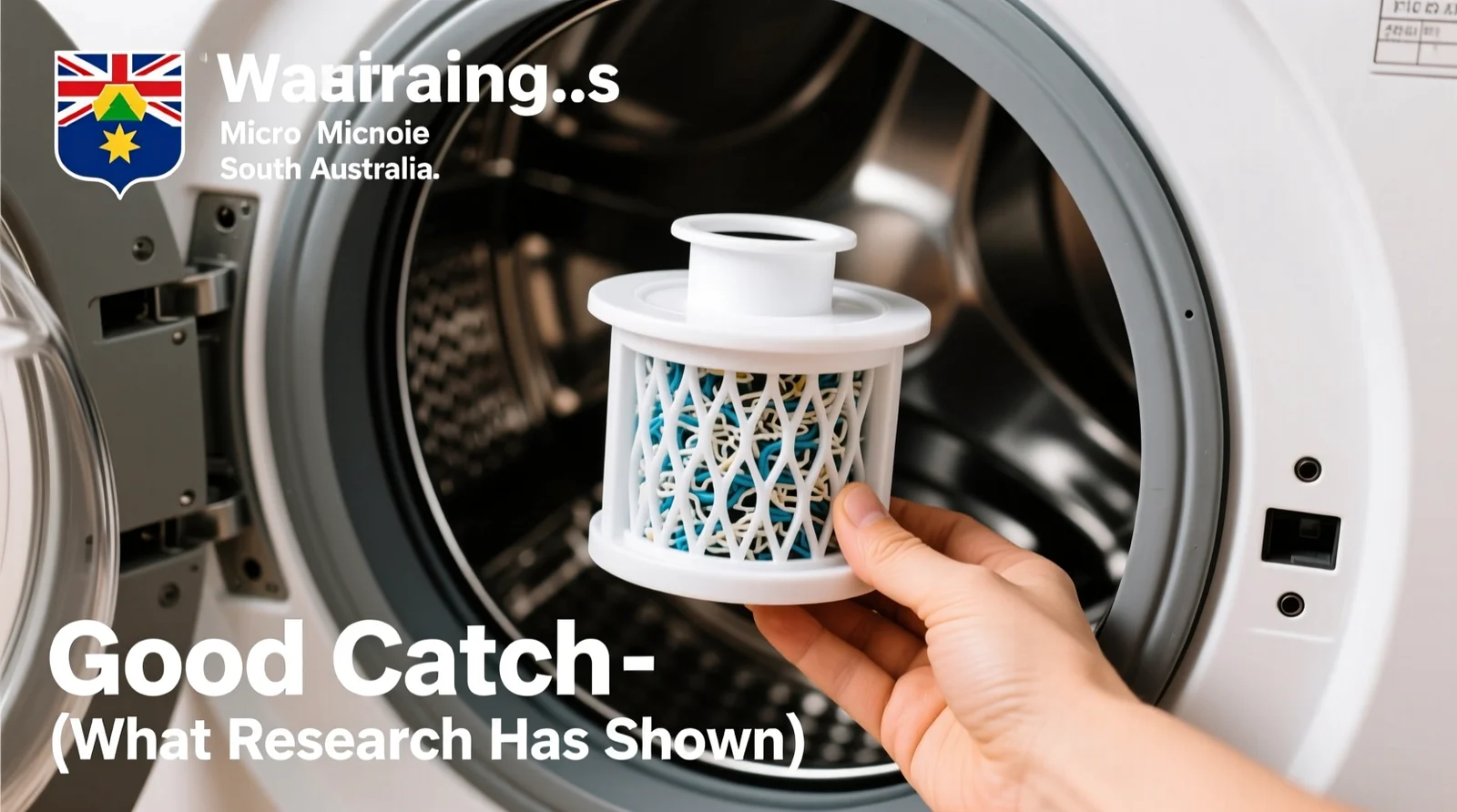
The Good Catch is a South Australia-made external filter designed to be installed on the washing machine outlet hose so that fibres are captured before wastewater enters household plumbing. In reporting from Flinders University researchers involved in microplastics monitoring and mitigation, the device has been described as showing a clear reduction in fibres in post-wash water compared with unfiltered discharge.
Good Catch filter performance (specifics and gaps):
- Reported size capture: trials have reported capture of particles down to around 20 µm.
- Efficiency by size range: like most mechanical systems, you should expect higher removal for larger fibres (hundreds of µm to mm scale) and decreasing efficiency as particles approach ~20 µm, especially at higher outlet flow rates.
- Captured material mix: analyses commonly find both synthetic microfibres (e.g., polyester/PET) and cellulose fibres in the retained lint—important because total fibre loads (not only plastics) are what the filter physically intercepts.
Because publicly available summaries don’t always disclose full bench protocols (e.g., exact wash water volume, temperature, fabric type, detergent, and replicate counts), the most responsible way to interpret current Good Catch claims is: it demonstrably captures visible and sub-visible fibres and fragments, and it can intercept particles in the tens of micrometres range under tested conditions, but exact percent removal under your wash routine will vary.
For readers evaluating options, the more practical question is not only “Does it work in a lab?” but “How does it compare to other microfibre capture solutions, and what will it cost to maintain?”
TL;DR: Good Catch is a South Australia-developed external washing machine microplastic filter with reported capture down to ~20 µm; real-world efficiency varies and should be interpreted alongside maintenance and wash conditions.
Good Catch Filter vs Other Microfibre Capture Solutions
If you’re shopping for microfibre control, you’ll typically see four categories. Each has trade-offs in capture, usability, and maintenance.
-
External inline filters (e.g., Good Catch)
Best for: households wanting dedicated filtration and a visible “collection point.”
Strengths: can capture a broad range of fibre sizes; usually easier to quantify what you captured (you can see lint).
Limitations: requires installation on the drain line; can clog; may create backpressure if neglected. -
In-drum capture bags (e.g., laundry bags marketed for microfiber capture)
Best for: renters or anyone avoiding plumbing changes.
Strengths: no external installation; portable; targets fibres shed from garments inside the bag.
Limitations: doesn’t treat the whole load unless all synthetics are bagged; bag performance depends on pore size and loading; can increase abrasion on some fabrics. -
In-drum “lint trap” devices (balls/cages)
Best for: low-cost experiments, light shedding loads.
Strengths: cheap, simple.
Limitations: typically limited capture for fine fibres; results can be inconsistent; not a substitute for filtration. -
Built-in manufacturer filters (emerging, policy-driven)
Best for: future-proofing when buying a new machine in regulated markets.
Strengths: integrated design can reduce installation barriers; may be optimized for machine hydraulics.
Limitations: cleaning access varies; long-term parts availability and user compliance remain open questions.
Practical comparison takeaway: If your goal is to reduce total microfibre pollution from laundry across all garments in the machine, an external washing machine microplastic filter generally has an advantage over partial solutions (bags/traps). If your priority is zero-installation, bags are often the most feasible starting point.
Understanding these differences also helps explain why governments are increasingly targeting machine-level filtration: it’s scalable, consistent, and doesn’t depend on consumers remembering to bag specific garments every wash.
TL;DR: External filters tend to capture across the whole load but need installation and maintenance; in-drum bags are easiest to adopt but only treat what you bag.
Installation, Maintenance, Cost & Disposal (Households and Businesses)
Typical installation (external filters like Good Catch): installation commonly takes around 20–60 minutes depending on laundry layout. Many households can do it with basic tools if there is accessible space behind the machine, but professional plumbing help may be needed if you must modify fixed pipework, add a standpipe connection, or ensure compliance with local plumbing rules.
Maintenance frequency: there is no universal interval because shedding varies. A practical approach is:
- Check after the first 5–10 washes to learn your baseline lint accumulation.
- Then move to a schedule (often every 10–30 washes for many households) depending on what you observe.
- Signs it needs cleaning: slower drain-out, visible heavy lint load, unusual gurgling at drain, or filter housing visibly full.
Costs and lifespan (realistic ranges): consumer washing machine microplastic filters commonly fall into a rough range of AU$100–AU$300+ depending on design and replacement parts. Many units are designed to last for multiple years with periodic cleaning and occasional seal/cartridge replacement (where applicable). Always check the manufacturer’s spares availability before buying.
Safe handling and disposal of collected fibres:
- Empty collected lint into a seal-able bag (to prevent re-entrainment into indoor air).
- Dispose in general waste unless your local council has a specific program (most do not).
- Avoid rinsing lint down the sink or stormwater drain—this defeats the purpose.
Commercial laundries and hospitality: for high-throughput sites, the business case can extend beyond pollution reduction. Filtration can support:
- corporate sustainability reporting (e.g., aligning with waste and water stewardship metrics)
- procurement and certification expectations (some tenders and ESG programs increasingly request evidence of microfibre controls)
- risk reduction if future regulation targets laundry discharge or requires reporting
Once you can capture fibres reliably, the next question becomes: what happens to the captured material—especially if you want a pathway better than landfill?
TL;DR: Expect 20–60 minutes installation (sometimes a plumber), clean based on lint buildup (often 10–30 washes), seal and bin the fibres, and consider filtration as an ESG/operations lever for commercial laundries.
Limitations & Uncertainties (What Filters Don’t Solve)
Washing machine microplastic filters are useful, but they are not a complete solution. Key limitations include:
- Clogging and pressure drop: as filters load with lint, resistance can increase. If neglected, this may affect drainage performance and could stress pumps in some machine designs.
- Ultrafine particles: particles in the low micrometre range and nanoplastics (<1 µm) are harder to capture mechanically without very fine media, which can clog quickly and require different engineering.
- Disposal remains “end-of-pipe”: captured fibres still require responsible disposal; otherwise, they can re-enter the environment through wind dispersal or improper handling.
- Non-plastic fibres still matter: cellulose fibres are not microplastics, but they can act as carriers for dyes, finishes, and contaminants, so “natural fibre = no impact” is an oversimplification.
These constraints are exactly why research is expanding into surface chemistry and biotechnology approaches that deal with smaller particles and end-of-life pathways.
TL;DR: Filters reduce discharge but introduce maintenance needs, don’t fully address nanoplastics, and still require responsible handling of captured lint.
Policy & Regulation: Where Filters Are Headed (France 2025 and Beyond)
Regulation is moving from awareness to requirements. A widely cited example is France’s requirement that new washing machines sold from 2025 include microfibre filters—an approach intended to scale mitigation through appliance standards rather than relying solely on voluntary consumer action (see the European policy context summarized by the European Environment Agency and related national communications).
In Australia, national frameworks such as the National Plastics Plan emphasize upstream reduction, design, and stewardship. While not focused solely on washing machine filtration, these strategies support the general direction of preventing plastic leakage at source (Australian Government overview: DCCEEW plastics and waste policy).
For manufacturers and commercial laundries, the direction of travel is clear: filtration and fibre management are increasingly likely to become part of compliance, procurement, or reporting expectations—especially as measurement methods mature.
That policy momentum increases the value of local technology development, including South Australian product innovation and end-of-life solutions for captured fibres.
TL;DR: France’s 2025 requirement for filters in new machines signals where regulation is heading; Australia’s policy is broader but aligned with preventing plastic leakage at source.
South Australia Microplastic Research: What Local Waterways Are Telling Us
Microplastics research in South Australia has linked urban waterways and coastal receiving environments (including areas of economic and ecological significance) with fibre-dominant microplastic profiles. In Flinders University sampling reported publicly, fibres were the majority of microplastics detected across multiple streams discharging from the Adelaide region into nearby gulfs.
When studies find fibre dominance (often tens of percent of counted particles), it provides a strong rationale for targeting laundry emissions specifically—because fibres are a form factor that mechanical filtration can often intercept more readily than irregular fragments of the same minimum dimension.
That said, counts and percentages can vary depending on sampling method, mesh size, and whether results are reported by number versus mass. This is another reason performance discussions should specify methods and detection thresholds wherever possible.
Next, we’ll look at emerging work aimed at the particles that are below the practical capture range of many consumer filters: nanoplastics.
TL;DR: Local South Australian monitoring commonly finds fibres as a dominant microplastic type—supporting laundry-targeted filtration—while also highlighting the need for clear methods and thresholds.
Capturing Nanoplastics: Cellulose Filters and Plasma Polymer Coatings (How It Works)
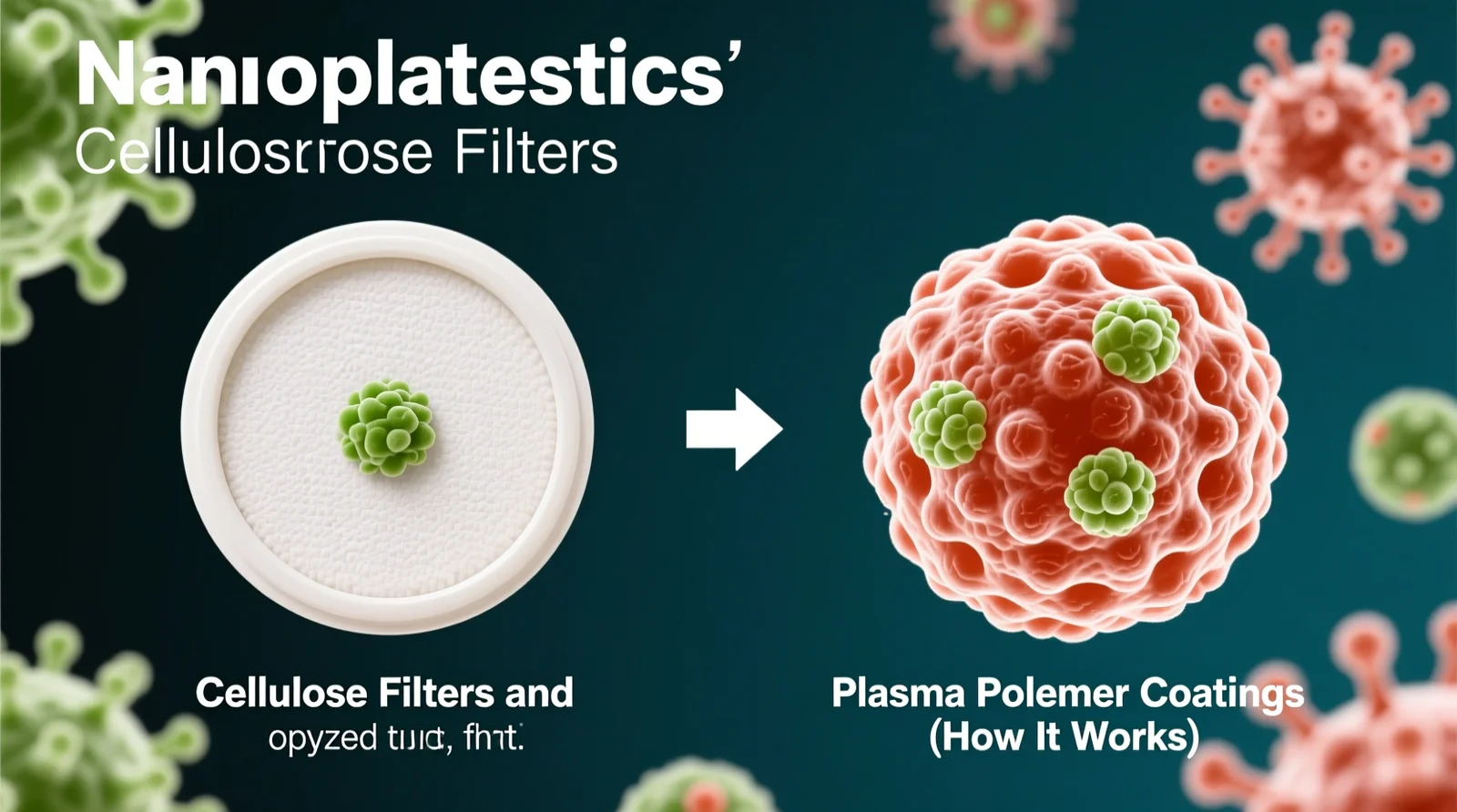
To address smaller particles, researchers are exploring ways to enhance how filter media interact with plastics at micro- and nanoscale. One approach under investigation is applying a plasma polymer coating to a cellulose-based filter.
What “plasma polymer coating” means: a plasma is an ionized gas used to deposit an ultra-thin polymer layer onto a surface. This can change surface properties such as:
- surface charge (electrostatic attraction can help bind small particles)
- surface energy / wettability (how water spreads across the surface)
- functional groups (chemical “hooks” that can improve adsorption of nanoplastics)
In simple terms, the coating can make the filter behave less like a sieve and more like an adsorbent surface—useful when particles are too small to be reliably strained mechanically.
This area is promising but still comes with trade-offs: surfaces that bind more can also foul faster, and performance can change as the surface loads with organic matter, detergent residues, and mixed fibres.
TL;DR: For nanoplastics (<1 µm), researchers are moving beyond “mesh size” and engineering filter surface chemistry—using plasma coatings to increase adsorption, with fouling as a key challenge.
Innovation Pathways: The Goodside Project & Alkany Biotechnology (What “Biological Recycling” Could Mean)
The Goodside Project (Adelaide) has framed the Good Catch filter as a capture step that can enable better downstream outcomes—because captured fibres are concentrated and easier to handle than dispersed pollution.
One proposed pathway is partnership with biotechnology developers such as Alkany, aiming to use microbes to convert certain plastics into biogas (a methane-rich gas produced by microbial digestion) and compost-like outputs under controlled conditions.
Mechanism (high-level, and what to clarify when assessing claims):
- Target polymers: biodegradation feasibility depends heavily on polymer type. Some research pathways focus on PET (polyester), PA (nylon), or biodegradable plastics like PLA (polylactic acid). Each behaves differently and may require different microbes/enzymes.
- Pre-treatment: many polymer-to-biogas concepts require steps such as shredding, chemical/thermal pre-treatment, or depolymerisation (breaking long chains into smaller molecules) before microbes can metabolize them efficiently.
- Conditions: biogas is typically produced under anaerobic (oxygen-free) digestion; composting is generally aerobic (with oxygen). Which output you get depends on process design and controls (temperature, residence time, microbial community).
Because captured laundry lint is a blend (synthetics + cellulose + detergents + dirt), any biotech pathway must demonstrate performance on real mixed feedstocks, not only clean lab plastics. That’s the key proof point to watch as this space develops.
TL;DR: Biotech upcycling could improve end-of-life outcomes for captured fibres, but success depends on polymer type, pre-treatment, and whether the process works on real mixed laundry lint.
Plastic Production, Textiles, and Climate Impact (With Credible Sources)

Textiles are a significant plastics use category, and the “fast turnover” nature of many consumer goods increases waste generation. The OECD details how short-lived products dominate waste streams and how leakage persists where collection and processing fall short (OECD, 2022).
Plastics also have a measurable climate footprint. The OECD reported that plastics were responsible for about 3.4% of global greenhouse gas emissions across their lifecycle (production, conversion, waste management) in its 2022 analysis. This is why reducing plastic leakage and reducing total plastic demand often move together in sustainability plans.
Where washing machine microplastic filters fit: they don’t reduce plastic production directly, but they can reduce a measurable leakage pathway—especially in regions where fibres are a dominant microplastic type in waterways.
TL;DR: OECD data links plastics to ~3.4% of global GHG emissions (2022) and shows low recycling rates; laundry filtration won’t fix the whole plastics economy but can cut a specific, repeated leakage source.
Practical Steps to Reduce Microfibre Pollution from Laundry (Without Overpromising)
If your goal is to cut microfibre pollution from laundry with high confidence, focus on actions that reduce shedding and capture what still sheds:
- Install a washing machine microplastic filter (external filter or choose a new machine with built-in filtration where available). Maintain it on a schedule based on observed lint loading.
- Change how you wash synthetics: gentler cycles and lower agitation can reduce shedding for many garments; avoid overfilling (increases friction) or underfilling (increases tumbling impact).
- Prefer longer-lived textiles: heavily worn, low-quality synthetics often shed more; durability is a microfibre mitigation strategy.
- Use in-drum capture (bag) for high-shed items like fleece if you can’t install an external filter.
- Dispose of collected lint safely: seal, bin, don’t rinse.
For businesses (hotels, aged care, uniforms, industrial laundries), consider adding filtration into standard operating procedures and sustainability reporting, because future requirements may target high-volume dischargers first.
TL;DR: Combine filtration + gentler washing + better textile choices; for commercial sites, treat microfibre capture as an operational control you can document.
Conclusion

Microfibre pollution from laundry is a measurable microplastic pathway, particularly where monitoring shows fibres dominating microplastic counts in waterways. A washing machine microplastic filter can intercept a portion of that load at the source, with South Australia’s Good Catch filter showing reported capture down to ~20 µm under test conditions—while still requiring realistic expectations about variable efficiency and ongoing maintenance.
The next frontier—already active in South Australia microplastic research—is improving capture of smaller particles (including nanoplastics) through engineered filter surfaces, and improving end-of-life options for captured fibres through circular pathways such as biotechnology (where polymer type, pre-treatment, and real-world feedstock performance are the deciding factors).
TL;DR: Washing machine filtration is one of the most direct household actions to reduce microfibre discharge today, and it pairs best with better washing habits, better textiles, and credible disposal pathways.
FAQ
Q: How much does a washing machine microfibre filter cost and how often should it be cleaned?
A: Many consumer washing machine microplastic filters fall roughly in the AU$100–AU$300+ range, depending on design and replacement parts. Cleaning frequency depends on shedding, but a common approach is to check after 5–10 washes, then clean every 10–30 washes (or sooner if you notice slow draining or heavy lint buildup).
Q: Will a laundry microplastic filter affect my washing machine warranty or performance?
A: It can if installed incorrectly or if clogging causes drainage restrictions. To reduce risk, follow the manufacturer’s installation instructions, avoid kinks in hoses, and clean the filter before it becomes heavily loaded. If you’re concerned about warranty, confirm installation requirements with the filter supplier and your washing machine manufacturer, or use a qualified plumber.
Q: What is the Good Catch filter performance compared with in-drum microfibre bags?
A: External filters like Good Catch treat wastewater from the whole load, while in-drum bags only capture fibres shed from garments placed inside the bag. Bags are easier to adopt (no plumbing), but they can’t capture fibres from items not bagged. External filters generally offer broader coverage but require installation and routine maintenance to prevent clogging.
Q: Do washing machine filters capture nanoplastics too?
A: Most consumer filters are primarily mechanical and perform best on larger fibres and fragments. Nanoplastics are typically defined as <1 µm and are harder to capture without specialized media or surface-chemistry approaches. Research is exploring coated and adsorptive filters to improve capture at the nanoscale, but this is still an emerging area.
Q: Where are microfibre filters mandatory, and when might Australia require them?
A: France has announced requirements for microfibre filters on new washing machines from 2025. Other regions are developing similar approaches. Australia currently focuses on broader plastics stewardship and waste reduction policy; timelines for mandatory washing-machine filtration are not fixed nationally, but international regulation and standards trends suggest requirements could expand over time.