Market Overview and Forecast (2025 Base Year)

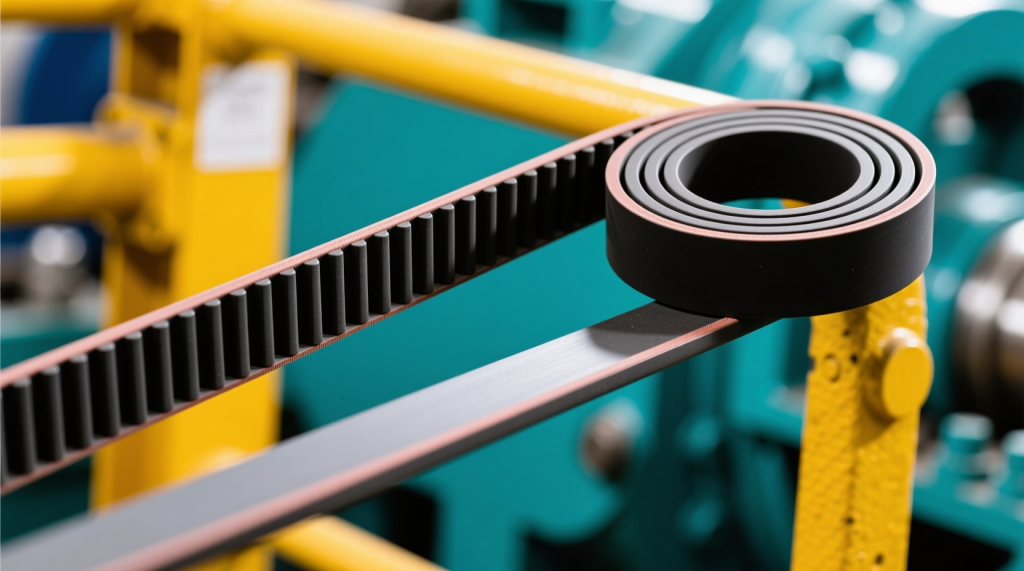
The global industrial V-belt market is projected to reach around USD 2.6 billion by 2035, up from USD 1.58 billion in 2025, representing a 5.0% compound annual growth rate (CAGR) across 2026–2035. Industrial V-belts are flexible power transmission components that transfer torque between grooved pulleys using a wedge effect from their trapezoidal cross-section.
Time-frame note: Unless stated otherwise, all segment shares in this report refer to 2025 and are presented on a revenue basis (not unit volume). The 2035 value is derived by applying the stated CAGR to the 2025 base.
Demand fundamentals are tied to the installed base of belt-driven equipment (fans, pumps, compressors, conveyors) in manufacturing and heavy industry. In practice, many sites keep belt drives because they tolerate misalignment better than rigid couplings, damp shock loads, and are serviceable with basic maintenance tools—important in plants where uptime is constrained by technician availability.
Scenario lens (forecast sensitivity): If industrial electricity prices rise faster than expected (as seen in many markets in recent years), adoption typically shifts toward cogged/notched and premium compound belts because energy and downtime savings become easier to justify. Conversely, if OEMs accelerate migration to direct drive (motor coupled directly to the load), replacement demand remains but new-install demand can soften in select high-precision equipment categories.
TL;DR: From a 2025 base of USD 1.58B, the industrial V-belt market is modeled to grow to ~USD 2.6B by 2035 (5.0% CAGR), with outcomes most sensitive to energy costs and the pace of direct-drive substitution.
Industry Data and Efficiency Benchmarks (What “95–98%” Really Means)
This section summarizes industrial V-belt efficiency improvement claims and clarifies operating conditions. Belt-drive efficiency varies significantly with pulley diameter, wrap angle, belt tension, alignment, and load stability.
- 95–98% transmission efficiency (standard V-belts): Often achievable in well-aligned drives with correct tension, adequate pulley diameters, and steady loads. Real-world efficiency can drop if belts are under-tensioned (slip), over-tensioned (bearing losses), or run on worn sheaves (pulleys).
- 12–18% power reduction vs older belts (premium “energy-saving” belts): This is typically reported when replacing aged belts and worn sheaves, correcting tension/alignment, and upgrading to low-bend-loss designs. Treat it as a “system upgrade” outcome rather than a belt-only outcome.
- ~60% better heat dissipation with EPDM compounds: EPDM (ethylene propylene diene monomer) rubber is commonly used for higher heat and ozone resistance; cooler running generally correlates with longer belt life, especially in hot enclosures.
- ~40% slip-rate reduction with optimized profiles/materials: Usually reflects a combination of improved compound friction characteristics, better tensile cords, and profile geometry that maintains wedging action under load.
- ~2% efficiency advantage for cogged belts: The U.S. Department of Energy notes cogged (notched) belts can be about 2% more efficient due to reduced bending resistance, particularly on smaller pulleys and higher-speed drives.
For credibility and additional context on motor and drive efficiency initiatives, reference the U.S. DOE resources on motor systems and efficiency improvements: U.S. Department of Energy – Motor Systems.
TL;DR: Published efficiency gains are most realistic when belts are selected, installed, and tensioned correctly; cogged belts can add ~2% efficiency, while larger savings often come from fixing the entire belt-drive system (belt + sheaves + alignment).

- Market forecast: USD 1.58B (2025) to ~USD 2.6B (2035), 5.0% CAGR (2026–2035).
- Asia Pacific: ~41.1% share in 2025 (~USD 0.6B), driven by manufacturing, mining, and infrastructure equipment fleets.
- Classical V-belts: ~45.5% share in 2025—still the default replacement choice for a large installed base of legacy drives.
- Rubber belts: ~60.1% share in 2025, reflecting cost/performance fit for “normal duty” environments.
- Automotive end use: ~35.1% share in 2025, spanning OEM and high-frequency aftermarket replacement cycles.
TL;DR: The market is replacement-driven, with Asia Pacific leading and classical rubber belts still dominating due to installed base realities.
Belt Type Analysis (Where Each Design Wins)
This section explains how industrial V-belt selection differs by torque density, pulley constraints, and duty cycle.
Classical V-belts (≈45.5% share in 2025) dominate largely because many plants run equipment designed decades ago with standard sheave profiles. For example, older centrifugal pump skids and air compressors in maintenance shops often use classical sections because retrofitting sheaves across fleets is rarely budgeted unless energy audits force a change.
Narrow V-belts are commonly chosen when users want higher power transmission per belt with tighter packaging. They are frequently used in newer process lines where motor frames shrink (higher power density) but the machine envelope cannot grow.
Wedge V-belts fit high-torque, high-shock applications. A practical example is a mining conveyor head drive where high starting torque and occasional material surges create transient loads; wedge belts are often paired with multiple belts in parallel to spread load and preserve redundancy.
Other types include:
- Double-sided V-belts: used when power is transmitted from both belt sides in serpentine or multi-accessory layouts.
- Variable speed belts: used in adjustable-speed mechanical drives (common in some machine tools and legacy process equipment).
- Specialty/custom sections: selected when OEMs specify unique lengths, antistatic properties, or unusual pulley geometries.
TL;DR: Classical belts remain the replacement default; narrow belts target compact high-power drives; wedge belts are favored where shock loads and torque spikes are common (e.g., mining conveyors).
Material and Construction Analysis (Consolidated View)

This section consolidates materials discussion to reduce repetition and clarify what changes performance: compound chemistry, cord reinforcement, and belt geometry.
Rubber V-belts (≈60.1% share in 2025) remain the workhorse because they balance cost, grip, and flexibility. Modern rubber belts often use improved synthetic compounds for better heat and ozone resistance—important for HVAC rooftop units and outdoor aggregate equipment exposed to weathering.
Polyurethane (PU) V-belts (PU = polyurethane) are selected where oils/chemicals and cleanliness matter. In packaging and certain food-processing zones, PU can be advantageous for washdown resilience and contamination control. Note: belts are not “FDA-certified” in the same way as food-contact plastics; instead, users typically require belts and associated materials to be compatible with food safety programs (e.g., hygienic design expectations under HACCP—Hazard Analysis and Critical Control Points). For regulatory context, see the FDA’s food guidance portal: U.S. FDA – Food Guidance.
Fabric/cord reinforced belts use tensile cords (often polyester or aramid) to control stretch and improve shock resistance. Aramid (e.g., Kevlar-type fiber) is typically chosen for high-shock, high-tension drives where belt elongation drives frequent re-tensioning—common on crushers, screeners, and heavily loaded conveyors.
Design note (cogged/notched belts): Cogging reduces bending losses and heat generation, especially on smaller pulley diameters and higher speeds. This is a common “drop-in” efficiency upgrade when sheave changes are not planned (see also the Buyer Guidance section).
Compliance note (EU): For Europe-focused procurement, suppliers are often asked for documentation aligned with REACH (Registration, Evaluation, Authorisation and Restriction of Chemicals) and RoHS (Restriction of Hazardous Substances) expectations for materials in the supply chain. Official references: ECHA – REACH and European Commission – RoHS.
TL;DR: Rubber dominates for cost/performance; PU is preferred for chemical/cleanliness needs; aramid/cord reinforcement reduces stretch under shock loads; cogged designs help cut bending losses and heat.
End-Use Industry Analysis (Grounded Examples by Application)
This section links V-belt demand to real drive configurations and operating profiles.
- Automotive (≈35.1% share in 2025): Demand is driven by both OEM and replacement cycles. While many passenger vehicles use multi-rib (serpentine) belts, industrial-style V-belts remain relevant in commercial/off-highway equipment where serviceability in the field matters.
- Industrial manufacturing: Common in fan/blower drives, compressors, and general conveyors. In a typical packaging line, narrow belts may be used to reduce footprint while keeping maintenance straightforward.
- Mining: Multi-belt drives are common on conveyors, crushers, and screens. These sites prioritize belts that tolerate dust ingress, shock load spikes, and long run hours—conditions that punish low-grade compounds and poor tensioning.
- Construction & aggregates: High vibration and contamination drive up wear; belts are often replaced on condition during planned service windows to avoid jobsite stoppages.
- Agriculture: Seasonal peaks (planting/harvest) concentrate replacement demand; belts must survive dust, chaff, and intermittent shock loads.
- Energy & utilities: HVAC fans/pumps in water and wastewater facilities often run continuously; even small efficiency gains can justify upgrading to cogged belts during maintenance shutdowns.
TL;DR: The biggest volumes come from applications with large installed bases (fans, pumps, conveyors) where belts remain the most serviceable and cost-effective transmission choice.
Market Segmentation Snapshot (2025)
Key segments in the industrial V-belt market are structured as follows.
By Belt Type
- Classical V-belts
- Narrow V-belts
- Wedge V-belts
- Others (double-sided, variable speed, specialty designs)
By Material
- Rubber V-belts
- Polyurethane (PU) V-belts
- Fabric/cord-reinforced V-belts
- Others (aramid-reinforced, silicone-based, composite constructions)
By End-Use Industry
- Automotive
- Industrial manufacturing
- Oil & gas
- Construction
- Agriculture
- Mining
- Energy & utilities
- Aerospace & defence
- Others (pharma, food & beverage, packaging, logistics, electronics)
TL;DR: Segmentation is standard by belt geometry, material system, and where the drives are deployed (automotive, manufacturing, mining, etc.).
Market Drivers (Industrial V-Belt Market Demand Signals)
Industrial V-belt market growth is primarily driven by replacement cycles in large equipment fleets plus incremental upgrades toward higher-efficiency designs.
1) Automation and higher equipment utilization
Automation raises runtime hours and increases the penalty of unplanned stops. In practice, this favors belts with lower re-tensioning needs and better heat control (e.g., EPDM compounds, higher-stability cords). It also increases demand for maintenance-friendly designs because technicians may be supporting more assets per shift.
2) Heavy industry throughput and infrastructure-linked utilization
When cement plants, mines, and aggregate sites ramp utilization, belt wear accelerates. In these environments, belt selection is often driven by:
- abrasive dust contamination risk (pulley groove wear and slip),
- shock loads during starts and surges,
- temperature exposure (hot enclosures or sunlight).
TL;DR: Demand rises when equipment runs longer and harder—automation increases uptime requirements, while mining/aggregates push belts into high-wear duty cycles.
Market Restraints (Separated: Substitution vs Operating Limits)
This section clarifies what limits the industrial V-belt market: technology substitution in new equipment and performance constraints in harsh conditions.
A) Substitution risk: direct drive and gearless architectures
Direct drive (motor coupled directly to the load) and gearless designs can reduce mechanical components and improve controllability for certain equipment. Substitution is most likely where:
- precise speed/position control is critical (some high-end automation cells),
- space constraints favor integrated motor-drive packages,
- OEMs design for minimal mechanical maintenance.
B) Operating constraints: temperature, chemicals, contamination, misapplication
Belts can underperform when drives are mis-sized, misaligned, under/over-tensioned, or run on worn pulleys. Extreme temperatures accelerate compound aging; chemical exposure can swell or harden elastomers; abrasive dust can polish sheaves and drive slip.
- Where V-belts remain preferred: retrofit replacements, shock-load damping needs, distributed maintenance teams, and cost-sensitive multi-drive layouts.
- Where substitution is more likely: new precision machines, sealed integrated drive modules, and applications pushing ultra-high efficiency with minimal maintenance access.
TL;DR: Direct drive is the main new-build threat, while the biggest “belt-specific” issues come from harsh environments and avoidable installation/maintenance errors.
Growth Factors (What Could Accelerate Adoption)
This section summarizes the most plausible accelerators of industrial V-belt market growth without repeating driver statements.
Emerging-economy capacity additions
New factories and processing plants add belt-driven fans, pumps, and conveyors quickly because belt drives are widely serviceable and tolerant of variable field conditions.
Energy-efficiency programs and payback logic
Upgrading to cogged or premium compound belts is often justified when:
- motors run many hours per year (continuous HVAC, pumps, conveyors),
- electricity rates are high or volatile,
- heat-driven belt failures cause downtime costs that exceed belt price.
Customization for duty-class extremes
Demand grows for belts tuned to dust, heat, oil exposure, or shock loading (compound + cord + geometry changes), particularly in mining, cement, and remote-site operations.
TL;DR: New industrial capacity, rising energy-cost sensitivity, and application-specific belt engineering are the clearest growth levers.
Design and Maintenance Considerations (Practical Guidance for Reliability)
This section is aimed at maintenance managers and engineers seeking industrial V-belt maintenance best practices.
Key design checks (before you buy):
- Sheave condition: worn grooves reduce wedging action and raise slip risk; replacing belts without addressing worn sheaves often yields repeat failures.
- Pulley diameter and wrap angle: small diameters increase bending stress; insufficient wrap reduces traction margin.
- Environmental exposure: heat, ozone, oils/chemicals, abrasive dust, and washdown dictate compound and cord choices.
Installation essentials:
- Alignment: misalignment drives edge wear and heat. Use straightedge/laser alignment tools where possible.
- Tensioning: under-tensioning causes slip and glazing; over-tensioning overloads bearings. Use manufacturer tension charts and re-check after run-in.
- Matched sets: on multi-belt drives, replace as a set to prevent load imbalance and premature failure.
Indicative inspection/replacement intervals (adjust to duty and criticality):
- Normal indoor duty (clean, moderate temp): inspect every 1–3 months; typical replacement planning window 2–5 years depending on runtime.
- Dusty/abrasive (aggregates, mining transfer points): inspect monthly or more; replacement commonly 6–24 months depending on sealing and tension control.
- High-temperature zones (hot enclosures, near process heat): inspect monthly; replacement commonly 6–18 months unless high-heat compounds are specified.
- High-shock/high-start cycles (crushers, heavy conveyors): inspect monthly; replacement often 6–24 months, with tension and sheave wear monitored closely.
Predictive maintenance (PdM) note: PdM (predictive maintenance) approaches—such as vibration analysis, thermal checks, and motor current trending—can flag belt slip, misalignment, and overload conditions earlier than visual inspection alone.
TL;DR: Most belt failures are preventable: correct sheave condition, alignment, and tensioning matter as much as belt material choice; inspection frequency should increase sharply in dust, heat, and shock-load environments.
Buyer Guidance: How End Users Can Capture Value
This section provides an actionable industrial V-belt selection guide and upgrade steps for energy and downtime reduction.
Step-by-step upgrade path (standard → energy-efficient):
- 1) Baseline the drive: record motor kW, runtime hours/year, belt type, pulley sizes, and failure history.
- 2) Fix mechanical basics: replace worn sheaves, correct alignment, and tension properly (many “efficiency” projects fail here).
- 3) Upgrade the belt: consider cogged/notched belts or higher-heat compounds (e.g., EPDM) when drives run hot or use smaller pulleys.
- 4) Validate results: track temperature, slip events, and energy (where metering exists) over several weeks of stable operation.
Simple ROI framing (energy-only): Annual savings ≈ (motor kW × operating hours × electricity rate) × efficiency improvement. Even a ~2% efficiency gain (typical of cogged belts under suitable conditions) can be meaningful on large fans/pumps that run 6,000–8,000 hours/year.
Questions to ask suppliers:
- What duty class is the belt designed for (temperature range, oil/chemical exposure, antistatic needs)?
- Do you provide tensioning specs and a run-in re-tension recommendation?
- Is a matched-set option available for multi-belt drives?
- What is the recommended sheave-groove inspection or replacement threshold?
V-belt vs direct drive comparison (procurement reality check): If an OEM offers direct drive, compare not just efficiency but also serviceability (spares, lead time), required technician skill, and downtime cost. In many plants, a belt swap is a planned-stop task; a direct-drive motor failure may require specialized parts and longer downtime.
TL;DR: The fastest paybacks come from fixing sheaves/alignment first, then upgrading to cogged/premium compound belts and tracking results; always compare against direct-drive alternatives using downtime and serviceability, not efficiency alone.
Emerging Trends (What’s Actually Changing)

This section highlights changes that materially affect industrial users rather than repeating broad innovation claims.
- Material shift toward higher-heat compounds: More EPDM-based belts are specified in hot-running enclosures and outdoor equipment to reduce heat-driven cracking and glazing.
- Higher-stability tensile members: Increased use of aramid and engineered cords reduces re-tension frequency on shock-load drives.
- Noise/vibration control via tighter tolerances: Particularly relevant for HVAC fans and indoor facilities where sound limits and comfort standards drive procurement.
- Condition-based practices: Maintenance teams increasingly treat belt drives as measurable assets (temperature, vibration, slip indicators) instead of purely consumables.
TL;DR: The practical trend is “less heat, less stretch, fewer re-tensions,” supported by better compounds, cords, and tighter manufacturing tolerances.
Regional Analysis (Industrial V-Belt Market by Geography, 2025)
Regional industrial V-belt market dynamics vary mainly by installed base mix (legacy vs new), heavy-industry exposure, and efficiency/regulatory pressure.
Asia Pacific leads on the back of high equipment counts in manufacturing, mining, and construction supply chains. Growth is typically strongest in:
- Classical replacements (installed base effect), alongside
- narrow/wedge upgrades in newer plants and higher power-density machinery.
Mining and cement utilization tends to pull demand toward reinforced constructions and heat-resistant compounds where maintenance access is limited.
North America
North America is more upgrade-oriented, with higher adoption of cogged belts and premium materials where energy and downtime are actively costed into maintenance decisions. Growth is often concentrated in utilities/HVAC retrofits and industrial MRO (maintenance, repair, and operations) programs.
Europe
Europe shows strong pull for documented material compliance and efficiency-oriented replacements, especially in regulated industries. Requests for supplier documentation aligned with REACH/RoHS are common in procurement workflows, which tends to favor established brands with strong traceability systems.
Middle East & Africa
Demand is linked to mining, construction, and oil & gas equipment fleets that operate in heat, dust, and remote conditions. This often increases the share of heavy-duty belts and reinforces the importance of local distribution and fast availability of matched sets.
Latin America
Mining and agriculture are major anchors. Demand patterns can be cyclical with commodity and currency volatility, which often shifts purchasing toward “fit-for-duty” belts that reduce emergency downtime rather than the lowest unit price.
Key regions and countries covered:
- North America: United States, Canada
- Europe: Germany, France, United Kingdom, Spain, Italy, Rest of Europe
- Asia Pacific: China, Japan, South Korea, India, Australia, Rest of APAC
- Latin America: Brazil, Mexico, Rest of Latin America
- Middle East & Africa: GCC Countries, South Africa, Rest of MEA
TL;DR: Asia Pacific leads on volume and installed base; North America/Europe skew toward efficiency and documented compliance; MEA and Latin America lean heavily on heavy-industry duty cycles and distribution reliability.
Methodology and Data Sources (Market Size and Forecast Method)
This report uses a 2025 base year and a 2026–2035 forecast window. The headline forecast applies the stated CAGR to the 2025 market value to estimate 2035 market size; segment shares are presented as 2025 revenue share unless noted.
Efficiency and design claims are cross-checked against publicly available technical guidance (e.g., U.S. DOE motor system efficiency resources) and commonly cited industry references. For belt-drive selection and maintenance fundamentals, manufacturer engineering handbooks are typically used by practitioners; a widely referenced baseline for power transmission standards is provided by organizations such as the American Gear Manufacturers Association (AGMA) (for general power transmission best practices and terminology across mechanical drives).
TL;DR: Forecast values are CAGR-based from a 2025 baseline; segment shares are 2025 revenue shares; technical statements are tied to public efficiency guidance and established power transmission references.
Key Company Insights (Who Competes and How)
The industrial V-belt market is moderately consolidated, with large global manufacturers competing on compound/cord technology, catalog breadth, and distribution reach. Differentiation is often visible in: (1) OEM engineering support and approvals, (2) heavy-duty product lines for mining/cement, and (3) rapid MRO availability for multi-belt matched sets.
- Gates Corporation: Broad industrial and automotive portfolio with strong distribution and application engineering; typically strong in MRO availability and cross-industry coverage.
- ContiTech Deutschland GmbH (Continental AG): Known for rubber engineering and global manufacturing footprint; often positioned strongly in industrial OEM collaborations and engineered rubber solutions.
- Mitsuboshi Belting Ltd.: Strong presence in Asia with emphasis on precision manufacturing and consistent quality for OEM and industrial applications.
- Optibelt GmbH / Arntz Optibelt Group: Often associated with premium industrial applications and technical support, especially where uptime and durability are heavily valued.
Other notable players include Bando Chemical Industries Ltd., SKF Group, Hutchinson Belt Drive Systems, PIX Transmissions Ltd., Timken Belts, Zhejiang Sanlux Rubber Co., Ltd., PowerDrive LLC, BEHA Innovation GmbH, Dunlop Belting Products, and Goodyear Belts.
TL;DR: Top players win through engineering support, premium duty-class product lines, and strong distribution—especially for fast replacement and matched-set supply.
Recent Developments
- December 2025 – Solve Industrial Motion Group acquired D&D Global, Inc. to expand power transmission portfolio and North American distribution.
- January 2025 – Belt Power acquired Sparks Belting Company, Inc., strengthening specialized belt distribution and technical support capabilities.
TL;DR: Distribution and service capability remain strategic—recent acquisitions focus on expanding product breadth and regional support.
Conclusion
The industrial V-belt market outlook through 2035 is supported by the sheer scale of installed belt-drive equipment and the practicality of belts in harsh, service-constrained environments. The competitive center of gravity is shifting toward belts that run cooler, stretch less, and deliver measurable efficiency improvements—especially where plants track energy and downtime cost explicitly.
Direct drive will continue to take share in select new equipment designs, but V-belts remain a preferred solution in many real-world scenarios where maintainability, shock absorption, and retrofit economics dominate the decision.
TL;DR: Belts stay relevant because they’re serviceable and forgiving; growth comes from installed base replacement plus premium upgrades, while direct drive is the main new-build substitute.
FAQ
Q: What is an industrial V-belt and how does it work?
A: An industrial V-belt is a trapezoidal-section power transmission belt that wedges into a grooved pulley (sheave). With correct tension, friction and wedging action transfer rotational power from the motor pulley to the driven pulley(s) for equipment like fans, pumps, compressors, and conveyors.
Q: How do I choose the right belt (industrial V-belt selection guide) for a conveyor vs an HVAC fan?
A: For conveyors—especially in mining/aggregates—prioritize shock-load capability, cord reinforcement, dust tolerance, and matched sets for multi-belt drives. For HVAC fans, prioritize low bending losses (often cogged belts), low noise/vibration, and heat/ozone resistance (EPDM is common). In both cases, confirm pulley condition and alignment limits before final selection.
Q: What are the best practices for installing and tensioning industrial V-belts?
A: Use correct sheave sizes and replace worn grooves, align pulleys (straightedge or laser), set tension using manufacturer charts (avoid “feel” methods), and re-check after run-in because belts seat into grooves. On multi-belt drives, replace belts as a matched set to prevent load imbalance and early failure.
Q: How can I diagnose common V-belt problems like slippage, noise, or overheating?
A: Slippage often shows as glazing (shiny belt sidewalls) and black dust near sheaves; check under-tensioning, worn grooves, or oil contamination. Noise can come from misalignment, incorrect belt section, or resonance at certain speeds. Overheating is commonly caused by slip, small pulley diameters, or over-tensioning (bearing losses). A quick field check is temperature comparison across similar drives plus visual inspection of grooves and belt sidewalls.
Q: V-belt vs direct drive comparison—when is substitution likely?
A: Direct drive is more likely in new equipment that needs precise speed/position control, compact integrated motor-drive assemblies, or minimal mechanical maintenance access. V-belts remain preferred in retrofit-heavy plants, shock-load applications, and sites where fast, low-skill serviceability and spare availability are critical decision factors.
Q: How often should industrial V-belts be replaced in dusty or high-temperature environments?
A: There isn’t a single universal interval, but planning ranges are often 6–24 months in dusty/high-shock duty and 6–18 months in hot zones unless high-heat compounds and correct pulley/tension practices are used. The most reliable approach is condition-based replacement using inspections (monthly or more in harsh duty) plus monitoring for slip, heat, cracking, and sheave wear.