Introduction

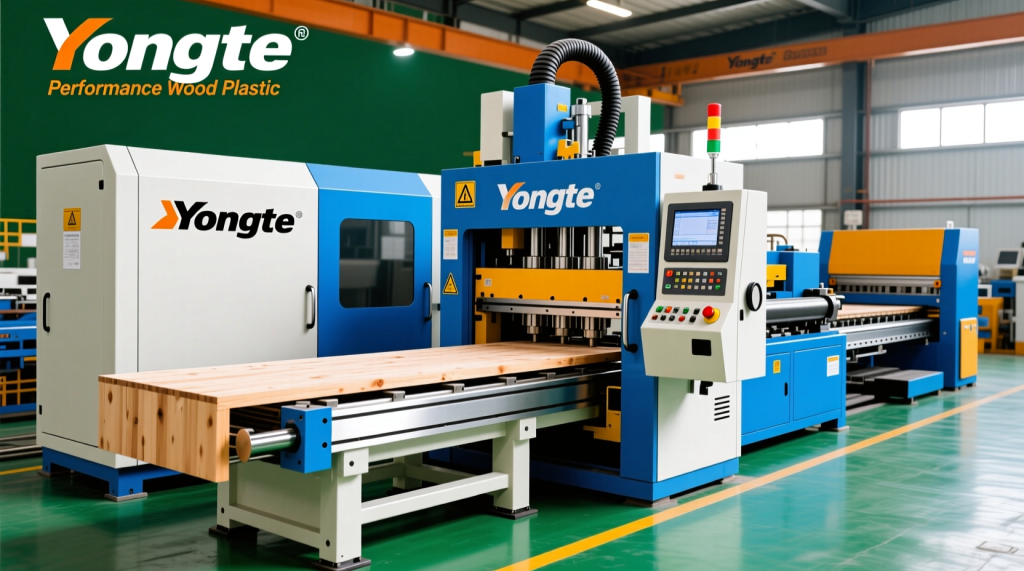
Qingdao Yongte Plastic Machinery Co., Ltd. designs and supplies industrial extrusion equipment from China for buyers across Asia, Europe, Africa, and the Americas. The core portfolio includes wood–plastic composite (WPC) extrusion lines (decking, cladding, profiles, and door boards), pipe extrusion plants for PVC (polyvinyl chloride), PPR (polypropylene random copolymer), and PE (polyethylene), plus profile, sheet, and recycling systems.
For engineering teams planning new capacity or upgrading older lines, Yongte focuses on line stability, scalable automation, and commissioning support—so the factory reaches targeted output, quality, and scrap-rate goals quickly.
TL;DR: Yongte supplies WPC, pipe, profile, and recycling extrusion lines with turnkey engineering support for international manufacturers.
Company Overview & Core Product Range
Yongte is an extrusion machinery manufacturer with its own production and assembly capabilities, supporting end-to-end projects—from line selection and layout to commissioning and operator training. Typical applications include building materials, municipal piping, furniture/outdoor products, packaging, and recycling-based product manufacturing.
- WPC profile lines: decking, wall panels, fencing, door boards, and decorative profiles
- Pipe extrusion systems: PVC / PPR / PE pipes for water, drainage, gas, and irrigation
- Plastic profile equipment: window/door profiles, cable ducts, industrial profiles
- Sheet lines: building and packaging sheet (configuration depends on polymer)
- Recycling & pelletizing: washing/granulation integration for circular manufacturing
For background on WPC material basics and market usage, buyers can reference the Wood-plastic composite overview on Encyclopaedia Britannica and general plastics processing concepts from PLASTICS (Plastics Industry Association).
TL;DR: The product range covers WPC, pipe, profile, sheet, and recycling lines, aimed at construction, infrastructure, and circular-economy manufacturing.
Key Buyer Challenges in Extrusion Projects (and How Lines Are Engineered to Address Them)
Energy cost and kWh/kg control
Electricity is often the largest operating cost after raw materials. Modern extrusion lines typically reduce consumption through high-efficiency motors/drives, optimized barrel heating control, and screw designs matched to the material’s melt behavior. In many real plants, energy benchmarks are tracked as kWh/kg of finished product (kilowatt-hours per kilogram), enabling objective comparison between line configurations.
Throughput, scrap rate, and uptime
Output is not only “kg/h” (kilograms per hour). Buyers also evaluate stability—melt pressure fluctuations, thickness tolerance, cooling efficiency, and downstream synchronization—because instability increases scrap and unplanned downtime. Many factories monitor OEE (Overall Equipment Effectiveness) to quantify performance improvement after upgrading automation and process control.
Process know-how (formulation, parameters, training)
Especially for WPC and thick-wall pipe, start-up success depends on formulation consistency, moisture control, temperature profiles, and calibration settings. Practical support typically includes process sheets, trial runs, and training so operators can hold dimensions and surface quality over long shifts.
Integration risk when sourcing from multiple suppliers
A complete line reduces interface risk across extruder, die, calibration, hauling, and cutting/stacking. Unified electrical design (drive matching, interlocks, alarms) also improves troubleshooting speed.
TL;DR: Buyers care most about kWh/kg, stable output (kg/h), low scrap, high OEE, and smooth line integration—so engineering focuses on control, matching, and commissioning.
WPC Extrusion Line Platform (Decking, Wall Panels, Door Boards, and Profiles)
WPC (wood–plastic composite) is commonly produced using PE, PP (polypropylene), or PVC as the resin base blended with wood flour and additives. Typical wood flour loading is often 50–70% (application-dependent), and moisture management is critical for surface quality and strength.
Most WPC profile lines share a core platform:
- Extruder: commonly conical or parallel twin-screw for high-filler compounding and stable output
- Screw design: application-specific mixing and venting; L/D (length-to-diameter ratio) depends on extruder series and formulation
- Die & calibration: profile die with vacuum calibration table; multi-zone cooling for dimensional stability
- Downstream: haul-off (often caterpillar type), cutting (saw/guillotine), and stacker
- Controls: PLC (programmable logic controller) + HMI (human–machine interface) for recipe storage, alarms, and speed synchronization (brand level typically selectable per project)
Typical capacity ranges (reference): WPC decking/profile lines are commonly configured around 150–600 kg/h depending on profile size, density (solid vs. foamed), and resin system. Door boards/wall panels may be set in a similar or higher range when using wide dies and adequate cooling capacity.
For readers comparing standards and testing expectations for WPC decking, the ASTM D7032 specification is a widely referenced baseline in many markets (note: the full text is paid, but the standard’s scope is publicly listed).
TL;DR: Decking, cladding, and door-board production typically runs on one shared WPC platform (twin-screw + die/calibration + synchronized downstream), commonly 150–600 kg/h depending on product geometry and formulation.
WPC Decking & Outdoor Profile Lines (Application Adaptations)
Outdoor products are judged heavily on surface appearance, dimensional stability, and weathering performance. In practice, buyers often specify:
- Profile type: solid, hollow, or foamed core (impacts weight, stiffness, and cost)
- Surface: brushed/embossed patterns; optional online embossing or post-processing
- Cooling length: extended calibration/cooling to hold width/thickness tolerance on wide boards
Performance targets (typical factory KPIs): after stable commissioning, many plants aim for scrap rates <2–3% on mature products and measurable OEE improvements after automation upgrades (actual results depend on raw material consistency, operator training, and maintenance routines).
TL;DR: Decking lines are usually tuned for outdoor-grade stability (cooling/calibration and surface finish), with KPIs centered on low scrap and repeatable dimensions.
WPC Door Board & Panel Lines (Application Adaptations)
WPC door products often focus on consistent density (especially for foamed boards), smooth surfaces for lamination/painting, and stable screw/die temperature control. Depending on the door design, a line may produce door boards, frames, and matching trims using different tooling sets on a shared extrusion platform.
Typical capacity ranges (reference): door board/panel extrusion is commonly configured around 200–700 kg/h depending on board width/thickness and whether foaming is used.
TL;DR: Door-board lines are typically a WPC platform optimized for surface quality and density control, often 200–700 kg/h depending on board geometry.
Plastic Pipe Extrusion Plants (PVC / PPR / PE) for Infrastructure
Pipe lines are selected mainly by material, diameter range, pressure class, and applicable standards. Many projects reference international or regional requirements such as ISO, DIN, ASTM, or GB/T (China national standards). For example, PE pressure pipes are often aligned with the ISO 4427 family; PVC pressure pipes are commonly aligned with ISO 1452 (standard availability varies by region and purchase access).
Pipe production commonly includes: extruder → pipe die/head → vacuum sizing tank → spray cooling → haul-off → cutting → belling/socketing (optional) → coiling or stacking.
PVC pipe extrusion lines
PVC pipe production often uses twin-screw extrusion for stable plastification. A common industrial diameter coverage is 16–630 mm (configuration-dependent), and output may range roughly 150–1200 kg/h depending on pipe size and wall thickness.
PPR pipe extrusion lines
PPR is widely used for hot/cold water piping. Lines often prioritize melt stability, precise gravimetric feeding (optional), and tight wall-thickness control. Typical diameter ranges are commonly 16–160 mm, with line speeds that vary strongly by size (small diameters run faster, large diameters slower).
PE pipe extrusion lines
PE (often HDPE—high-density polyethylene) lines are common for water, gas, and irrigation. Depending on the application, diameter coverage frequently spans 16–1200 mm with outputs commonly 200–1500+ kg/h on larger, high-output systems. Gas and pressure applications often require stable melt temperature control and reliable sizing/cooling capacity.
Typical speed ranges (reference): pipe line speed may be around 0.5–25 m/min depending on diameter, wall thickness, and cooling length (small pipes run faster; large pipes are slower).
For general guidance on PE pipe usage and properties in infrastructure, see the Plastic Pipe Institute (PPI).
TL;DR: Pipe lines are chosen by material + diameter + standard/pressure class; typical speeds range ~0.5–25 m/min and capacities scale widely with size (from a few hundred to 1500+ kg/h).
Plastic Profile Extrusion Equipment (PVC, PE/PP, and WPC Profiles)
Profile extrusion covers a broad set of shapes—window/door profiles, cable ducts, decorative panels, and industrial trims. Key engineering factors include die design, calibration tooling, cooling efficiency, and haul-off control to prevent twisting and shrinkage.
Common configuration options: co-extrusion (e.g., cap layer), online punching, inline marking/printing, and automated length counting/stacking (depending on profile type).
TL;DR: Profile lines are tooling-driven (die + calibration + cooling) and are often expanded with options like co-extrusion, punching, and inline marking.
Recycling-Based Plastic Lumber & Circular Manufacturing
Recycled plastic lumber lines convert sorted waste plastics into durable boards used for pallets, outdoor furniture components, and construction boards. A typical project may include washing (as needed), drying, granulation/pelletizing, and final extrusion—depending on incoming material cleanliness and consistency.
For readers evaluating recycling system design principles and waste-plastic processing context, see UNEP’s resources on plastic pollution and circularity at the United Nations Environment Programme (UNEP).
TL;DR: Plastic lumber projects often combine recycling steps (washing/granulation) with extrusion so waste becomes saleable boards with controlled quality.
How to Choose the Right Extrusion Line (Buyer Checklist)
The fastest way to avoid under- or over-specifying equipment is to define product and capacity targets first, then confirm utilities and automation needs. Use the checklist below as a starting point.
| Decision factor | What to define | Why it matters |
|---|---|---|
| Product & dimensions | Profile drawing / pipe OD (outside diameter) & wall thickness / board width | Determines die, calibration, cooling length, and haul-off selection |
| Planned capacity | Target kg/h and annual output (t/year) | Sets extruder size, downstream speed, and required automation |
| Material & formulation | PVC/PE/PP/PPR; WPC wood flour %, additives, moisture limits | Controls screw design, venting, feeding system, and process window |
| Standards & certification | Target ISO/DIN/ASTM/GB/T; customer acceptance tests | Impacts tooling, QA plan, and testing requirements |
| Utilities & energy cost | Voltage/frequency, available kW, water temperature/flow, compressed air | Affects achievable output and operating cost (kWh/kg) |
| Automation level | Manual vs. semi-auto vs. fully automatic; recipe management; data logging | Impacts labor, OEE, scrap rate, and training requirements |
| Factory space | Available line length, crane access, storage and packing area | Ensures practical layout and safe, maintainable operation |
TL;DR: Choose a line by product specs + capacity first, then verify standards, utilities, automation level, and space to avoid expensive redesigns.
Standard vs. Optional Configuration (What’s Typically Included)

Exact scope depends on the product and quotation, but international buyers commonly ask what is “standard” versus “optional.” Below is a practical guide.
Typically included (baseline line)
- Main extruder (single-screw or twin-screw, depending on material)
- Die/mold set for the specified product
- Calibration and cooling system (vacuum tank/spray cooling as applicable)
- Haul-off + cutting + basic stacker
- Electrical cabinet with PLC + HMI control (brand level configurable)
- Documentation, FAT (Factory Acceptance Test) support, and commissioning guidance
Common options (selected by product and budget)
- Gravimetric dosing (loss-in-weight feeding) for tighter formulation control
- Co-extrusion (cap layer for surface/UV layer or multi-layer pipe)
- Online marking/printing for traceability and branding
- Automatic belling/socketing for PVC pipe systems
- Online embossing/brushing for decking surface finish
- Automatic packing/strapping to reduce labor and improve throughput
- Remote diagnostics module for faster troubleshooting
TL;DR: Baseline scope covers extrusion + tooling + cooling + haul/cut + controls; options typically add dosing, co-extrusion, marking, belling, surface finishing, and packing automation.
Global Project Experience (Examples with Practical Specs)
Below are representative project examples showing how line configuration ties to output targets and operational KPIs. Exact results vary by raw materials, utilities, and operator experience.
Canada – WPC decking/profile production
A WPC profile line was configured for decking and construction profiles using recycled plastic and wood flour. Typical customer focus areas included dimensional stability on wide boards and reducing scrap during changeovers. After stabilization, the project targeted consistent throughput in the mid-capacity range (commonly 200–500 kg/h for similar products) with improved start-up efficiency through recipe management and operator training.
India – recycled plastic lumber line
A recycling-based lumber project converted packaging waste into boards used for pallets and outdoor products. The engineering emphasis was on material preparation consistency (sorting/cleaning strategy) and steady extrusion to reduce surface defects. Many plants of this type aim for scrap reductions of 1–3 percentage points after the first optimization cycle once feedstock quality is stabilized.
Algeria – PPR pipe lines (energy and output upgrade)
Multiple PPR lines were commissioned for building hot/cold water applications. The upgrade objective was to reduce unit energy consumption and raise stable output with tighter thickness control. In similar modernization projects, factories often report measurable decreases in kWh/kg once drive control and temperature zoning are optimized, with ROI commonly evaluated over 12–24 months depending on local electricity cost and production volume.
Vietnam – PVC pipe line (medium to large diameter range)
A PVC pipe line was supplied for municipal and building applications covering a broad diameter range (commonly cited industrial ranges include 50–500 mm for many construction-focused portfolios). Key acceptance items usually include roundness, wall thickness stability, and cutting/belling reliability for downstream installation efficiency.
TL;DR: Real projects are evaluated on measurable KPIs—stable kg/h, scrap rate, kWh/kg, and time-to-stable production—not just machine specifications.
Quality Standards, Compliance, and Buyer Assurance
International engineering buyers commonly request documented quality processes and electrical/mechanical compliance for their market. Depending on the destination and project scope, typical expectations include:
- ISO 9001 quality management practices (when applicable to the supplier’s system)
- CE conformity for equipment supplied into the European Economic Area (when quoted as CE-compliant)
- Alignment to relevant pipe/product standards (ISO/DIN/ASTM/GB/T) based on end-market requirements
- FAT checklists: safety circuits, interlocks, temperature control verification, load testing, and dimensional trials
For general context on CE marking in the EU, see the European Commission’s overview: CE marking (European Commission).
TL;DR: Buyers typically verify quality systems, destination compliance (e.g., CE), and standard-aligned testing (ISO/DIN/ASTM/GB/T) through documented FAT and commissioning results.
Turnkey Engineering & Overseas After-Sales Support
Turnkey support typically includes line layout planning, utilities confirmation (power/water/air), process guidance, installation/commissioning, and training. For overseas customers, fast troubleshooting is often enabled via remote diagnostics (VPN/secure remote access where permitted), video support, and spare-parts planning.
Practical service expectations to clarify in a quotation:
- Response time target for remote support (e.g., within 24 hours on working days)
- Commissioning duration estimate based on line complexity and site readiness
- Spare parts list and recommended stock for the first 12 months
- Availability of regional agents or partner service resources (where applicable)
TL;DR: A turnkey approach reduces integration risk, and overseas support works best when response time, remote tools, commissioning scope, and spares are defined upfront.
How to Request a Quotation (What Happens After You Contact)

To speed up line selection and budgeting, include: product drawings/specs, target output (kg/h), material type and formulation notes, required standards, factory layout constraints, and local power parameters (voltage/frequency).
After receiving your inquiry, an engineering team typically proposes a preliminary configuration and budgetary quotation within 1–3 working days, followed by a finalized technical proposal after confirming product details and site utilities.
Direct contact: sales@yongteplast.com | Phone: +86 13583233866 | Website: https://www.yongteplast.com
TL;DR: Send product specs + capacity + utilities; you should expect a preliminary configuration and budget quote in 1–3 working days.
FAQ
Q: What output (kg/h) is typical for a WPC decking extrusion line?
A: Many WPC decking/profile lines are configured around 150–600 kg/h depending on board size (width/thickness), solid vs. hollow/foamed structure, resin type (PE/PP/PVC), and cooling capacity. A supplier should confirm the target output against your exact profile drawing and formulation.
Q: What diameter range can one PVC pipe extrusion line cover?
A: It depends on the extruder size, die set, and downstream sizing/cooling. Many construction-focused configurations cover ranges such as 50–500 mm, while broader systems can be designed for smaller or larger diameters (e.g., 16–630 mm) with appropriate tooling and downstream modules.
Q: How much factory space do I need for a WPC decking production line?
A: Space depends on calibration/cooling length and finishing/packing. As a rough planning rule, a single decking line often needs a long, straight installation area plus staging space for raw materials and finished boards. Provide your target board length and output, and the supplier can propose a layout with the required line length and access clearances.
Q: What is the typical delivery time for a pipe extrusion plant (PVC/PPR/PE)?
A: Delivery varies with diameter range, automation options (belling, marking, gravimetric dosing), and electrical brand requirements. In many industrial projects, lead time commonly falls in the range of 30–90 days after technical confirmation, but you should confirm the schedule in the contract for your exact configuration.
Q: What options are worth adding if I want lower scrap and better consistency?
A: Common upgrades include gravimetric dosing (tighter formulation control), improved calibration and cooling capacity, inline marking for traceability, and more advanced PLC/HMI recipe management. These options typically reduce variation during long runs and speed up changeovers, which lowers scrap in day-to-day production.